Who pays first when EU steel and e-commerce regulations turn China’s trade surplus into a border problem: the Chinese exporter, the European importer, or the shopper clicking “buy now”?
XOOMAR Intelligence
Analyst Take
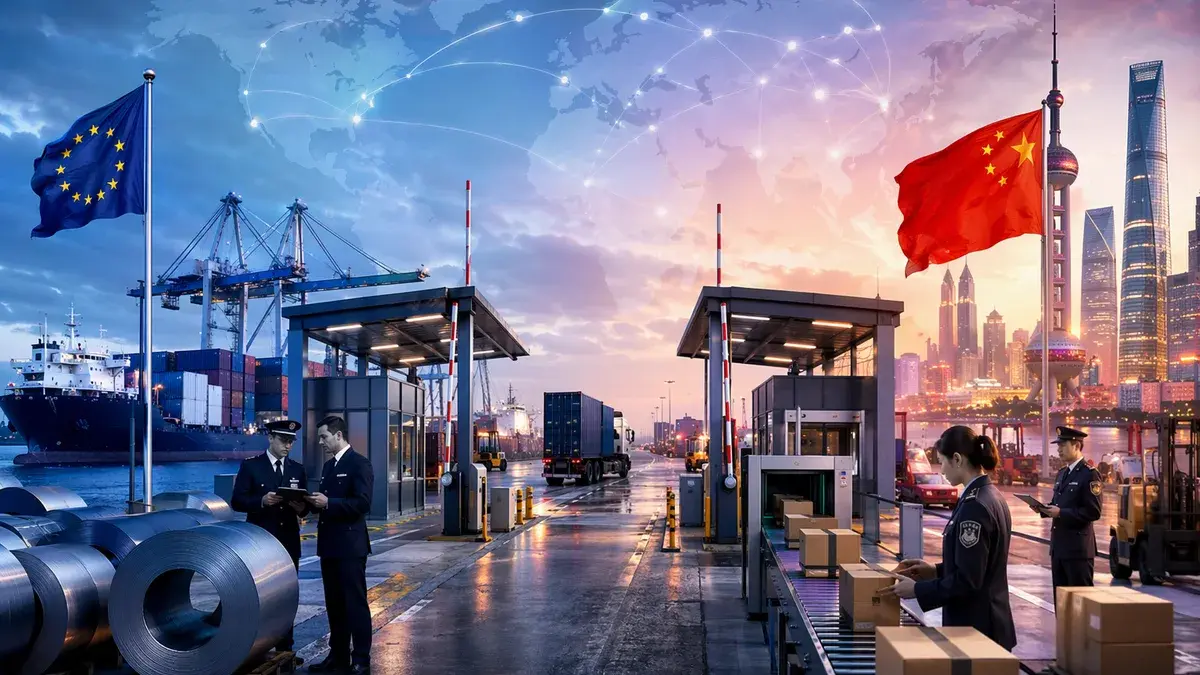
The European Union has rolled out two linked measures: a 3 euro ($3.42) customs duty on small parcels and tighter steel import rules with tariff-free quotas and steep out-of-quota duties, according to ABC International. Brussels says the goal is fairness. The deeper issue is control. The EU’s trade deficit with China widened in 2025 to around 360 billion euros ($410 billion), roughly 1 billion euros a day, and is rising in 2026.
“Today’s change is about restoring fairness for European businesses and better protecting our consumers,” European Commission President Ursula von der Leyen said. “The surge in low-value online imports has put our retailers at an unfair disadvantage. Too many of these products also fail to meet EU safety standards, putting consumers at risk.”
Why did Brussels pair steel mills with small parcels in the same trade fight?
Because both expose the same weakness in Europe’s China trade position: scale.
On one side sits steel, a heavy industry the European Commission calls “a strategically crucial European industry.” The Commission says new import rules are meant to shield EU plants and jobs from “the damaging impacts of global overcapacity.” China produces more than half of the world’s steel, and critics in Brussels say subsidies have pushed pressure through global markets.
On the other side sit low-value e-commerce parcels. The Commission said 5.9 billion small packages entered the EU in 2025, up from about 1.4 billion in 2022. That is roughly 16 million a day. Those parcels made up 97% of import traffic but only 2% of import value.
That mismatch matters. Customs systems face the volume. Retailers face the price pressure. Consumers face the safety risk Brussels says it found in many packages.
Analysis: The EU steel and e-commerce regulations are not random housekeeping. They mark a harder trade posture, aimed at sectors where China-linked supply is either overwhelming in volume or distorting prices through global overcapacity.
How do the new EU steel rules work against overcapacity pressure?
The EU steel quota sets tariff-free quotas at 18.3 million metric tons annually and imposes a 50% out-of-quota duty on 26 types of steel imports.
That is a blunt instrument. Imports can still enter tariff-free up to the quota. Beyond that, the cost jumps.
The rules also demand more transparency around where the “melt and pour” stage occurs. That phrase refers to the point where steel is first made from raw or semi-finished inputs. Brussels wants to know that origin point so steel cannot be routed through third countries to sidestep protections.
| Measure | What changes | Target problem |
|---|---|---|
| Steel quota | 18.3 million metric tons tariff-free annually | Import surges |
| Out-of-quota duty | 50% on 26 steel types | Price pressure from excess supply |
| Melt and pour tracing | More origin transparency | Circumvention through third countries |
| Parcel duty | 3 euros ($3.42) on small packages | Low-value import surge |
Europe’s steel industry is already under strain. The European Steel Association said crude steel output fell to a “historic low” in 2026.
“Europe’s steel production is shrinking while imports as a share of the EU market are rising,” said Axel Eggert, the group’s director-general, in March. “EU policymakers must therefore agree the new steel trade measure quickly without it being weakened otherwise Europe risks losing more industrial capacity.”
The complication: the EU does not mostly import steel directly from China. The source lists the U.K., Ukraine, India, Taiwan, Turkey, Japan and South Korea among major suppliers. That means a China-driven overcapacity measure can still hit partners that are not China.
What changes for Temu-style parcels entering the EU?
The EU is removing the customs duty exemption known as de minimis for parcels valued under 150 euros. From Wednesday, those small packages face the new 3 euro duty.
The Commission said Chinese firms including Temu and Shien control about 90% of this type of trade. The spelling “Shien” appears in the source material.
This is where the policy becomes visible to consumers. A low-value order that once moved through under the exemption now carries a fixed charge. On a high-priced item under 150 euros, that may be tolerable. On a very cheap item, it changes the math quickly.
Gary Ng, a research fellow at the Central European Institute of Asian Studies, warned the duty might “not affect the big picture” because it is small compared with the price gap between Europe and China for e-commerce goods. Still, he said it may reduce small orders and impulse purchases, while customers and platforms can still use group orders.
Analysis: Brussels is not banning direct-to-consumer trade. It is making the lowest-friction version of that model less frictionless.
Who gains and who loses from EU steel and e-commerce regulations?
The most obvious winners are European steel producers and some local retailers facing ultra-cheap parcel competition. They get protection, or at least breathing room.
The pressure falls elsewhere.
Bargain-focused consumers face the clearest immediate change: a 3 euro duty on small packages. Overseas sellers may need to absorb some of that cost, pass it on, or push buyers toward larger orders. The source does not say how platforms will respond.
Steel importers face quota limits and the risk of a 50% duty once volumes exceed tariff-free allowances. The source also notes possible penalties in free trade agreements with countries such as Japan, while some exemptions have been granted to Ukraine as it battles Russia.
EU policymakers gain a test case. If the measures hold, Brussels gets a template for responding to overcapacity without naming China as the direct legal target.
That matters because XOOMAR has been tracking a wider shift toward trade policy as pressure politics, including in Trump Turns USMCA Renewal Into a Trade Pressure Trap. The China angle also sits beside broader strategic competition, seen in coverage such as Australia Vanuatu Military Deal Boxes Out China in Pacific.
What does a steel quota and a 5 euro gadget show about Brussels’ strategy?
Take a hypothetical 5 euro gadget ordered from a China-linked marketplace. A 3 euro duty is not marginal. It is a major add-on relative to the item price. That does not end the transaction, but it can kill the impulse logic behind ultra-cheap baskets.
Now compare that with steel. A European producer facing rising import share gets a quota wall and a 50% penalty above it. That does not solve every cost problem inside the industry. It does change the border economics.
The two examples reveal Brussels’ core logic: small parcels and steel are different products, but both rely on scale that the EU believes is straining its market rules.
Bernd Lange, head of the European Parliament’s trade committee, put it sharply:
“Europe finally shows teeth against flood of cheap package deals.”
Analysis: The EU is using narrow tools to send a broad message. Market access remains open, but not cost-free when Brussels believes the terms are tilted.
How hard could China push back before the October deadline?
China has already warned against the steel rules. The Chinese Ministry of Commerce said in May that China would firmly respond to “discriminatory measures” against its companies and products.
Beijing’s public line is that the EU is misdiagnosing the problem. “China and the EU are partners, not rivals,” Chinese Foreign Ministry spokesperson Guo Jiakun said Tuesday. “The root cause of the EU’s problems does not lie with China.”
The EU is not sounding patient. Trade representative Maroš Šefčovič met China’s Commerce Minister Wang Wentao in Brussels on Monday and has set an October deadline for meaningful progress in rebalancing trade during a visit to Beijing.
“The status quo is not an option,” Šefčovič said.
The practical watch item is whether the EU steel and e-commerce regulations remain targeted tools or become the first stage of a broader overcapacity playbook. Alicia García-Herrero of Natixis said China will oppose the instrument even if it does not directly target China: “This could be a springboard for more.”
That is the real test. If parcel flows adjust and steel imports stay within quotas, Brussels will claim the measures work. If China pushes back and talks stall before October, Europe’s defensive trade turn will move from policy signal to open confrontation.
Impact Analysis
- The EU is using border rules to push back against a China trade deficit of about 360 billion euros.
- New parcel duties could raise costs for shoppers buying low-value goods online.
- Steel quotas and tariffs may protect European jobs but could increase costs for importers and manufacturers.
EU Trade Measures Targeting China-Linked Imbalances
| Measure | Target | Key Details | EU Rationale |
|---|---|---|---|
| Small parcel customs duty | Low-value e-commerce imports | 3 euro customs duty on small parcels | Protect EU retailers and consumers from unsafe or unfairly priced goods |
| Steel import rules | Steel imports | Tariff-free quotas with steep duties above quota | Shield EU steel plants and jobs from global overcapacity |
Small Packages Entering the EU
Primary Sources & Disclosures

Written by
XOOMAR Insights Team
Research and Editorial Desk
The XOOMAR Insights Team pairs automated research with human editorial judgment. We track hundreds of sources across technology, fintech, trading, SaaS, and cybersecurity, cross-check the facts, and explain what happened, why it matters, and what to watch next. We do not just rewrite headlines. Every article is fact-checked and scored for reliability before it goes live, and we link back to the original sources so you can verify anything yourself.