
What happens when a government tries to make Budapest Pride disappear, loses power, and then more than 10,000 people march through 38 C (100 F) heat anyway?
Global TrendsJune 27, 2026· 8 min read· By XOOMAR Insights Team
38 C Heat Turns Budapest Pride Into Orbán Reckoning
Updated on June 27, 2026
XOOMAR Intelligence
Analyst Take
58/ 100
4 sources analyzedLow confidenceTrend20Freshness90Source Trust82Factual Grounding92Signal Cluster20
That was the real question hanging over Budapest on Saturday, when Hungary held its first annual Pride march since the electoral defeat of Viktor Orbán, according to Independent World. The event was not just a celebration of LGBTQ+ visibility. It was a public stress test for post-Orbán Hungary.
The march’s signal was blunt: Orbán’s anti-LGBTQ+ politics did not make Pride vanish. They made it more politically loaded.
Did Budapest Pride become a verdict on Orbánism rather than only an LGBTQ+ march?
Yes, but not because one march can settle Hungary’s direction. It became a verdict because Orbán had made it one.
Last year, Orbán tried to ban the march as part of a wider political campaign targeting LGBTQ+ rights. That effort backfired. Instead of shrinking the event, it helped turn Pride into a mass anti-government demonstration. This year, after Orbán’s April 2026 electoral defeat to Péter Magyar’s center-right Tisza party, the march went ahead with police authorization and security along the route.
That detail matters. Hungary’s new government has not repealed the Orbán-era legislation that outlawed Pride, according to the supplied AP reporting. So this was not a clean legal reset. It was a controlled political opening.
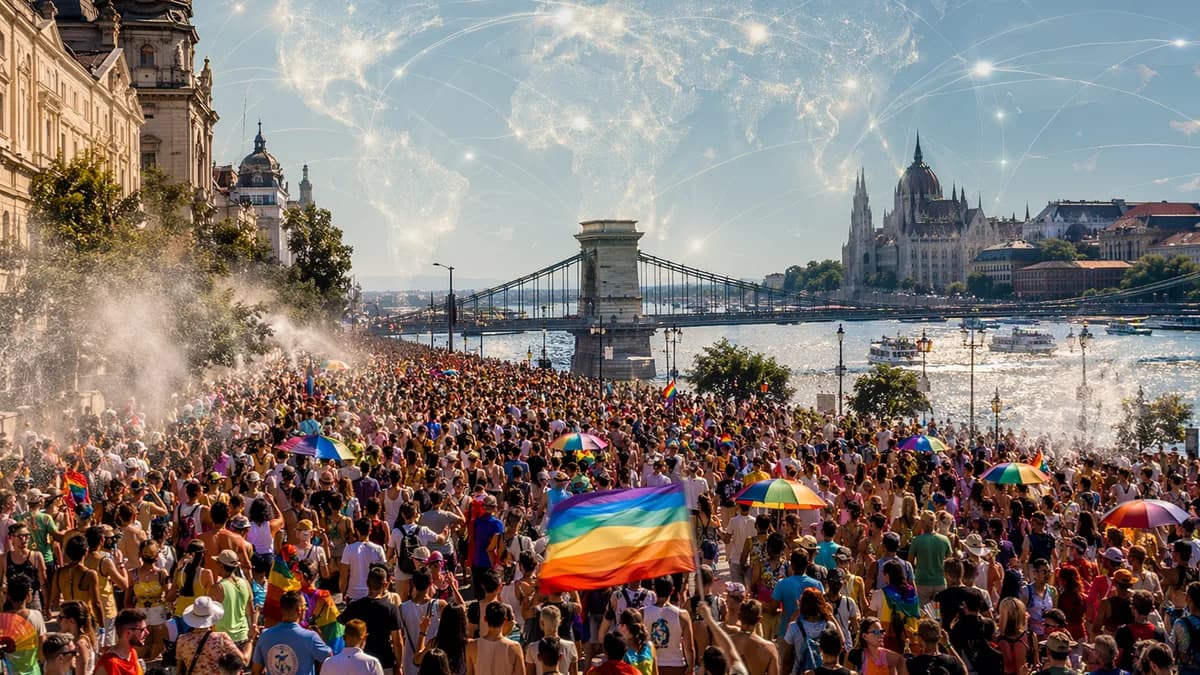
Participants left from Budapest’s Opera house, moved through the city center, and crossed the Erzsébet Bridge over the Danube. They carried rainbow flags and European Union flags. They danced in heat that forced organizers to hand out water bottles, while the city’s public water utility opened fountains along the route.
XOOMAR analysis: the scale of Budapest Pride suggests Orbán’s culture-war strategy mobilized opponents as well as supporters. When a state turns a march into a test of loyalty, attendance becomes more than attendance. It becomes a vote cast in public.
Why did the Budapest Pride numbers matter when the legal fight was not over?
The numbers mattered because the conditions were punishing and the legal backdrop remained unresolved.
The march began Saturday afternoon as temperatures reached at least 38 C (100 F) during a record-breaking heat wave affecting much of Europe. More than 10,000 Hungarians joined, according to Independent World, while AP reporting described the crowd as tens of thousands. Organizers distributed water. Public fountains were opened. People still came.
That heat dimension should not be treated as color. It raised the cost of showing up. For separate XOOMAR coverage of how extreme heat is testing public systems, see Record Heat Ignites France's Air Conditioning Fight and Heatwave Forces Neso Into Second Power Supply Alert. Budapest Pride added a civic version of the same pressure point: public life does not pause neatly when temperatures spike.
| Measure | Source-supported detail | XOOMAR read |
|---|---|---|
| This year’s turnout | More than 10,000, with AP describing tens of thousands | Strong enough to show the march remained politically meaningful after Orbán’s defeat |
| Heat | At least 38 C (100 F) | Attendance carried a higher physical cost |
| Last year’s march | Went ahead despite Orbán’s attempted ban and drew massive turnout, with AP reporting organizers estimated over 350,000 | The attempted ban helped transform Pride into a national flashpoint |
| Legal status | Orbán-era legislation has not been repealed, but police authorized this year’s event | The opening is real, but incomplete |
Crowd size matters in systems where public pressure has been chilled by state rhetoric or legal risk. It signals whether fear is still working. On Saturday, it looked weaker than Orbán intended.
How did Orbán’s anti-LGBTQ+ strategy turn one parade into a national test?
Orbán turned Budapest Pride into a national test by tying LGBTQ+ visibility to his broader claim that Hungary needed protection from Western liberalism.
His government passed laws ending the change of gender in personal documents, halting adoption by same-sex couples, and banning school materials seen as promoting homosexuality or gender transition. Hungary’s previous government also argued that Pride violated children’s rights to moral and spiritual development, a position rights groups and many experts rejected.
The political structure was clear. Orbán framed LGBTQ+ rights as a threat to children, national identity, and Christian values. That allowed his government to cast restrictions not as repression, but as protection.
But the same framing raised the stakes. Once Pride was treated as a danger to be banned, joining Pride became an act of public refusal.
Some participants described the atmosphere as more hopeful and focused on the demand for equal rights after years of political hostility.
That sentiment captures the shift better than any slogan. The march was no longer only about visibility. It was about whether the state could decide which citizens were allowed to be visible.
Why did marchers and the new government see different risks on the same route?
Marchers saw relief. The new government saw a legal and political trap.
Some people at the march described the mood as freer because politics had changed. Others focused less on the parade itself and more on daily life, arguing that LGBTQ+ people could feel safer and more accepted when political leaders stop treating them as a threat.
Yet Magyar’s position remains cautious. He is conservative, and when asked by Hungarian media about changing laws that curtailed LGBT rights, he has asked for patience. That restraint explains why the march felt both liberated and unfinished.
The split is visible:
| Actor | What they appeared to gain | What remains unresolved |
|---|---|---|
| LGBTQ+ Hungarians | Public visibility, safer atmosphere, political optimism | Legal equality on adoption, marriage, gender documents |
| Magyar government | Distance from Orbán-era confrontation | Whether to repeal or revise restrictive laws |
| Orbán-aligned conservatives | A continued morality argument around children and public life | Loss of control over the Pride issue after electoral defeat |
| EU institutions | A concrete example of rights pressure inside a member state | Whether Hungary’s laws will be brought into line with EU law |
This is why the event should not be misread as a completed victory. The police authorized the march. The legal architecture that made authorization politically sensitive still exists.
Why did Brussels matter if the march was fought on Budapest streets?
Because Orbán’s LGBTQ+ policy was never only domestic.
Participants waved European Union flags, and in April the EU's highest court ruled that Orbán-era legislation from 2021 banning the availability of LGBTQ+ content to minors violates EU law and breaches a foundational treaty guaranteeing respect for human rights and equality.
That ruling gives the Pride fight a second arena. On the street, the question is whether LGBTQ+ Hungarians can gather without intimidation. In EU law, the question is whether Hungary can maintain restrictions that the court says breach human rights and equality commitments.
XOOMAR analysis: this is where Magyar’s caution becomes hard to sustain. If his government keeps the laws while allowing Pride through police authorization, it buys time. But it also leaves Hungary with a contradiction: a more relaxed civic atmosphere sitting on top of unrepealed Orbán-era restrictions.
Can Budapest Pride pressure Péter Magyar without letting Orbán define the fight again?
That is the next test.
The evidence to watch is practical, not rhetorical. Does Magyar’s government move on same-sex adoption, same-sex marriage, gender document rules, or school-content restrictions? Does Parliament’s debate, referenced by first-time Pride participant Kristóf Györgyi, turn into legislation? Do police authorize future Pride events as routine civic gatherings, or does each year become another political negotiation?
The risk for LGBTQ+ Hungarians is backlash after visibility. The risk for Magyar is different: if he moves too slowly, he disappoints the voters and civil society groups who read Orbán’s defeat as a democratic opening. If he moves too quickly, he gives Orbán’s side a familiar culture-war target.
One march won’t rewrite Hungary’s political order. But Orbán tried to make Budapest Pride politically untouchable, and the result was the opposite. In record heat, under unresolved law, thousands showed that the issue can no longer be pushed out of sight.
Impact Analysis
- The march showed that Orbán’s anti-LGBTQ+ strategy may have strengthened public resistance rather than silenced it.
- Police authorization signaled a political shift, even though Orbán-era legal restrictions remain unresolved.
- The turnout in extreme heat made Budapest Pride a broader test of Hungary’s post-Orbán democratic direction.
Budapest Pride Before and After Orbán’s Defeat
| Orbán-era context | Post-Orbán march |
|---|---|
| Orbán tried to ban Budapest Pride as part of a wider anti-LGBTQ+ campaign. | The march went ahead with police authorization and security along the route. |
| Pride became a flashpoint in Hungary’s culture-war politics. | More than 10,000 people marched despite 38 C heat. |
| Orbán-era legislation outlawing Pride remained in place. | The new government has not repealed that legislation, making the march a controlled political opening. |
Sources

Written by
XOOMAR Insights Team
Research and Editorial Desk
The XOOMAR Insights Team pairs automated research with human editorial judgment. We track hundreds of sources across technology, fintech, trading, SaaS, and cybersecurity, cross-check the facts, and explain what happened, why it matters, and what to watch next. We do not just rewrite headlines. Every article is fact-checked and scored for reliability before it goes live, and we link back to the original sources so you can verify anything yourself.
Explore More Topics
Related Articles
 Global Trends
Eight-Year Cap Blocks Orbán in Hungary Term Limit Fight
Hungary’s new eight-year cap could bar Viktor Orbán from returning as prime minister, turning Tisza’s win into a constitutional showdown.
Jun 20, 20267 min
 Global Trends
Summer Crush May Halt EU Entry/Exit Checks in Rome
Rome airports may let non-EU travelers bypass EES checks if biometric enrolment jams peak summer border queues.
Jun 26, 20267 min
 Global Trends
Cheap Chinese Steel Forces UK Steel Tariffs to 50%
Britain will halve duty-free steel quotas and slap 50% duties above them, turning cheap Chinese metal into an industrial fight.
Jun 25, 20268 min
 Global Trends
Six-Hour Queues Trap UK Travellers in EU Entry/Exit System
New biometric checks could leave UK holidaymakers stuck for hours at Schengen borders, with missed flights now a real summer risk.
Jun 24, 20269 min
 Global Trends
Dembele Hat-Trick Turns France vs Norway Into Rout
Dembele hit a first-half hat-trick as France beat Norway 4-1, won Group I and found another knockout threat beyond Mbappe.
Jun 27, 20266 min
 Global Trends
150 Million Swelter as Europe Heatwave Records Shatter
Record heat has pushed into northern Europe, putting 150 million people above 35C and straining health, transport and local services.
Jun 27, 20268 min
 Technology
SoftBank CEO Torches Elon Musk’s Orbital Data Centers
Masayoshi Son says orbital data centers won’t win the AI race because chips, not power, dominate the cost stack.
Jun 27, 20267 min
 Global Trends
1,430 Dead as Venezuela Earthquakes Shatter the North
Venezuela’s twin quakes killed 1,430 and left tens of thousands reported missing as rescuers push into blocked northern zones.
Jun 27, 20265 min
 Technology
Price Hike Turns $299 Prime Day iPad Into the Deal
$299 makes the base iPad the Prime Day deal to beat, especially after Apple lifted its own sticker price to $449.
Jun 27, 20267 min
 Technology
Kobo Libra Colour Sale Steals Prime Day From Kindle
Kobo’s $230 Libra Colour deal gives Prime Day shoppers color E Ink, buttons, notes, and a rare reason to skip Kindle.
Jun 27, 20267 min
Don't miss the signal
Get our weekly roundup of the stories that matter across tech, fintech, and trading. No noise, just signal.
Free forever. No spam. Unsubscribe anytime.