
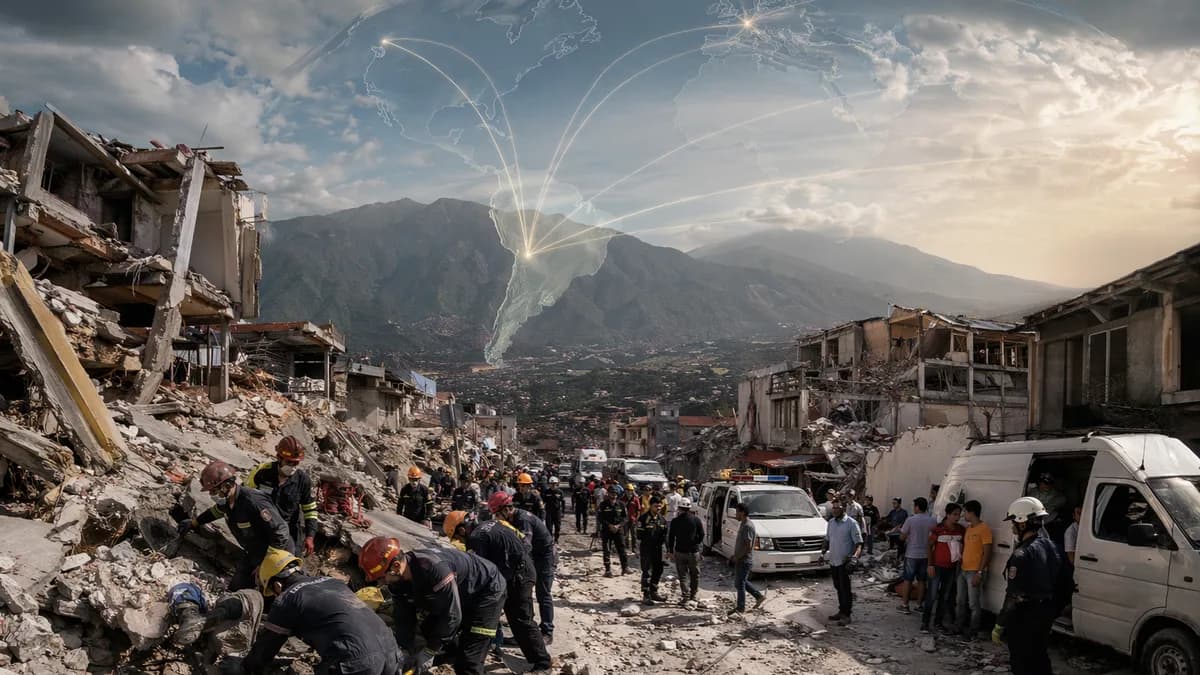
Venezuela’s twin earthquakes have killed 1,430 people, left 3,200 injured, and made 3,100 people homeless, according to National Assembly president Jorge Rodríguez, as rescuers keep digging through collapsed buildings in the country’s north.
Global TrendsJune 27, 2026· 5 min read· By XOOMAR Insights Team
1,430 Dead as Venezuela Earthquakes Shatter the North
Updated on June 29, 2026
XOOMAR Intelligence
Analyst Take
84/ 100
4 sources analyzedMedium confidenceTrend10Freshness97Source Trust90Factual Grounding90Signal Cluster100
The updated toll was announced on state television after the 7.2 and 7.5 magnitude quakes struck within a minute of each other on Wednesday evening, flattening buildings and cutting off access to some areas, according to Guardian World. The numbers remain provisional. Rescue teams are still reaching damaged zones, and families have reported tens of thousands of people unaccounted for.
Venezuela twin earthquakes death toll climbs to 1,430 as rescue crews keep searching
The latest official figures mark another sharp rise in the human cost of the Venezuela earthquakes. Rodríguez said 1,430 deaths had been confirmed, while 3,200 people were injured and 3,100 were left homeless.
The twin shocks hit within a minute of each other, a sequence that gave buildings already under stress almost no time to settle before the second impact. The worst damage reported so far is in northern Venezuela, including La Guaira, where civilians have joined rescue workers in searching through debris.
Key confirmed figures so far:
- Deaths: 1,430 confirmed by Jorge Rodríguez.
- Injured: 3,200 people.
- Homeless: 3,100 people.
- Unaccounted for: At least 68,900 reported by family members.
- Estimated damage: $6.7bn, equal to 6% of Venezuela’s GDP, according to the UN.
The official death toll could still rise. That is not speculation about the final number, it follows from the current rescue reality: teams are still searching collapsed structures, access to affected areas has been restricted, and some communities remain difficult to reach.
A UN Development Programme preliminary assessment put damage at $6.7bn, covering losses to assets including housing. It does not include broader economic disruption, which means the full cost of the disaster is still not captured.
Nearly 70,000 relatives have reported loved ones unaccounted for
At least 68,900 people have been reported unaccounted for by their families, a figure that signals the scale of panic and communication breakdown after the earthquakes. It does not automatically mean every person listed is confirmed missing or dead.
That distinction matters. In major disasters, missing-person reports can include duplicate names, people cut off by power failures or damaged phone networks, and residents who fled without being able to contact relatives. But the size of the number shows how wide the uncertainty has become.
In La Guaira, one of the hardest-hit areas, residents have used shovels and bare hands to search through collapsed buildings. Images from the scene showed a Mexican rescue worker and a sniffer dog combing through rubble on Saturday.
The pressure is now hitting every layer of the emergency response: injured survivors need treatment, displaced families need shelter, and rescue teams need routes into blocked areas. Acting president Delcy Rodríguez said on state television that more than 14,000 members of the military and police were patrolling affected areas, where access has been blocked and special permits are required to enter.
The access controls may help manage security and rescue logistics. They also create a bottleneck. If permits, damaged roads, and limited transport slow down specialists, the search window narrows.
XOOMAR previously tracked how the disaster disrupted critical transport infrastructure in Twin Quakes Cripple Venezuela Earthquake Rescue Hub. That issue now sits at the center of the response: aid is only useful if it reaches collapsed buildings, hospitals, and makeshift shelters fast enough.
International teams are arriving. Governments including Mexico, the US, Brazil, El Salvador, and France sent further rescue teams on Saturday, after earlier deployments from countries including the Netherlands, Turkey, and the UK.
“People are trapped under rubble, and the priority is to get the search and rescue teams and the medical professionals and others to them as quickly as possible to save lives,” Jeremy Lewin, a US state department official, said.
Rescue operations become a race against blocked roads, damaged buildings, and time
The next phase is brutal and simple: find survivors, treat the injured, shelter the displaced, and restore enough basic services to keep the disaster from compounding.
Rescue workers face collapsed buildings, blocked access routes, damaged infrastructure, and strained communications. The sources describe affected zones where entry is restricted, survivors are digging by hand, and foreign teams are being flown in to reinforce local crews.
As we reported after the initial shocks in Twin Shocks Shatter Caracas in Venezuela Earthquake, the danger was never limited to the first collapse. Aftershocks, unstable structures, and delayed access can turn an earthquake into a prolonged rescue crisis.
The International Red Cross’s regional director for the Americas, Loyce Pace, captured the psychological aftershock now facing survivors:
“People are still terrified to re-enter what were their homes.”
That fear has practical consequences. People who cannot return home need shelter. Families waiting near rubble need food, water, and verified information. Hospitals and rescue posts need clear triage channels as more survivors are pulled out or bodies are recovered.
Foreign nationals have also been confirmed among the dead, reportedly including 15 of Portuguese nationality or descent, seven Chinese, two Brazilians, five Spaniards, and an Italian-Venezuelan.
The most important near-term watch item is not one number. It is whether casualty updates, missing-person lists, and aid logistics start moving in the same direction. If rescue teams gain faster access to La Guaira and other hard-hit areas, the official figures should become clearer. If access remains slow, families may spend days trapped between hope, rumor, and silence.
Impact Analysis
- The death toll has risen to 1,430 and may increase as rescuers reach more collapsed buildings.
- Tens of thousands are reported unaccounted for, raising pressure on emergency response efforts.
- The UN estimates $6.7bn in damage, a major economic blow equal to 6% of Venezuela’s GDP.
Confirmed and Reported Human Impact of Venezuela Earthquakes
Deaths
people1,430
Injured
people3,200
Homeless
people3,100
Reported unaccounted for
people68,900
Sources

Written by
XOOMAR Insights Team
Research and Editorial Desk
The XOOMAR Insights Team pairs automated research with human editorial judgment. We track hundreds of sources across technology, fintech, trading, SaaS, and cybersecurity, cross-check the facts, and explain what happened, why it matters, and what to watch next. We do not just rewrite headlines. Every article is fact-checked and scored for reliability before it goes live, and we link back to the original sources so you can verify anything yourself.
Explore More Topics
Related Articles
 Global Trends
Tokyo Floods Kill Four, Paralyze Airport Amid Record Rain
Four people died and thousands were stranded at an airport after a single, record-breaking night of rain flooded Tokyo’s eastern commuter region, revealing a de
Aug 14, 20267 min
 Global Trends
Colombia Earthquake Kills 110, Flattens Buildings
The strongest earthquake in Colombia this century has killed at least 110 people and collapsed dozens of buildings, triggering a desperate, large-scale rescue o
Aug 14, 20264 min
 Global Trends
Colombia Earthquake Death Toll Climbs As Rescuers Race Clock
A powerful 7.4 magnitude earthquake has killed over 180 people in Colombia, with hundreds still missing as rescue teams confront widespread building collapses.
Aug 12, 20266 min
 Global Trends
Powerful 7.4 Quake Collapses Buildings Across Colombia
A 7.4 magnitude earthquake struck western Colombia, collapsing buildings in Cali and damaging regional airports while violent shaking was felt in the capital, B
Aug 10, 20264 min
 Trading
Mike Ashley Seizes 48% of Hugo Boss After Board Snub
Mike Ashley's Frasers Group seized 48% of Hugo Boss, moving within reach of a full takeover after shareholders sold out despite the board rejecting his bid.
Aug 18, 20264 min
 Global Trends
Your Commute Is Secretly Slashing Your Hourly Wage
A new index shows 64% of workers have changed how they work, with 15% refusing shifts, because rising fuel costs are destroying the real value of their hourly p
Aug 18, 20268 min
 Fintech
Credit Unions Ditch Teller Windows for Financial Guidance
Credit unions aren't closing branches, they're retooling them from transaction centers into dedicated spaces for high-stakes financial advice that members won't
Aug 18, 20267 min
 Global Trends
Zambian Leader's 60% Win Overshadowed by Raid, Arrests
Zambian President Hakainde Hichilema wins re-election decisively, but his victory is marred by police raids and fraud allegations from the opposition.
Aug 18, 20264 min
 Trading
Dollar Traders Flee After Snapback Meets Selling Resistance
The US Dollar Index rebounded sharply from a two-month low, but the rally is stalling at a critical technical barrier, leaving traders questioning if the move i
Aug 18, 20264 min
 Fintech
Pound Crashes Below 1.35 on Tepid UK Jobs Data
The British pound crashed past 1.35 against the dollar after a lukewarm UK jobs report failed to convince markets, highlighting sterling's vulnerability amid we
Aug 18, 20265 min
Don't miss the signal
Get our weekly roundup of the stories that matter across tech, fintech, and trading. No noise, just signal.
Free forever. No spam. Unsubscribe anytime.