
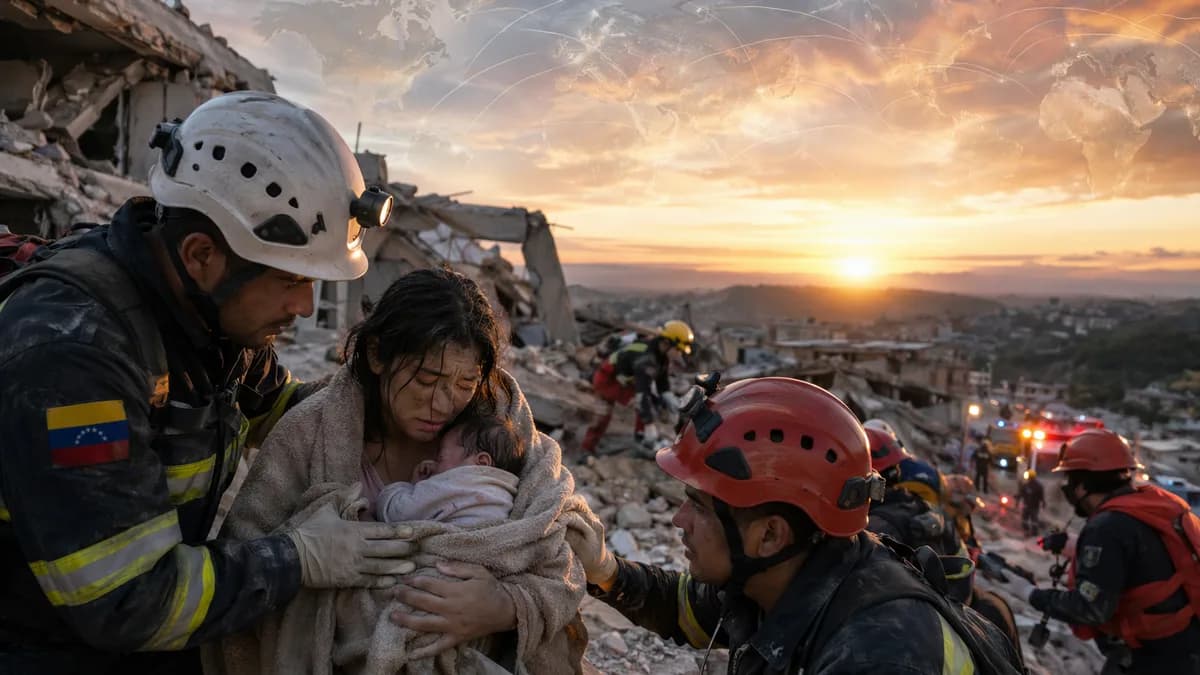
An 18-day-old baby and his mother were pulled alive from Venezuela earthquake rubble, giving the country one of its clearest images of survival after twin quakes killed at least 1,450 people.
Global TrendsJune 29, 2026· 6 min read· By XOOMAR Insights Team
Mother Defies Venezuela Earthquake Rubble to Save Newborn
Updated on June 29, 2026
XOOMAR Intelligence
Analyst Take
58/ 100
4 sources analyzedLow confidenceTrend10Freshness97Source Trust92Factual Grounding92Signal Cluster20
Dayana Patino told BBC World that her newborn son, Juan David, kept her conscious while she was trapped beneath their destroyed home in La Guaira.
"As long as he was alive, I was going to be alive. Every now and then I was touching his nose for proof that he was still breathing," she said.
The Venezuela earthquake baby rescue has spread far beyond the disaster zone because it compresses the whole emergency into one scene: a mother pinned under concrete, a newborn still breathing, and rescuers trying to find life in a country where tens of thousands are still missing.
Newborn Juan David pulled alive from Venezuela earthquake rubble after mother clings to hope
Patino was in her eighth-floor apartment in the northern coastal region of La Guaira, washing dishes, when the earthquakes struck on Wednesday. She said she rushed to hold Juan David, thinking the shaking would be "only a light tremor."
Then the building failed.
"I felt like I was flying. After that, I felt like I was sinking in water and dirt, and then I fell into the pit where I remained. I don't know how I didn't let go of my baby because I was flying. I got crushed against furniture," she said.
Patino said she screamed at first, then stopped when she realized no one could hear her. She decided to save her strength until she heard voices or footsteps nearby.
Her condition was severe. She said her left leg was trapped under concrete and her temple was pressed against a rock. In the darkness, she felt a bible beneath her and later saw a "pinprick of light that looked like the moon."
The rescue came after she heard her brother calling her name.
"I said to myself, this is my only chance. From the top of my lungs I cried out… I screamed 'Here I am' with all my might, and he said 'I found you, and I promise you that I won't leave until I get you out'."
A delicate Venezuela earthquake rescue operation brought Patino and Juan David out of the rubble on Thursday night. The BBC reported that Patino suffered injuries to both legs, while Juan David sustained only minor injuries. The Associated Press described the rescue as happening 32 hours after the earthquakes.
Baby’s survival becomes a symbol of hope as Venezuela counts earthquake losses
Juan David’s survival has become a rare point of relief in a national disaster. The BBC reported that footage of the rescue has been shared around the world, with the newborn becoming a symbol of hope after the twin earthquakes.
Patino’s husband, Gerson, had just returned home and parked the car when the quakes hit. He escaped by jumping over a fence, then saw what had happened to the apartment building and feared his wife and baby were dead.
"It was indescribable. I thought they were dead. And when I saw my son I felt like I was born again. I couldn't believe it… I felt the life come back to me," Gerson told the BBC.
He called the rescue "a miracle." The family’s home has been destroyed, along with their possessions. Their pet dog remains missing. Still, Gerson said they will "begin from scratch."
"We lost almost everything but here we are.… We will rebuild everything we lost," he said.
The wider toll remains brutal. The BBC reported that the earthquakes have killed at least 1,450 people, while tens of thousands more are missing. The country’s interim president has described it as the "most brutal natural catastrophe" in Venezuela’s history.
CBS News reported that Jorge Rodríguez, president of Venezuela’s National Assembly, said 3,150 people had reported injuries to hospitals in La Guaira and other affected areas. CBS also reported that online databases listed about 51,000 people as missing, while noting that such figures may include duplicates or people unable to contact relatives because of lost cellphone service.
| Case | Reported details |
|---|---|
| Juan David and Dayana Patino | Pulled from rubble in La Guaira on Thursday night, baby had minor injuries, mother injured in both legs |
| National emergency | At least 1,450 dead, tens of thousands missing, search efforts continuing |
| Rescue outlook | Hopes are diminishing that more survivors will be found, according to the BBC |
For readers tracking the wider operation, XOOMAR is following related developments in Rivals Rush Into Venezuela Earthquake Rescue Scramble and Twin Quakes Cripple Venezuela Earthquake Rescue Hub.
Search teams race the clock as the Venezuela earthquake baby rescue becomes the exception
The Venezuela earthquake baby rescue stands out because search conditions are becoming harsher with each passing hour. The BBC reported that search efforts are continuing, but hopes are diminishing that more survivors will be found.
Emergency crews are still trying to locate survivors, clear debris and treat the injured. Families are also searching on their own in some areas, according to CBS News, which reported that people have dug through collapsed homes and apartment buildings while citing a lack of government aid.
International help is now part of the response. CBS reported that U.S. rescue assets were sent to Venezuela, including airmen to help expand air traffic flow in and out of the country’s main airport, Marine Corps personnel to help reopen the port in hard-hit La Guaira, the amphibious ship USS Fort Lauderdale, and Army helicopters.
CBS also reported that volunteers from Mexico, El Salvador, Switzerland and other countries were operating in Venezuela, citing Venezuelan officials.
Aid agencies often treat the first 48 to 72 hours after a collapse as the most critical period for finding survivors alive, CBS reported, while noting that survival can extend longer if people have access to food and water. That makes Patino and Juan David’s rescue both a relief and a warning: each successful recovery is happening against a clock that is already running down.
The next test is whether rare rescues can translate into a wider survival operation
The immediate focus now is clear: find anyone still trapped, keep damaged structures from claiming more lives, and get medical care to people already pulled from the wreckage. The next official updates will likely sharpen the scale of the disaster, including confirmed deaths, injuries, missing-person figures and damage assessments.
XOOMAR analysis: Juan David’s rescue is powerful because it gives the disaster a face, but it should not soften the scale of the emergency. One newborn survived. Thousands of families are still waiting for names, bodies, calls, or voices under concrete.
The practical watch item is whether rescue teams can keep producing recoveries as the search window narrows, and whether aid routes through the airport and La Guaira port can move fast enough to support hospitals, crews and displaced families. The story of Dayana Patino and Juan David is already being told as a miracle. The harder measure comes next, how many more lives can still be reached.
Why It Matters
- The rescue of 18-day-old Juan David and his mother has become a rare survival story after quakes killed at least 1,450 people.
- Dayana Patino’s account shows the extreme conditions survivors faced while trapped under collapsed buildings.
- The story highlights the ongoing urgency of rescue efforts as many people remain missing after the disaster.
Sources

Written by
XOOMAR Insights Team
Research and Editorial Desk
The XOOMAR Insights Team pairs automated research with human editorial judgment. We track hundreds of sources across technology, fintech, trading, SaaS, and cybersecurity, cross-check the facts, and explain what happened, why it matters, and what to watch next. We do not just rewrite headlines. Every article is fact-checked and scored for reliability before it goes live, and we link back to the original sources so you can verify anything yourself.
Explore More Topics
Related Articles
 Global Trends
Lebanon Votes to Abolish the Death Penalty
Lebanon's parliament has voted to abolish the death penalty, making it the first country in the Middle East to formally end capital punishment.
Aug 11, 20266 min
 Technology
Hayden Panettiere, Heroes Star, Dies Unexpectedly at 36
Actress Hayden Panettiere, famous for 'Heroes' and 'Nashville,' has died at age 36, just days before her birthday, weeks after publishing a memoir detailing her
Aug 17, 20264 min
 Trading
Oil Hits Two-Week High as Strait Showdown Goes Live
A live-fired standoff in the Strait of Hormuz has WTI crude holding near a two-week high as traders price in the real risk of a major supply shock.
Aug 18, 20265 min
 Trading
Mike Ashley Seizes 48% of Hugo Boss After Board Snub
Mike Ashley's Frasers Group seized 48% of Hugo Boss, moving within reach of a full takeover after shareholders sold out despite the board rejecting his bid.
Aug 18, 20264 min
 Global Trends
Your Commute Is Secretly Slashing Your Hourly Wage
A new index shows 64% of workers have changed how they work, with 15% refusing shifts, because rising fuel costs are destroying the real value of their hourly p
Aug 18, 20268 min
 Fintech
Credit Unions Ditch Teller Windows for Financial Guidance
Credit unions aren't closing branches, they're retooling them from transaction centers into dedicated spaces for high-stakes financial advice that members won't
Aug 18, 20267 min
 Global Trends
Zambian Leader's 60% Win Overshadowed by Raid, Arrests
Zambian President Hakainde Hichilema wins re-election decisively, but his victory is marred by police raids and fraud allegations from the opposition.
Aug 18, 20264 min
 Trading
Dollar Traders Flee After Snapback Meets Selling Resistance
The US Dollar Index rebounded sharply from a two-month low, but the rally is stalling at a critical technical barrier, leaving traders questioning if the move i
Aug 18, 20264 min
 Fintech
Pound Crashes Below 1.35 on Tepid UK Jobs Data
The British pound crashed past 1.35 against the dollar after a lukewarm UK jobs report failed to convince markets, highlighting sterling's vulnerability amid we
Aug 18, 20265 min
 Trading
Silver Standoff Freezes Traders on Fed
Silver traders are frozen, caught between dovish economic data and hawkish oil price inflation, as they wait for the Fed to tip the scales.
Aug 18, 20266 min
Don't miss the signal
Get our weekly roundup of the stories that matter across tech, fintech, and trading. No noise, just signal.
Free forever. No spam. Unsubscribe anytime.