
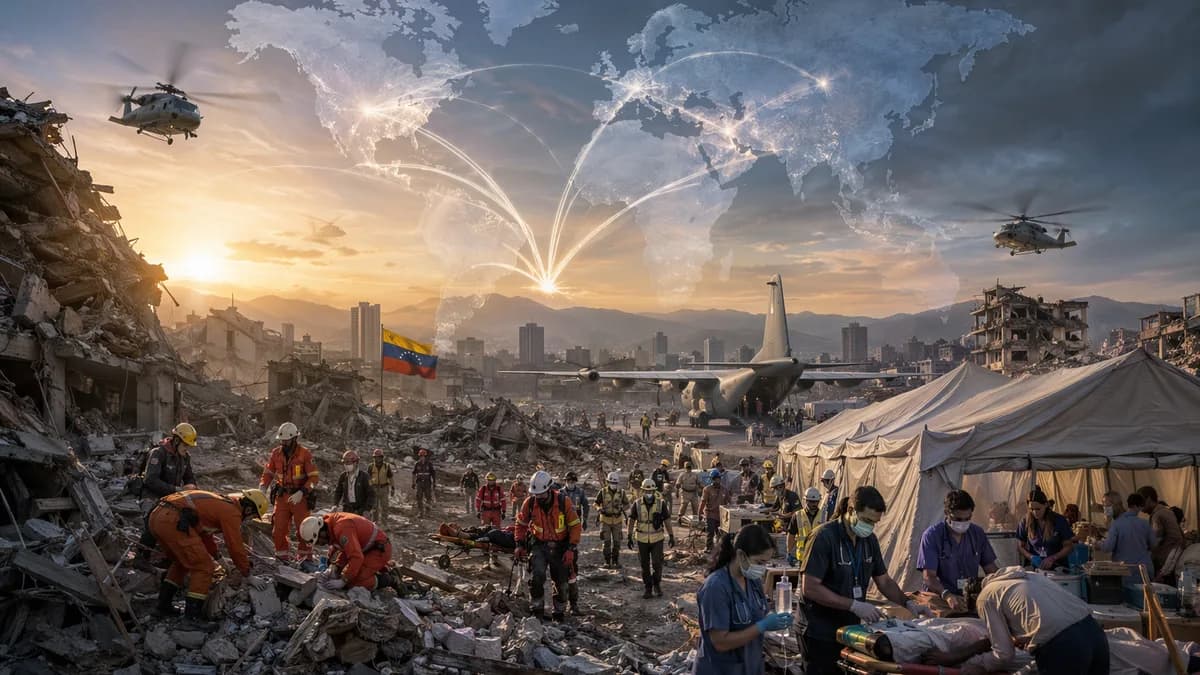
The Venezuela earthquake has put the US, Cuba and Iran inside the same rescue effort, despite wider US-Iran tensions, and the people most exposed are Venezuelans whose health and basic-service systems were already under severe strain.
Global TrendsJune 25, 2026· 8 min read· By XOOMAR Insights Team
Rivals Rush Into Venezuela Earthquake Rescue Scramble
Updated on June 27, 2026
XOOMAR Intelligence
Analyst Take
69/ 100
4 sources analyzedMedium confidenceTrend10Freshness98Source Trust90Factual Grounding88Signal Cluster20
Two back-to-back quakes hit on the evening of 24 June, measuring 7.2 and 7.5, killing at least 164 people, injuring close to 1,000, and damaging Caracas and northern Venezuela, according to Guardian World. The immediate story is rescue. The deeper test is whether a crowded field of governments and aid agencies can convert pledges into useful help for Venezuela earthquake victims before overwhelmed local systems buckle further.
For Venezuela's rescuers: outside help is no longer symbolic
The numbers explain why foreign rescue capacity matters. Venezuela is not dealing with a single isolated shock. It absorbed two major earthquakes in the same evening, with casualties already high and damage spread across the capital and the north.
As XOOMAR reported in Twin Shocks Shatter Caracas in Venezuela Earthquake, the sequence matters because the second shock compounds the first. Rescue crews, hospitals and local authorities don’t get a clean pause between emergencies. They move from impact to triage while people are still missing, buildings remain unstable, and families search through debris.
The Guardian’s image from Catia La Mar, La Guaira state, captured people searching for survivors and trying to recover belongings from a collapsed building. That detail matters. In the first phase after a quake, local residents often become the first responders before specialist rescue teams arrive.
The hard question is simple: can international help arrive fast enough to change survival outcomes, not just headlines?
Tommaso Della Longa, spokesman for the International Federation of Red Cross and Red Crescent Societies, framed the operational strain clearly:
“We are talking about a system that in some parts was already, if not weak, then under several constraints and challenges.”
He added:
“If you look at the number of injuries, just to give an example, that would overwhelm any health system.”
That is the practical core of the crisis. The Venezuela earthquake did not hit a country with abundant spare capacity. It landed on top of a system already under pressure from an economic crisis, flooding and health issues, according to Della Longa.
For families in Caracas and the north: the disaster began before the buildings fell
The earthquake struck a country where 7.9 million people already needed humanitarian assistance, according to the UN figure cited by the Guardian. That equals nearly 28% of Venezuela’s 28.5 million people.
Persistent gaps in healthcare, water, education and energy were already among the most critical needs for vulnerable communities. For families now displaced or injured, that means rescue is only the first layer. Medical care, shelter, clean water and continuity of basic services quickly become the next emergency.
This is where the quake becomes more than a casualty count. A disaster in a country with a quarter of the population already in need pushes humanitarian groups into a stacked crisis. People injured by falling concrete may need treatment from facilities that were already short of capacity. Families who lose homes may have fewer fallback options if public services were already strained.
Jan Egeland, secretary general of the Norwegian Refugee Council, put the pre-existing vulnerability bluntly:
“This earthquake will deepen the suffering for millions already in dire need. More than a quarter of the country’s population needed urgent aid even before the earthquakes.”
For readers tracking the destruction in the capital, our earlier coverage of how the Venezuela earthquake ripped open Caracas buildings in seconds shows why urban damage can quickly become a nationwide humanitarian issue. Caracas is not just a symbolic center. Damage there strains coordination, health response and public confidence.
For Washington, Havana and Tehran: pledges are easier than neutral delivery
The most politically striking fact is not one country offering help. It is the range of countries doing so.
Marco Rubio, the US secretary of state, said on Thursday that the US would provide a “whole-of-government” response.
“It’ll be big, it’ll be fast, and it’ll be effective,” he told reporters during a visit to Bahrain, adding that the US Department of Defense would play a “big logistical role”.
Cuba is already present in the response, according to its foreign minister, Bruno Rodríguez, who said Cuban health workers were “fully mobilised and providing medical services to the affected population”.
Iran also offered help. Foreign ministry spokesman Esmaeil Baqaei announced “Iran’s readiness to provide any assistance required in relief and rescue operations”, while expressing “solidarity with the government and people of Venezuela”.
China said it was ready to send whatever was needed.
What does this alignment prove? Less than it may appear. The source material establishes pledges and statements, not motives. XOOMAR’s analysis is narrower: when countries with sharply different foreign-policy positions offer aid to the same emergency, the credibility test shifts from rhetoric to coordination.
A rescue pledge has value only if it turns into people, equipment, medical care and logistics that fit the government-led response. Otherwise, it becomes parallel messaging around the same rubble.
Foreign offers now on the table
| Country or group | Assistance described in source |
|---|---|
| US | “Whole-of-government” response, with a “big logistical role” for the US Department of Defense |
| Cuba | Health workers already present and providing medical services |
| Iran | Readiness to provide assistance for relief and rescue operations |
| Netherlands | About €2m (£1.72m) for a rescue team with workers, dogs and equipment |
| Spain and France | Dozens of rescuers |
| Germany | Six military transport planes |
| Switzerland | Emergency teams and rescue dogs |
| China | Ready to send whatever was needed |
For Latin America and Europe: Venezuela earthquake relief is a regional capacity test
Latin American countries including Mexico, Brazil, El Salvador, Ecuador, the Dominican Republic and Cuba offered solidarity and help. European governments also moved, with the Netherlands, Spain, France, Germany and Switzerland promising rescue personnel, equipment or transport capacity.
This matters because the response is becoming multinational fast. Multinational help can expand capacity. It can also create coordination problems if needs are not verified, roles are duplicated, or specialist teams arrive without a clear place in the operation.
The source gives one important anchor: Tom Fletcher, the UN humanitarian chief, said specialist rescue teams were heading to Venezuela to help search for survivors. He praised the offers, but tied them to a longer effort.
“The solidarity and practical offers from the region and beyond were superb.”
He added:
“The coming days will require a massive collective effort to support the government-led response and help communities … Sustained international support for humanitarian organisations responding on the ground is essential and urgent.”
That phrase, government-led response, is important. It signals that foreign rescue assets are not a substitute for national coordination. They have to plug into it.
Can a broad coalition stay disciplined once the emergency moves from search-and-rescue to shelter, sanitation and medical follow-up? That is where many disaster responses become harder, because the cameras often move faster than the funding.
For donors and aid agencies: the funding gap is the real aftershock
The most dangerous figure may not be the quake magnitude. It may be the funding gap.
The humanitarian response plan in Venezuela is badly underfunded. Only $146.9m (£111m) of the $632.2m promised has been delivered, according to the Guardian. The 2025 humanitarian response plan was just 20% funded, while the 2024 plan was 28% funded.
That means emergency teams are entering a response where the baseline aid operation was already short of money. Rescue dogs and transport planes help in the first phase. Sustained funding determines whether injured people receive continuing care, whether displaced families get support, and whether humanitarian groups can keep operating after the initial surge.
Egeland’s warning was direct:
“The deep suffering of the crisis-engulfed people in Venezuela has been neglected for too long … Donors must urgently step up support as this earthquake has become a catastrophe on top of a crisis. There can be no delay in this support.”
XOOMAR’s read: the Venezuela earthquake will separate performative solidarity from operational seriousness. Evidence that would support a stronger response includes delivered funding, deployed specialist teams, functioning medical support, and aid reaching damaged areas beyond the capital. Evidence that would weaken it includes pledges that remain announcements, fragmented delivery, and a funding gap that stays mostly intact after the rescue phase fades from global attention.
The next test is not who offers sympathy. It is who can still deliver when the work turns slower, more expensive and less visible.
The Stakes
- Venezuela’s already strained hospitals and basic services face a major surge in need after two powerful quakes.
- International coordination will determine whether aid reaches survivors quickly enough to affect outcomes.
- The joint involvement of the US, Cuba and Iran shows the scale of the crisis crossing political divides.
Reported Venezuela Earthquake Casualties
Deaths
people164
Injuries
people1,000
Sources

Written by
XOOMAR Insights Team
Research and Editorial Desk
The XOOMAR Insights Team pairs automated research with human editorial judgment. We track hundreds of sources across technology, fintech, trading, SaaS, and cybersecurity, cross-check the facts, and explain what happened, why it matters, and what to watch next. We do not just rewrite headlines. Every article is fact-checked and scored for reliability before it goes live, and we link back to the original sources so you can verify anything yourself.
Explore More Topics
Related Articles
 Global Trends
Gas Hits $4.06, a Record Tax on Failed Diplomacy
The failure of US-Iran peace talks has directly spiked gas prices to a record $4.06 per gallon for August, turning stalled diplomacy into a new consumer tax.
Aug 17, 20268 min
 Global Trends
Oil Plunges 2% on Secret Iran Peace Deal Hints
Crude oil prices dropped 2% on unconfirmed reports that a ceasefire deal between the U.S. and Iran could reopen the Strait of Hormuz, despite ongoing attacks on
Aug 10, 20267 min
 Global Trends
Trump Halts South Korea Drills, Rewriting US Alliance Tactic
President Trump ordered an eleventh-hour 'substantial reduction' of major US-South Korea military exercises, citing his personal rapport with Kim Jong Un and Se
Aug 17, 20266 min
 Global Trends
Trump Ties South Korea Drills To Iran Feud
President Trump is slashing joint military exercises with South Korea as a direct punishment for Seoul's refusal to support U.S. pressure on Iran, turning allia
Aug 16, 20267 min
 Global Trends
Incheon Airport Crowned World's Busiest by Iran War
South Korea's Incheon International Airport became the world's busiest for international passengers in early 2026, a surge directly fueled by flight diversions
Aug 16, 20266 min
 Trading
Trump Wins Naval Standoff, Crude Prices Refuse To Move
WTI oil prices held flat near $84 as President Trump rejected a truce extension, highlighting a tense standoff where market belief in unbroken supply chains is
Aug 18, 20268 min
 Trading
Silver Standoff Freezes Traders on Fed
Silver traders are frozen, caught between dovish economic data and hawkish oil price inflation, as they wait for the Fed to tip the scales.
Aug 18, 20266 min
 Trading
Dow Falls 260 Points as Iran War Shift Unsettles Markets
The Dow Jones plunged 260 points, moving below 53,500, as markets abruptly priced in heightened war risks after a critical diplomatic deadline in the Strait of
Aug 17, 20268 min
 Trading
Mike Ashley Seizes 48% of Hugo Boss After Board Snub
Mike Ashley's Frasers Group seized 48% of Hugo Boss, moving within reach of a full takeover after shareholders sold out despite the board rejecting his bid.
Aug 18, 20264 min
 Global Trends
Your Commute Is Secretly Slashing Your Hourly Wage
A new index shows 64% of workers have changed how they work, with 15% refusing shifts, because rising fuel costs are destroying the real value of their hourly p
Aug 18, 20268 min
Don't miss the signal
Get our weekly roundup of the stories that matter across tech, fintech, and trading. No noise, just signal.
Free forever. No spam. Unsubscribe anytime.