
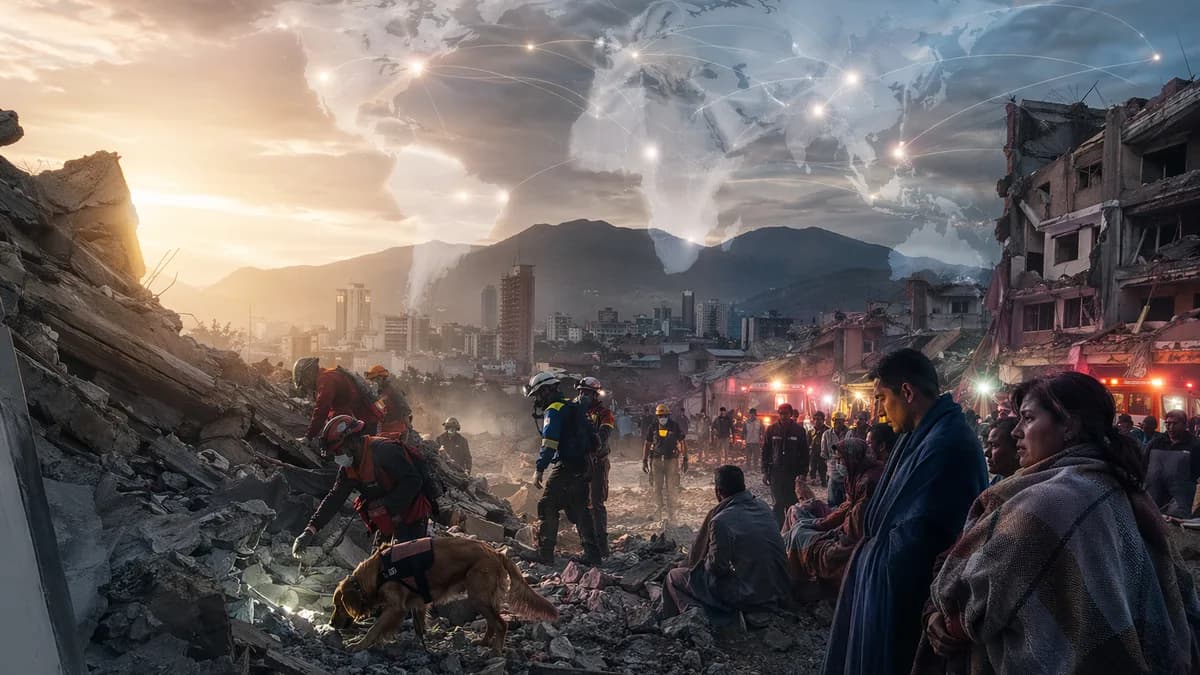
The confirmed death toll from the Venezuela earthquakes has reached at least 235, but the people most exposed now are those still trapped under collapsed buildings in La Guaira, Caracas, and nearby northern states.
Global TrendsJune 26, 2026· 8 min read· By XOOMAR Insights Team
235 Dead as Venezuela Earthquakes Force Survivor Race
Updated on June 27, 2026
XOOMAR Intelligence
Analyst Take
69/ 100
4 sources analyzedMedium confidenceTrend10Freshness95Source Trust90Factual Grounding93Signal Cluster20
Rescue workers and residents are digging through rubble more than a day after twin quakes struck Wednesday evening, according to Guardian World. Authorities fear the toll could climb sharply, with thousands reported missing and more than 4,000 injured. NBC News, citing Venezuelan Health Minister Carlos Alvarado, put the injury count at more than 4,300.
Venezuela's earthquake response is now a race against time and state capacity
The first hard truth is that 235 dead may be an early count, not the scale of the disaster. The two earthquakes, measured at magnitude 7.2 and 7.5, struck less than 40 seconds apart in northern Venezuela near the capital. The Guardian describes them as the most powerful to hit the country in more than a century.
For families at collapse sites, the national emergency has narrowed to one question: can rescuers reach people before the survival window closes?
Acting president Delcy Rodríguez visited Macuto, in La Guaira state, to assess damage and observe rescue operations. The trip matters politically and operationally. It puts the government at the center of the hardest-hit coastal zone, where rows of apartment blocks were reduced to rubble and where Venezuela’s main airport is located.
“We hope to rescue as many living people as possible,” Rodríguez said.
That statement is now the benchmark. Not the declaration of a state of emergency. Not the promised reconstruction fund. The test is whether people under concrete hear machinery, crews, and medical support arrive in time.
XOOMAR is tracking the wider disaster through related coverage, including Twin Shocks Shatter Caracas in Venezuela Earthquake, Rivals Rush Into Venezuela Earthquake Rescue Scramble, and help Venezuela earthquake victims safely.
The numbers behind the Venezuela earthquake: 235 confirmed dead, thousands feared, aid still moving in
The known figures are already severe:
| Measure | Reported figure |
|---|---|
| Confirmed deaths | At least 235 |
| Injured | More than 4,000, with NBC reporting more than 4,300 |
| Quake magnitudes | 7.2 and 7.5 |
| Time between quakes | Less than 40 seconds |
| Collapsed buildings in La Guaira region | More than 100, according to Ocha |
| Reconstruction fund announced | $200m |
Early earthquake tolls often rise because the first counts come from places authorities can reach. Here, several constraints are visible in the source reports: collapsed buildings, damaged roads, overloaded hospitals, power and internet failures cited by Caracas-based journalist Luis Hernandez to the BBC, and the closure of Simón Bolívar international airport due to damage.
The most important operational shortage may be heavy equipment. Rodríguez appealed to businesses to make construction machinery available for rescue operations. That tells us something blunt: people are trapped in structures that residents and first responders cannot clear by hand.
One account from Yamileth Jimenez in La Guaira captures the gap between official urgency and local capacity:
“He’s under the slabs and there’s no machinery to get him out,” Jimenez told Reuters, referring to her 19-year-old son trapped in the debris of their seven-story apartment building.
The U.S. response also points to the scale of the logistical problem. Marco Rubio said the defence department would help search and rescue teams deploy after the airport closure complicated aid efforts. He called the next 72 “golden” hours critical.
Macuto and La Guaira show where the disaster is most concentrated
La Guaira is not just another affected region in the Venezuela earthquakes. It is the clearest picture so far of concentrated urban damage, overwhelmed medical facilities, and disrupted logistics.
The UN humanitarian agency Ocha reported more than 100 buildings collapsed in the La Guaira region alone, including Ritasol Palace and the seafront Eduard’s Hotel. NBC reported Alvarado saying the highest number of injured and deceased was in La Guaira state, and that hospitals there were “very full of patients,” with field hospitals set up.
The urgent question for residents is simple: which damaged buildings are still survivable voids, and which are becoming recovery sites?
The BBC reported that the quakes were shallow, with the first centered 20.3km below the surface and the second at 10km, citing the US Geological Survey. Shallow earthquakes tend to produce more intense surface shaking. In this case, that helps explain why tall residential structures, hotels, roads, and public infrastructure suffered severe damage in places close to Caracas and along the coast.
Analysis: La Guaira’s significance is not only its casualty count. The area also contains the country’s main international airport, and damage there directly slows outside help. One devastated zone can therefore become both a humanitarian crisis and a logistics bottleneck.
Rodríguez's aid pledge faces a delivery test as survivors wait
The government has moved visibly. Rodríguez declared a state of emergency, announced a $200m reconstruction fund for damaged hospitals and homes, and said international aid was imminent. NBC also reported that she visited Macuto and said:
“We are supporting the families, and they have our solidarity. We hope to recover alive as many people as possible.”
That message is necessary. It is not sufficient.
For survivors, credibility will be measured in water, generators, ambulances, rescue dogs, cranes, field hospitals, and clear information about missing relatives. For emergency workers, the pressure is different: triage the injured, stabilize unsafe sites, and decide where scarce crews and machines go first.
Health Minister Carlos Alvarado said the public health system had reached capacity as of 7 p.m. Thursday, according to NBC. He said most patients had mild symptoms, but there were also “moderate and severe cases.” That detail matters because a mass-casualty disaster is not only about those trapped under rubble. It also strains operating rooms, blood supplies, orthopedic care, trauma teams, and follow-up treatment.
The trust problem is practical, not abstract. If few government rescue teams were initially seen outside Caracas, as the Guardian reported, communities in La Guaira and other affected areas will judge the state by the speed of deployment.
Past comparisons are tempting, but 1967 is the sourced reference point here
The current crisis will inevitably invite historical comparisons. The supplied reports give one firm point of reference: the 1967 earthquake that struck Caracas and killed 200 people, according to the BBC. The same BBC report said Altamira and Los Palos Grandes were among the worst-hit neighborhoods then and are again among the worst affected now, citing Interior Minister Diosdado Cabello.
The harder question is whether Venezuela has learned enough from earlier seismic risk to reduce deaths when strong shaking hits dense urban areas.
BBC also reported that the second earthquake is the strongest to hit Venezuela since 1900, based on USGS records. The USGS said “High casualties and extensive damage are probable and the disaster is likely widespread.” Its estimates included a 42% chance of more than 10,000 deaths and a 33% chance of more than 100,000, figures the BBC correctly framed as emergency-response modeling rather than an exact prediction.
Analysis: This is where disaster risk becomes governance risk. Geography and tectonics create the hazard. Building performance, emergency access, hospital capacity, and communications decide how deadly that hazard becomes after the shaking stops.
Humanitarian access and reconstruction money will define the recovery
International aid is moving into the story fast. Rubio said the U.S. immediate priority was search and rescue. NBC reported that a senior U.S. Southern Command official, Marine Maj. Gen. Kevin J. Jarrard, arrived in Caracas to coordinate Defense Department relief efforts. NBC also reported that Pope Leo sent an initial €100,000 emergency donation.
The key question for aid groups is whether they can operate quickly inside damaged areas while local authorities manage security, logistics, and public communication.
Reconstruction will be expensive even before the final death toll is known. The government’s $200m fund is aimed at damaged hospitals and homes, but the visible damage already includes collapsed residential towers, hotels, roads, and airport infrastructure. If schools, clinics, water systems, and power networks are also impaired in affected areas, the recovery burden will extend far beyond search and rescue.
Analysis: disaster funds can rebuild safer structures, or they can disappear into slow procurement and political signaling. The evidence to watch is concrete: published priorities, visible contracts, independent access for aid agencies, and whether displaced families receive shelter before attention moves elsewhere.
The next 72 hours will decide rescues, the next year will judge the rebuild
The confirmed toll from the Venezuela earthquakes is likely to rise as crews reach deeper into collapsed buildings and as reports from damaged communities become clearer. That is not a prediction beyond the sources. It follows directly from thousands reported missing, collapsed multi-story buildings, overloaded hospitals, and official fears that deaths could climb into the thousands.
The government will keep staging visible aid moves and high-profile visits. That is normal in a national disaster. The harder test is distribution: who gets machinery first, which hospitals receive support, how missing-person information is verified, and whether damaged transport links can be restored fast enough to keep rescue teams moving.
For now, the decisive clock is Rubio’s 72 “golden” hours. After that, Venezuela’s challenge changes. The focus shifts from finding survivors to housing the displaced, treating the injured, reopening infrastructure, and proving that the reconstruction fund can produce safer homes and hospitals rather than another cycle of promises after tragedy.
The Stakes
- Rescuers are racing to reach people trapped under collapsed buildings before survival chances fall further.
- The death toll of 235 is expected to rise, with thousands still reported missing.
- Damage in La Guaira, Caracas, and nearby northern states is testing Venezuela’s emergency response capacity.
Confirmed casualties from Venezuela earthquakes
Confirmed deaths
people235
Reported injuries
people4,300
Sources

Written by
XOOMAR Insights Team
Research and Editorial Desk
The XOOMAR Insights Team pairs automated research with human editorial judgment. We track hundreds of sources across technology, fintech, trading, SaaS, and cybersecurity, cross-check the facts, and explain what happened, why it matters, and what to watch next. We do not just rewrite headlines. Every article is fact-checked and scored for reliability before it goes live, and we link back to the original sources so you can verify anything yourself.
Explore More Topics
Related Articles
 Global Trends
Colombia Earthquake Death Toll Climbs As Rescuers Race Clock
A powerful 7.4 magnitude earthquake has killed over 180 people in Colombia, with hundreds still missing as rescue teams confront widespread building collapses.
Aug 12, 20266 min
 Global Trends
Colombia Earthquake Kills 110, Flattens Buildings
The strongest earthquake in Colombia this century has killed at least 110 people and collapsed dozens of buildings, triggering a desperate, large-scale rescue o
Aug 14, 20264 min
 Global Trends
Powerful 7.4 Quake Collapses Buildings Across Colombia
A 7.4 magnitude earthquake struck western Colombia, collapsing buildings in Cali and damaging regional airports while violent shaking was felt in the capital, B
Aug 10, 20264 min
 Trading
Mike Ashley Seizes 48% of Hugo Boss After Board Snub
Mike Ashley's Frasers Group seized 48% of Hugo Boss, moving within reach of a full takeover after shareholders sold out despite the board rejecting his bid.
Aug 18, 20264 min
 Global Trends
Your Commute Is Secretly Slashing Your Hourly Wage
A new index shows 64% of workers have changed how they work, with 15% refusing shifts, because rising fuel costs are destroying the real value of their hourly p
Aug 18, 20268 min
 Fintech
Credit Unions Ditch Teller Windows for Financial Guidance
Credit unions aren't closing branches, they're retooling them from transaction centers into dedicated spaces for high-stakes financial advice that members won't
Aug 18, 20267 min
 Global Trends
Zambian Leader's 60% Win Overshadowed by Raid, Arrests
Zambian President Hakainde Hichilema wins re-election decisively, but his victory is marred by police raids and fraud allegations from the opposition.
Aug 18, 20264 min
 Trading
Dollar Traders Flee After Snapback Meets Selling Resistance
The US Dollar Index rebounded sharply from a two-month low, but the rally is stalling at a critical technical barrier, leaving traders questioning if the move i
Aug 18, 20264 min
 Fintech
Pound Crashes Below 1.35 on Tepid UK Jobs Data
The British pound crashed past 1.35 against the dollar after a lukewarm UK jobs report failed to convince markets, highlighting sterling's vulnerability amid we
Aug 18, 20265 min
 Trading
Silver Standoff Freezes Traders on Fed
Silver traders are frozen, caught between dovish economic data and hawkish oil price inflation, as they wait for the Fed to tip the scales.
Aug 18, 20266 min
Don't miss the signal
Get our weekly roundup of the stories that matter across tech, fintech, and trading. No noise, just signal.
Free forever. No spam. Unsubscribe anytime.