
Can Venezuela earthquake rescuers get the right teams to the right ruins fast enough, not just bring more rescuers into the country?
Global TrendsJune 27, 2026· 7 min read· By XOOMAR Insights Team
Venezuela Earthquake Rescuers Race a 72-Hour Clock
Updated on June 29, 2026
XOOMAR Intelligence
Analyst Take
72/ 100
4 sources analyzedLow confidenceTrend10Freshness95Source Trust92Factual Grounding92Signal Cluster100
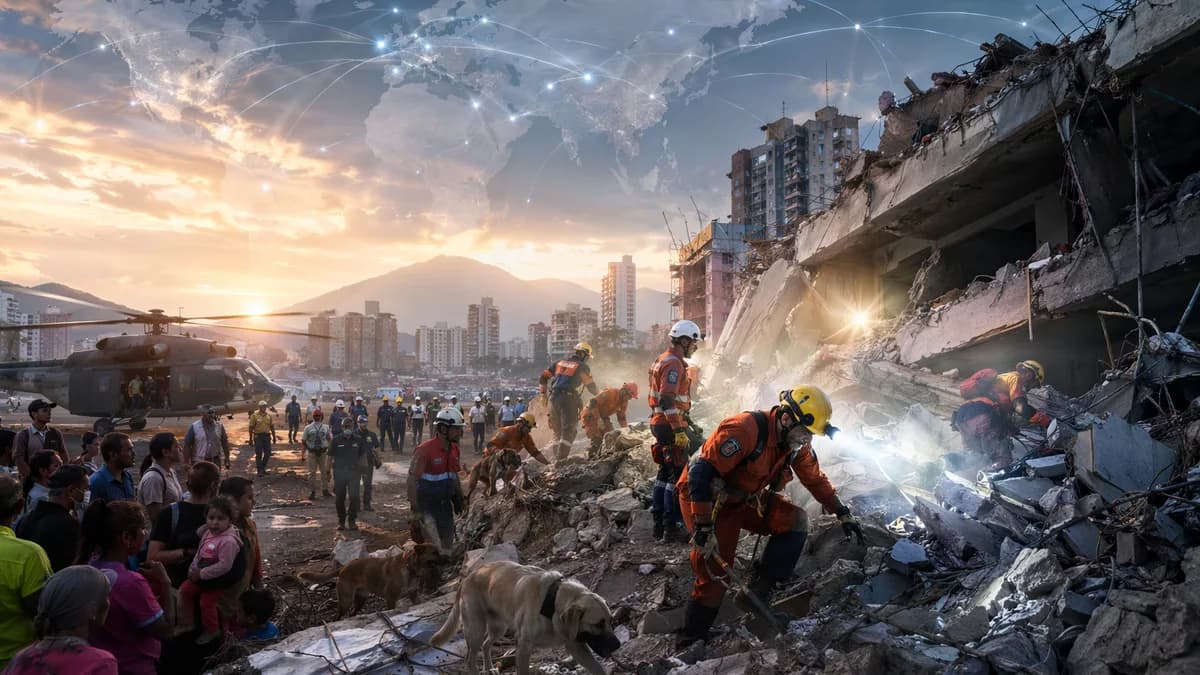
That is the brutal constraint now facing crews after the Venezuela earthquakes, as the period when trapped survivors are most likely to be found alive is closing and international teams are still moving into position, according to BBC World. The BBC said around 2,000 search and rescue officials have gone into Venezuela from countries including the UK, Mexico, Costa Rica, France and Spain.
Can Venezuela earthquake rescuers beat the closing survival window?
The BBC’s Dan Johnson, reporting from Cucuta, the Colombian town near the Venezuela border, described the mission as a battle against time. The core problem is not only manpower. It is getting people, gear and specialist teams to the exact places where they can still make a rescue.
Al Jazeera reported that search operations had entered their second day as the critical 72-hour “golden window” neared. ColombiaOne, citing official figures at the time of its report, said the death toll stood at 920 fatalities and that 50,000 people remained missing. The Sydney Morning Herald, citing AP and Venezuelan government figures, later reported that the Venezuela earthquakes death toll had risen to 1430 on Saturday local time, with families reporting at least 68,900 people missing.
Those figures are moving fast, and they do not line up cleanly across reports. The BBC video itself did not provide a full casualty count. That gap matters because the scale of the missing count shapes every rescue decision, from which collapsed buildings get acoustic sensors first to where medical teams wait.
| Source report | Confirmed in supplied material |
|---|---|
| BBC World | Around 2,000 search and rescue officials entered Venezuela from several countries |
| Al Jazeera | Rescue operations entered a second day as the 72-hour “golden window” neared |
| ColombiaOne | Official toll at its report: 920 fatalities, 50,000 missing |
| Sydney Morning Herald/AP | Government toll later reported at 1430 killed, families reported 68,900 missing |
Venezuela’s acting President Delcy Rodríguez said in an overnight briefing that she still had “faith and hope” survivors would be rescued.
Rodríguez said she still had “faith and hope” survivors would be rescued.
XOOMAR analysis: that wording signals the tension now driving the response. Officials are trying to project control while the rescue clock is doing the opposite. In collapsed structures, hope has to be converted into location data, silence zones, equipment access and safe extraction routes.
Where is the rescue effort getting slowed down?
The BBC’s clearest operational warning is logistical: “getting people to the right area with the right equipment is a complex task,” as Johnson reported from near the border. That is the issue behind the headline number of 2,000 rescuers. A team in the country is not the same as a team at the slab where a survivor may still be alive.
The hardest-hit areas cited in the supplied reports include Caracas, La Guaira, Maiquetia, Catia La Mar and other affected communities in northern Venezuela. The Sydney Morning Herald reported that residents in La Guaira used shovels, heavy equipment, ropes and bare hands to search through toppled concrete.
In some areas, civilians appear to have moved faster than the state. The SMH report described frustration over what residents saw as an inadequate official response, even as authorities tried to show a large mobilization.
“There’s a pile of bodies over there from last night. Newborn babies. Look what time it is, and they still haven’t come to recover them,” said Mileidy Romero, who was searching rubble in Caraballeada. “What are they waiting for?”
The same report said acting President Rodríguez stated on state television that more than 14,000 members of the military and police were patrolling the area, where access was blocked and special permits were required to enter. That may help secure damaged zones, but it can also complicate movement if rescue teams, aid workers or relatives cannot reach priority sites quickly.
The transport bottleneck is another pressure point. The SMH reported that Simón Bolívar International Airport, which serves Caracas, was badly damaged, with one runway operational as US teams worked to repair the route. For more context on why damaged transport infrastructure matters in this disaster, see XOOMAR’s coverage of the Venezuela earthquake rescue hub.
How are international teams changing the operation?
Foreign rescue teams are now widening the response, but they are not magic. They bring trained dogs, listening devices, medical units and collapsed-structure specialists. They also need access, coordination and reliable information from the ground.
The BBC named teams coming from the UK, Mexico, Costa Rica, France and Spain. The SMH reported that search teams and aid from Mexico, the US, Brazil, El Salvador, France and others continued arriving on Saturday morning. ColombiaOne said at least 17 countries had sent specialized search-and-rescue teams, medical personnel, emergency supplies and technical equipment.
That international surge raises the odds that more voids in collapsed buildings will be searched properly. It also increases the burden on whoever is assigning teams to sites.
Operational pressure points now include:
- Access: Damaged roads, blocked areas and permit requirements can slow movement to rubble sites.
- Airport capacity: One operational runway at a damaged main airport limits the pace of incoming aid.
- Silence discipline: SMH reported Mexican soldiers and volunteers asked for quiet so they could listen for survivors under rubble.
- Medical handoff: Search teams need nearby medical staff ready when survivors are extracted.
- Site selection: With many missing, teams must choose where specialist equipment goes first.
The US response, as described in the SMH report, points to how large the operation has become. Jeremy Lewin, a senior State Department official in charge of foreign assistance, said the US military would help coordinate flights carrying search and rescue workers, mobile hospitals and supplies. He also said two 80-person search teams were at work and a US Navy transport ship was off Venezuela’s coast to receive airlifted survivors needing medical attention.
“People are trapped under rubble, and the priority is to get the search and rescue teams and the medical professionals and others to them as quickly as possible to save lives,” Lewin said.
For the broader regional and international response, XOOMAR readers can follow our related file on the international rescue scramble in Venezuela.
Which decisions will matter after the 72-hour mark passes?
The next phase will test whether Venezuela’s rescue command can turn international support into targeted rescues before the survival window narrows further. The supplied reports do not confirm a full national damage map, a settled casualty toll, a final missing-person count, the quake depth or a reliable aftershock outlook.
That uncertainty is not a footnote. It is the story. Search teams are operating inside an information fog while families wait outside collapsed buildings for names, voices or bodies.
The most important near-term signals will be practical ones: whether more runways or routes open, whether foreign teams reach the worst rubble fields, whether official casualty figures stabilize and whether authorities publish clearer missing-person data. Watch also for confirmed rescue breakthroughs, formal requests for more international aid and any official account of which communities remain hardest to reach.
The rescue phase is still measured in hours. The accountability phase will take much longer.
Impact Analysis
- The 72-hour rescue window makes speed and coordination critical for finding survivors alive.
- Conflicting casualty and missing-person figures complicate decisions about where to send teams and equipment.
- International rescue support is arriving, but the main challenge is deploying specialists to the right collapse sites quickly.
Reported Venezuela Earthquake Figures by Source
| Source | Key figure reported | Context |
|---|---|---|
| BBC World | Around 2,000 search and rescue officials | International teams entered Venezuela from countries including the UK, Mexico, Costa Rica, France and Spain |
| Al Jazeera | 72-hour golden window | Search operations were in their second day as the critical rescue window neared |
| ColombiaOne | 920 fatalities; 50,000 missing | Cited official figures at the time of its report |
| Sydney Morning Herald / AP | 1,430 killed; at least 68,900 missing | Cited Venezuelan government figures and family reports |
Reported Venezuela Earthquake Death Toll
ColombiaOne
people920
Sydney Morning Herald / AP
people1,430
Sources

Written by
XOOMAR Insights Team
Research and Editorial Desk
The XOOMAR Insights Team pairs automated research with human editorial judgment. We track hundreds of sources across technology, fintech, trading, SaaS, and cybersecurity, cross-check the facts, and explain what happened, why it matters, and what to watch next. We do not just rewrite headlines. Every article is fact-checked and scored for reliability before it goes live, and we link back to the original sources so you can verify anything yourself.
Explore More Topics
Related Articles
 Global Trends
Colombia Earthquake Death Toll Climbs As Rescuers Race Clock
A powerful 7.4 magnitude earthquake has killed over 180 people in Colombia, with hundreds still missing as rescue teams confront widespread building collapses.
Aug 12, 20266 min
 Global Trends
Colombia Earthquake Kills 110, Flattens Buildings
The strongest earthquake in Colombia this century has killed at least 110 people and collapsed dozens of buildings, triggering a desperate, large-scale rescue o
Aug 14, 20264 min
 Global Trends
Putin Warns of Retaliation for Commercial Ship Seizures
President Vladimir Putin has threatened direct retaliation against Western nations for seizing Russian commercial ships, calling the actions 'piracy' and riskin
Aug 12, 20265 min
 Global Trends
Belgium Faces Largest Wildfire on Record as Drought Engulfs Europe
Belgium's largest recorded wildfire has scorched over 3,000 hectares, fueled by extreme drought, while deadly fires erupt across France and Greece, forcing mass
Aug 17, 20264 min
 Global Trends
Met Police Chooses Victims Who Matter, Mother Says
Mina Smallman, a mother who lost two daughters to murder and witnessed police corruption, declares the Metropolitan Police incapable of reform after seeing how
Aug 17, 20265 min
 Fintech
Pound Crashes Below 1.35 on Tepid UK Jobs Data
The British pound crashed past 1.35 against the dollar after a lukewarm UK jobs report failed to convince markets, highlighting sterling's vulnerability amid we
Aug 18, 20265 min
 Trading
Dollar Buckles, Pound Leaps on Fed Rate Hike Bet Retreat
The pound is climbing near 1.3550 after weak U.S. retail and inflation data slashed expectations for a Fed rate hike, shifting attention to the upcoming UK empl
Aug 18, 20268 min
 Technology
Reform UK Welfare Ban Targets 1.5 Million Vulnerable Residents
Reform UK proposes a sweeping ban on nearly all non-UK nationals claiming core benefits, a move requiring the UK to break its treaty with the EU and targeting s
Aug 17, 20266 min
 Trading
Mike Ashley Seizes 48% of Hugo Boss After Board Snub
Mike Ashley's Frasers Group seized 48% of Hugo Boss, moving within reach of a full takeover after shareholders sold out despite the board rejecting his bid.
Aug 18, 20264 min
 Global Trends
Your Commute Is Secretly Slashing Your Hourly Wage
A new index shows 64% of workers have changed how they work, with 15% refusing shifts, because rising fuel costs are destroying the real value of their hourly p
Aug 18, 20268 min
Don't miss the signal
Get our weekly roundup of the stories that matter across tech, fintech, and trading. No noise, just signal.
Free forever. No spam. Unsubscribe anytime.