
How fast can rescuers reach Venezuela’s collapsed coastal towns when the country’s main international airport is damaged?
Global TrendsJune 27, 2026· 6 min read· By XOOMAR Insights Team
Twin Quakes Cripple Venezuela Earthquake Rescue Hub
Updated on June 27, 2026
XOOMAR Intelligence
Analyst Take
81/ 100
4 sources analyzedMedium confidenceTrend10Freshness97Source Trust90Factual Grounding90Signal Cluster80
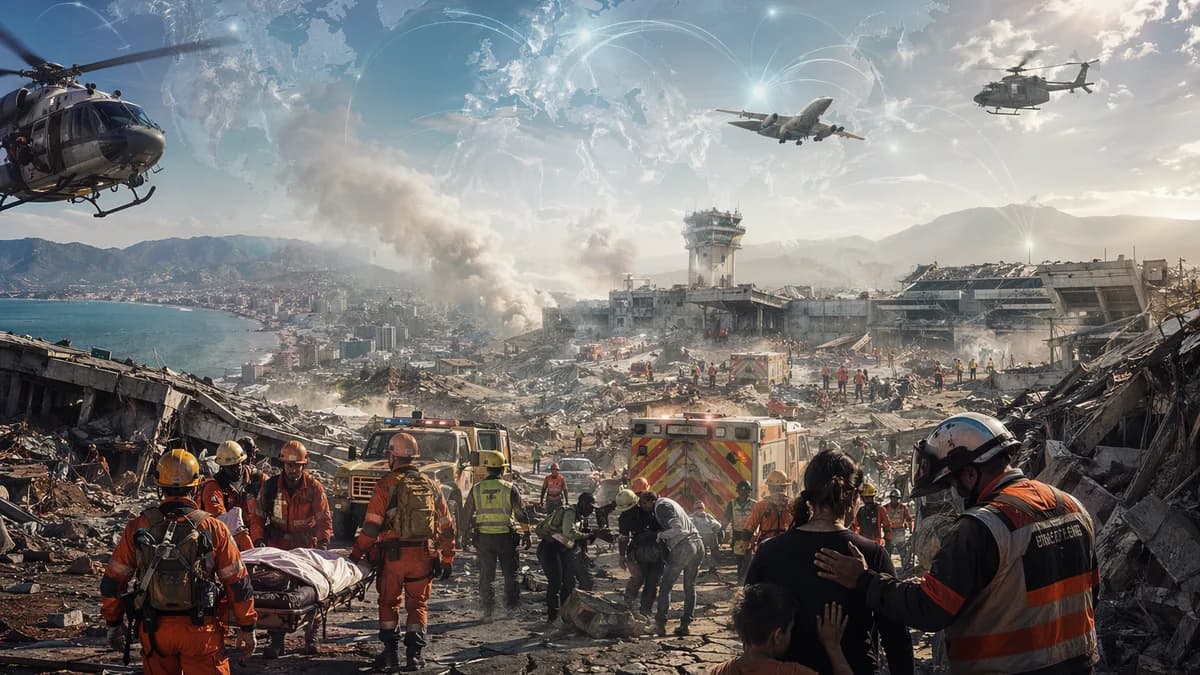
That question now sits at the center of the Venezuela earthquake response after two powerful quakes struck less than 40 seconds apart late Wednesday afternoon, flattening buildings along the northern coast and badly damaging Simón Bolívar international airport, according to Guardian World.
How much damage did the twin Venezuela earthquake cause in less than a minute?
The twin shocks, reported at 7.2 and 7.5 magnitude, hit Venezuela’s northern coast late Wednesday afternoon and turned parts of La Guaira, Catia La Mar and Caraballeda into rescue zones.
Early casualty figures remained fluid, with acting president Delcy Rodríguez reporting at least 188 deaths and more than 1,500 injuries, while officials warned the toll could rise sharply. A missing-person tracker listed tens of thousands unaccounted for, underscoring the uncertainty around the first counts.
The worst damage appears concentrated near the country’s main international gateway, close to Caracas. The UN’s humanitarian agency, Ocha, reported that more than 100 buildings had collapsed in the La Guaira region alone, including the Ritasol Palace apartment block and the seafront Eduard’s Hotel.
Families are searching through rubble for missing relatives. In some cases, entire households of four or five people have disappeared.
“This is an utter tragedy,” acting president Delcy Rodríguez said in a televised broadcast, declaring the La Guaira region a disaster zone.
Caracas also suffered severe damage. Guardian World reported building collapses in Altamira and Los Palos Grandes, while aftershocks continued to shake northern Venezuela on Thursday.
XOOMAR analysis: the casualty count is almost certain to move. The key reason is not just the number of collapsed buildings, but the kind of collapse described in the source material: large tower blocks, hotel structures and apartment buildings where void spaces may be limited and access requires heavy equipment. That turns the first search window into a logistics race.
For earlier casualty reporting and survivor conditions, see XOOMAR’s coverage of 235 Dead as Venezuela Earthquakes Force Survivor Race and Venezuela Earthquake Rips Open Caracas Buildings in Seconds.
Why does damage at Simón Bolívar airport make the rescue race harder?
Simón Bolívar international airport, near Caracas, was badly damaged by the quakes. That matters because it is Venezuela’s main international gateway and a natural entry point for foreign rescue teams, medical supplies, heavy equipment and emergency shelter materials.
If access is limited, the first wave of help becomes harder to stage. Rescue crews need aircraft slots, landing clearance, usable roads out of the airport and coordination with local authorities before they can reach collapsed buildings on the coast.
Rubio framed the next phase around the first 72 “golden” hours, the window when rescuers still have the best chance of reaching people alive beneath debris.
“They have [lots of] collapsed buildings and so they will need a lot of help in terms of digging through that,” Marco Rubio told reporters.
The operational burden is clear: crews must triage survivors, locate trapped people, clear debris, set up temporary medical points and decide which damaged buildings are too dangerous to enter.
| Bottleneck | Why it matters now |
|---|---|
| Airport damage | Slows entry for foreign teams, equipment and medical supplies |
| Collapsed towers | Requires specialized search crews and heavy machinery |
| Aftershocks | Raises the risk of secondary collapses during rescue work |
| Power and access disruptions | Complicates night operations, communications and patient movement |
XOOMAR analysis: airport damage does not just delay arrivals. It can distort the entire rescue map. If teams cannot land close to the disaster zone, the mission shifts from pure search-and-rescue into route clearance, staging and fuel management.
How is the US joining the international rescue push?
The United States is sending help through the Department of Defense, Rubio said, with the immediate focus on getting search-and-rescue teams into the affected region.
The US role, based on the official remarks cited, is logistical and operational. Rubio did not describe the response as a political mission. He described a rubble problem: collapsed buildings, trapped people and too little time.
Other countries also offered support. Guardian World reported that Brazil, Mexico, Spain, Portugal, Canada and Qatar promised aid. France said it would deploy 85 French specialised rescuers immediately.
Tom Fletcher, head of Ocha, said the UN was mobilizing search-and-rescue support.
“We are fully mobilised right now … We will surge in people, we will surge in solidarity and, most important, we will surge in search and rescue support … for people who have lost so much … Now is the time for action.”
The US Treasury also moved to waive some sanctions until 23 October to allow earthquake relief transactions that would otherwise be prohibited.
The practical constraint remains timing. The scale of foreign help will depend on airport conditions, landing alternatives, road access and how quickly international teams can plug into Venezuelan command structures already operating under pressure.
For more on the aid scramble, read XOOMAR’s Rivals Rush Into Venezuela Earthquake Rescue Scramble.
Which numbers will decide the next phase of the Venezuela earthquake crisis?
The next critical numbers are not just the death toll. They are the number of people still trapped, the number of reachable collapse sites, the number of buildings too unstable for entry and the capacity of hospitals near Caracas and La Guaira.
Aftershocks remain a serious variable. They can force rescuers to pull back from unstable structures, slow debris removal and push residents out of buildings that survived the first shocks but may no longer be safe.
Rodríguez appealed to businesses to make heavy construction equipment available for rescue operations. That request points to the central gap: bare hands and small tools can find surface survivors, but major concrete collapses require machines, trained teams and tight coordination.
Public needs are also widening. The source material points to trauma injuries, missing children and elderly residents, damaged buildings, disrupted access and rescue teams trying to reach people buried under rubble. Clean water, medical continuity and shelter will become more urgent as the search phase stretches.
XOOMAR analysis: the harder question, the one that won’t be answered in the next update, is whether the collapse pattern reflects only the force of the quakes or also deeper construction failures. Related reports cited experts warning that older buildings, weak reinforcement and soft-story designs may have worsened the devastation. If that holds, Venezuela’s recovery will not end with debris clearance. It will require a building-by-building safety reckoning.
For now, the most reliable signal will be convergence between official tolls, hospital counts, rescue-team reports and local government updates. In a disaster this fragmented, early figures can lag reality by hours or days.
Impact Analysis
- Damage to Simón Bolívar international airport could slow the arrival of international rescue teams and supplies.
- Collapsed buildings in La Guaira and Caracas raise fears the death toll may rise sharply as searches continue.
- Tens of thousands listed as unaccounted for show how uncertain and urgent the disaster response remains.
Early reported casualties
Deaths reported at least
people188
Injuries reported more than
people1,500
Sources
- [1] Guardian World
- [2] Rescue teams race to Venezuela amid fears thousands killed in earthquakes
- [3] Venezuela Earthquake LIVE Updates: Venezuela earthquake death toll rises to 920 as rescue window narrows, says report
- [4] Race is on to find hundreds feared trapped in Venezuela after powerful quakes | CBC News

Written by
XOOMAR Insights Team
Research and Editorial Desk
The XOOMAR Insights Team pairs automated research with human editorial judgment. We track hundreds of sources across technology, fintech, trading, SaaS, and cybersecurity, cross-check the facts, and explain what happened, why it matters, and what to watch next. We do not just rewrite headlines. Every article is fact-checked and scored for reliability before it goes live, and we link back to the original sources so you can verify anything yourself.
Explore More Topics
Related Articles
 Global Trends
Ghana Hijacks Slavery Reparations Talks as Lead Prosecutor
Ghana is no longer just a victim of the slave trade. It is now the lead prosecutor, declaring itself the crime scene and leveraging diplomatic power to force a
Aug 16, 20268 min
 Global Trends
Drones Cripple Russian Grain Hub In Black Sea Attack
Ukrainian drone strikes have knocked major Russian grain export terminals offline at the Novorossiysk port, escalating a campaign of economic sabotage that thre
Aug 12, 20266 min
 Trading
Mike Ashley Seizes 48% of Hugo Boss After Board Snub
Mike Ashley's Frasers Group seized 48% of Hugo Boss, moving within reach of a full takeover after shareholders sold out despite the board rejecting his bid.
Aug 18, 20264 min
 Global Trends
Your Commute Is Secretly Slashing Your Hourly Wage
A new index shows 64% of workers have changed how they work, with 15% refusing shifts, because rising fuel costs are destroying the real value of their hourly p
Aug 18, 20268 min
 Fintech
Credit Unions Ditch Teller Windows for Financial Guidance
Credit unions aren't closing branches, they're retooling them from transaction centers into dedicated spaces for high-stakes financial advice that members won't
Aug 18, 20267 min
 Global Trends
Zambian Leader's 60% Win Overshadowed by Raid, Arrests
Zambian President Hakainde Hichilema wins re-election decisively, but his victory is marred by police raids and fraud allegations from the opposition.
Aug 18, 20264 min
 Trading
Dollar Traders Flee After Snapback Meets Selling Resistance
The US Dollar Index rebounded sharply from a two-month low, but the rally is stalling at a critical technical barrier, leaving traders questioning if the move i
Aug 18, 20264 min
 Fintech
Pound Crashes Below 1.35 on Tepid UK Jobs Data
The British pound crashed past 1.35 against the dollar after a lukewarm UK jobs report failed to convince markets, highlighting sterling's vulnerability amid we
Aug 18, 20265 min
 Trading
Silver Standoff Freezes Traders on Fed
Silver traders are frozen, caught between dovish economic data and hawkish oil price inflation, as they wait for the Fed to tip the scales.
Aug 18, 20266 min
 Global Trends
Major Parties Cut Weak Gambling Deal Gutting Reforms
Labor and the Coalition have struck a deal to pass a watered-down gambling ad bill, directly rejecting core recommendations from a landmark parliamentary review
Aug 18, 20267 min
Don't miss the signal
Get our weekly roundup of the stories that matter across tech, fintech, and trading. No noise, just signal.
Free forever. No spam. Unsubscribe anytime.