
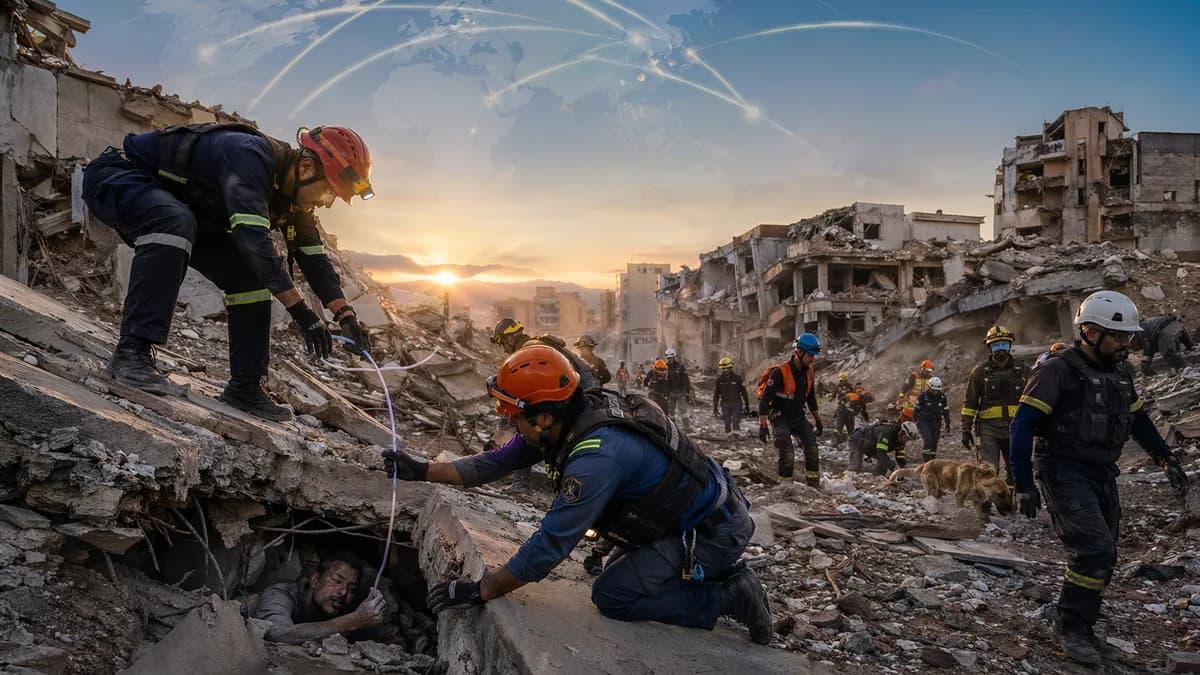
The effort to pull Aaron Levi Cantillo Vargas, 21, from beneath a collapsed building in Caraballeda, La Guaira state, shows what Venezuela’s earthquake rescue has become: a shrinking test of time, machinery, foreign aid, and state capacity.
Global TrendsJune 29, 2026· 8 min read· By XOOMAR Insights Team
Critical Hours Squeeze Venezuela Earthquake Rescues
Updated on June 29, 2026
XOOMAR Intelligence
Analyst Take
68/ 100
2 sources analyzedMedium confidenceTrend10Freshness97Source Trust90Factual Grounding91Signal Cluster40
Venezuela earthquake survivors are now caught in the narrowest rescue window
The search for Venezuela earthquake survivors is entering the phase officials fear most, when every hour below concrete changes the mission from rescue to recovery. El Salvador’s president Nayib Bukele said teams from El Salvador, Venezuela and Mexico are working to extract Cantillo Vargas and have already reached him medically, according to Guardian World.
“We have already managed to locate him, and one of our doctors has been able to administer fluids to keep him hydrated,” Bukele wrote in a post on X.
That detail matters. Hydration is not symbolism. It is evidence that rescuers have at least some access to a trapped survivor and that the operation has moved beyond listening for signs of life into sustaining one. But it also exposes the brutal constraint: locating someone is not the same as getting them out.
The larger disaster is already severe. Jorge Rodríguez, president of Venezuela’s National Assembly, said the death toll has risen to at least 1,450, with 3,150 injured and 12,721 displaced. He warned that the country is in “critical hours” for rescues and emergency shelter.
“We are in critical hours, in crucial hours to continue rescuing lives and to build camps where those people who have lost their homes, or who cannot return, for whatever reason, to their residences can stay,” Rodríguez said.
XOOMAR analysis: that phrase, “critical hours,” is doing two jobs. It describes the biological clock facing trapped survivors. It also signals a political and logistical deadline for the state, which must prove it can coordinate rescue, shelter, hospitals and foreign help at the same time.
For readers tracking the rescue timeline, see XOOMAR’s related coverage on Venezuela earthquake rescuers racing a 72-hour clock and the pressure around the damaged rescue hub in Twin Quakes Cripple Venezuela Earthquake Rescue Hub.
The numbers show a disaster still expanding, not stabilizing
The official figures are not a final count. They are a moving snapshot from a disaster zone where collapsed buildings, disrupted communications and missing-person reports can lag reality.
The core numbers now shaping the response are stark:
| Measure | Reported figure |
|---|---|
| Confirmed deaths | At least 1,450 |
| Injured | 3,150 |
| Displaced | 12,721 |
| Reported unaccounted for by families | 68,900 |
| Quake magnitudes | 7.2 and 7.5 |
| Timing | Struck within a minute of each other on Wednesday evening |
The second quake was described in the source material as one of the strongest tremors to hit Venezuela in a century. Both quakes flattened buildings in the north of the country. Search and rescue operations continued in La Guaira on 28 June, 2026.
Early death counts after major disasters often move sharply, not because officials are necessarily manipulating them, but because the denominator keeps changing. Families file missing reports. Crews open buildings that were unreachable. Hospitals receive patients from neighborhoods that were cut off. Some names appear in multiple informal lists before being reconciled.
That uncertainty is visible here. At least 68,900 people have been reported unaccounted for by relatives. Another supplied report says more than 50,000 people were listed missing on one non-governmental database, while making clear it was uncertain how many had since been found.
The strongest counterpoint is that “missing” does not mean dead. Some people may be displaced, unreachable because of poor cell service, or recorded across fragmented databases. But the scale of the unaccounted-for list still tells rescuers where the pressure is building: families need confirmation, not vague assurances.
Foreign rescue teams are arriving, but equipment and coordination are the choke points
More search and rescue teams are reaching Venezuela five days after the twin quakes. The arrival of teams from El Salvador, Mexico and other countries creates a chance to save lives, but the source material points to a hard operational limit: Venezuela has a severe shortage of heavy machinery needed to rescue survivors, and state manpower has been lacking.
That is the central bottleneck. Rescuers can hear survivors, locate voids and provide medical access, but extraction from a collapsed building can stall without machinery and safe access. In Cantillo Vargas’s case, the reported ability to administer fluids is encouraging. It also suggests a delicate operation where rushing could endanger the person crews are trying to save.
There are signs of a larger international push. The supplied reporting from Global News says more than 2,200 rescue workers from around the world had arrived by Saturday, citing the U.N., with more still arriving. It also says authorities reported more than 770 buildings had totally or partially collapsed, and aftershocks measuring 4.2 and 4.5 hit Sunday morning.
That matters because each aftershock can force crews to reassess unstable structures. XOOMAR analysis: in this phase, coordination may matter as much as courage. Multiple teams can crowd the same disaster zone unless access, assignments, medical evacuation and security are clear.
The counterpoint is that international arrivals appeared to improve organization in La Guaira, according to the supplied reporting. But better organization on Sunday does not erase the earlier constraint: the first 48 to 72 hours are widely described by experts in the source material as the narrow rescue window, and Venezuela is now beyond that period.
Bukele’s X post turned one rescue into a regional crisis signal
Bukele’s public update on Cantillo Vargas did more than report progress. It placed a specific trapped survivor at the center of a regional aid effort. That can help focus attention. It can also raise expectations faster than rubble can be cleared.
Venezuela’s acting president Delcy Rodríguez said power has been restored to La Guaira, a port city near the country’s main international airport that was badly affected by the earthquakes. That is a meaningful operational gain. Power restoration can support hospitals, communications and night operations. But the same source material says heavy machinery is scarce and state manpower has been insufficient, leaving the government reliant on international assistance.
The political tension is unavoidable, but it should not swallow the human emergency. The supplied reporting says the government has faced criticism from Venezuelans who viewed the response as inadequate and overshadowed by civilian-led rescue efforts. It also says more than 14,000 members of the military and police are now patrolling La Guaira state, where access is blocked and special permits are required to enter.
For families, the demand is simple: speed and credible information. For rescuers, the priority is access and safety. For hospitals, the burden is already visible, with more than 3,100 wounded people treated and many crush injuries reported in the supplied material.
The strongest counterpoint is that large disasters overwhelm even capable states in the early days. But the documented shortages, blocked access, poor cell service and reliance on outside teams make this more than a natural disaster story. It is now a test of whether Venezuela can turn fragmented rescue energy into a disciplined operation.
The evidence points to a long emergency after the rubble search fades
La Guaira’s crisis will not end when the last survivor is pulled out or the last body is recovered. The emergency will shift toward shelter, trauma care, sanitation, food distribution and family reunification. Rodríguez has already linked rescue work with the need to build camps for people who lost homes or cannot return to them.
The supplied reporting does not provide enough evidence to make firm claims about building age, inspection failures, informal construction patterns or past Venezuelan disasters. Those questions matter, but they require forensic work, not guesswork. What is documented is already enough: two powerful quakes, more than 770 collapsed or damaged buildings in the broader supplied reporting, thousands injured, and tens of thousands reported unaccounted for.
Hospitals will remain under strain. Domingo Luciani Hospital in Caracas was described in the supplied reporting as handling an influx of patients with help from donations. That is a hopeful detail, but also a warning. Donation flows can fill immediate gaps. They do not replace a coordinated public health response.
Residents looking for ways to help should also treat the aid surge carefully. Disaster giving draws legitimate groups and opportunists. XOOMAR’s guide on how to help Venezuela earthquake victims without getting duped is relevant as donations, missing-person lists and informal aid channels multiply.
The next week will test the thesis. If casualty data becomes clearer, machinery reaches the worst sites, camps open quickly, hospitals keep functioning, and families receive credible updates, Venezuela will have turned late rescue urgency into recovery planning. If missing-person lists remain fragmented, access stays blocked without explanation, and survivors remain dependent on ad hoc civilian efforts, the quakes will expose a deeper failure than collapsed concrete.
The Stakes
- Rescuers are in a narrowing window where trapped survivors may still be saved.
- The scale of deaths, injuries, and displacement is straining Venezuela’s emergency response capacity.
- International rescue teams are playing a critical role as local resources face severe pressure.
Venezuela Earthquake Impact
Deaths
people1,450
Injured
people3,150
Displaced
people12,721
Sources

Written by
XOOMAR Insights Team
Research and Editorial Desk
The XOOMAR Insights Team pairs automated research with human editorial judgment. We track hundreds of sources across technology, fintech, trading, SaaS, and cybersecurity, cross-check the facts, and explain what happened, why it matters, and what to watch next. We do not just rewrite headlines. Every article is fact-checked and scored for reliability before it goes live, and we link back to the original sources so you can verify anything yourself.
Explore More Topics
Related Articles
 Global Trends
Mexico Ex-President's Son Appeals Visa Revocation to Trump
The son of Mexico's former president Andrés Manuel López Obrador had his U.S. visa revoked and appealed directly to Donald Trump, a move widely seen as a politi
Aug 14, 20267 min
 Global Trends
Global Coalition Smuggles China Past US Tariffs
A White House report reveals more than 40 countries, including major allies, are helping China circumvent U.S. tariffs, exposing a fundamental flaw in unilatera
Aug 14, 20267 min
 Global Trends
Colombia Earthquake Kills 110, Flattens Buildings
The strongest earthquake in Colombia this century has killed at least 110 people and collapsed dozens of buildings, triggering a desperate, large-scale rescue o
Aug 14, 20264 min
 Trading
Oil Hits Two-Week High as Strait Showdown Goes Live
A live-fired standoff in the Strait of Hormuz has WTI crude holding near a two-week high as traders price in the real risk of a major supply shock.
Aug 18, 20265 min
 Trading
Mike Ashley Seizes 48% of Hugo Boss After Board Snub
Mike Ashley's Frasers Group seized 48% of Hugo Boss, moving within reach of a full takeover after shareholders sold out despite the board rejecting his bid.
Aug 18, 20264 min
 Global Trends
Your Commute Is Secretly Slashing Your Hourly Wage
A new index shows 64% of workers have changed how they work, with 15% refusing shifts, because rising fuel costs are destroying the real value of their hourly p
Aug 18, 20268 min
 Fintech
Credit Unions Ditch Teller Windows for Financial Guidance
Credit unions aren't closing branches, they're retooling them from transaction centers into dedicated spaces for high-stakes financial advice that members won't
Aug 18, 20267 min
 Global Trends
Zambian Leader's 60% Win Overshadowed by Raid, Arrests
Zambian President Hakainde Hichilema wins re-election decisively, but his victory is marred by police raids and fraud allegations from the opposition.
Aug 18, 20264 min
 Trading
Dollar Traders Flee After Snapback Meets Selling Resistance
The US Dollar Index rebounded sharply from a two-month low, but the rally is stalling at a critical technical barrier, leaving traders questioning if the move i
Aug 18, 20264 min
 Fintech
Pound Crashes Below 1.35 on Tepid UK Jobs Data
The British pound crashed past 1.35 against the dollar after a lukewarm UK jobs report failed to convince markets, highlighting sterling's vulnerability amid we
Aug 18, 20265 min
Don't miss the signal
Get our weekly roundup of the stories that matter across tech, fintech, and trading. No noise, just signal.
Free forever. No spam. Unsubscribe anytime.