
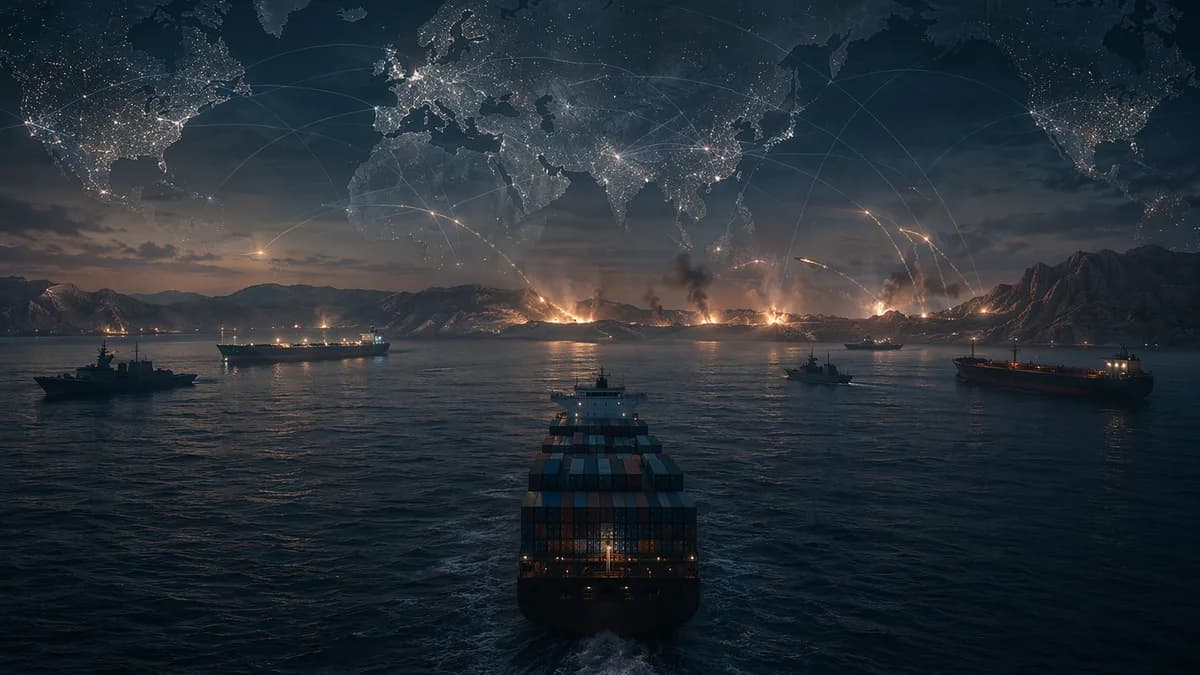
US strikes Iran targets hit missile and drone storage facilities and coastal radar positions after a cargo ship was attacked in the Strait of Hormuz, escalating a fragile ceasefire dispute into direct military action.
Global TrendsJune 26, 2026· 6 min read· By XOOMAR Insights Team
Cargo Ship Attack Triggers US Strikes on Iran Sites
Updated on June 27, 2026
XOOMAR Intelligence
Analyst Take
59/ 100
4 sources analyzedLow confidenceTrend10Freshness93Source Trust92Factual Grounding91Signal Cluster40
The strikes were announced by US Central Command on Friday after President Donald Trump accused Iran of a “foolish violation” of its truce, according to BBC World. The immediate pressure point is commercial shipping: vessels, crews, insurers and energy traders now have to price the risk that the ceasefire can rupture at sea before it collapses on land.
US strikes Iran missile, drone and coastal radar sites after cargo ship attack
Centcom said American forces struck Iranian missile and drone storage facilities and coastal radar positions in response to the Thursday attack on a cargo ship near the Strait of Hormuz.
No casualties were reported after the ship was struck by a one-way attack drone, BBC reported. The incident also prompted a planned evacuation of more than 11,000 sailors stuck in the region, tying the security crisis directly to crews waiting for safe passage.
The attack details remain incomplete. The BBC report did not identify the vessel’s owner, flag, cargo or full damage assessment. CNN, citing the United Kingdom Maritime Trade Operations, reported that the cargo vessel was struck on its starboard side by an unknown projectile, damaging the bridge, with no casualties or environmental impact reported.
Trump had signaled a possible response shortly before Centcom announced the strikes. Asked whether the US would respond, he told reporters: “you'll see.” Later, he said: “You'll find out.”
“The unwarranted aggression against commercial shipping by Iranian forces clearly violated the ceasefire,” Centcom said.
Centcom described the US action as “a powerful response” and said the military would “continue to provide safe passage coordination and support to commercial vessels transiting the strait”.
For shipping operators, the question is immediate: does this remain a contained exchange, or does every Hormuz transit now require a fresh threat calculation?
The US and Iran agreed on 17 June to end hostilities under a 14-point memorandum of understanding — part of the wider U.S.-Iran deal affecting airfares — which called for Iran to use its “best efforts for the safe passage of commercial vessels with no charge for 60 days”. The drone attack now tests that language in the most direct way possible.
Readers tracking the crew and transit fallout can follow XOOMAR’s related file on the Cargo Ship Strike Freezes Strait of Hormuz Evacuation, and the broader toll dispute in 11,000 Sailors Expose Strait of Hormuz Toll Power Play.
Shipping operators face a narrower route and a wider risk premium
The Strait of Hormuz matters here because the supplied reporting describes it as a critical waterway for oil and gas shipments, as well as other commodities including fertiliser. After US and Israeli attacks against Iran began at the end of February, Tehran effectively closed the strait, causing a spike in global oil prices and choking off shipments of those commodities, according to the BBC account.
That history makes Friday’s US strikes Iran response more than a tactical hit list. It places commercial vessels back at the center of military signaling.
The target categories matter. Missile storage, drone storage and coastal radar positions are all tied, in different ways, to the ability to detect, threaten or strike ships. That does not prove what was destroyed or how much capability was degraded. It does show what Washington chose to name.
The maritime message is limited but sharp
The US is not saying, based on the supplied reports, that it has resumed major combat operations. CNN reported that a US official said Friday’s strikes do not reflect a return to major combat operations, at least for now.
That caveat matters. Washington is trying to punish an attack on commercial shipping without declaring that the June truce is dead.
Trump kept his own language deliberately noncommittal. Speaking at the White House, he refused to say whether he viewed the ceasefire as still intact.
“I don't like the fact that they took a shot yesterday. They shouldn't be doing that,” Trump said.
Analysis: The strike package points to a calibrated response. It hits military infrastructure connected to the maritime threat profile, while US officials leave room for diplomacy to continue. The risk is that Tehran reads the same action as escalation, not calibration.
Iran’s silence leaves traders, crews and negotiators waiting
There had been no comment yet from Iran at the time of the BBC report. That silence is now one of the main variables.
A denial, a threat of retaliation, or a claim that the US violated the ceasefire would each move the story in a different direction. So would evidence of further drone launches, missile alerts or new maritime restrictions.
Trump had said in a Truth Social post on Wednesday that Iran informed the US there would be “no tolls, no insurance costs and no other charges of any kind being sought or received”. He added: “If this is false information, negotiations would end, immediately.”
That statement sits uneasily beside other remarks from the region. On Tuesday, Iranian and Omani officials held talks in Muscat on “the future management of navigation”. Omani Foreign Minister Badr Al-Busaidi said both countries were committed to “toll-free safe passage”.
Iran’s chief negotiator, Mohammed Bagher Ghalibaf, gave a harder signal to state-affiliated news outlets:
“everyone should know that the administration of the Strait of Hormuz will never go back to the way it was before the war.”
For commercial operators, the embedded question is blunt: whose interpretation of safe passage controls the route?
If Iran insists on new navigation conditions and the US insists on toll-free passage, the ceasefire’s maritime clause becomes the stress point. That could affect naval coordination, convoy planning, insurance assumptions and vessel routing, but the supplied reports do not yet show new advisories or rerouting orders.
The next signals are damage reports, maritime advisories and Iran’s response
The next phase will turn on verification. US officials may release more details on targets, munitions, battle damage assessment or whether additional Iranian sites were struck. Satellite imagery and local reporting could help establish whether missile, drone or radar capabilities were actually degraded.
Maritime authorities are the second watch point. Any updated guidance from naval coordination centers, insurers or commercial operators would show whether the shipping industry treats this as a contained incident or a renewed threat cycle around Hormuz.
The market angle is also live, but still conditional. The source material ties earlier Strait disruption to a spike in global oil prices and blocked commodity shipments. It does not yet provide fresh oil, freight, shipping stock or defense stock moves after Friday’s strikes.
For Washington, the practical test is whether US strikes Iran targets can deter another attack without reopening the broader war. For Tehran, the test is whether it responds militarily, politically, or through pressure on navigation rules.
The most important near-term signal will be whether commercial vessels continue transiting the Strait of Hormuz under US-backed safe passage coordination, or whether operators begin treating the ceasefire as too fragile to rely on.
The Stakes
- Direct US strikes on Iranian targets raise the risk of wider military escalation around the Strait of Hormuz.
- Commercial ships, crews and insurers now face higher uncertainty over safe passage through a critical energy route.
- The planned evacuation of more than 11,000 sailors shows the crisis is already affecting maritime operations on a large scale.
Sources

Written by
XOOMAR Insights Team
Research and Editorial Desk
The XOOMAR Insights Team pairs automated research with human editorial judgment. We track hundreds of sources across technology, fintech, trading, SaaS, and cybersecurity, cross-check the facts, and explain what happened, why it matters, and what to watch next. We do not just rewrite headlines. Every article is fact-checked and scored for reliability before it goes live, and we link back to the original sources so you can verify anything yourself.
Explore More Topics
Related Articles
 Global Trends
Oil Plunges 2% on Secret Iran Peace Deal Hints
Crude oil prices dropped 2% on unconfirmed reports that a ceasefire deal between the U.S. and Iran could reopen the Strait of Hormuz, despite ongoing attacks on
Aug 10, 20267 min
 Global Trends
Iran Seizes Control Over Strait of Hormuz Via Secret Oman Deal
Iran formalized a temporary shipping route with Oman, cementing Tehran's administrative control over the Strait of Hormuz while keeping blame for insecurity on
Aug 5, 20266 min
 Global Trends
Trump Iran Talks Turn Paused U.S. Strike Into Leverage
Trump paused U.S. strikes to force Iran back to talks, but the threat could deepen the Hormuz and nuclear standoff.
Aug 3, 20267 min
 Global Trends
Saudi Oil Tanker Hit, Exposing World's Backup Supply Routes
A reported Houthi missile strike on a Saudi Aramco tanker near the Red Sea port of Yanbu has shattered the global oil market's primary contingency plan, proving
Aug 9, 20266 min
 Global Trends
Israeli Strikes Rattle Hamas Disarmament Deal as 8 Die
Israeli strikes killed at least eight in Gaza, putting Hamas’s new disarmament pledge under immediate pressure.
Aug 2, 20268 min
 Trading
Strait of Hormuz Shutdown Lifts Oil Prices 6%
WTI crude oil jumped over 6% after Iran confirmed talks on shipping routes don't mean the Strait of Hormuz will reopen, setting the stage for a prolonged geopol
Aug 10, 20268 min
 Trading
Sterling Slips as Hormuz Fears Prompt Safe-Haven Dollar Rush
The British Pound fell from recent highs because rising tensions in the Middle East, centered on the Strait of Hormuz, triggered a classic flight to the safety
Aug 10, 20266 min
 Trading
Stocks Ignore Record Job Losses as Fed Pledge Trumps Payrolls
The Dow Jones Industrial Average showed no fear after July's shocking job losses, as investors bet weak labor data will keep the Federal Reserve from raising ra
Aug 10, 20266 min
 Fintech
RBA Rate Hike Collapses to 4% as Inflation Falters
The Reserve Bank of Australia's implied probability of an August rate hike collapsed from over 20% to just 4% after softer inflation data, forcing a dramatic po
Aug 11, 20266 min
 Fintech
Malls That Throw Block Parties Lure Record Retailer Sales
Simon Property Group's malls posted a 13.9% jump in retailer sales, fueled by turning their properties into event hubs like the massive National Outlet Shopping
Aug 11, 20265 min
Don't miss the signal
Get our weekly roundup of the stories that matter across tech, fintech, and trading. No noise, just signal.
Free forever. No spam. Unsubscribe anytime.