
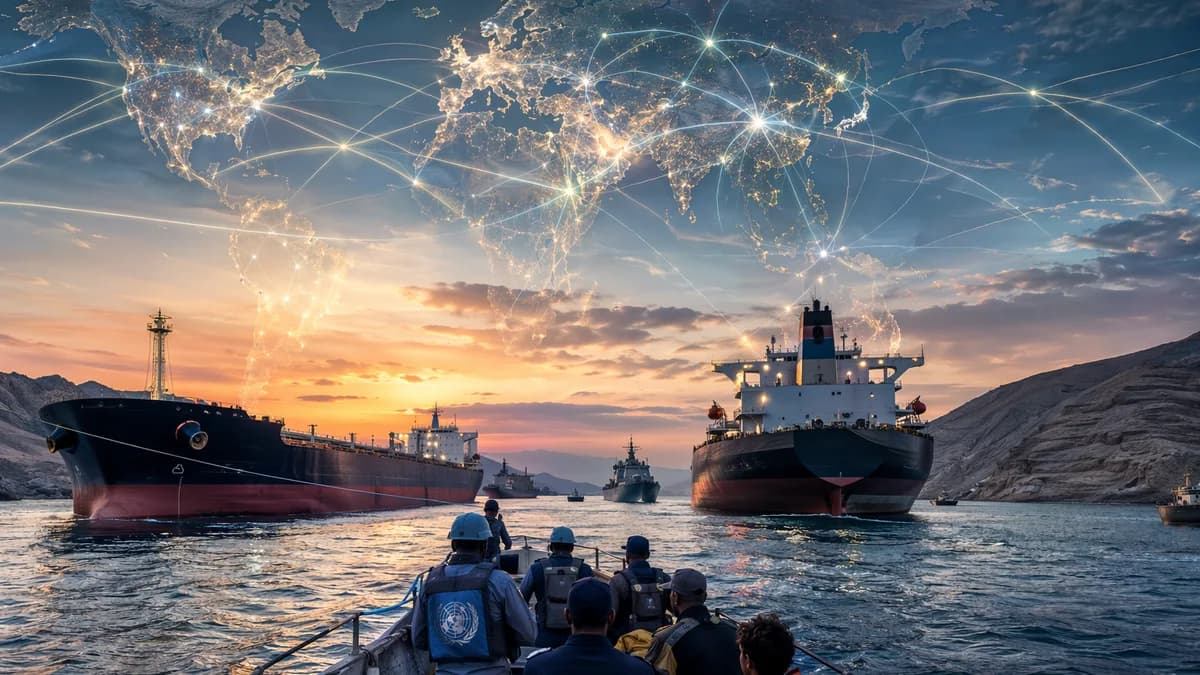
More than 11,000 sailors are stranded in the Gulf, and the UN now has to organize their exit through the same Strait of Hormuz that Iran has been accused of trying to turn into a toll gate. That is the real signal beneath the headline: a humanitarian evacuation has become a test of who controls access to a chokepoint that can move oil prices, cargo schedules, and regional diplomacy in a matter of days.
Global TrendsJune 23, 2026· 8 min read· By XOOMAR Insights Team
11,000 Sailors Expose Strait of Hormuz Toll Power Play
Updated on June 24, 2026
XOOMAR Intelligence
Analyst Take
59/ 100
4 sources analyzedLow confidenceTrend10Freshness99Source Trust92Factual Grounding91Signal Cluster20
The International Maritime Organization is preparing a “large-scale operation” to evacuate the seafarers in cooperation with Iran, Oman, the US, other coastal states and the maritime industry, according to BBC World. The operation follows an interim US-Iran deal signed last week, but the same reporting shows the deal is already under strain over nuclear inspections, missile capabilities, and now Strait of Hormuz tolls.
Iran's Strait of Hormuz toll threat turns stranded sailors into geopolitical leverage
The evacuation is not just a shipping story. It shows how quickly civilian mariners can become trapped inside state-level bargaining.
IMO secretary-general Arsenio Dominguez said the agency had “secured the necessary safety guarantees” and verified conditions for safe navigation. That matters because the evacuation depends on the strait staying open long enough for hundreds of vessels and crews to move out in a controlled way.
“We have secured the necessary safety guarantees and have thoroughly verified the conditions for safe navigation to support these operations,” Dominguez said.
Marco Rubio, arriving in the UAE at the start of a Gulf tour that will also include Kuwait and Bahrain, framed the toll issue as a hard legal boundary for Washington.
“It's an international waterway. No country is allowed to charge tolls or fees on an international waterway. That's existing international law,” Rubio said.
XOOMAR analysis: Rubio’s warning is aimed at more than Iran. If a state can close a chokepoint during a conflict and then reopen it under a fee structure, the move starts to look less like security management and more like monetized control. That is why Strait of Hormuz tolls matter even before any formal toll system exists.
For related XOOMAR context on how the dispute moved into a negotiation window, see Vance Iran Talks Push Hormuz Deal Onto a 60-Day Clock, Trump Toll Threat Jolts Strait of Hormuz Iran Talks, and Congress’s Iran war powers measure.
The Hormuz numbers show a partial reopening, not a return to normal
The available data points to recovery, but not normalization.
After February 28, when attacks against Iran first began, Iran effectively closed the strait, according to the BBC. That pushed Brent crude oil above $100 (£75) a barrel and choked off shipments of energy and commodities including fertiliser.
Since the interim deal, traffic has resumed. But the gap remains large:
| Metric | Source-reported figure |
|---|---|
| Sailors stranded in the Gulf | More than 11,000 |
| Vessels through reopened Strait of Hormuz so far | At least 172 |
| Ships through on Saturday | 42 |
| Pre-conflict average crossings | Some 138 each day |
| Tankers apparently waiting inside the strait on Tuesday | More than 200 |
| Reference point after deal | 18 June, the day after the deal was signed |
The source material does not provide a quantified share of global oil or LNG flows through Hormuz, so the safer conclusion is narrower: the disruption was large enough to push Brent above $100 (£75) and slow shipments of energy and fertiliser. That is sufficient to show why markets react sharply to Hormuz risk without adding outside estimates.
The human number is harder to trade around. More than 11,000 seafarers are not abstractions in an oil chart. They are workers stuck between military escalation, diplomatic ambiguity, and maritime safety planning.
Rubio's warning against Hormuz tolls rests on a bigger fight over maritime law
Rubio’s line was simple: Iran cannot charge ships to pass through an international waterway.
That statement turns the dispute into a test of freedom of navigation. The US position, as Rubio stated it, is that Strait of Hormuz tolls would violate existing international law. Iran’s reported push to charge ships, by contrast, would imply a right to treat passage as something closer to a controlled service.
There is a narrower maritime issue too. Oman’s notice to mariners, provided by the IMO, says two temporary routes through the strait could be used, with vessels contacted individually for instructions. Reuters, via U.S. News, reported that Oman’s defence ministry said the Traffic Separation Scheme was “not safe for use at this time.” That scheme is the routing system that organizes vessel lanes through the strait.
XOOMAR analysis: temporary routing is a safety tool. A toll regime would be different. It would attach a price or fee condition to passage, which is why Washington is drawing the line publicly rather than treating this as a technical shipping matter.
Iran’s broader posture is not conciliatory. President Masoud Pezeshkian said in Pakistan that Iran “will never negotiate with anyone, under any circumstances, ever, about our defensive capabilities”. He added that without Iran’s missiles, Israel and the US would have “ploughed Iran just like Gaza”.
Sailors, shipowners, Gulf capitals, and Washington face different Hormuz risks
The same crisis looks different depending on where you sit.
| Stakeholder | Immediate concern | Source-grounded pressure point |
|---|---|---|
| Sailors | Safe exit from the Gulf | IMO says vessels will be contacted individually and moved through temporary routes |
| Shipowners and operators | Vessel movement, crew safety, cargo timing | More than 200 tankers appeared to be waiting inside the strait Tuesday |
| Gulf governments | Keeping passage open without widening the conflict | Rubio is visiting the UAE, Kuwait and Bahrain to discuss the Tehran deal |
| Iran | Preserving leverage after the interim deal | Tehran disputes parts of the US account on inspections and rejects talks on missiles |
| Washington | Blocking fees while defending the deal framework | Rubio says no country can impose tolls or fees on the strait |
The IMO is trying to separate evacuation from strategic bargaining. That will be difficult. Dominguez called the plan “a decisive step towards restoring maritime security and bringing to an end the unacceptable attacks against civilian shipping”.
The phrase “civilian shipping” is doing heavy work. It signals that the evacuation is not only about moving ships. It is about re-establishing a boundary between military pressure and commercial passage.
From February's closure to today's toll threat, Hormuz has shifted from disruption to control
The supplied record for this episode begins with the effective closure after February 28, not with older Gulf shipping crises. On that record alone, the pattern is clear.
First came closure. Then came an interim deal. Now comes a dispute over whether Iran can charge ships using the strait, while the UN coordinates a phased evacuation under safety guarantees.
That sequence matters. A closure is blunt. It is visible, disruptive, and costly. A toll or fee system could look more administrative, but it would still change the power relationship between coastal authority and international shipping.
XOOMAR analysis: the toll threat is more dangerous as precedent than as a revenue idea. The fee itself is not the core issue in the available reporting. The issue is whether a state under pressure can convert a reopened chokepoint into a conditional passage regime.
The evacuation plan will test the US-Iran deal before nuclear inspections do
The US and Iran are already clashing over the Memorandum of Understanding.
The US says the MoU includes guarantees that Iran’s nuclear weapons programme will come under IAEA inspections. Donald Trump posted Tuesday that Iran had “fully and completely agreed to highest level Nuclear inspections long into the future (Infinity!!!). This will insure 'Nuclear Honesty.'”
Iran’s position is different. Shortly before Trump’s post, Iran said the UN watchdog would not be able to inspect nuclear sites bombed by the US and Israel last year. A US official responded that “the Iranians have agreed to robust IAEA inspections of the remains of their nuclear weapons programme” and said Tehran would say what it needed to say for its domestic audience.
That disagreement makes the maritime issue more fragile. If the parties cannot agree on what the MoU means for inspections, they may also clash over what it means for passage, safety guarantees, and control of the strait.
No formal Hormuz tolls are visible yet, but the cost of trust is rising
The next test is practical, not rhetorical.
If the IMO’s daily reports show ships leaving safely, if the temporary routes work, and if the number of waiting tankers falls, the evacuation will strengthen the argument that the strait can reopen without a wider maritime bargain. That would weaken Iran’s leverage around Strait of Hormuz tolls.
If vessels remain stuck, if Iran keeps pressing fees, or if Washington and Tehran continue issuing incompatible versions of the MoU, the opposite signal takes hold. The strait may stay technically open, but every voyage through it becomes harder to price, insure, schedule, and defend diplomatically.
For now, the most grounded view is this: the Strait of Hormuz is reopening, but not yet normal. The sailors are the urgent case. The toll dispute is the precedent everyone else is watching.
Impact Analysis
- More than 11,000 sailors are stranded, turning a maritime disruption into a major humanitarian operation.
- The Strait of Hormuz is a critical global shipping chokepoint, so access disputes can affect oil prices and cargo schedules quickly.
- Rubio’s warning signals that Washington sees any toll attempt as a violation of international law and a test of regional control.
Key actors in the Strait of Hormuz evacuation dispute
| Actor | Role | Position or action |
|---|---|---|
| International Maritime Organization | Evacuation coordinator | Preparing a large-scale operation after securing safety guarantees for navigation |
| Iran | Coastal state and negotiating party | Accused of trying to impose tolls on Strait of Hormuz transit |
| United States | Diplomatic and legal challenger | Marco Rubio warned that international waterways cannot be subject to tolls or fees |
| Oman, UAE, Kuwait and Bahrain | Regional stakeholders | Part of the broader Gulf diplomacy surrounding the evacuation and maritime access |
Sources

Written by
XOOMAR Insights Team
Research and Editorial Desk
The XOOMAR Insights Team pairs automated research with human editorial judgment. We track hundreds of sources across technology, fintech, trading, SaaS, and cybersecurity, cross-check the facts, and explain what happened, why it matters, and what to watch next. We do not just rewrite headlines. Every article is fact-checked and scored for reliability before it goes live, and we link back to the original sources so you can verify anything yourself.
Explore More Topics
Related Articles
 Global Trends
Iran Seizes Control Over Strait of Hormuz Via Secret Oman Deal
Iran formalized a temporary shipping route with Oman, cementing Tehran's administrative control over the Strait of Hormuz while keeping blame for insecurity on
Aug 5, 20266 min
 Global Trends
Oil Plunges 2% on Secret Iran Peace Deal Hints
Crude oil prices dropped 2% on unconfirmed reports that a ceasefire deal between the U.S. and Iran could reopen the Strait of Hormuz, despite ongoing attacks on
Aug 10, 20267 min
 Global Trends
Trump Iran Talks Turn Paused U.S. Strike Into Leverage
Trump paused U.S. strikes to force Iran back to talks, but the threat could deepen the Hormuz and nuclear standoff.
Aug 3, 20267 min
 Global Trends
Saudi Oil Tanker Hit, Exposing World's Backup Supply Routes
A reported Houthi missile strike on a Saudi Aramco tanker near the Red Sea port of Yanbu has shattered the global oil market's primary contingency plan, proving
Aug 9, 20266 min
 Global Trends
Mideast Powers Forge Pact Echoing NATO Mutual Defense
Saudi Arabia, Turkey, and Pakistan signed a pact vowing mutual defense like Article 5 of NATO, forming a Sunni bloc with a nuclear deterrent during a war with I
Aug 7, 20265 min
 Trading
Strait of Hormuz Shutdown Lifts Oil Prices 6%
WTI crude oil jumped over 6% after Iran confirmed talks on shipping routes don't mean the Strait of Hormuz will reopen, setting the stage for a prolonged geopol
Aug 10, 20268 min
 Trading
Sterling Slips as Hormuz Fears Prompt Safe-Haven Dollar Rush
The British Pound fell from recent highs because rising tensions in the Middle East, centered on the Strait of Hormuz, triggered a classic flight to the safety
Aug 10, 20266 min
 Trading
Stocks Ignore Record Job Losses as Fed Pledge Trumps Payrolls
The Dow Jones Industrial Average showed no fear after July's shocking job losses, as investors bet weak labor data will keep the Federal Reserve from raising ra
Aug 10, 20266 min
 Fintech
RBA Rate Hike Collapses to 4% as Inflation Falters
The Reserve Bank of Australia's implied probability of an August rate hike collapsed from over 20% to just 4% after softer inflation data, forcing a dramatic po
Aug 11, 20266 min
 Fintech
Malls That Throw Block Parties Lure Record Retailer Sales
Simon Property Group's malls posted a 13.9% jump in retailer sales, fueled by turning their properties into event hubs like the massive National Outlet Shopping
Aug 11, 20265 min
Don't miss the signal
Get our weekly roundup of the stories that matter across tech, fintech, and trading. No noise, just signal.
Free forever. No spam. Unsubscribe anytime.