
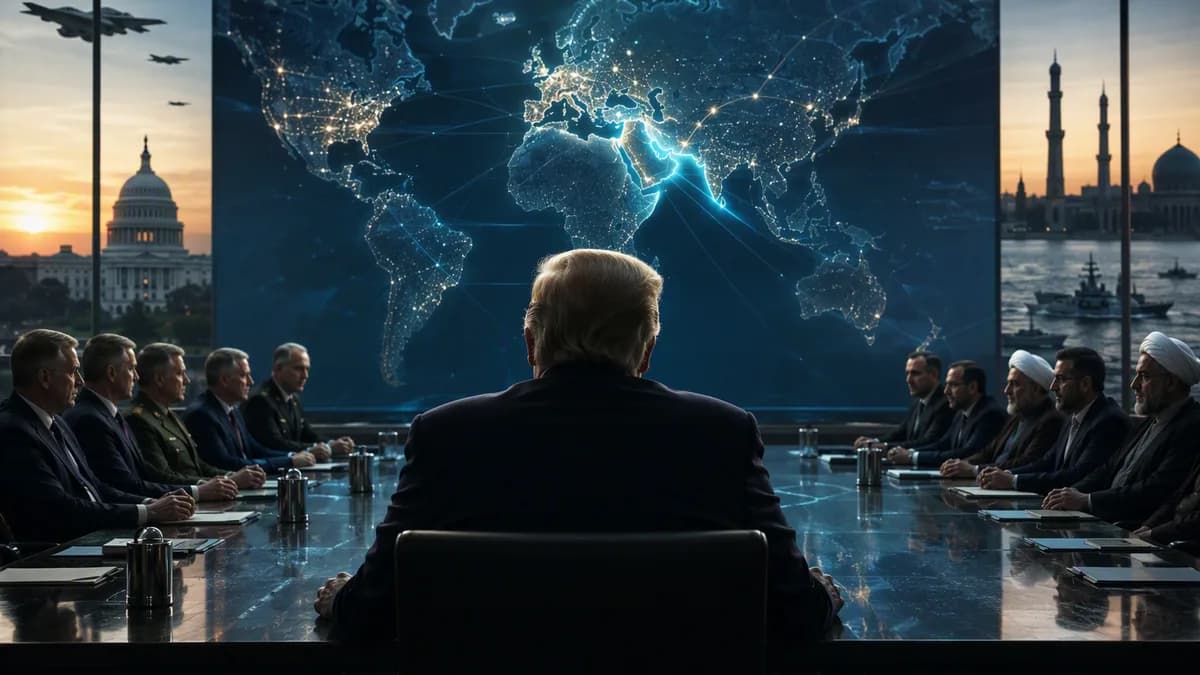
Trump Iran talks are set to begin Monday afternoon because President Donald Trump says he paused what he described as a potentially historic U.S. attack to test whether Tehran will bargain over the Strait of Hormuz and its nuclear program.
Global TrendsAugust 3, 2026· 7 min read· By XOOMAR Insights Team
Trump Iran Talks Turn Paused U.S. Strike Into Leverage
Updated on August 3, 2026
XOOMAR Intelligence
Analyst Take
80/ 100
4 sources analyzedLow confidenceTrend30Freshness93Source Trust85Factual Grounding91Signal Cluster100
Trump told reporters aboard Air Force One that the United States is “holding” a “massive attack” but can launch it “anytime we want,” according to NBC World. That is not de-escalation in the clean sense. It is coercive diplomacy under a live military trigger.
“We’re ready to go anytime we want. Would I rather make a deal? I’m not looking to kill people,” Trump told reporters.
The problem for Washington is simple: a paused strike creates pressure only if the diplomatic ask is clear enough for Iran to answer. If the demands are too broad, or if either side uses the talks mainly to buy time, Monday becomes another stop in the same cycle of threats, pauses, and renewed strikes.
Trump turns aborted Iran strikes into a high-risk bargaining chip
Trump said earlier that he agreed to call off the attacks amid what he called the “perimeters of a deal,” including resumed shipping through the key global trade route and talks on Tehran’s nuclear program. He also claimed the canceled strikes would have been “the biggest attack since World War II.”
That phrasing matters. Trump is trying to present restraint as strength, not retreat. The message to Tehran is that the U.S. can still escalate at will, but would prefer a deal if Iran moves on Hormuz and nuclear terms.
XOOMAR analysis: this works only if the White House can keep the threat credible without making diplomacy look like surrender under fire. The source record shows a pattern of Trump threatening major attacks, citing diplomatic progress, then watching talks collapse as both sides return to tit-for-tat strikes. That pattern weakens every new pause unless Monday produces concrete movement.
This follows XOOMAR’s earlier read on how Trump had already shelved Iran strikes unless a deal lands fast. The new talks test whether that pause was tactical discipline or another temporary delay before escalation resumes.
The Strait of Hormuz raises the stakes far beyond Washington and Tehran
The Strait of Hormuz sits at the center of the talks because Iran has attacked shipping and insisted vessels use pre-approved routes through the waterway, according to the supplied NBC reporting. The U.S. and world powers reject Tehran’s effort to control passage and charge a toll.
That turns a bilateral war into a global oil-market risk. The source material does not provide daily barrel volumes through Hormuz, so any precise oil-flow figure would go beyond the record here. But the reporting does identify Hormuz as a crucial route for global energy supplies and a key global trade route.
Markets reacted before any final agreement. AFP reporting included in the supplied material said West Texas Intermediate fell 4.7 percent to $80.72 per barrel at the opening of Asian trade after Trump announced the new negotiations. That move shows how quickly traders price the possibility of reduced conflict risk, even before Iran publicly responds.
For readers tracking the market angle, XOOMAR’s related coverage of oil-market moves as U.S.-Iran talks restart fits the same pressure point: Hormuz risk is being repriced in real time.
The numbers behind an Iran deal are still missing where they matter most
The hard data in the supplied reporting is thin but important.
| Issue | Source-supported detail | Why it matters |
|---|---|---|
| Talk timing | Monday afternoon | Creates a short window between paused strikes and diplomatic test |
| Oil reaction | WTI down 4.7 percent to $80.72 in Asian trade | Markets treated talks as a de-risking signal |
| War duration | Entering its sixth month | Shows diplomacy is operating inside a prolonged conflict, not a fresh crisis |
| Ceasefire history | June memorandum, ceasefire declared “over” in early July | Prior process failed to hold |
| Maritime risk | Kpler said traffic through Hormuz had dropped sharply | Shipping behavior already reflects danger |
The nuclear side is less defined. Trump said the talks would cover Tehran’s nuclear program and, according to AFP material, ultimately the denuclearization of Iran. Western nations accuse Iran of seeking a bomb, while Tehran insists its program is entirely civilian.
But the sources do not specify enrichment levels, stockpile limits, inspection access, or breakout-time benchmarks. That absence is not a detail. It is the negotiation.
XOOMAR analysis: a Hormuz arrangement may be easier to shape quickly than a nuclear framework. Routes, tolls, and shipping access can be tested by observable vessel movement. Nuclear concessions require verification, sequencing, and trust between governments that have repeatedly watched pauses break down.
Iran, the White House, Gulf states, and oil markets all want different things from Monday’s talks
The White House wants to convert a canceled strike into visible concessions. Trump can argue he used military pressure to force talks. If talks fail, critics can frame the same move as a bluff or an escalation threat without an executable political endgame.
Iran has not publicly responded to Trump’s NBC-reported comments about new talks. AFP material says Iranian media denied that Tehran asked Trump not to strike. That distinction matters because Iran will not want to appear as if it entered talks under U.S. coercion.
Regional diplomacy is active. Iranian Foreign Minister Abbas Araghchi spoke with Saudi counterpart Prince Faisal bin Farhan and Pakistan’s army chief Asim Munir, according to Iran’s state media cited in the NBC material. Saudi Crown Prince Mohammed bin Salman spoke with Trump by phone Saturday and, according to the Saudi state news agency, said dialogue was needed to de-escalate tensions and raised concerns over plans for new strikes.
Stakeholder goals are not aligned:
- Trump: A fast negotiation that validates restraint and keeps military pressure alive.
- Iran: A deal that protects its claimed rights in Hormuz and avoids looking pressured.
- Saudi Arabia: De-escalation through dialogue, based on the reported call.
- Oil markets: Evidence that shipping risk is easing, not just softer rhetoric.
- Shipping firms: Practical route clarity, especially after reports of reduced Hormuz traffic and a tanker hearing an explosion near Oman.
From the June memorandum to Monday’s table, the same failure keeps returning
The supplied sources do not support a full comparison to the 2015 nuclear agreement, U.S. withdrawal, or later sanctions cycles, so this analysis should not pretend otherwise. The confirmed diplomatic chain here is narrower and more immediate.
There was a brief reprieve in June, when the two sides signed a memorandum of understanding outlining a process for talks to end the war. In early July, Trump declared the ceasefire “over,” and the countries resumed strikes.
That is the relevant precedent for Monday. The issue is not whether the sides can announce a process. They already did. The issue is whether a process can survive the first tactical disagreement over Hormuz routes, nuclear language, or military positioning.
Iran and Oman have also been discussing the strait’s future. Iranian foreign ministry spokesman Esmaeil Baqaei said a route acceptable to both sides was close, but also said such an understanding would not mean reopening the strait. That leaves a major gap between route talks and full commercial normalization.
A Monday breakthrough would reset energy risk, but only evidence will count
A narrow deal could start with Hormuz: agreed routes, reduced attacks on shipping, and a halt to new U.S. strikes while talks continue. A weaker outcome would be another pause with vague language and no proof that vessel traffic is recovering. A breakdown would likely return attention to Trump’s warning that the U.S. can strike “anytime we want.”
The strongest confirmation of progress would be practical, not theatrical:
- Shipping: Clear evidence that vessels can move through Hormuz without Iranian pre-approved routing becoming the new normal.
- Diplomacy: Public acknowledgment from both sides that Monday’s talks are happening, with named participants or mediators.
- Energy: Continued easing in oil risk pricing after the initial WTI drop.
- Security: No new cycle of tit-for-tat strikes after the talks begin.
The weakest signal would be another round of competing claims: Washington saying a deal is close, Tehran denying pressure, and Gulf shipping still operating under threat. That would mean the strike pause bought time, but not control.
The Stakes
- The Strait of Hormuz is a key global trade route, so renewed conflict could disrupt shipping and energy markets.
- Trump’s pause keeps diplomacy alive but leaves a major U.S. strike as an active threat.
- Monday’s talks will test whether coercive pressure can produce a deal or simply restart the cycle of threats and retaliation.
U.S. Options on Iran
| Approach | What It Signals | Main Risk |
|---|---|---|
| Paused military strike | The U.S. can still escalate quickly | Threat loses credibility if talks stall again |
| Negotiated deal | Washington prefers movement on Hormuz and nuclear issues | Iran may use talks to buy time or reject broad demands |
Sources

Written by
XOOMAR Insights Team
Research and Editorial Desk
The XOOMAR Insights Team pairs automated research with human editorial judgment. We track hundreds of sources across technology, fintech, trading, SaaS, and cybersecurity, cross-check the facts, and explain what happened, why it matters, and what to watch next. We do not just rewrite headlines. Every article is fact-checked and scored for reliability before it goes live, and we link back to the original sources so you can verify anything yourself.
Explore More Topics
Related Articles
 Global Trends
Trump Shelves Iran Strikes Unless a Deal Lands Fast
Trump says Iran strikes are shelved only if a rapid deal opens Hormuz and ends the nuclear threat. The pressure hasn't vanished.
Aug 2, 20265 min
 Global Trends
US-Escorted Tankers Hit as Strait of Hormuz Shuts Down
Iran says it struck two US-escorted tankers, nearly closing Hormuz and forcing Trump to weigh war strategy as energy prices jump.
Jul 31, 20267 min
 Global Trends
Houthi Attacks Turn Saudi Oil Escape Route Into Trap
Houthi attacks are squeezing Saudi Arabia’s Red Sea oil route just as Hormuz falters, raising the risk of wider supply shocks.
Jul 26, 20268 min
 Global Trends
Oil Shock Exposes Germany Energy Drag Behind Ifo Jump
Germany’s Ifo jump may be stale. Commerzbank sees oil costs capping 2026 growth at just 0.6%.
Jul 28, 20267 min
 Global Trends
Bread and Fear Push Iran Internal Crises to the Brink
Iran’s war narrative is cracking as inflation, executions and public defiance turn daily life into Tehran’s most dangerous front.
Jul 30, 202611 min
 Trading
8% Wipeout Crushes WTI Crude Oil on Iran Deal Hopes
WTI crude oil slid nearly 8% as Iran deal hopes cut the war premium and dragged Hormuz risk back into focus.
Aug 3, 20266 min
 Trading
Chip Sell-Off Cracks Dow Jones Industrial Average Rally
The Dow rallied on ceasefire hopes, then faded as China-linked chip selling stole the tape.
Aug 2, 20267 min
 Trading
Oil Rout Grips Forex Today as US-Iran Talks Restart
WTI plunged more than 8% as renewed US-Iran talks crushed the oil risk premium and lifted risk appetite.
Aug 3, 20267 min
 Trading
US Help Turns Japanese Yen Intervention Into Bear Trap
US help makes yen intervention harder to fade, but the Fed-BoJ rate gap still gives USD/JPY bulls a macro lifeline.
Aug 3, 20268 min
 Fintech
Transaction Data Crowns the B2B Payments AI Winners
Boost's Dean Leavitt says B2B payments AI will hinge on transaction data, not chatbot polish.
Aug 3, 20268 min
Don't miss the signal
Get our weekly roundup of the stories that matter across tech, fintech, and trading. No noise, just signal.
Free forever. No spam. Unsubscribe anytime.