
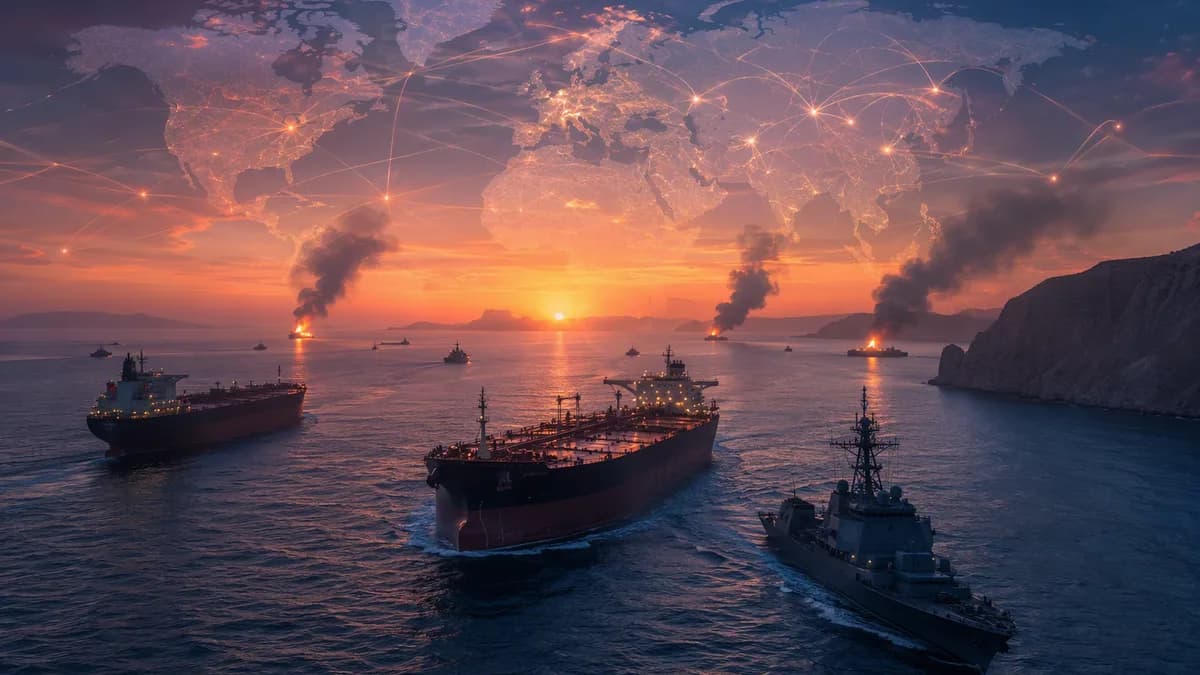
Two tankers trying to cross the Strait of Hormuz under US military escort were struck on Friday, Iran’s Revolutionary Guard said, turning one of the world’s most important energy chokepoints into the immediate test for Donald Trump’s war strategy.
Global TrendsJuly 31, 2026· 7 min read· By XOOMAR Insights Team
US-Escorted Tankers Hit as Strait of Hormuz Shuts Down
Updated on July 31, 2026
XOOMAR Intelligence
Analyst Take
71/ 100
4 sources analyzedMedium confidenceTrend10Freshness95Source Trust90Factual Grounding94Signal Cluster40
The Strait of Hormuz tanker strikes came as Donald Trump headed to Camp David with his cabinet to discuss the war, rising prices and the political fallout before US midterm elections, according to Guardian World. The report said fighting between the US and Iran resumed two weeks ago, leaving the strait “almost completely closed to traffic” and pushing energy prices higher.
Two US-escorted tankers hit as Hormuz traffic is almost shut
Iran’s Islamic Revolutionary Guard Corps said Friday that it hit two tankers attempting to move through the strait under a US military “aerial escort.” The IRGC said the ships used an “undeclared route.”
The “non-compliant oil tankers … were struck and brought to a halt, while four other oil tankers quickly changed course and returned to their previous positions”.
The supplied reports do not identify the two tankers, their flags, operators, cargoes or crew conditions. There is also no independent damage assessment in the source material, and no confirmed casualty report tied directly to the two tanker strikes.
That matters because the first hours after a Hormuz attack are often dominated by competing claims. Here, the core confirmed fact is narrower: Iran says it struck the tankers, and the Guardian reports the claim in the context of a nearly closed strait and renewed US-Iran fighting.
A related CBS live update said Iran’s Persian Gulf Strait Authority declared transit through the Strait of Hormuz “not possible” because of “aggressive actions” by US military forces in the region. CBS also reported that US Central Command said Thursday it had redirected 24 commercial vessels since restarting a blockade on Iranian ports earlier this month.
| Actor | Route or enforcement claim in supplied reports | Reported action |
|---|---|---|
| Iran | Ships should not use what it calls undeclared or non-compliant routes | Iran says it struck two tankers and turned four others back |
| United States | Ships are operating under US protection, while Washington enforces a blockade on Iranian ships and ports | US has struck Iran in retaliation and redirected commercial vessels |
| Commercial shipping | Traffic through Hormuz has almost stopped | Tankers are changing course, being halted or facing attack claims |
XOOMAR analysis: The central escalation isn’t only that two tankers were hit. It’s that Iran and the US are trying to enforce rival rules over the same narrow waterway. That turns each ship movement into a potential military test.
For more on how the war is feeding pressure inside Iran, see XOOMAR’s earlier coverage, Bread and Fear Push Iran Internal Crises to the Brink.
$90 crude and a one-fifth energy chokepoint put prices back at center of the war
The Strait of Hormuz is the market pressure point because of scale. CBS, citing the Associated Press, said the waterway previously served as a delivery route for a fifth of the world’s oil and natural gas.
The Guardian reported that crude oil pushed past $90 a barrel on Thursday after the US struck Iran in retaliation for attacks on US bases in Jordan. CBS reported that Brent crude had risen from about $70 to above $100 a barrel for much of March, April and May, reaching $126 at one point.
The price shock is already visible in corporate earnings. CBS reported that Exxon Mobil posted $14.53 billion in second-quarter profit, up 105% from a year earlier, while Chevron reported $12.07 billion, up 385%.
“There are constituencies around the world who are having a very good crisis, and the oil producers are one of them,” said Patrick Galey, fossil fuels lead at Global Witness.
The consumer side is uglier. The Guardian said gas and grocery prices remain high in the US because of the energy disruption, complicating Republican prospects in November’s midterm elections. CBS reported that gasoline, diesel and jet fuel prices climbed during the April to June period, raising costs for drivers and airline passengers.
Market pressure points now include:
- Crude supply: Hormuz traffic has been largely halted in the supplied reports.
- Fuel costs: Higher crude and refined fuel prices are hitting consumers and transport.
- Corporate profits: Major oil companies are reporting sharply higher earnings.
- Political inflation: The war’s price effects are now part of the US midterm fight.
The energy shock is also part of a broader economic drag outside the Gulf. XOOMAR has tracked that pressure in Oil Shock Exposes Germany Energy Drag Behind Ifo Jump, where higher energy costs became a constraint on industrial sentiment.
Kuwait drones and Lebanon blast show the conflict spreading beyond Hormuz
The Hormuz tanker strikes landed in a wider regional escalation. The Kuwaiti defence ministry said Friday it had shot down Iranian drones targeting “vital and military facilities” and reported no casualties.
CBS reported that Iran also claimed drone strikes at US military facilities at Ahmad al-Jaber Air Base in southern Kuwait. CBS said there was no immediate comment from US Central Command.
In Lebanon, the Guardian reported that the Israeli military carried out a large overnight detonation near Beaufort Castle, saying it targeted Hezbollah tunnels and infrastructure. Lebanese officials accused Israel of violating the ceasefire, while Israel said it was acting to secure its northern residents.
XOOMAR analysis: The geography is widening. Hormuz is the economic choke point, but Kuwait, Jordan and Lebanon show how quickly the war’s military map is stretching across the region.
Camp David cabinet meeting puts Trump between escalation and the ballot box
Trump gathered his cabinet at Camp David on Friday to discuss what the Guardian called a stalling war and its fallout. The meeting comes after Trump promised the Iran war would last a few weeks, while the Guardian says it has now dragged on for five months.
The White House had framed the retreat in far lighter terms last week. Press secretary Karoline Leavitt said the cabinet meeting would be “a lot of fun and something different for the cabinet to experience together”.
That tone now sits beside a harder political picture. A Reuters-Ipsos poll cited by the Guardian found that one in three Americans support the war, the lowest level since it began. In Congress, the Senate narrowly rejected a war powers resolution asking the president to stop the war, with the measure failing 49-50.
XOOMAR analysis: Based on the actions already described in the supplied reports, the cabinet’s practical menu is likely constrained to a few tracks: more naval and aerial protection for commercial ships, further targeted strikes, tighter enforcement of sanctions or blockade measures, and diplomatic channels through regional intermediaries. Each path carries a price risk if it fails to reopen Hormuz.
The immediate watch item is verification. The next signal should come from the Pentagon, shipping operators, Gulf governments and oil market authorities. Iran’s claim alone doesn’t settle the full picture.
If the US can keep traffic moving through the Strait of Hormuz, markets may treat Friday’s strikes as another severe episode in an already dangerous war. If more tankers are hit or more ships turn back, the story shifts from tanker attacks to a regional shipping shutdown with direct consequences for fuel prices, inflation and Trump’s political margin.
The Stakes
- The Strait of Hormuz is a critical energy chokepoint, so attacks there can quickly affect global oil flows and prices.
- The strikes raise the risk of direct US-Iran escalation because the tankers were reportedly under US military escort.
- Unconfirmed details about ship identities, damage and casualties leave markets and governments reacting to incomplete information.
Tankers affected in Hormuz incident
Struck and halted
tankers2
Changed course
tankers4
Sources

Written by
XOOMAR Insights Team
Research and Editorial Desk
The XOOMAR Insights Team pairs automated research with human editorial judgment. We track hundreds of sources across technology, fintech, trading, SaaS, and cybersecurity, cross-check the facts, and explain what happened, why it matters, and what to watch next. We do not just rewrite headlines. Every article is fact-checked and scored for reliability before it goes live, and we link back to the original sources so you can verify anything yourself.
Explore More Topics
Related Articles
 Global Trends
Saudi Oil Plot Triggers US CENTCOM Strikes in Iraq
CENTCOM hit Iran-backed groups in Iraq over alleged plots against US troops and Saudi oil sites, tightening the fuse on a wider clash.
Jul 29, 20266 min
 Global Trends
Iran Vows Eye-for-Eye Strikes if Trump Hits Tehran
Iran says any US strike on its infrastructure will be met in kind, risking a wider energy crisis around the Strait of Hormuz.
Jul 23, 20266 min
 Global Trends
Houthi Attacks Turn Saudi Oil Escape Route Into Trap
Houthi attacks are squeezing Saudi Arabia’s Red Sea oil route just as Hormuz falters, raising the risk of wider supply shocks.
Jul 26, 20268 min
 Global Trends
Red Sea Tanker Attacks Drag Saudi Oil Into Iran Fight
Two Saudi tankers turned a Houthi claim into a shipping risk, with US strikes on Iran adding pressure on oil routes.
Jul 23, 20267 min
 Global Trends
Houthis Drag Red Sea Tankers Into US-Iran Firestorm
Houthi tanker claims and fresh US strikes on Iran put Red Sea and Hormuz shipping risk back at the heart of the Gulf crisis.
Jul 23, 202610 min
 Fintech
Bitcoin Insurance Trap Lands Iran-Linked Firms on Blacklist
Treasury says Iran-linked firms used Hormuz shipping risks to collect crypto payments, turning maritime insurance into a sanctions case.
Jul 31, 20265 min
 Trading
Oil Shock Pins British Pound Below $1.33 After Iran Threat
WTI ripped higher on Iran war risk, but GBP/USD stayed stuck below $1.33. The calm in sterling looks fragile.
Jul 30, 20265 min
 Trading
Bitcoin Defies Oil Spike as Fed and Iran Rattle Markets
Bitcoin held near $64K as oil surged 8% after Iran strikes and the Fed split hawkish, but the calm looks fragile.
Jul 30, 20266 min
 Global Trends
Hamas Disarmament Plan Forces Gaza’s Hardest Trade
Hamas disarmament offers rare hope for Gaza, but sequencing, trust and enforcement could break the deal fast.
Jul 31, 20268 min
 Fintech
Options Sellers Smother Bitcoin Bull Run Hopes at $63K
Options sellers, AI capital and slow U.S. rules are capping Bitcoin's rally, STS Digital CEO Maxime Seiler says.
Jul 31, 20268 min
Don't miss the signal
Get our weekly roundup of the stories that matter across tech, fintech, and trading. No noise, just signal.
Free forever. No spam. Unsubscribe anytime.