
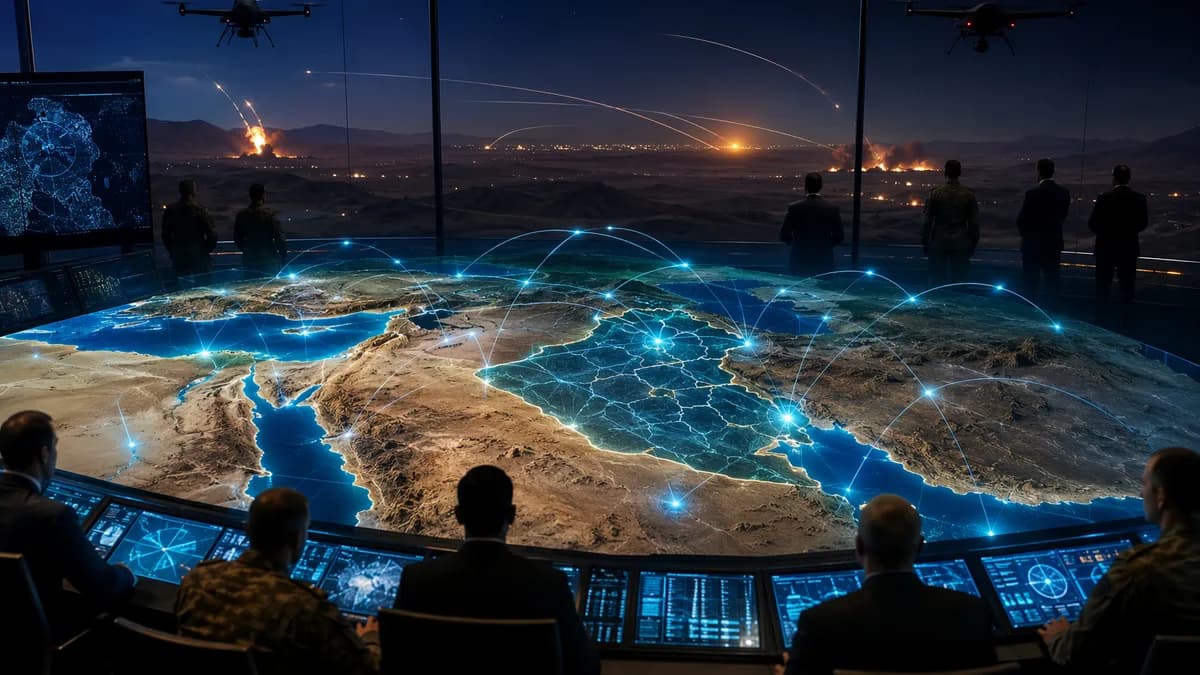
US CENTCOM strikes in Iraq targeted Iran-backed groups that the US says were planning attacks on American forces and Saudi oil facilities, raising the risk that the latest exchange becomes a wider military and oil-market shock. The unanswered question now is whether this was a contained retaliation or the start of a new round of direct strikes inside Iraq.
Global TrendsJuly 29, 2026· 6 min read· By XOOMAR Insights Team
Saudi Oil Plot Triggers US CENTCOM Strikes in Iraq
Updated on July 29, 2026
XOOMAR Intelligence
Analyst Take
58/ 100
3 sources analyzedLow confidenceTrend10Freshness99Source Trust84Factual Grounding94Signal Cluster20
US Central Command said it carried out precision strikes in Iraq against Iran-backed groups, according to FXStreet, which cited CENTCOM’s statement that the groups were planning attacks on US forces and Saudi oil facilities.
Why did US CENTCOM strikes in Iraq hit Iran-backed groups now?
CENTCOM framed the operation as a response to imminent or ongoing threats from Iran-backed groups in Iraq. The targets, according to the supplied source material, were linked to planning attacks on US troops in the Middle East and Saudi energy infrastructure.
The US military also said Iranian Islamic Revolutionary Guard Corps forces launched multiple ballistic missiles from Iran at 5:45 p.m. ET. CENTCOM said all Iranian missiles were effectively intercepted, and that US forces remain on high alert.
That puts two claims on the table at once:
- Iraq strikes: CENTCOM says it hit Iran-backed groups inside Iraq.
- Missile launches: The US says the IRGC fired multiple ballistic missiles from Iran at US troops in the Middle East.
- Air defense result: The US says all Iranian missiles were intercepted.
- Force posture: US forces are staying at high readiness.
Exact target locations, the full casualty picture, and the US assets used in the strikes were not fully detailed in the FXStreet report. Related reporting from the Economic Times said Saudi Arabia’s armed forces, in coordination with CENTCOM, carried out “targeted strikes” against Iran-backed groups in Iraq that Riyadh accused of drone attacks on Saudi oil facilities.
Saudi Arabia’s Defense Ministry confirmed that strikes were coordinated with US Central Command. It said the action was retaliation for drone attacks on oil facilities, while also saying Riyadh had no desire for escalation but would respond to aggression.
How does Iran’s denial complicate the US and Saudi account?
Iran pushed back on the attribution. Iranian state TV reported that a military source denied Iran was involved in projectiles fired from other nations at targets in Saudi Arabia.
The Economic Times, citing Iranian state broadcaster IRIB, reported that an unnamed Iranian military official called attempts to attribute attacks on US interests in the region to Iran a “major miscalculation.”
That denial matters because CENTCOM and Saudi Arabia are describing the strikes as a response to Iran-backed or IRGC-directed activity, while Tehran is rejecting responsibility for at least some attacks tied to Saudi targets.
At the same time, the IRGC said that “three oil tankers were 'struck and stopped' a few hours ago after ignoring warnings in the Strait of Hormuz.” The source material does not provide independent confirmation of that claim, the tankers’ identities, or their condition.
“The IRGC and its terrorist proxies must cease these attacks to avoid further US military response,” CENTCOM said, according to related reporting from Kurdistan 24.
XOOMAR analysis: The competing statements leave a narrow path for de-escalation. CENTCOM and Riyadh are signaling that attacks on US forces and Saudi energy assets will draw military responses. Iran is denying responsibility for some cross-border attacks while the IRGC is making separate claims about tanker actions in the Strait of Hormuz. That mix makes attribution, not just firepower, the key issue.
Why did oil react so sharply to the Iraq strikes?
The market reaction was immediate. WTI, the US oil benchmark, built on its rebound from two-week lows near $77 and was trading up 4% at $81.60, according to FXStreet.
That move reflects the part of the story traders can price quickly: Saudi oil facilities were named in the threat picture, Saudi Arabia confirmed participation in strikes, and the Strait of Hormuz appeared in an IRGC statement about tankers.
For readers tracking the broader energy-risk thread, XOOMAR has covered related oil-market pressure in WTI Oil Price Sinks 7% as U.S.-Iran Pause Tests Bulls and regional shipping vulnerability in Houthi Attacks Turn Saudi Oil Escape Route Into Trap.
The current report does not say Saudi output was disrupted. It does not confirm damage to oil facilities. It also does not verify the IRGC tanker claim. Still, the price action shows traders are treating the threat to energy infrastructure as material before the operational facts are complete.
The immediate read for markets
| Issue | Confirmed in supplied material | Still unclear |
|---|---|---|
| CENTCOM strikes in Iraq | Yes | Exact full target list |
| Saudi coordination | Yes | Scope of Saudi operational role |
| Iranian missile launches | US says yes | Tehran’s full official response |
| Missile interceptions | US says all were intercepted | Independent confirmation |
| WTI reaction | Up 4% at $81.60 | Whether the move holds |
| Oil facility damage | Not confirmed | Any physical impact |
XOOMAR analysis: Oil is reacting less to confirmed damage than to expanding military geography. Iraq, Saudi energy sites, US forces, Iranian missiles, and the Strait of Hormuz are now all inside the same news cycle.
Can Baghdad contain the fallout from strikes on Iraqi soil?
Iraq is now in the most difficult position in this story. The strikes took place on Iraqi territory, while the groups targeted are described as Iran-backed. Baghdad must manage the presence of US-linked military activity, Saudi concerns about attacks launched from Iraq, and powerful Iran-aligned factions operating inside the country.
Related Economic Times reporting said two members of Iraq’s Popular Mobilization Forces were wounded when an air strike targeted the group’s command headquarters in Basra, citing Iraq’s INA news agency. The PMF, also known as Hashd al-Shaabi, is an umbrella group of mostly Shi'ite paramilitary factions that has been formally integrated into Iraq’s state security forces and includes groups aligned with Iran.
The same report said Iraqi Prime Minister Ali al-Zaidi ordered an investigation into the drone attacks, saying Iraq would not allow its territory to be used to launch attacks against neighbors.
That investigation now has more weight. If Baghdad confirms launches from Iraqi territory, pressure rises on Iran-aligned factions. If it disputes the US or Saudi account, the diplomatic strain shifts toward Washington and Riyadh.
Which flashpoint decides whether this stays limited?
The next flashpoint is retaliation. The story turns on whether the targeted groups respond against US bases, diplomatic sites, Saudi energy assets, or regional shipping.
A second test is documentation. Casualty reports, target details, intercepted missile evidence, and any Iraqi government findings will matter more than broad claims from either side.
For now, the practical readout is clear: US CENTCOM strikes in Iraq have moved the confrontation from warning statements to kinetic action, while oil traders are already pricing the risk before the battlefield record is settled. The watch item is whether the next confirmed event is a de-escalatory statement from Baghdad or another launch tied to Iran-backed groups.
The Stakes
- The strikes raise the risk of a broader US-Iran confrontation inside Iraq.
- Threats to Saudi oil facilities could unsettle global energy markets.
- US forces remain on high alert after CENTCOM said Iranian missiles were intercepted.
Sources

Written by
XOOMAR Insights Team
Research and Editorial Desk
The XOOMAR Insights Team pairs automated research with human editorial judgment. We track hundreds of sources across technology, fintech, trading, SaaS, and cybersecurity, cross-check the facts, and explain what happened, why it matters, and what to watch next. We do not just rewrite headlines. Every article is fact-checked and scored for reliability before it goes live, and we link back to the original sources so you can verify anything yourself.
Explore More Topics
Related Articles
 Global Trends
Red Sea Tanker Attacks Drag Saudi Oil Into Iran Fight
Two Saudi tankers turned a Houthi claim into a shipping risk, with US strikes on Iran adding pressure on oil routes.
Jul 23, 20267 min
 Global Trends
Houthi Attacks Turn Saudi Oil Escape Route Into Trap
Houthi attacks are squeezing Saudi Arabia’s Red Sea oil route just as Hormuz falters, raising the risk of wider supply shocks.
Jul 26, 20268 min
 Global Trends
Saudi Arabia Uranium Enrichment Puts Trump in a Bind
A new U.S.-Saudi nuclear pact could open the door to Saudi uranium enrichment, complicating Trump's hard line on Iran.
Jul 22, 20267 min
 Global Trends
Iran Vows Eye-for-Eye Strikes if Trump Hits Tehran
Iran says any US strike on its infrastructure will be met in kind, risking a wider energy crisis around the Strait of Hormuz.
Jul 23, 20266 min
 Global Trends
Houthi Maritime Embargo Throws Saudi Oil Route in Doubt
Houthis say Saudi ships are barred from Bab al-Mandab, putting a key oil route under new strain.
Jul 20, 20266 min
 Trading
Safe-Haven Premium Cracks as Silver Price Slides Before Fed
Silver fell near $57.55 as geopolitical fear cooled, but the Fed decision and a stronger dollar keep XAG/USD exposed.
Jul 28, 20266 min
 Trading
Oil Shock Traps Gold Price Near $4,000 Before Fed Decision
Gold is pinned near $4,020 as Middle East risk supports haven demand, but Fed hike pricing keeps buyers from chasing the rally.
Jul 29, 20267 min
 Trading
War Risk Bet Unwinds as Brent Crude Crashes 8.7% in a Day
Brent crude’s 8.7% plunge shows traders dumping war-risk premium, not proof that Gulf energy flows are out of danger.
Jul 28, 20265 min
 Global Trends
Jalen Carter Contract Shakes NFL DT Market at $152M
Philadelphia made Jalen Carter the NFL's top-paid defensive tackle before his peak, turning a projection bet into the market benchmark.
Jul 29, 20268 min
 Cybersecurity
FCC Robot Inverter Ban Locks Foreign Tech Out of U.S.
The FCC blocked new foreign-made mobile robots and connected power inverters from U.S. approval over national security risks.
Jul 29, 20266 min
Don't miss the signal
Get our weekly roundup of the stories that matter across tech, fintech, and trading. No noise, just signal.
Free forever. No spam. Unsubscribe anytime.