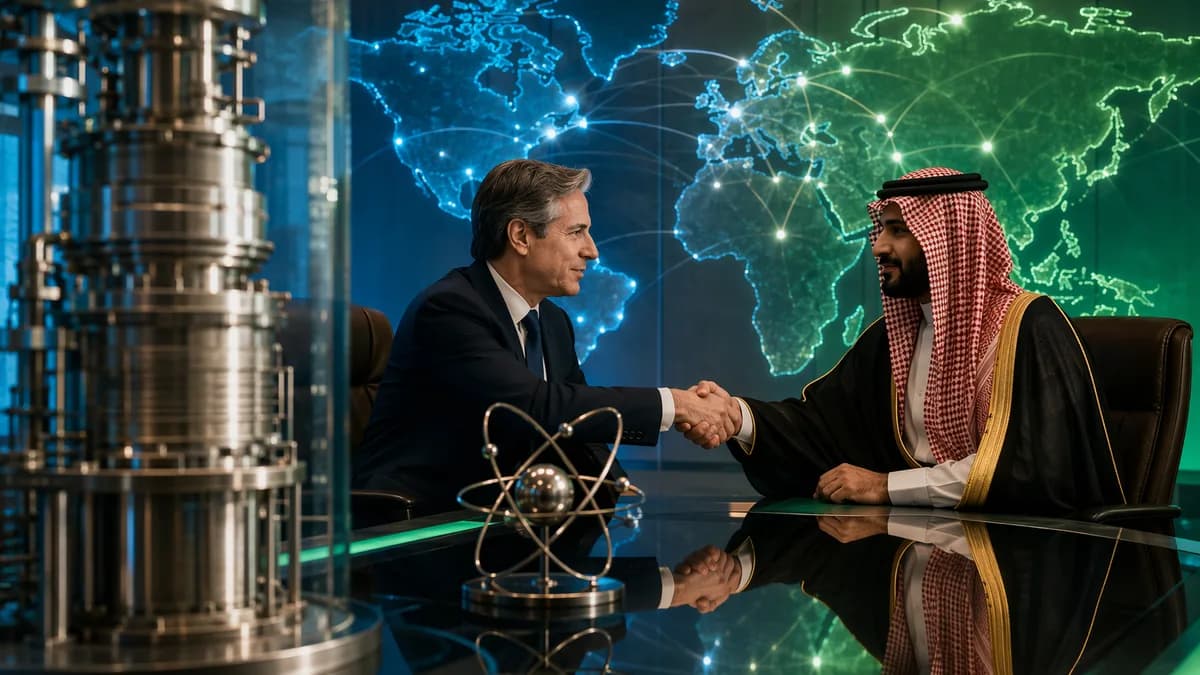
While the U.S. and Israel are fighting Iran in part to wipe out Tehran’s ability to develop a nuclear weapon, the Trump administration has signed a new nuclear pact that could eventually let Saudi Arabia pursue uranium enrichment for a civilian program.
XOOMAR Intelligence
Analyst Take
The agreement, signed Wednesday by U.S. Energy Secretary Chris Wright and Saudi Energy Minister Abdulaziz bin Salman, is a nuclear cooperation pact known as a 123 agreement, paired with what the administration called a “bilateral safeguards agreement,” according to Independent World.
US and Saudi Arabia sign nuclear pact as Saudi Arabia uranium enrichment moves onto the table
The administration released few details. But the framework could clear a path for building a uranium enrichment facility in Saudi Arabia after a joint U.S.-Saudi study, according to people familiar with the matter who spoke on condition of anonymity because they weren’t authorized to comment publicly.
That makes the deal politically explosive. Saudi Arabia uranium enrichment has long been one of the hardest issues in U.S.-Saudi nuclear talks because enrichment can produce fuel for reactors, but it can also move a state closer to the material base needed for a weapons program if safeguards fail.
Wright framed the agreement as a commercial and security win.
“These agreements reflect our two nations’ shared commitment to strengthening U.S.-Saudi commercial relations, delivering prosperity at home and security to our allies abroad,” Wright said. “Rest assured, these agreements uphold the highest standards of nuclear safety and nonproliferation, while relying on the world’s best nuclear technology and scientists, designed right here in the United States.”
Secretary of State Marco Rubio, speaking while traveling in the Philippines, pushed back against early criticism.
“The U.S. is not going to reach any agreement with any country in the world that leads to the risk of proliferation,” Rubio said.
The problem for the administration is that the deal does not include the International Atomic Energy Agency’s Additional Protocol, according to one person familiar with the decision. That protocol would allow more monitoring, inspections and verification.
The pact is expected to last 30 years and involve U.S. firms in developing Saudi Arabia’s nuclear program. The Energy Department said it will submit the agreement to Congress, where it could run into opposition.
Saudi Arabia uranium enrichment breaks with the UAE model Washington once praised
The sharpest contrast is with the United Arab Emirates, Saudi Arabia’s neighbor. The UAE signed a 123 agreement with the U.S. for its Barakah nuclear power plant, built with South Korean assistance, but did not seek enrichment. Nonproliferation experts have described that as the “gold standard” for countries pursuing civilian nuclear power.
Saudi Arabia is pushing for something more sensitive.
| Issue | UAE nuclear deal | Saudi nuclear deal |
|---|---|---|
| Enrichment | Did not seek enrichment | Could pave way for Saudi enrichment after a joint study |
| U.S. role | 123 agreement supported civilian power | 123 agreement plus bilateral safeguards agreement |
| Oversight concern | Held up by experts as “gold standard” | Does not include IAEA Additional Protocol, according to a person familiar |
| Political risk | Lower proliferation concern in the supplied material | Faces scrutiny in Congress and among nonproliferation experts |
Alexander Bollfrass, a nuclear expert at the International Institute for Strategic Studies in London, called the approach a major departure from the usual nonproliferation posture.
“The revolutionary aspect of this agreement is that the United States is not asking Saudi Arabia to abide by the highest possible safeguards, internationally monitored safeguards that are standard and are available today, but instead is willing to at least theoretically transfer highly sensitive technology without the same level of oversight that one would expect,” Bollfrass said.
The regional context is impossible to separate from the deal. The announcement comes during the war against Iran launched by the U.S. and Israel, in part, to wipe out Tehran’s ability to develop a nuclear weapon. Iran says its enrichment program is peaceful.
Saudi Arabia’s de facto leader, Crown Prince Mohammed bin Salman, has suggested the kingdom could pursue a nuclear weapon if Tehran obtains one. That makes Saudi Arabia uranium enrichment more than an energy question. It becomes a test of whether Washington can give Riyadh advanced nuclear capability without weakening the nonproliferation line it has drawn elsewhere.
For readers tracking separate Saudi-linked security headlines, XOOMAR has also covered Tankers Flee Saudi Route After Houthi Shipping Threat and Houthi Maritime Embargo Throws Saudi Oil Route in Doubt. Those stories are not part of this nuclear agreement, but they sit in the same regional risk file policymakers will be reading.
Congress, safeguards, and Westinghouse now decide how far the deal can go
The next fight moves to Capitol Hill. Typically, 123 agreements go into effect unless veto-proof majorities in Congress pass joint resolutions of disapproval. Rubio, when he was a Republican senator from Florida, backed a bipartisan 2018 proposal requiring Congress to approve any 123 agreement with Saudi Arabia. Democratic lawmakers reintroduced that bill in March, but it has not become law.
The questions lawmakers are likely to press are narrow and consequential:
- Enrichment rights: Does Saudi Arabia get a practical route to domestic enrichment, or only a studied option?
- Inspection access: What replaces the IAEA Additional Protocol, and how strong is the bilateral safeguards agreement?
- Technology control: Can the U.S. keep sensitive enrichment technology from being misused or replicated?
- Commercial winners: Which U.S. firms capture the reactor and fuel-cycle work?
The commercial angle is already visible. Rep. Brad Sherman, a California Democrat, predicted the deal would benefit Westinghouse, the U.S. nuclear giant that builds large light-water reactors Saudi Arabia is seeking.
The Trump administration said last month it is providing $17.5 billion in loans to speed development of 10 new large nuclear reactors designed by Westinghouse to meet power demand from massive data centers. The planned Saudi reactors could use the same AP1000 design, according to the source material.
Sherman attacked the contradiction directly at a House Foreign Affairs Committee hearing Wednesday, saying the U.S. military is “bombing Iran because they insist upon enriching and reprocessing” nuclear material, while U.S. officials now appear to be giving Saudi Arabia “the green light to reprocess and to enrich.”
Rosemary Kelanic, Middle East director at Defense Priorities, warned that Saudi enrichment could become a bargaining chip against Washington.
“Giving Riyadh uranium enrichment could functionally enmesh the United States with the Kingdom of Saudi Arabia forever,” Kelanic said.
XOOMAR analysis: The administration is trying to thread a needle: bind Saudi Arabia to American nuclear technology, keep U.S. firms inside a decades-long buildout, and argue that U.S. involvement is safer than leaving Riyadh to seek other suppliers. The weak point is oversight. If Congress concludes the safeguards fall short, the Saudi Arabia uranium enrichment question could turn from a commercial nuclear deal into a full proliferation fight.
The practical next step is the congressional review. The watch item is whether the administration releases enough detail on inspections, enrichment limits and U.S. control of sensitive technology to keep the agreement alive. If those details stay thin, opposition won’t need to attack civilian nuclear power. It will attack the gap between Washington’s Iran policy and what it is now prepared to offer Riyadh.
Impact Analysis
- The deal could reshape U.S.-Saudi nuclear cooperation by putting uranium enrichment back on the table.
- It raises nonproliferation concerns because enrichment technology can serve both civilian energy and weapons-related purposes.
- The timing is politically sensitive as the U.S. and Israel confront Iran over similar nuclear risks.
Nuclear Policy Contrast
| Issue | Iran | Saudi Arabia |
|---|---|---|
| U.S. posture | U.S. and Israel are fighting to eliminate Tehran’s ability to develop a nuclear weapon. | The Trump administration signed a nuclear cooperation pact that could eventually allow uranium enrichment for a civilian program. |
| Enrichment concern | Viewed as part of a potential weapons pathway. | Framed as civilian, but politically sensitive because enrichment can also support weapons capability if safeguards fail. |
| Safeguards | Central concern is preventing weaponization. | The pact is paired with a bilateral safeguards agreement, though details remain limited. |
Primary Sources & Disclosures

Written by
XOOMAR Insights Team
Research and Editorial Desk
The XOOMAR Insights Team pairs automated research with human editorial judgment. We track hundreds of sources across technology, fintech, trading, SaaS, and cybersecurity, cross-check the facts, and explain what happened, why it matters, and what to watch next. We do not just rewrite headlines. Every article is fact-checked and scored for reliability before it goes live, and we link back to the original sources so you can verify anything yourself.