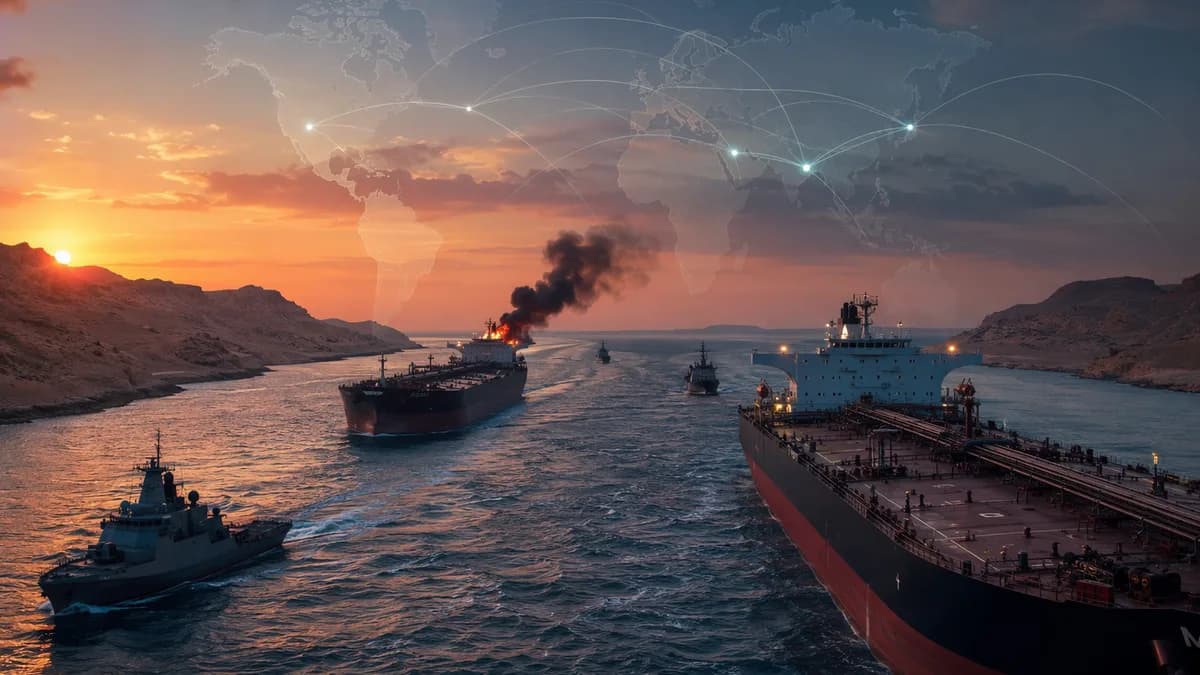
The unanswered question after the Houthi Saudi oil tankers claim is whether this was a contained Red Sea strike, or the start of a wider campaign against Saudi-linked energy shipping.
XOOMAR Intelligence
Analyst Take
Did the Houthis hit Saudi oil tankers ENCELA and LAYLIA in the Red Sea?
Yemen’s Houthis said Thursday they targeted two Saudi oil tankers, identified as ENCELA and LAYLIA, while the vessels were transiting the Red Sea, according to FXStreet.
The Iran-backed group said the tankers violated a naval blockade it said it imposed on Monday. The claim has not been independently verified in full, and Saudi Arabia has not commented in the supplied source material.
“We targeted two Saudi oil tankers, named ENCELA and LAYLIA, for their violation of the blockade decision issued by the armed forces,” Houthi military spokesperson Yahya Saree said.
The UK Maritime Trade Operations center said it had received reports that a tanker was struck by an unknown projectile and caught fire in the Red Sea, 70 nautical miles from Saudi Arabia’s Al Shuqaiq. That gives the Houthi claim a serious operational backdrop, even though the available official report does not independently confirm both named vessels were hit.
Al Jazeera, citing Saree, reported that the attacks were carried out “using a number of ballistic and cruise missiles, as well as drones,” and that fires broke out on the ships. UKMTO’s account was narrower: the master of a tanker reported being struck by an unknown projectile, with the crew fighting a fire onboard.
That distinction matters. The Houthis are making a two-vessel military claim tied to a declared blockade. Maritime authorities, at least from the supplied reporting, have confirmed a reported tanker strike and onboard fire, not the full Houthi version.
The group also claimed it had forced “nearly ten ships… to abandon their routes, and turn back,” according to Al Jazeera. That claim also has not been independently verified in the provided material.
How much pressure does a Houthi Saudi oil tankers claim put on oil routes?
The Houthi Saudi oil tankers claim hits a pressure point for energy markets: the Red Sea route linking the Indian Ocean, the Bab al-Mandeb Strait, the Suez Canal, and Mediterranean markets.
The immediate market reaction showed how quickly traders price risk into oil when tankers enter the story. FXStreet reported that West Texas Intermediate (WTI) was up 3.35% on the day at $87.05 at the time of writing.
That move does not prove the Houthi claim drove the entire price action. It does show the market was already sensitive to disruption risk around oil flows.
The Red Sea and Bab al-Mandeb matter because they sit on a narrow shipping artery. Al Jazeera reported that the Bab al-Mandeb Strait is 29km (18 miles) wide at its narrowest point and that in 2024, about 4.1 billion barrels of crude oil and refined petroleum products passed through it, around 5 percent of the global total.
For Saudi Arabia, the political signal may be as important as the reported damage. The Houthis are not framing this as a random maritime attack. They are presenting it as enforcement of a blockade against Saudi-linked shipping.
That is why this incident connects directly to earlier Red Sea shipping pressure we covered in Houthi Maritime Embargo Throws Saudi Oil Route in Doubt and Tankers Flee Saudi Route After Houthi Shipping Threat. The question is no longer only whether tankers can pass. It is whether shipowners, insurers, and charterers will treat Saudi-linked routes as newly exposed.
A useful distinction for readers:
| Issue | Confirmed in supplied reporting | Claimed by Houthis |
|---|---|---|
| Tanker struck by projectile | Yes, via UKMTO report | Yes |
| Fire onboard | Yes, via UKMTO report | Yes |
| Two Saudi tankers targeted | Not fully independently confirmed | Yes |
| ENCELA and LAYLIA named | Reported by FXStreet and Houthi statement | Yes |
| Missiles and drones used | Reported via Houthi claim | Yes |
| Nearly ten ships turned back | Not independently verified | Yes |
The harder market question is whether tanker operators respond to the claim itself, not only to confirmed damage. In maritime risk, perception can reroute ships before investigators finish their work.
Can a claimed naval blockade change Red Sea shipping decisions?
Yes, if operators believe the Houthis can identify, reach, and repeatedly threaten Saudi-linked vessels.
The Houthis have already used maritime attacks as a political tool. The supplied Al Jazeera reporting says the group disrupted global commerce after October 2023, and that those attacks ended with the announcement of a “ceasefire” in Gaza in October 2025.
Now the declared target set appears to have widened toward Saudi-linked oil transport. That is the material shift.
gCaptain reported that Equasis records identify Encelia (IMO 9240172) as a Saudi-flagged 109,250 DWT oil products tanker built in 2003, commercially managed by Bihar International Co. of Jeddah, with ISM management by Red Sea Marine Services LLC in Dubai. It also reported that Layla (IMO 9336098) is a Saudi-flagged 317,821 DWT crude oil tanker built in 2007, owned by National Shipping Company Saudi Arabia (Bahri) and managed by Bahri Ship Management DMCC in Dubai.
Those details support the Houthis’ characterization of the vessels as Saudi-linked, if the vessels identified in shipping records match the ships involved in the incident. The naming is not perfectly aligned across reports, with FXStreet citing ENCELA and LAYLIA, while gCaptain refers to Encelia and Layla.
The blockade language is also designed to force decisions beyond the two vessels named. Al Jazeera reported that the Houthis imposed a maritime blockade on Saudi Arabia on July 20 after the Yemeni government bombed Houthi-controlled Sanaa airport to stop an Iranian plane from landing.
The group framed the blockade as retaliation. It said the declaration was based on “an eye for an eye” and referred to “the right of our great people to respond to the blockade with a blockade.”
Saudi Arabia, according to Al Jazeera, has rejected claims that it imposed a siege on the Yemeni people.
Will this stay a single tanker incident, or become a Saudi shipping campaign?
That depends on verification, response, and repetition.
The next hard facts need to come from maritime security agencies, vessel operators, Saudi authorities, and regional naval forces. Confirmation of the vessels’ condition, crew status, cargo status, environmental impact, and ownership links will shape how the shipping market treats the threat.
There are three practical watch items now:
- Verification: Whether UKMTO, vessel managers, or Saudi authorities confirm damage to one tanker or two.
- Enforcement pattern: Whether the Houthis name more vessels or repeat attacks under the blockade claim.
- Route behavior: Whether tankers alter Red Sea passages, especially Saudi-linked oil shipments.
The Houthi Saudi oil tankers claim also lands as regional shipping risk is already being watched around other chokepoints. We previously tracked that pressure in Iran's Threats Ignite Strait of Hormuz Trade Route Fears, and the Red Sea claim now adds another route-specific stress point for energy transport.
For markets, the immediate issue is not whether every Houthi claim is proven. It is whether enough owners and insurers decide the risk has changed before proof arrives.
If this remains a single reported strike, the effect may be limited to short-term caution. If the Houthis keep naming Saudi-linked vessels and UKMTO reports keep following, the Red Sea becomes a more expensive and more contested oil route.
Impact Analysis
- A confirmed attack on Saudi-linked tankers would raise risks for energy shipping through the Red Sea.
- The gap between Houthi claims and maritime authority reports leaves uncertainty over the scale of the incident.
- A wider campaign could pressure oil markets, insurers, and commercial shipping routes.
Houthi Claim vs. Maritime Authority Report
| Source | What Was Reported | Scope |
|---|---|---|
| Houthis | Claimed attacks on two Saudi oil tankers, ENCELA and LAYLIA, using missiles and drones. | Two-vessel strike tied to a declared naval blockade. |
| UK Maritime Trade Operations | Reported one tanker struck by an unknown projectile and catching fire. | Confirmed a reported tanker incident 70 nautical miles from Al Shuqaiq, without verifying both named vessels. |
Primary Sources & Disclosures

Written by
XOOMAR Insights Team
Research and Editorial Desk
The XOOMAR Insights Team pairs automated research with human editorial judgment. We track hundreds of sources across technology, fintech, trading, SaaS, and cybersecurity, cross-check the facts, and explain what happened, why it matters, and what to watch next. We do not just rewrite headlines. Every article is fact-checked and scored for reliability before it goes live, and we link back to the original sources so you can verify anything yourself.