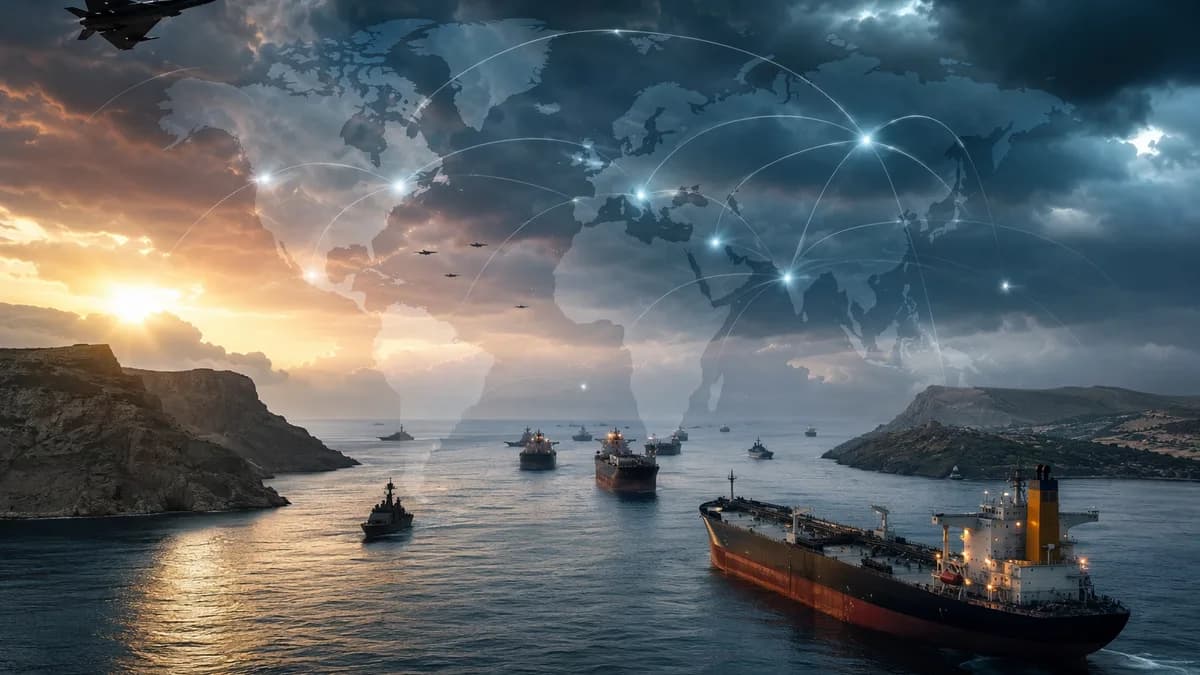
On Tuesday evening, the US restored its blockade of Iranian ports, and within a day Iran was threatening to close other oil and gas export routes while US strikes on Iran hit military sites tied to the Strait of Hormuz. That timing matters because the conflict is no longer only about battlefield punishment. It is now testing whether both sides can coerce each other back to talks without breaking the trade routes that carry the crisis into energy markets, shipping schedules, and regional security planning.
XOOMAR Intelligence
Analyst Take
The latest escalation came as US Central Command said it had targeted "Iranian military capabilities used to threaten vessels" moving through the Strait of Hormuz, according to BBC World. Iran, meanwhile, said it had struck US military targets in the region, including in Bahrain and Kuwait, while state media reported air defences sounding in Tehran.
XOOMAR analysis: the central risk is that Washington and Tehran are both using pressure to force negotiations, but the instruments they are choosing make negotiations harder. A blockade, attacks near the Strait, threats against infrastructure, and warnings over other export routes all raise the political cost of backing down.
Tuesday's blockade turned the Strait of Hormuz back into the main pressure point
The immediate trigger was the renewed US blockade on Iranian ports, imposed on Tuesday evening. Centcom said it had redirected two commercial vessels since the blockade returned, stopping vessels from transiting to and from Iranian ports and coastal areas.
That blockade had previously been lifted under a memorandum of understanding struck last month, which aimed to end the months-long conflict. The BBC reports that a dispute over the strait has become a key point of contention.
Iran's response widened the threat beyond its own coastline. The Islamic Revolutionary Guard Corps warned the US that it should:
"expect the closure of other oil and gas export routes that serve the interests of the United States and its allies"
The IRGC did not say which routes it meant. That omission is part of the signal. Ambiguity forces shipping firms, energy buyers, and governments to price a wider range of disruption scenarios before any specific route is named.
This follows the same pressure pattern XOOMAR tracked in Power Plants in Crosshairs as Trump Iran Threats Hit Hormuz, where infrastructure threats and maritime pressure began feeding into the same negotiation channel.
July 16 US strikes on Iran targeted coastal defences, missiles, drones, and surveillance sites
The military sequencing is clear. On Wednesday, the US said it had launched a fresh wave of strikes. Earlier in the day, Centcom said it had "further degraded Iran's ability to attack commercial shipping in the Strait of Hormuz".
A 90-minute wave targeted Iran's coastal defences and cruise missile storage and launch sites on Greater Tunb Island, according to Centcom. Later, at 21:00 ET (01:00 GMT) on Wednesday, Centcom said a second wave had been completed.
Centcom said the second wave hit Iranian:
| US-stated target category | Reported location or context |
|---|---|
| Command centers | Iran |
| Air defense sites | Iran |
| Missile and drone capabilities | Iran |
| Coastal surveillance facilities | Including in Bandar Abbas, on the Strait of Hormuz |
State media also reported that a hospital in Ahvaz, near the head of the Gulf, was evacuated because of nearby missile strikes. That detail matters because the closer strikes come to civilian infrastructure and dense urban areas, the harder it becomes to frame the campaign as narrow maritime deterrence.
For readers tracking the widening strike cycle, this sits alongside XOOMAR's prior coverage of US Strikes on Iran Rip Into Airport, Bridges and Rail, which focused on how infrastructure references have moved closer to the center of the conflict.
Trump's bridges and power plants threat raises the stakes beyond Hormuz
Donald Trump threatened late on Tuesday to attack Iranian bridges and power plants if Iran did not return to talks next week. Asked late on Wednesday whether he would give a deadline before doing so, he said:
"I don't like giving deadlines, but they pretty much know, they know the story... they better behave."
He later told delegates at a defence summit that Iran was "not happy right now".
"They want to settle so badly. They don't like what we're doing," he said. "We'll find out whether we want to settle with them or if we just finish it off."
XOOMAR analysis: naming bridges and power plants changes the character of the threat. These are not just military nodes. They sit close to the systems that keep civilian movement, electricity, and economic activity functioning. The source material does not confirm that such strikes have happened in this latest wave, but the threat itself shifts the bargaining frame from maritime security to national infrastructure pressure.
That matters legally and diplomatically too. The BBC notes that Trump's previous April threat to bomb Iran's civilian infrastructure drew condemnation from UN human rights chief Volker Türk, who said it would be a war crime.
Iran is mixing retaliation with a narrow diplomatic signal
Iran's top negotiator, Mohammad Bagher Ghalibaf, told state media Tehran had "no reason" to abide by the deal if it did not benefit from it. He also said Iran's national security depended on maintaining "Iranian arrangements" in the strait.
That phrasing suggests Tehran is not treating the Strait of Hormuz as a side issue. It sees control or influence there as part of its security position in the conflict.
Iran also said it had targeted US army communication systems and storage facilities in Jordan using drones. Jordanian state media said its military intercepted eight drones, with no injuries or material damage.
Yet the same day brought a small diplomatic opening. Trump welcomed Iran's release of Dena Karari, an American detainee he said had been "wrongfully detained" in December 2024.
"She is now safely outside of Iran, and in good condition," Trump wrote on Truth Social. "The United States of America appreciates this gesture of Goodwill by Iran!"
Her attorney, Jared Genser, said on X that Karari was on her way back to the US.
XOOMAR analysis: the detainee release does not undo the military escalation. But it shows the channel is not fully closed. That is the contradiction at the heart of this phase: both sides are escalating while preserving fragments of bargaining space.
Oil prices already show how quickly a local fight becomes a global cost
The BBC reports that ongoing US-Iran hostilities have underscored the strategic importance of the Strait of Hormuz to the global economy, with a sharp rise in oil prices triggered by tanker traffic virtually stalling through the key shipping lane.
No further price data is provided in the source, so the hard market claim stops there. But the mechanics are straightforward.
XOOMAR analysis:
- Energy traders: They do not need a confirmed long-term closure to reprice risk. The combination of blockade enforcement, redirected vessels, drone claims, and strikes near the Strait is enough to change probabilities.
- Shipping firms: The immediate question is whether voyages to Iranian ports and nearby coastal areas can proceed under predictable rules. Centcom's redirection of two commercial vessels shows the blockade is not just rhetorical.
- Insurers and cargo owners: The source does not provide premium data, but the risk inputs are visible: missile sites, coastal surveillance facilities, drones, and naval enforcement.
- Policymakers: A sharp rise in oil prices can feed into broader cost pressure, but the source does not quantify pass-through into inflation or central bank decisions.
The key point is not that every barrel has stopped moving. The point is that tanker traffic through the Strait has "virtually" stalled, according to the BBC, while both sides are warning that more routes or more targets may come into play.
The next decision point is whether threats stay coercive or become infrastructure war
The next week is the hinge. Trump has linked future attacks on bridges and power plants to Iran returning to talks. Iran has linked its willingness to abide by the memorandum of understanding to whether it benefits from the deal. The IRGC has warned of possible closures beyond the Strait of Hormuz but has not specified where.
That gives markets and governments a short list of evidence to track:
- Blockade enforcement: More redirected vessels would show the US is tightening pressure on Iranian ports.
- Target selection: Strikes remaining limited to military capabilities near shipping lanes would support the argument that Washington is focused on maritime coercion.
- Infrastructure targeting: Any move toward bridges or power plants would mark a sharper escalation, especially given prior UN criticism of threats against civilian infrastructure.
- Iranian route threats: Specific naming of other oil and gas export channels would turn ambiguity into operational risk.
- Diplomatic signals: Further detainee releases, public messages about talks, or renewed references to the memorandum of understanding would suggest the bargaining channel still exists.
XOOMAR's read: this is still a bargaining crisis, but it is moving along a dangerous edge. The evidence that would confirm containment is narrow target selection, fewer attacks on regional US positions, and a path back to talks. The evidence that would weaken it is just as clear: infrastructure strikes, named route closures, or successful attacks that damage US assets or allied territory.
The Stakes
- The Strait of Hormuz is a critical energy corridor, so disruption could affect oil and gas markets.
- Both sides are using coercive measures that may make negotiations politically harder.
- The conflict is spreading from military targets to trade routes, raising risks for shipping and regional security.
US and Iran escalation tactics
| Side | Reported actions | Pressure point |
|---|---|---|
| US | Restored blockade of Iranian ports and struck Iranian military sites tied to the Strait of Hormuz | Restricting Iranian port access and targeting threats to vessels |
| Iran | Threatened to close other oil and gas export routes and said it struck US military targets in Bahrain and Kuwait | Expanding risk to regional energy exports and US military presence |
Primary Sources & Disclosures

Written by
XOOMAR Insights Team
Research and Editorial Desk
The XOOMAR Insights Team pairs automated research with human editorial judgment. We track hundreds of sources across technology, fintech, trading, SaaS, and cybersecurity, cross-check the facts, and explain what happened, why it matters, and what to watch next. We do not just rewrite headlines. Every article is fact-checked and scored for reliability before it goes live, and we link back to the original sources so you can verify anything yourself.