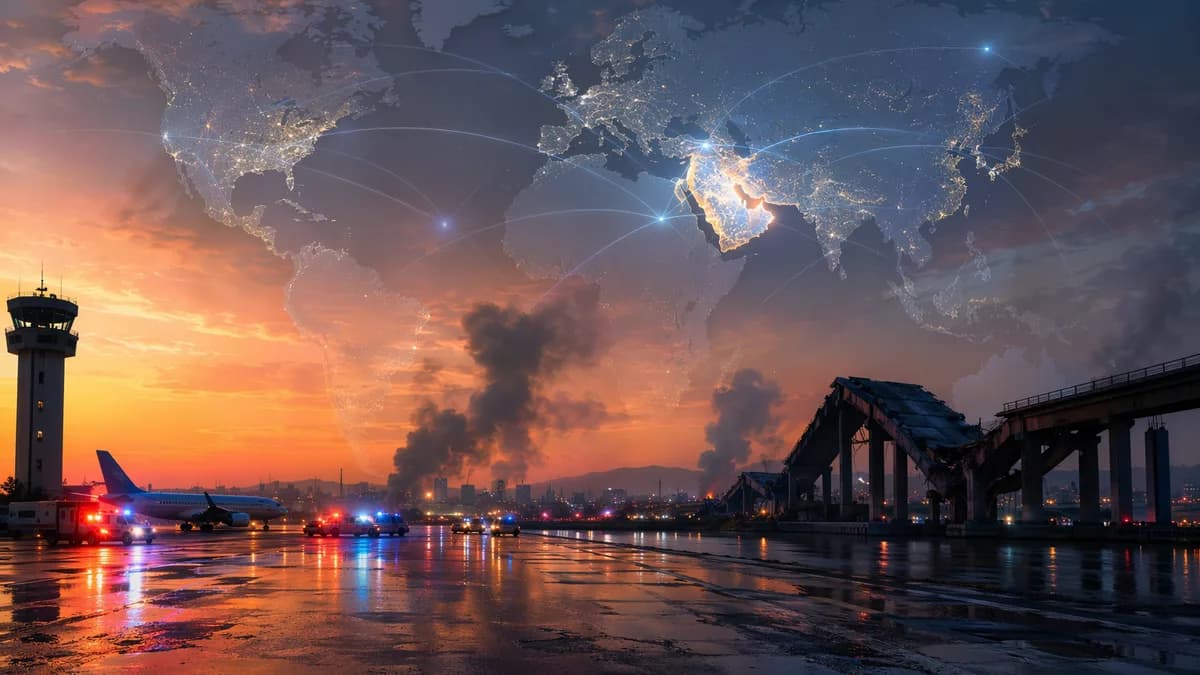
US strikes on Iran reportedly hit an airport, a railway station and two bridges overnight, pushing the week-long escalation deeper into transport infrastructure as Iranian officials reported rising civilian casualties.
XOOMAR Intelligence
Analyst Take
Iranian state media said three blasts were heard around Iranshahr airport in the south-east and that at least one US projectile hit, while Bandar Abbas station and two bridges in Hormozgan province were also targeted, according to Guardian World. Iran’s health ministry said 38 people have been killed in recent US attacks, with more than 400 injured.
US strikes on Iran reportedly hit Iranshahr airport, Bandar Abbas rail station and Hormozgan bridges
Hossein Kermanpour, head of public relations for Iran’s ministry of health, reported the casualty figures on X, saying 22 women and nine children were among the injured.
Iranian state and semi-official media described strikes on Iranshahr airport, Bandar Abbas station in the southern port city, and two bridges in southern Hormozgan province. Casualty details around the bridge strikes were not consistent across the supplied material: Fars reported two people killed and four injured in attacks on the two bridges, while a separate report said seven people were injured in a US attack on an area of Bandar Abbas.
| Reported target | Location | Reported damage or effect | Confirmation status |
|---|---|---|---|
| Iranshahr airport | South-east Iran | Three blasts heard, at least one US projectile reportedly hit | Reported by Iranian state media, not independently confirmed in the source |
| Bandar Abbas station | Southern port city | Reported target of US strike | Extent of damage unclear |
| Two bridges | Hormozgan province | Fars reported two killed and four injured in attacks on the bridges | Damage level and traffic disruption unclear |
The latest airport, rail and bridge reports suggest the pressure campaign is no longer confined to ships, ports and military nodes.
At publication time, the extent of damage at Iranshahr airport, Bandar Abbas station and the Hormozgan bridges had not been independently verified from the supplied source material. It also remains unclear whether the airport is operating, whether rail traffic has stopped, or how many civilians were at or near the strike sites.
Civilian casualty figures put transport strikes under sharper scrutiny
Airports, rail stations and bridges are not just strategic points on a map. They move people, fuel, food, medical teams and emergency crews. When they are hit, the damage can spread well beyond the blast site.
That is the pressure point in Friday’s reports. Iran’s health ministry is now saying 38 people have been killed in recent US attacks and more than 400 injured. Those numbers, if confirmed, put civilian harm at the center of the next diplomatic and military exchange.
XOOMAR analysis: The reported targets matter because transport infrastructure creates second-order effects. A damaged bridge can slow ambulances. A disrupted rail station can block evacuations or supply movements. An airport hit, even without confirmed runway damage, can force rerouting while officials assess safety.
Iran also accused the US of launching a “barbaric attack” near a children’s cancer hospital in Ahvaz on Wednesday night, saying the facility had to be evacuated. The source material does not independently verify that allegation, but it shows how Tehran is framing the strikes: not only as military escalation, but as attacks with civilian consequences.
The casualty figures may still change. In fast-moving conflicts, counts often shift as hospitals update lists, local authorities reach damaged areas, and emergency services clear strike sites. That is especially true when reported attacks hit transport links or places where access may be limited.
The latest strikes also landed during what the Guardian described as a week-long escalation that has largely unravelled last month’s truce. Centcom said it hit dozens of Iranian targets in the latest strikes, which concluded at dawn on Friday, the sixth night in a row of American attacks.
That follows the same escalation arc we covered in Six Nights of US Strikes Pound Iran's Hormuz Lifeline, where the battlefield focus had already moved toward chokepoints, ports and Gulf access.
Tehran and Washington now face pressure to clarify targets, casualties and retaliation risk
The next phase depends heavily on official statements. Washington has not, in the supplied source material, confirmed the specific reported strikes on Iranshahr airport, Bandar Abbas station or the two Hormozgan bridges. Tehran’s local authorities and health officials are likely to drive the first detailed casualty updates.
Several questions now matter more than broad claims of escalation:
- Airport status: Is Iranshahr airport still operational, or did the reported strike damage runways, navigation systems or support buildings?
- Rail disruption: Did the reported attack on Bandar Abbas station halt passenger or freight service?
- Bridge access: Are the two Hormozgan bridges passable, restricted or destroyed?
- Civilian presence: Were civilians, workers or emergency responders present at the strike sites when they were hit?
- US targeting rationale: If Washington confirms the strikes, will it identify military use, logistics value or blockade enforcement as the basis?
Iran’s regional response is already widening. Authorities in Qatar warned the public to take shelter on Friday as Iranian missiles targeted the country, with explosions heard while air defences fired interceptions. Iran had earlier targeted Bahrain and Kuwait over the US airstrikes hitting Iranian bridges overnight, according to the supplied Guardian source material.
The Gulf risk is no longer theoretical. A drone also struck a ship off Basra in southern Iraq, with AFP and Reuters citing oil and security sources as saying the vessel was “carrying American-branded cars” and had arrived from the United Arab Emirates.
Oil markets were reacting to the Strait of Hormuz tension in the source material, with Brent crude briefly climbing above $86 a barrel on Thursday US time before falling back to $84.08, down 1% from the previous day.
The practical watch now is narrow and urgent: confirmation from Washington, revised casualty figures from Iran, and hard evidence of whether transport routes in southern Iran remain usable. If the reported bridge, rail and airport damage is confirmed, the crisis shifts from strike counts to network damage, the kind that can slow civilian movement and military logistics at the same time.
The Stakes
- The reported strikes suggest the escalation is expanding into Iran’s transport infrastructure.
- Iranian officials say civilian casualties are rising, with women and children among the injured.
- Key details remain unverified or inconsistent, making independent confirmation critical.
Reported US Strike Targets in Iran
| Target | Location | Reported impact | Confirmation status |
|---|---|---|---|
| Iranshahr airport | South-east Iran | Three blasts heard; at least one US projectile reportedly hit | Reported by Iranian state media; not independently confirmed in the source |
| Bandar Abbas station | Southern port city of Bandar Abbas | Reported target of US strike; damage unclear | Reported by Iranian state and semi-official media |
| Two bridges | Hormozgan province | Fars reported two killed and four injured | Casualty reports were inconsistent across supplied material |
Reported Casualties From Recent US Strikes
Primary Sources & Disclosures
- [1]Guardian World
- [2]US Attacks Key Infrastructure In Iran On Sixth Night of Strikes: Bridges, Airport, Communication Tower Hit
- [3]US Attacks Iran In Tit-For-Tat Strikes, Hits Airport, Railway Station, Bridges
- [4]US strike reportedly destroys key bridges near Bandar Abbas, blasts heard near Iranshahr Airport as conflict with Iran escalates

Written by
XOOMAR Insights Team
Research and Editorial Desk
The XOOMAR Insights Team pairs automated research with human editorial judgment. We track hundreds of sources across technology, fintech, trading, SaaS, and cybersecurity, cross-check the facts, and explain what happened, why it matters, and what to watch next. We do not just rewrite headlines. Every article is fact-checked and scored for reliability before it goes live, and we link back to the original sources so you can verify anything yourself.