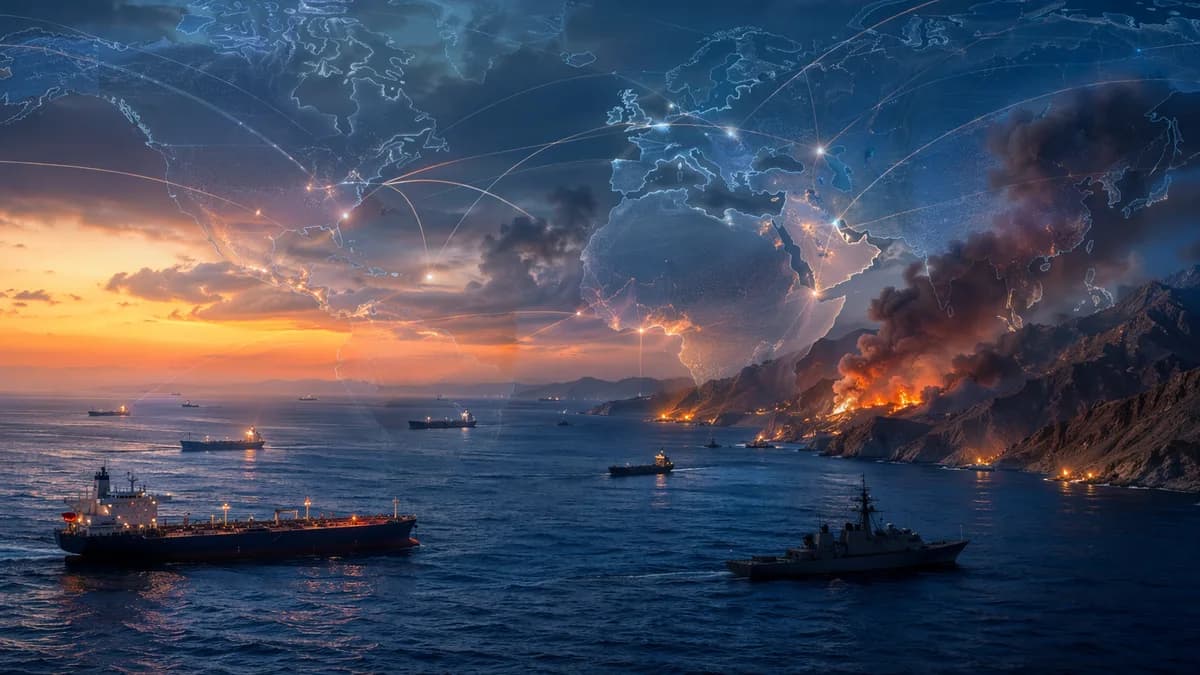
Six straight nights of US strikes on Iran have turned the fight over the Strait of Hormuz from a pressure tactic into a sustained military contest, with Washington saying it wants to “further degrade Iranian military capabilities” while Tehran signals it still wants control over the waterway.
XOOMAR Intelligence
Analyst Take
The latest US strikes Iran escalation included reported blasts near Qeshm, Bandar Abbas, and Bushehr, according to BBC World. The BBC also said it verified an attack on one bridge west of Bandar Abbas in Hormozgan province, after Iranian state media reported two bridges had been hit.
That verified bridge strike is the detail that sharpens the story. Airstrikes against military systems are one thing. Strikes on infrastructure near a major port zone and the Strait of Hormuz move the conflict toward a more legally and politically exposed phase.
US Central Command said the attacks were intended to “further degrade Iranian military capabilities”.
Six nights of US strikes Iran pressure have changed the tempo
The most important shift is tempo. A single strike can be framed as retaliation. Six nights in a row begins to look like a campaign.
Centcom said it had also boarded an oil tanker in the Gulf of Oman as part of the renewed US blockade of Iranian ports, which began on Tuesday night. It said marines had “redirected 3 commercial vessels trying to run the blockade”.
That blockade matters as much as the bombs. It puts military pressure directly into trade routes, not just military sites. It also builds on a prior US blockade of Iranian ports between 13 April to 18 June, when Centcom said US forces disabled nine ships and redirected more than 140.
For earlier XOOMAR context on how the blockade became central to the war’s logic, see Trump Turns Iran Strikes Into Strait of Hormuz Blockade and US Strikes Iran as Strait of Hormuz Crisis Threatens Oil.
The hard numbers now define the Strait of Hormuz fight
The known facts point to a widening contest, but not every claim carries the same weight. The US has confirmed strikes and maritime interdictions. Iranian state media has reported locations hit. The BBC has verified one bridge attack. Claims about strikes on bases and other damage remain claims unless independently confirmed.
| Event or claim | Source in supplied material | Status |
|---|---|---|
| US launched strikes for a sixth night in a row | Centcom via BBC | Reported as US military statement |
| Strikes aimed to “further degrade Iranian military capabilities” | Centcom via BBC | Confirmed official statement |
| Missiles struck near Qeshm, Bandar Abbas, and Bushehr | Iranian state media via BBC | Reported claim |
| One bridge west of Bandar Abbas was attacked | BBC verification | Verified by BBC |
| Marines boarded an oil tanker in the Gulf of Oman | Centcom via BBC | Confirmed official statement |
| 3 commercial vessels redirected under renewed blockade | Centcom via BBC | Confirmed official statement |
| Previous blockade disabled nine ships and redirected more than 140 | Centcom via BBC | Confirmed official statement |
| Tehran said it struck US bases in Jordan, Kuwait and Bahrain | Iranian state media via BBC | Reported claim |
| US said it carried out a six-hour wave of strikes in the strait | US statement via BBC | Reported official claim |
The US strikes Iran campaign is now operating across two layers: attacks on military capacity and coercion around shipping. That combination is more volatile than either on its own.
Bridges and power plants push the conflict into legal danger
The verified bridge attack lands in a sensitive context. Earlier this week, Donald Trump threatened to strike Iran’s bridges and power plants if Tehran did not return to talks. The BBC also notes that after Trump said in April that the US would bomb civilian infrastructure in Iran, including bridges and power plants, UN human rights chief Volker Türk said “deliberately attacking civilians and civilian infrastructure is a war crime”.
The legal line is not automatically crossed by the word “bridge”. A bridge can have military use. But the source material raises the issue because the 1949 Geneva Conventions prohibit attacks on sites considered essential for civilians.
XOOMAR analysis: that is why this phase is so risky for Washington. If the US frames the campaign as degrading Iranian military capability, it needs a clear military rationale for targets that also serve civilian life. The more the target list appears to drift toward infrastructure pressure, the more the political and legal burden rises.
Airstrikes can degrade, but repeated degradation creates its own risk
“Degrade” is a precise military word with an imprecise political shelf life. It can mean destroying radar, launch systems, boats, drones, or command nodes. A related report in the supplied material said Centcom described strikes on Iranian military air-defense systems, coastal radar sites, missile and drone capabilities, and small boats.
But degradation is rarely permanent if the other side can disperse, repair, relocate, or retaliate in another domain. The source material does not provide evidence that Iran’s ability to fight has been decisively reduced. It shows the US is trying to reduce that ability through repeated strikes.
That distinction matters. If Washington’s goal is punishment, a limited strike can be enough. If the goal is deterrence, Iran has to believe further action will cost more than it gains. If the goal is lasting degradation, the US may need repeated attacks, and repeated attacks create more chances for miscalculation.
The current pattern suggests Washington is not only answering immediate fire. It is trying to shape Iran’s future options around the Strait of Hormuz.
Washington and Tehran are talking while fighting over the same waterway
The diplomacy is still alive, at least in public. White House press secretary Karoline Leavitt said Trump remained open to talks with Iran.
“The president will hold them accountable when they turn their back on the words that they state to the United States. But he is always open to diplomacy at the very same time,” Leavitt told reporters.
She also said Iran has expressed that it still wants a deal with the US, adding:
“We're talking to them, but again, the president is not going to allow them to fire on ships in the strait without paying a consequence for that.”
Iran’s top negotiator, Mohammad Bagher Ghalibaf, gave the opposite framing to state media. He said Tehran had “no reason” to abide by any agreement that did not benefit the country, and tied Iran’s national security to maintaining what he called “Iranian arrangements” in the Strait of Hormuz.
That phrase is doing heavy work. The US says Iran does not get to control shipping through the strait. Tehran is presenting control, or at least coercive influence, as a national security requirement.
Oil and shipping risk are now tied directly to military momentum
The Strait of Hormuz has remained shut, according to the BBC, after Tehran effectively blocked it in response to US-Israeli strikes. That is the clearest economic transmission channel in the source material.
A related wires report in the supplied material said Brent crude rose by 3% Monday, while remaining below earlier peaks in the nearly five-month-old conflict. That is a limited data point, not a full market map. But it shows how quickly the Strait of Hormuz fight bleeds into energy pricing when military action and shipping disruption overlap.
XOOMAR analysis: the key market issue is not only whether the strait is physically closed at any given hour. It is whether vessels, insurers, and governments can trust that passage will remain predictable. The source material does not report insurance changes, airline route moves, or cyber activity, so those should remain watch items rather than asserted consequences.
For the regional military angle, XOOMAR’s earlier coverage of Iran-US strikes pulling Gulf bases into a wider crisis is relevant context, especially after Tehran said it had struck US military bases in Jordan, Kuwait and Bahrain.
The next phase depends on retaliation, verification, and backchannels
Three paths now fit the verified record.
Controlled retaliation: both sides keep striking but avoid confirmed mass casualties, direct attacks that force a larger response, or irreversible damage to civilian infrastructure. Diplomacy stays open.
Prolonged exchange: the US continues waves of strikes and interdictions, while Iran keeps using the Strait of Hormuz and regional base claims to show it has options. This is the current track.
Wider regional war: attacks on US personnel, confirmed strikes beyond Iran and the strait, or repeated hits on infrastructure could force faster escalation.
The evidence to watch is concrete: verified damage, casualties, maritime boardings, attacks on US forces, and whether talks move beyond public statements. The story won’t be decided by one blast near Bandar Abbas or one line from Centcom. It will be decided by whether Washington and Tehran can keep military signaling from becoming military momentum.
The Stakes
- Six straight nights of strikes suggest the conflict is becoming a sustained campaign, not a one-off retaliation.
- Attacks near port infrastructure and the Strait of Hormuz raise risks for global trade and energy flows.
- The blockade brings direct military pressure onto commercial shipping routes, increasing the chance of wider escalation.
Renewed US blockade vs earlier blockade
| Measure | Current renewed blockade | Prior blockade |
|---|---|---|
| Timing | Began Tuesday night | 13 April to 18 June |
| US actions | Boarded an oil tanker; redirected 3 commercial vessels | Disabled 9 ships; redirected more than 140 |
| Conflict tempo | Six straight nights of US strikes | Earlier port blockade phase |
Key reported escalation counts
Primary Sources & Disclosures

Written by
XOOMAR Insights Team
Research and Editorial Desk
The XOOMAR Insights Team pairs automated research with human editorial judgment. We track hundreds of sources across technology, fintech, trading, SaaS, and cybersecurity, cross-check the facts, and explain what happened, why it matters, and what to watch next. We do not just rewrite headlines. Every article is fact-checked and scored for reliability before it goes live, and we link back to the original sources so you can verify anything yourself.