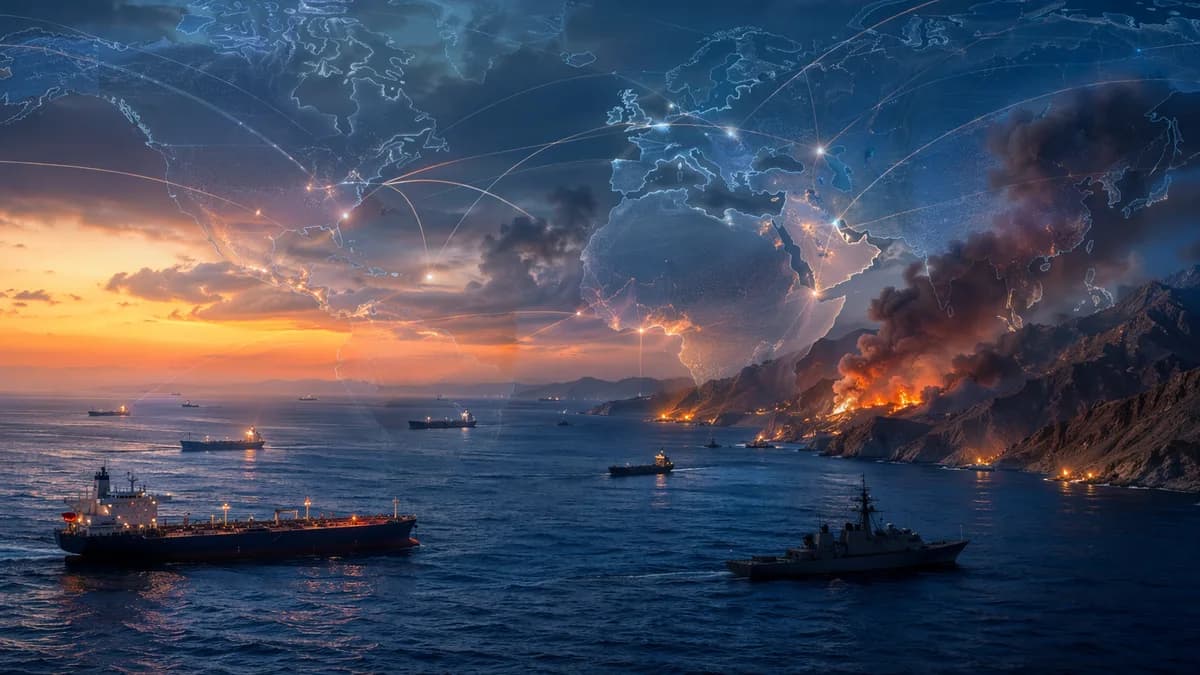
On Tuesday, the US launched strikes on Iran after three commercial vessels were hit in the Strait of Hormuz, turning a 24-hour tanker crisis into a direct American military response. US Central Command said the assault was meant “to impose heavy costs” after attacks on shipping in an international waterway, according to BBC World.
XOOMAR Intelligence
Analyst Take
The timing matters. The strikes came just weeks after Washington and Tehran signed a memorandum of understanding that extended a ceasefire, and on the same day the US Treasury revoked a sanctions waiver that had temporarily lifted oil sanctions on Iran.
US strikes Iran after Monday and Tuesday tanker attacks in the Strait of Hormuz
CENTCOM said the US strikes on Iran were “in response to Iranian attacks” on commercial vessels transiting the Strait of Hormuz. Iran has not claimed responsibility for the tanker attacks.
“Iran's demonstrated aggression was unwarranted, dangerous, and a clear violation of the ceasefire,” CENTCOM said.
The UK Maritime Trade Operations, or UKMTO, said the tankers were damaged within a 24-hour period on Monday and Tuesday. No casualties were reported.
The reported vessel incidents broke down this way:
| Timing | Reported incident | Vessel condition |
|---|---|---|
| Monday | A tanker reported a fire after an unknown projectile hit an engine room | Fire reported, no casualties reported |
| Tuesday | A tanker reported being hit as it exited the Strait | It was able to proceed to its next port of call |
| Tuesday | A tanker reported minor structural damage after being struck | Minor damage reported, no casualties reported |
The scale of the US operation is still not fully clear. CENTCOM described a series of “powerful” strikes, but the available account did not detail exact targets, damage assessments, or casualties from the American action.
That gap matters because Washington is making a serious attribution claim while Tehran has not publicly claimed the tanker attacks. The US position is explicit. The independent confirmation picture is still developing.
For related XOOMAR files on the same corridor, see Projectile Sets Tanker Ablaze on Strait of Hormuz Oil Route, Iran Strait of Hormuz Attack Jolts Global Oil Shipping, and Strait of Hormuz control fight.
Hormuz tanker attacks push Gulf governments into open accusation
Qatar and Saudi Arabia both denounced the tanker attacks, with each saying one of its vessels had been hit while transiting in or near the Strait of Hormuz.
Qatar’s foreign ministry spokesperson Majed Al Ansari said Doha held Iran “fully responsible” for an apparent targeted attack on Al-Rekayyat. He demanded that Iran “immediately cease all practices that undermine regional security” and “refrain from endangering global energy supplies & the resources of the countries of the region in pursuit of narrow interests”.
Saudi Arabia’s foreign ministry said Iran had targeted the Saudi tanker Wadyan as it crossed the Strait. It called the assaults “an attack on the security and safety of international navigation, and the security of global energy supplies”.
Iran’s foreign ministry spokesman Esmail Baghaei has so far commented only on Qatar’s accusations. He described them as “contrary to the principle of good neighbourliness”.
Baghaei also said commercial vessels using routes not coordinated with Iran, or tampering with ship tracking, risk collision and disrupt Iran’s efforts to “facilitate safe transit” in the Strait.
XOOMAR analysis: that statement stops short of a claim of responsibility, but it points to the operational dispute now sitting underneath the military crisis. The tanker attacks, the US strikes on Iran, and the Gulf states’ accusations are all tied to who controls safe passage through the Strait of Hormuz and under what conditions.
Treasury’s 17 July deadline adds pressure to the ceasefire deal
The military strikes landed alongside a financial move. The US Treasury revoked a licence that had authorised Iran to sell oil and petrol products under the memorandum of understanding signed by Washington and Tehran last month.
A Treasury notice published Tuesday said transactions previously allowed under the waiver would have a wind-down period until 17 July.
That puts a near-term deadline inside an already unstable diplomatic track. A US official, speaking anonymously before CENTCOM’s announcement, said Iran would face consequences and called the tanker attacks “wholly unacceptable”. The same official said US negotiators would continue working in “good faith” toward a final deal with Iran.
The memorandum of understanding had extended a ceasefire between the two countries. The 14-point agreement said it would end all conflict “on all fronts”, stated that Iran will never have a nuclear weapon, and committed a $300bn (£220bn) fund for the “reconstruction and economic development” of Iran, though the US is not required to contribute.
That makes Tuesday’s escalation especially sharp. Washington is still talking about negotiations, but it has now paired diplomacy with direct strikes and sanctions pressure.
Iran’s next move will decide whether the Hormuz crisis spreads
The immediate question is how Iran responds. Tehran could issue a diplomatic protest, answer militarily, tighten pressure around commercial shipping, or try to preserve the memorandum while rejecting US accusations.
The next signals to watch are specific: statements from Tehran, the White House, CENTCOM, Qatar, Saudi Arabia, UKMTO and major shipping operators. The condition and location of the damaged tankers will also matter, especially if more vessels report incidents in or near the Strait of Hormuz.
For now, the confirmed facts show a fast escalation: tankers hit Monday and Tuesday, Gulf governments blaming Iran, CENTCOM launching strikes, and Treasury setting a 17 July wind-down deadline on the sanctions waiver.
The risk is miscalculation. Crowded waters, commercial vessels, military forces, projectiles and disputed routing claims leave little room for error. If both sides treat Tuesday’s events as a contained exchange, the ceasefire process may still have a path. If either side expands the target set, the Strait of Hormuz crisis becomes harder to keep limited.
The Stakes
- The US strikes mark a direct military escalation with Iran after attacks on commercial shipping.
- The Strait of Hormuz is a critical global oil transit route, so instability there can affect energy markets.
- The action comes amid fragile diplomacy, including a recent ceasefire extension and renewed US oil sanctions pressure.
Reported Strait of Hormuz Tanker Incidents
| Timing | Reported incident | Vessel condition |
|---|---|---|
| Monday | Tanker reported a fire after an unknown projectile hit an engine room | Fire reported; no casualties reported |
| Tuesday | Tanker reported being hit as it exited the Strait | Able to proceed to its next port of call |
| Tuesday | Tanker reported minor structural damage after being struck | Minor damage reported; no casualties reported |
Primary Sources & Disclosures

Written by
XOOMAR Insights Team
Research and Editorial Desk
The XOOMAR Insights Team pairs automated research with human editorial judgment. We track hundreds of sources across technology, fintech, trading, SaaS, and cybersecurity, cross-check the facts, and explain what happened, why it matters, and what to watch next. We do not just rewrite headlines. Every article is fact-checked and scored for reliability before it goes live, and we link back to the original sources so you can verify anything yourself.