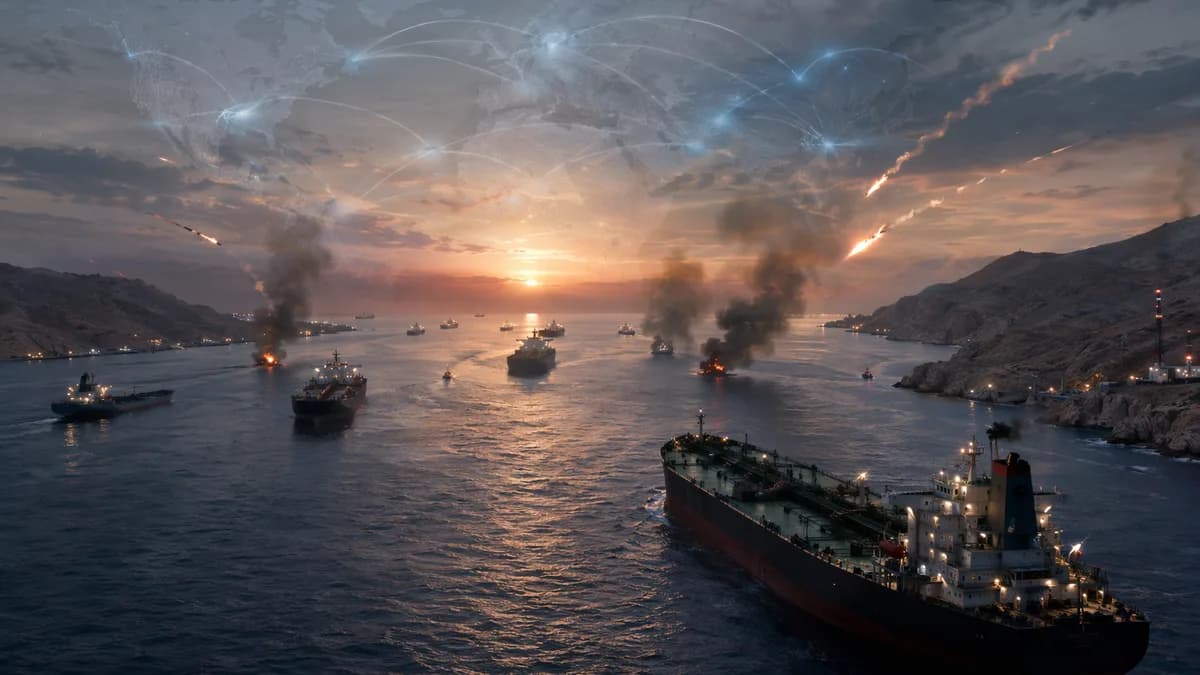
The Strait of Hormuz attack report puts commercial shipping and oil flows back on alert after a US official said Iran fired at least two missiles at ships moving through the waterway.
XOOMAR Intelligence
Analyst Take
Bloomberg carried the report from an Axios reporter, citing a US official, and FXStreet said two commercial ships were hit and suffered significant damage. No casualties were reported in that account.
Iran reportedly fires missiles at commercial ships in the Strait of Hormuz
The reported Iran Strait of Hormuz attack centers on Strait of Hormuz control in one of the world’s most sensitive shipping corridors, where tankers and cargo vessels move between the Persian Gulf and global markets. The immediate danger is simple: if merchant vessels can be hit while transiting the strait, every operator planning a Gulf voyage has to reassess route, timing, insurance, and crew risk.
The Bloomberg report, as carried by FXStreet, cites a single US official. That matters. The allegation is serious, but the public record remains incomplete.
Key details still missing from the FXStreet account include:
- Ship identities: The vessels were not named in the available source material.
- Operators and owners: No company names were provided.
- Flag states: The report did not identify where the ships were registered.
- Cargo: The source did not say whether the ships were carrying oil, gas, containers, or other freight.
- Military response: No US or Iranian official statement was included in the FXStreet report.
The UK Maritime Trade Operations also reported that a tanker was reportedly hit by an unknown projectile on its port side while traveling southbound, causing a fire. UKMTO did not identify the projectile as Iranian in the supplied source material.
That distinction is important. The Bloomberg account attributes the missile fire to Iran through a US official. The UKMTO report describes a strike by an unknown projectile. Until governments or maritime authorities publish more detail, those are related but not identical claims.
If confirmed, direct Iranian fire on commercial shipping would mark a serious escalation in maritime tensions. Commercial vessels are not symbolic targets. They are the plumbing of energy trade.
For readers tracking how Tehran has framed pressure and retaliation in recent weeks, our coverage of Iran’s MoU breach accusation and Tehran Turns Khamenei Funeral Into Revenge Warning gives useful context for the political temperature around Iran’s military posture.
Strait of Hormuz missile fire threatens oil flows, tanker routes, and war-risk premiums
The Strait of Hormuz attack matters because the waterway is not just another maritime route. CBS News, citing Kpler data and regional reporting, described it as a chokepoint that normally carries one-fifth of the world’s oil. It is also a critical corridor for liquefied natural gas and Gulf cargo traffic.
That is why traders will focus less on statements and more on operational facts. Were vessels disabled? Is the channel still open? Are tankers slowing, diverting, or waiting? Are naval escorts expanding?
A reported missile strike changes the pricing conversation fast.
| Market channel | Immediate pressure point |
|---|---|
| Crude oil | Risk premiums can rise if traders see a credible threat to Gulf exports. |
| Tankers | Operators may delay sailings or wait for clearer security guidance. |
| Insurance | War-risk premiums can climb when underwriters see active fire on commercial vessels. |
| Freight | Longer waits, route changes, or convoy requirements can raise costs. |
| AIS tracking | Gaps, slowdowns, and clusters near ports become market signals. |
TIME reported in related coverage that Brent crude briefly rose more than 2% to around $75.50 a barrel after a separate Thursday strike report, before falling around 2% in early Friday trading to $74.03 a barrel. It also reported that WTI followed a similar move before sinking more than 2% to $70.38 a barrel.
Those figures show how quickly prices can react to a Hormuz shock, then reverse when traders reassess whether flows are actually disrupted.
The same logic applies now. A headline about missiles is not enough to sustain a market move on its own. Sustained pressure would require evidence that shipping is slowing, cargoes are delayed, or naval forces are changing posture.
CBS News reported that ship traffic had picked up significantly after a US-Iran memorandum of understanding raised hopes for renewed passage, with 70 vessels sailing through the strait on Tuesday compared with six a week earlier, according to Kpler. That rebound makes any new strike more consequential. More ships in motion means more exposure.
The broader risk is not just oil. It is command and control at sea. When commercial vessels, Iranian forces, US officials, maritime authorities, and insurers are all interpreting different rules in real time, a single hit can ripple across routes and contracts.
Global security shocks have been forcing faster political and military decisions elsewhere too, as we reported in Deadly Kyiv Strikes Corner NATO on Ukraine Air Defenses. Hormuz is different because the market transmission is immediate: ships, barrels, premiums, and freight rates.
US response, ship damage reports, and Tehran's next move will decide how far the Hormuz crisis spreads
The next phase of this Strait of Hormuz attack story depends on confirmation.
Reporters and markets will be watching for statements from US Central Command, the White House, Iran’s government, and maritime security bodies such as UKMTO. The first hard details will matter more than broad rhetoric.
Watch for:
- Vessel names: Identification will allow tracking of route, cargo, owner, and insurer exposure.
- AIS behavior: Sudden signal gaps or course changes can indicate distress or security instructions.
- Port diversions: Rerouting would show operators are changing behavior, not just monitoring risk.
- Damage reports: Fire, flooding, bridge damage, or engine failure would define severity.
- Crew status: Casualties would sharply raise political pressure.
- Advisories: Any warning to avoid parts of the strait would hit shipping decisions fast.
Related reporting from CBS News quoted Secretary of State Marco Rubio saying the Trump administration would judge Iran by activity at sea, not by rhetoric.
"If ships are moving as they should be moving, then that's what we're going to judge, and that's what we're going to react to," Rubio said. "If, on the other hand, this rhetoric is backed up by actual ships being threatened and ships are not moving, that's a violation of the agreement, and we're going to have a problem with it."
That is the escalation ladder in one paragraph. If vessels keep moving normally, markets may absorb the shock. If ships are threatened and traffic slows, the incident becomes a test of US and allied tolerance.
The practical near-term stakes are clear. An incident with no casualties but confirmed damage can still lift the cost of moving energy through the Gulf. A strike that causes casualties, disables a tanker, or triggers naval escorts would widen the risk fast.
For now, the most useful signals are operational: shipping advisories, tanker tracks, port queues, official confirmations, and whether insurers reprice Gulf voyages. If the strait stays open and vessels keep transiting, the reaction may stay contained. If shipowners start waiting outside the corridor, oil, freight, and war-risk markets will price a wider conflict scenario before diplomats finish their statements.
The Stakes
- The Strait of Hormuz is a critical corridor for Persian Gulf shipping and global energy flows.
- Any confirmed attack on commercial vessels could raise insurance, routing, and crew-safety risks.
- Key facts remain unverified, including ship identities, cargo, ownership, and official military responses.
Reported Strait of Hormuz Incident Accounts
| Source | Attribution | Reported Impact |
|---|---|---|
| Bloomberg/Axios via FXStreet | US official said Iran fired at least two missiles | Two commercial ships reportedly hit with significant damage; no casualties reported |
| UK Maritime Trade Operations | Unknown projectile; not attributed to Iran in the supplied material | A tanker reportedly hit on its port side while southbound, causing a fire |
Primary Sources & Disclosures

Written by
XOOMAR Insights Team
Research and Editorial Desk
The XOOMAR Insights Team pairs automated research with human editorial judgment. We track hundreds of sources across technology, fintech, trading, SaaS, and cybersecurity, cross-check the facts, and explain what happened, why it matters, and what to watch next. We do not just rewrite headlines. Every article is fact-checked and scored for reliability before it goes live, and we link back to the original sources so you can verify anything yourself.