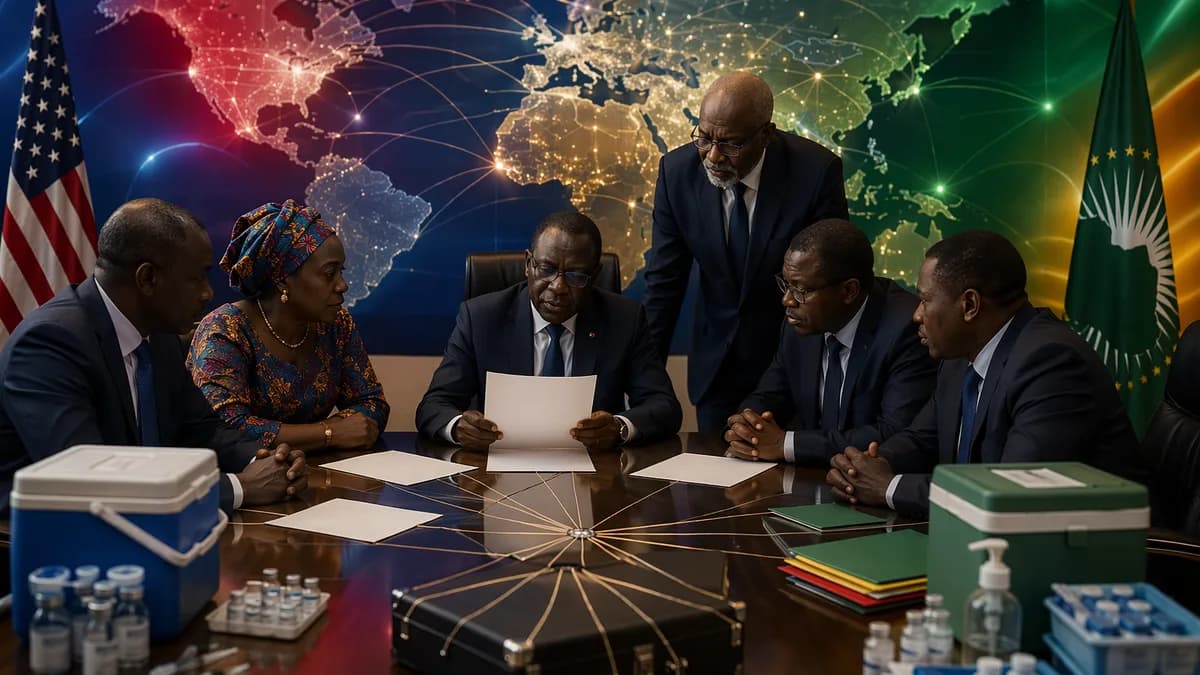
A $2.5bn Kenya health agreement has become the test case for why some African nations are turning down Trump aid money: the cash now arrives with a visible price tag.
XOOMAR Intelligence
Analyst Take
The Trump administration is offering new health deals after ordering the closure of USAID, but several African governments are resisting terms tied to data, minerals, pharmaceuticals and broader US strategic interests, according to BBC World. XOOMAR analysis: this is less a story about African governments rejecting healthcare funding outright, and more about a harder negotiation over who controls the assets around health, data and national policy.
The $2.5bn Kenya deal shows the new price of Trump aid money in Africa
Kenya was supposed to be the model. President William Ruto signed the first health Memorandum of Understanding in Washington last December, with Secretary of State Marco Rubio saying he hoped it would be “the first of many.”
“We hope to sign, I don't know, 30, 40, how many? Fifty? Well, this is number one. We'll always remember this one… and we think we've picked the perfect partner,” Rubio declared.
The agreement is worth $2.5bn (£1.9bn). The US would contribute $1.6bn, while Kenya would pledge $850m over five years. Even that deal was delayed after activists went to court, before cabinet ministers approved it last month.
That delay matters. If Kenya, Washington’s showcase partner, can face legal resistance over the terms, other governments can read the room. Ghana rejected a proposed $109m health deal in April over data protection concerns. Zimbabwe and Zambia also resisted signing, each for different reasons.
The keyword here is Trump aid money Africa, but the deeper issue is control. The administration’s new approach asks recipient governments to spend more on health while accepting direct bilateral deals aligned with US priorities. That makes the offer more politically exposed at home.
32 countries signed by mid-May, but Ghana, Zambia and Zimbabwe exposed the weak spots
By mid-May, 32 countries had accepted the health MOUs across Latin America, the Caribbean and at least 20 in Africa. The number sounds like momentum. The refusals show the friction.
| Country | Reported issue with the US deal | Why it matters |
|---|---|---|
| Kenya | Court challenges over patient privacy | Even the flagship agreement faced legal pushback |
| Ghana | Data protection and sovereignty concerns | A $109m deal was rejected in April |
| Zambia | Concern over linking health funding to critical minerals access | Lusaka wanted separate negotiations |
| Zimbabwe | Concerns over medical data and pathogens | Officials questioned who would benefit from future drugs or vaccines |
| South Africa | US withdrawal from HIV/Aids programme funding | Washington tied the move to unmet “policy requests” |
Zambia’s objection cuts straight to the new bargain. Foreign Minister Mulambo Haimbe told the BBC that US officials wanted a health agreement and a separate critical minerals agreement handled as a package.
“Our [US] colleagues looked at it from the perspective that [the two deals] must be taken as a package to be negotiated and concluded at one particular time,” he said.
He added:
“The US felt that there is need for there to be a preferential treatment in the use of critical minerals. And the framework was to reflect that.”
The State Department did not explicitly confirm that linkage when asked by the BBC, but its response was blunt.
“The Trump administration has made clear, US foreign assistance is not charity - rather it is strategic capital to be wisely invested to advance US interests - and we expect all of our allies and recipient nations to take seriously American strategic and commercial priorities,” a department spokesperson said.
That sentence is the clearest description of the policy. Aid is being treated as state capital. African governments are being asked to accept that logic in public.
Data and pathogens turned health aid into a sovereignty dispute
The most sensitive fight is not only about money. It is about health data, patient information and pathogens, meaning disease-causing organisms such as viruses, bacteria and parasites.
Ghana’s Data Protection Commission objected to the breadth of data requested. Arnold Kavaarpuo, its executive director, told the BBC:
“We had concerns around the scope and breadth of data that was being required.”
He continued:
“It was us generating data and passing it on to the US authorities, and there were no real reciprocal measures when it comes to the protection of Ghanaian data and Ghanaian sovereignty.”
And the core objection was even sharper:
“Once the data left the Ghanaian borders, we had no control over what becomes of it.”
Zimbabwe made a related argument. Officials raised concerns that medical data, potentially shared with US pharmaceutical companies, might help develop drugs or vaccines without guarantees that Zimbabweans would later get access. The government pointed to the WHO as already having a system for members to share data and benefit from treatments in future pandemics.
The US says the material requested is aggregated and de-identified data of the kind used for years in infectious disease work. That may be technically true. But XOOMAR analysis: the political context has changed. After the closure of USAID and US withdrawal from the WHO early this year, African governments are less likely to treat data transfer as routine cooperation.
For readers tracking Trump’s broader pressure tactics across international arenas, XOOMAR has covered related political flashpoints in Trump FIFA Call Turns Balogun Ban Into World Cup Scandal and Trump Drags Balogun Red Card Into FIFA Firestorm for USMNT.
Ebola in DR Congo tests whether bilateral health deals can replace USAID speed
The Democratic Republic of Congo accepted one of the new US health deals, and Washington says the agreement is helping coordinate Kinshasa’s response to a new Ebola outbreak. The US also says it has donated $270m to tackle the epidemic.
Critics tell a different story. Humanitarian workers and former US health officials say cuts to DR Congo and the WHO weakened the frontline response.
Amadou Bocoum, DR Congo country director for Care, said he laid off 36 workers, about a third of his staff, after USAID cuts. Those workers included people responsible for community mobilisation, health education and Ebola prevention.
“When this new Ebola came, the staffing was not there, and the emergency stock that we also used to have was also not there,” he said.
He added:
“With proper funding, we would have had prepositioned stock and begun distributing critical supplies like PPE from day one, but instead, we started with nothing and lost 10 days.”
That is the operational risk behind the policy fight. The Trump administration argues the new system is more “aligned and effective.” Critics argue that dismantling USAID removed logistics, local outreach and early detection capacity that cannot be rebuilt instantly through government-to-government MOUs.
America First health deals replace softer aid language with hard bargaining
US conditional aid is not new. What has changed is the frankness. Rubio told a congressional committee that US aid would no longer be “dollars distributed to an NGO” that then enters a country and imposes programmes.
“Not only are we treating the acute situations on the ground of people that are sick, we are helping them build the capacity and the capability to do this for themselves.”
That argument has appeal. The BBC notes that the State Department’s global health strategy asks recipient governments to increase their own health spending, with the goal of building systems that can eventually sustain themselves.
But the policy document also says:
“Our global health foreign assistance programme is not just aid - it is a strategic mechanism to further our bilateral interests around the world.”
That is where the resistance begins. If US funding prioritises US pharmaceuticals and medical firms, asks for sensitive data, or appears linked to minerals access, African leaders risk looking as if they accepted a cheque in return for policy concessions.
Civil society groups have already turned some of these deals into legal and political battles. Kenya’s court challenge focused on patient privacy. Ghana’s objection focused on data sovereignty. Zambia wanted health and minerals discussed separately. These are not abstract diplomatic complaints. They are domestic political hazards.
The next US-Africa aid fight will be judged by who pays the hidden cost
The Trump administration can argue that US taxpayers deserve a return and that aid should advance American strategic and commercial goals. African governments can argue that health financing should not require surrendering data control, minerals preference or political autonomy.
Both positions are now out in the open.
The forward signal is clear: future Trump aid money Africa deals will face tougher screening by courts, ministries, civil society groups and opposition politicians. The headline number will matter less than the attached obligations.
Evidence that would strengthen Washington’s case: faster epidemic response, visible national health capacity, and agreements that protect patient data while still funding essential programmes. Evidence that would weaken it: more rejected MOUs, more court blocks, more aid cuts hitting HIV/Aids or Ebola programmes, and more governments saying the trade is not fair.
The old aid bargain is weakening. The new one will be negotiated harder, refused more often and judged by a colder metric: not how much money is offered, but who carries the cost after signing.
Impact Analysis
- African governments are increasingly weighing health funding against sovereignty over data, minerals and policy.
- Kenya’s delayed $2.5bn agreement signals that even close US partners may face domestic pushback.
- The shift from USAID-style aid to bilateral strategic deals could reshape US influence across Africa.
African Responses to New Trump-Era Health Aid Deals
| Country | Deal/Status | Key Concern |
|---|---|---|
| Kenya | $2.5bn health MoU approved after delay | Legal resistance over deal terms and control |
| Ghana | Rejected proposed $109m health deal | Data protection concerns |
| Zimbabwe | Resisted signing | Terms tied to broader US strategic interests |
| Zambia | Resisted signing | Concerns differed from other governments |
Aid Deal Amounts Mentioned
Primary Sources & Disclosures

Written by
XOOMAR Insights Team
Research and Editorial Desk
The XOOMAR Insights Team pairs automated research with human editorial judgment. We track hundreds of sources across technology, fintech, trading, SaaS, and cybersecurity, cross-check the facts, and explain what happened, why it matters, and what to watch next. We do not just rewrite headlines. Every article is fact-checked and scored for reliability before it goes live, and we link back to the original sources so you can verify anything yourself.