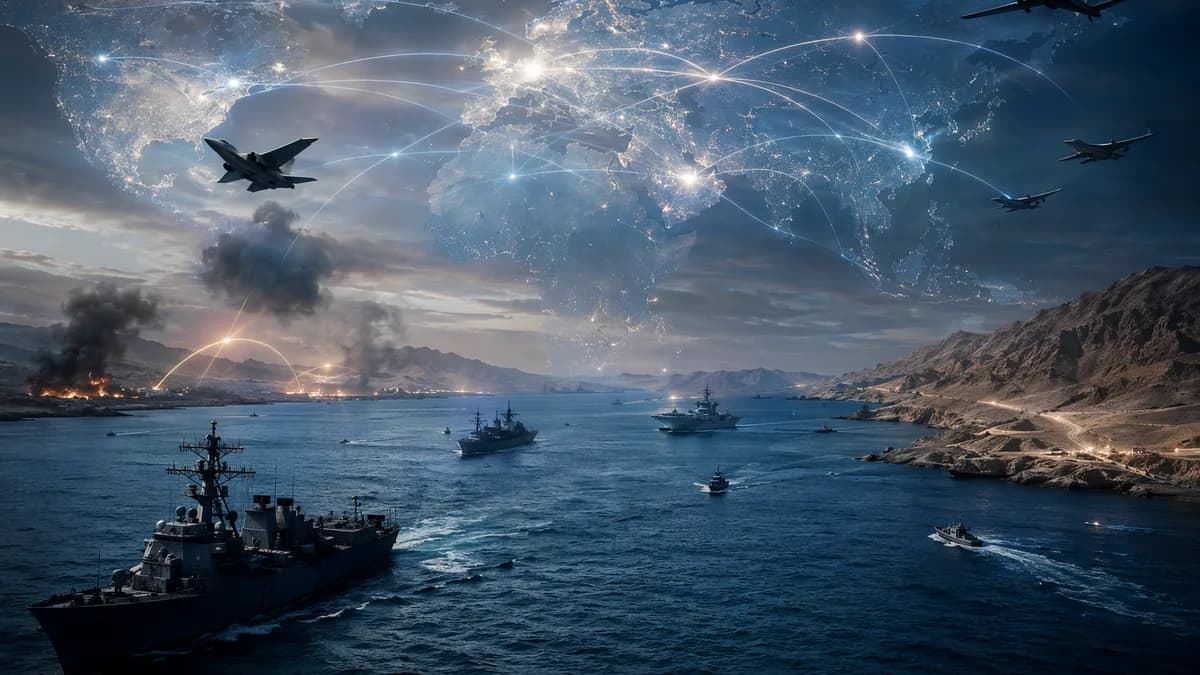
Iran’s most dangerous move may not be the vow of a “crushing response”, it’s the claim that tankers are safe in the Strait of Hormuz only if they use Tehran’s chosen route.
XOOMAR Intelligence
Analyst Take
That turns a ceasefire dispute into a control fight over one of the world’s most important oil chokepoints. CENTCOM said US forces struck more than 80 targets on 7 July, including more than 60 IRGC small boats, after attacks on commercial vessels in the strait, according to Forexlive.
XOOMAR analysis: the market signal is blunt. This is no longer just about whether the US and Iran accuse each other of a memorandum of understanding breach. It’s about whether commercial shipping through Hormuz is governed by international transit norms, US-backed naval protection, or Iran’s own routing instructions.
For earlier context on the first phase of this escalation, see XOOMAR’s coverage of US strikes after Hormuz tanker attacks shattered the truce and the Iran Strait of Hormuz attack jolting global oil shipping.
Tehran’s Strait of Hormuz route claim shifts the fight from retaliation to control
Iran’s Khatam al-Anbiya Central Headquarters accused the US military of targeting parts of southern Iran and said Iranian armed forces would deliver what it called a “crushing response.” That rhetoric matters, but the routing language matters more.
Iran’s military command said it would not allow US interference in management of the Strait of Hormuz. It also said the only safe passage for commercial vessels and oil tankers is the route determined by Iran.
Iran’s military command said Tehran would not allow US interference in the management of the Strait of Hormuz, declaring that the only safe passage for commercial vessels and oil tankers through the waterway is the route determined by Iran.
That is a sharper claim than a general warning. It implies Tehran is asserting operational authority over ship movement through the waterway. If Iran tries to enforce that position, then even a vessel that believes it is operating under normal commercial or naval guidance could become a target in a wider dispute over legitimacy.
The ceasefire may still exist on paper. But traders, shippers and energy buyers respond to behavior. XOOMAR analysis: once both sides frame their actions as enforcement rather than escalation, the risk premium in oil becomes harder to unwind quickly.
CENTCOM’s 80-plus target list shows this was not a warning shot
The US account points to a much larger operation than a symbolic strike. CENTCOM said US forces completed a new round of offensive strikes on 7 July, hitting more than 80 targets with precision munitions in response to Iran’s latest attacks on commercial shipping in the strait.
The target set included:
- Air defense systems: part of Iran’s ability to contest follow-on operations.
- Command and control networks: the connective tissue for coordinated military action.
- Coastal radar sites: key to monitoring vessels and military movements.
- Anti-ship missile capabilities: directly tied to maritime threat projection.
- More than 60 IRGC small boats: assets CENTCOM said were operating in and near the waterway.
CENTCOM framed the strikes as an effort to degrade Iran’s ability to continue attacking vessels transiting the corridor. That detail is central. The US was not only responding to a past attack. It says it was reducing Iran’s capacity to repeat one.
XOOMAR analysis: the scale cuts both ways. A larger strike package may reduce some immediate tactical risks if the targeted systems and boats were materially damaged. But it also gives Tehran a stronger basis, politically and militarily, to argue that the US has crossed from deterrence into direct escalation.
That is why the phrase “over 80 targets” will stick in market conversations. It gives this round a size and seriousness that earlier, narrower reporting could not.
Al Rekayyat, Wedyan and Cyprus Prosperity make the shipping risk concrete
CENTCOM identified three commercial vessels struck by Iran: the Marshall Islands-flagged M/T Al Rekayyat, the Saudi Arabia-flagged M/T Wedyan and the Liberian-flagged M/T Cyprus Prosperity.
Those names matter because they move the crisis out of abstraction. This is not only state-on-state signaling. It is commercial shipping getting hit while moving through a corridor that energy markets treat as essential.
| Vessel | Flag cited by CENTCOM | Relevance to the crisis |
|---|---|---|
| M/T Al Rekayyat | Marshall Islands | Named by CENTCOM as one of the commercial vessels struck |
| M/T Wedyan | Saudi Arabia | Places Gulf-linked shipping directly inside the escalation |
| M/T Cyprus Prosperity | Liberia | Shows the risk extends across internationally flagged commercial traffic |
For shipping operators, blame is secondary to route safety. A tanker owner, charterer, insurer, cargo buyer or crew manager does not need a formal closure of Hormuz to change behavior. They need to assess whether a vessel can transit without becoming part of the confrontation.
The compliance trap is now visible. Following Iran’s designated route may be treated as acceptance of Tehran’s control claim. Ignoring it may increase exposure if Iran tries to enforce its position. For a deeper look at the earlier vessel incident that fed into this escalation, see XOOMAR’s report on the projectile that set a tanker ablaze on the Strait of Hormuz oil route.
Washington and Tehran are describing two different ceasefires
The US position is straightforward. CENTCOM described the strikes as an immediate response to attacks on commercial vessels and said those attacks were an unwarranted and dangerous violation of the ceasefire that undermines freedom of navigation.
Iran rejects that framing. Qalibaf, Iran’s top negotiator, said Washington committed major violations of the memorandum of understanding that ended the earlier war. He cited the US attacks on southern Iran, reinstated oil sanctions and threats of further strikes. He also pointed to continued Israeli military action in Lebanon as a separate breach of the agreement.
That creates a severe diplomatic problem. The same event is being used by each side as proof that the other side broke the truce.
XOOMAR analysis: the memorandum is no longer functioning as a shared restraint mechanism if both governments can cite it to justify action. In that environment, the legal status of the ceasefire matters less than whether either side still sees value in preserving it.
Qalibaf’s line that “the era of bullying and extortion is over” and that Iran “does not fold” also narrows the room for a quiet climbdown. Public language can trap governments into follow-through.
Oil risk stays sticky while Hormuz becomes the bargaining table
The immediate scenarios are narrow but dangerous: limited Iranian retaliation, more vessel attacks, US follow-on strikes, emergency maritime coordination for commercial traffic, or a rushed diplomatic effort to preserve what remains of the memorandum.
None of those paths removes the Strait of Hormuz risk quickly.
For energy traders, the key question is not whether Hormuz is formally closed. It is whether flows remain predictable. For shippers, the practical question is whether routes can be chosen without triggering Iranian claims of noncompliance or US claims of coercion. For diplomats, the test is whether the memorandum can be treated as damaged but alive, rather than void in practice.
XOOMAR analysis: Qalibaf’s rejection of the US framing, combined with Iran’s route-control claim and CENTCOM’s large strike list, suggests the ceasefire has lost much of its market value. It may still exist as a reference point, but it no longer caps behavior in a convincing way.
The next evidence to watch is concrete, not rhetorical: whether Iran attempts to enforce its designated Hormuz route, whether commercial vessels are struck again, whether CENTCOM announces further operations, and whether either side reframes the latest strikes as an endpoint rather than the opening of another round. Until then, Strait of Hormuz risk will remain the dominant variable for oil-linked markets.
Impact Analysis
- The dispute raises the risk of further military escalation between the US and Iran.
- Iran’s routing claim challenges international control over a critical oil shipping chokepoint.
- Any disruption in the Strait of Hormuz could quickly affect global energy markets.
Competing positions over the Strait of Hormuz
| Issue | US/CENTCOM | Iran |
|---|---|---|
| Trigger | Says US forces struck more than 80 targets on 7 July after attacks on commercial vessels. | Accuses the US of targeting parts of southern Iran. |
| Military focus | Included more than 60 IRGC small boats among the targets. | Vows a “crushing response” by Iranian armed forces. |
| Hormuz control | Frames the issue around protection of commercial shipping and transit norms. | Says tankers are safe only on the route determined by Tehran. |
Reported US strike targets on 7 July
Primary Sources & Disclosures

Written by
XOOMAR Insights Team
Research and Editorial Desk
The XOOMAR Insights Team pairs automated research with human editorial judgment. We track hundreds of sources across technology, fintech, trading, SaaS, and cybersecurity, cross-check the facts, and explain what happened, why it matters, and what to watch next. We do not just rewrite headlines. Every article is fact-checked and scored for reliability before it goes live, and we link back to the original sources so you can verify anything yourself.