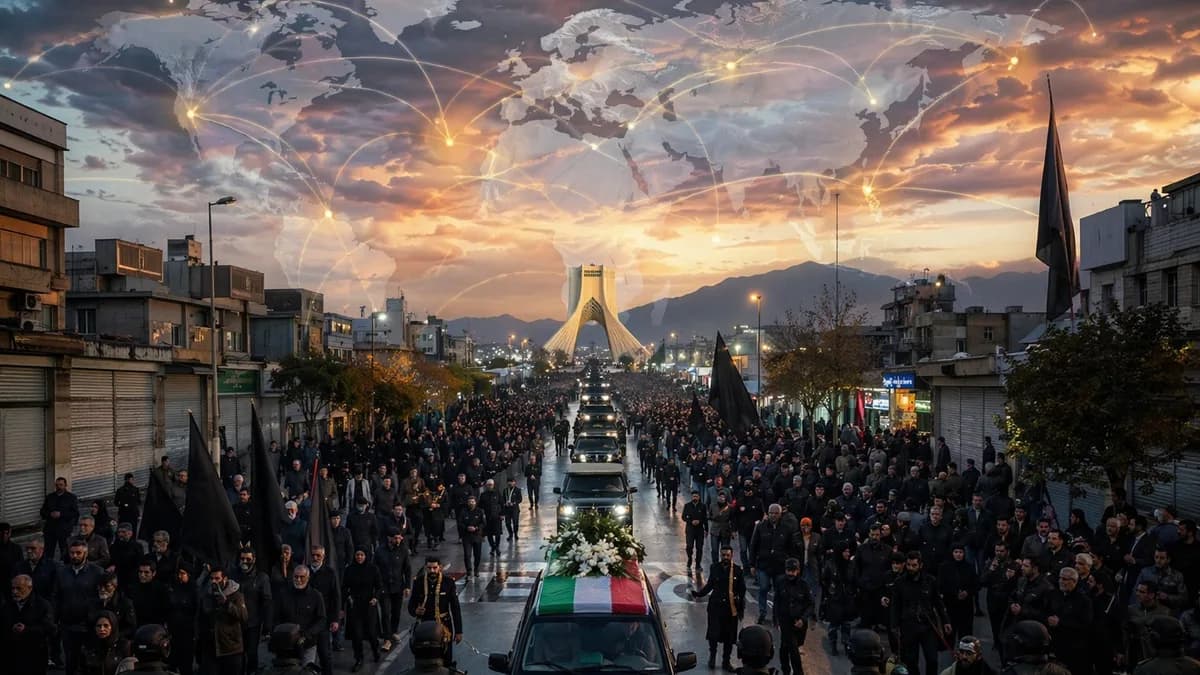
The Khamenei funeral was engineered to solve Tehran's immediate political problem: how to turn the assassination of a supreme leader into evidence that the Islamic Republic still commands the street.
XOOMAR Intelligence
Analyst Take
Three days of public mourning in Tehran ended with a vast, choreographed procession for Ayatollah Ali Khamenei and four family members, according to BBC World. The message was not subtle. This was grief staged as defiance, and defiance sharpened into revenge.
Tehran turned Khamenei's farewell into a warning shot, not a private goodbye
The Khamenei funeral was built around a contradiction Iran's leaders appear willing to exploit. For loyalists, the mourning was real. For others, absence was the statement.
The BBC reported that millions joined Monday's procession along a 10km route, one of the largest public gatherings in Tehran in years. It also reported that many stayed away, citing two wars in less than a year, inflation at around 80%, and anger after January's anti-government protests. Some blame Khamenei, who was commander-in-chief, for a security crackdown that killed many thousands.
That split matters. A state funeral on this scale does two jobs at once. It gives believers a sacred national moment. It also pressures everyone else to watch the state fill the capital with loyal bodies, flags, slogans, cameras, and foreign media.
"Tears arise from the pain and sorrow that surges within a person, and the world sees this truth," declared Iran's President Masoud Pezeshkian, responding to US President Donald Trump's claim that the tears were "fake tears".
XOOMAR analysis: the regime's core signal was continuity under attack. The assassination created vulnerability. The funeral converted that vulnerability into a public claim of discipline.
The Khamenei funeral choreography used black mourning and red revenge
The procession carried five caskets on a flatbed truck decorated with intricate latticework and Arabic Islamic script. The coffins were painted in the green, red, and white of Iran's flag. The smallest belonged to Zara, Khamenei's 14-month-old granddaughter.
All five were killed by Israeli-American air strikes on 28 February, in the first hours of the war, the BBC reported.
The visual grammar was deliberate:
- Black: mourning clothes and religious solemnity.
- Red: blood, martyrdom, and revenge.
- English posters: messages aimed at foreign journalists, not just domestic television.
- Slogans: "death to America" and "death to Israel" chanted by loyalists.
- Mobilized hospitality: mookebs, rest stations offering free food and water, much of it from private donations.
The state also gave rare access to hundreds of foreign journalists. It wanted witnesses. It wanted images exported.
An Iranian messaging app had advised government supporters to use slogans including "Our revenge is inevitable," and "They will pay. Hard." That language performs several functions. It reassures hardliners that Khamenei's death won't be absorbed quietly. It warns Washington and Israel. It also prevents the funeral from looking like a ceremony of defeat.
"Soon, very soon you will see signs of revenge at the top of the White House, and soon the colour of the White House will be the colour of my red flag," said a grey-haired man named Mojtaba, speaking to the BBC.
A government official gave the BBC a more careful reading: "Some of these calls are just ritualistic. But the anger is real among hardline critics within the system who oppose the new deal with the United States which killed our leader."
Three days, 10km, millions: the numbers show mobilization, not unanimity
The Khamenei funeral produced hard numbers, but not a clean measure of national loyalty.
| Signal | Reported detail | What it can show | What it cannot prove |
|---|---|---|---|
| Mourning period | Three days in Tehran | State control of ritual timing | Total public consent |
| Procession route | 10km | Logistical capacity and turnout | Whether attendance was voluntary |
| Crowd size | Millions, per BBC description | Large loyalist mobilization | National majority support |
| Inflation | Around 80% | Public economic strain | Exact political impact |
| Media access | Hundreds of foreign journalists | Intent to broadcast the spectacle | Independent control of narrative |
| Influencers | Government says 400 social media influencers | Digital amplification strategy | Organic online support |
The BBC does not provide independent crowd estimates beyond its description of millions. That matters because crowd size is political ammunition in moments like this. The regime needs the images to say: the system survived, the street is not lost, and revenge has a constituency.
But the same report includes a counter-image. One man outside a mookeb told the BBC: "Of course I'm not going to the funeral." He added: "Many people don't have work and are so unhappy."
Two young women, dressed like mourners, whispered that the "real voices of revolution" had been heard months earlier in protests on the same streets. That is the weakness inside the spectacle. The state can stage unity. It cannot make every witness believe it.
From Khomeini's broken coffin to Khamenei's controlled procession
The Islamic Republic has long treated mourning as political infrastructure. The BBC's Lyse Doucet drew the most direct comparison herself: nearly four decades ago, she was in Iran when it buried its first supreme leader, Ayatollah Khomeini. His flimsy wooden coffin broke in a frenzied stampede, and his white-shrouded body tumbled into the crowd.
This time, the choreography appears designed to avoid chaos and maximize symbolism. The commemorations move from Tehran to Qom on Tuesday, then to Najaf and Karbala in Iraq. Final burial is set for Thursday at the Imam Reza Shrine in Mashhad, Khamenei's birthplace and Iran's holiest city.
Mohammad Eslami, a research fellow at Tehran University, put the strategy plainly:
"The funeral proceedings are designed to frame him as more than a national leader but a transcendent religious and political figure whose authority extended across the Muslim world, and particularly Shia Islam."
Karim Sadjadpour, author of Reading Khamenei: the World View of Iran's Most Powerful Leader, offered the opposite verdict: "The revolution he preserved was for a world which no longer exists."
That tension is the real story. The state is trying to elevate Khamenei beyond politics at the same moment many Iranians are judging his rule through war, inflation, and repression.
Every audience saw a different funeral in Tehran
Hardliners saw revenge. Loyalists saw martyrdom. Dissenters saw performance and pressure. Foreign journalists saw a state working hard to control how weakness is interpreted.
The BBC source supports some readings more strongly than others. It shows hardline anger inside the system. It shows ordinary Iranians divided between grief, refusal, and whispered dissent. It shows Tehran directing messages toward Trump, Israel, foreign media, and the Shia religious geography of Iran and Iraq.
It does not provide enough evidence to say how Gulf governments, exile communities, or Iran-aligned armed groups are reading the event in real time. Those are watch items, not established facts from this report.
For readers tracking how governments turn political stress into tests of authority, XOOMAR's coverage of Morgan McSweeney Admits Labour 2024 Won Before It Could Rule and £4.7bn Gap Traps Starmer Defence Plan in PMQs Fire offers a separate, non-Iranian lens on power under pressure. The contexts differ sharply. The common thread is that public messaging often reveals where leaders feel least secure.
Mojtaba Khamanei's absence made succession the loudest silence
Iran now enters a new phase under its third supreme leader, 56-year-old Mojtaba Khamanei, the BBC reported. He has not been seen in public since the air strikes that killed his father and severely injured him.
His absence at the open-air Grand Musalla mosque compound was made more visible by the presence of his three brothers. Iranian officials point to continuing Israeli threats to assassinate him too.
That makes the funeral more than a farewell. It becomes a controlled test of succession optics. Who stands near the coffin? Who speaks? Who stays invisible? Which symbols replace the missing leader's body in public view?
The largest symbol was literal: a colossal clenched fist over Enqelab, or Revolution Square, described by organizers as the "fist of defiance." The statue's message was aimed both outward and inward. Enemies should see survival. Iranians should see inevitability.
The next evidence will matter more than the funeral images. Watch whether revenge rhetoric stays ritualistic or moves into policy. Watch whether Mojtaba Khamanei appears in public, and under what security conditions. Watch whether negotiations with the United States continue, since the BBC reports Iran's new leaders need relief through sanctions easing and unfreezing of assets.
The funeral proved Tehran can still mobilize mass mourning. Succession will show whether it can still command obedience when the cameras move on.
Impact Analysis
- The funeral was used to project regime strength after the assassination of Iran's supreme leader.
- Public participation and absence both revealed deep political divisions inside Iran.
- The event signaled that Tehran may frame Khamenei's death around resistance and revenge.
How Iranians Responded to Khamenei's Funeral
| Loyalists | Dissenters or Absentees |
|---|---|
| Joined a vast Tehran procession framed as mourning and defiance. | Stayed away amid anger over wars, inflation, and repression. |
| Viewed the funeral as a sacred national moment. | Saw absence as a political statement. |
| Helped project regime continuity after the assassination. | Underscored the public split beneath the state choreography. |
Primary Sources & Disclosures

Written by
XOOMAR Insights Team
Research and Editorial Desk
The XOOMAR Insights Team pairs automated research with human editorial judgment. We track hundreds of sources across technology, fintech, trading, SaaS, and cybersecurity, cross-check the facts, and explain what happened, why it matters, and what to watch next. We do not just rewrite headlines. Every article is fact-checked and scored for reliability before it goes live, and we link back to the original sources so you can verify anything yourself.