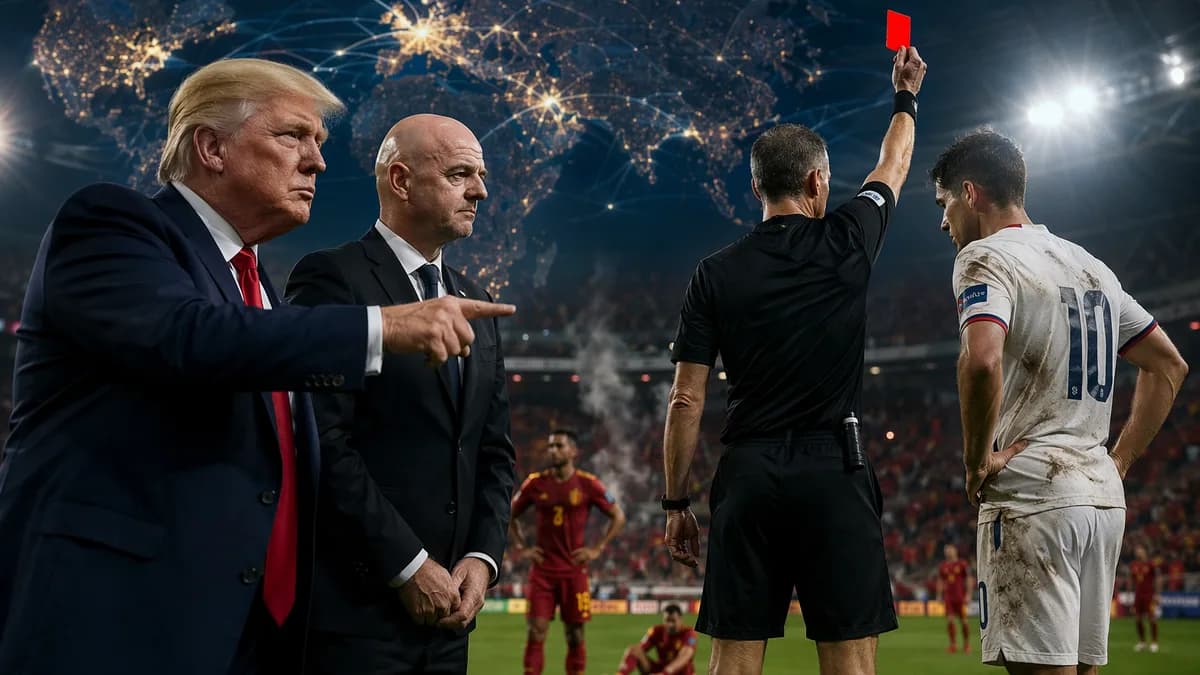
President Donald Trump turned the Folarin Balogun red card into a political loyalty test when he called referee Raphael Claus “very suspect,” and that is reckless, self-serving, and bad for Team USA, according to Independent World.
XOOMAR Intelligence
Analyst Take
The call itself deserved scrutiny. Balogun was sent off in the 64th minute of the U.S. team’s 2-0 win over Bosnia-Herzegovina in San Francisco after a foul on defender Tarik Muharemovic. FIFA later suspended the striker’s one-match ban for a probationary period of one year, meaning he could play against Belgium in the last 16.
But Trump’s FIFA intervention changed the story. A disputed officiating decision became a test of whether political access can bend soccer process. That’s exactly the kind of shadow Team USA doesn’t need before a knockout match.
Trump’s attack on the Balogun red card referee drags Team USA into a fight it doesn’t need
Trump said he watched the play and saw nothing worthy of punishment.
“I saw the play, and I’m a person that loves sports... That wasn’t a foul. That wasn’t even an infraction.”
Fine. Presidents can have sports opinions. Fans scream worse things every weekend.
The problem came next. Trump didn’t just say Raphael Claus made a bad call. He said: “This referee, who is a little bit suspect if you check his past.” That phrasing implies bias, corruption, or some hidden pattern, without presenting evidence in the supplied record.
That matters because Trump isn’t a random fan with a phone. He is the sitting president, speaking from the White House, about a FIFA decision affecting a U.S. team in a World Cup the U.S. is co-hosting with Canada and Mexico.
XOOMAR analysis: Team USA needs credibility, discipline, and focus. It doesn’t need its biggest knockout-week storyline to be a political figure publicly leaning into referee suspicion while the rest of the world asks whether FIFA just made a special exception.
This follows our earlier coverage of how the episode pulled the tournament into a governance fight in Trump Pulls Folarin Balogun Ban Into FIFA Firestorm.
Folarin Balogun’s suspended red card deserved scrutiny, not a presidential megaphone
The Folarin Balogun red card was always going to be contested. According to CNN, the referee did not initially rule the incident a foul, then reviewed slow-motion replays after video assistant referee intervention. Those replays showed Balogun’s spikes catching the ankle of the Bosnian player.
That is exactly the sort of sequence that splits viewers. At live speed, collisions can look accidental. In slow motion, studs, ankles, and twisted joints can look damning.
Fans, coaches, and players have every right to argue the call was harsh or inconsistent. U.S. manager Mauricio Pochettino and playmaker Christian Pulisic welcomed Balogun’s reprieve, according to the Independent source material. Secretary of State Marco Rubio had previously said the U.S. “got screwed” by the sending off.
But there is a difference between criticizing a decision and branding the official “very suspect.” The first belongs to sport. The second drags the official’s integrity into the fight.
Loose accusations stick, especially when they come from the White House. If Trump has evidence about Claus, he should produce it. If he doesn’t, the smarter line is simple: the call was wrong, the review process was flawed, and FIFA owes everyone a clearer explanation.
Trump’s Infantino conversation turns a referee controversy into a FIFA power story
Trump said he asked FIFA President Gianni Infantino for a review. According to CNN, Trump said: “All I did was ask for a review. I didn’t say, ‘You have to do this.’” He also said, “I didn’t tell him what to do, I can’t tell him what to do,” and referred to an independent committee making the decision.
That distinction may matter legally or procedurally. It doesn’t solve the perception problem.
Infantino is not another sports administrator. He is the top official in global soccer. When the U.S. president says he raised a U.S. player’s suspension with him, then FIFA suspends the ban before a knockout match, the optics are brutal.
FIFA’s statement relied on Article 27 of the FIFA disciplinary code, saying:
“In line with Article 27 of the FIFA disciplinary code, the implementation of the match suspension is suspended for a probationary period of one year.”
That provision matters because it lets FIFA suspend implementation of a disciplinary sanction under probation. In plain terms, Balogun’s red card was not erased. The ban was put on hold, and if he commits another similar infringement during the probationary period, the suspension can be enforced.
Still, FIFA offered little in the supplied record that would quiet critics asking why this case received that treatment. The Royal Belgian Football Association said it was “astonished.” UEFA, according to CBS News, said FIFA “crossed a red line” and called the decision “unprecedented, incomprehensible and unjustifiable.”
That is not routine griping from an opponent. That is institutional distrust going public.
Team USA’s World Cup credibility depends on acting bigger than one bad call
The U.S. men’s national team wants to be treated as a serious soccer nation. Serious soccer nations don’t need politicians turning disciplinary disputes into personal theater.
Balogun benefits more from professionalism than spectacle. If the U.S. case is strong, make it through formal channels. Point to the video review process. Explain why the punishment was disproportionate. Ask FIFA to explain its reasoning in detail.
That approach protects the player and the team. Trump’s approach protects Trump.
The international reaction shows the cost. Belgium manager Rudi Garcia said: “I didn’t know that at the World Cup the 5th of July is actually the first of April. It’s April Fools.” He added: “We’re not defending the national team or the federation, we are defending football, integrity.”
British pundits piled on. Gary Neville said Balogun’s reprieve “absolutely stinks.” Wayne Rooney called it “an absolute disgrace.”
Maybe U.S. fans won’t care if Balogun scores and Team USA advances. That’s understandable. Knockout soccer does not reward moral elegance.
But the shirt matters. A win that looks politically assisted gives opponents an easy narrative and puts players in the position of answering for a process they didn’t control. Team USA should want its matches decided by talent, shape, nerve, and execution, not by who got through to Infantino.
The broader World Cup governance question also fits with concerns we raised in World Cup Surveillance May Outlive the Final Whistle: mega-events don’t just test athletes. They test institutions under global pressure.
The fair counterargument: powerful voices can expose weak FIFA officiating
The best defense of Trump is straightforward: FIFA often explains too little, too late. A red card can change one match, and a suspension can reshape the next one. If ordinary appeals are limited or unavailable, powerful pressure may force a governing body to account for itself.
There is merit there. Fans are tired of opaque disciplinary calls. Coaches hate vague standards. Players deserve consistency, especially when video review turns a live-speed collision into a frame-by-frame prosecution.
Trump also understands attention. His Truth Social post thanking FIFA for “reversing a great injustice” guaranteed that the issue would not stay inside soccer media. That can create pressure. Sometimes pressure exposes weak process.
But accountability requires evidence, process, and precision. Calling a referee “very suspect” skips all three.
If Trump’s argument is that Balogun’s challenge was not serious foul play, say that. If his argument is that the VAR review used improper slow-motion emphasis, say that. If his argument is that Article 27 should apply because the punishment was disproportionate, say that.
Name-calling is not oversight. It is fog.
U.S. Soccer should defend Balogun through process, not Trump-style pressure
U.S. Soccer should now do two things at once: defend Balogun firmly and distance the team’s credibility from Trump-style pressure.
That means demanding a clear FIFA explanation through official channels. It means releasing a calm, detailed account of why the federation believed the one-match ban should be suspended. It means keeping the focus on process, not personality.
FIFA also has work to do. When a World Cup red card is reviewed, punished, and then partially suspended before a knockout match involving a host nation, a short disciplinary note is not enough. The governing body should explain why Article 27 applied here, how similar cases are handled, and what standard future teams can expect.
The unresolved tension is now bigger than Balogun. Belgium has challenged the player’s eligibility, according to CNN. UEFA has publicly attacked FIFA’s decision. Trump has put the referee’s integrity in play without showing evidence.
Team USA’s best answer to a suspect call isn’t a louder politician. It’s a cleaner process, a tougher team, and a refusal to let the circus own the shirt.
Impact Analysis
- Trump’s comments turn a disputed soccer call into a political controversy around Team USA.
- FIFA’s decision to suspend Balogun’s one-match ban keeps him available for the Belgium knockout match.
- Publicly questioning a referee’s integrity without evidence risks undermining confidence in the tournament process.
Primary Sources & Disclosures

Written by
XOOMAR Insights Team
Research and Editorial Desk
The XOOMAR Insights Team pairs automated research with human editorial judgment. We track hundreds of sources across technology, fintech, trading, SaaS, and cybersecurity, cross-check the facts, and explain what happened, why it matters, and what to watch next. We do not just rewrite headlines. Every article is fact-checked and scored for reliability before it goes live, and we link back to the original sources so you can verify anything yourself.