World Cup surveillance is becoming the hidden infrastructure story of America’s 2026 summer, as security for soccer, July Fourth, and America250 pushes cameras, counter-drone systems, biometric tools, and federal data-sharing deeper into public life.
XOOMAR Intelligence
Analyst Take
The clearest warning is not that fans will face more checkpoints. They will. The deeper issue is that equipment bought for a temporary spectacle may remain after the crowds leave, according to The Verge. That matters for ticket holders, but also for residents who never bought a seat and still move through monitored streets, buses, parks, and transit hubs.
World Cup surveillance is being built as public safety, but it may outlast the tournament
The 2026 World Cup and America250 are being framed as civic celebrations. Security agencies are treating them as high-risk, high-visibility operations. That tension defines the moment.
Both the Fourth of July fireworks on the National Mall and the July 19th World Cup final in New Jersey have been designated National Special Security Events, or NSSEs, by the Department of Homeland Security. The Verge notes that the designation is routine for events like the Super Bowl, but this is the first time it has applied to the Fourth of July.
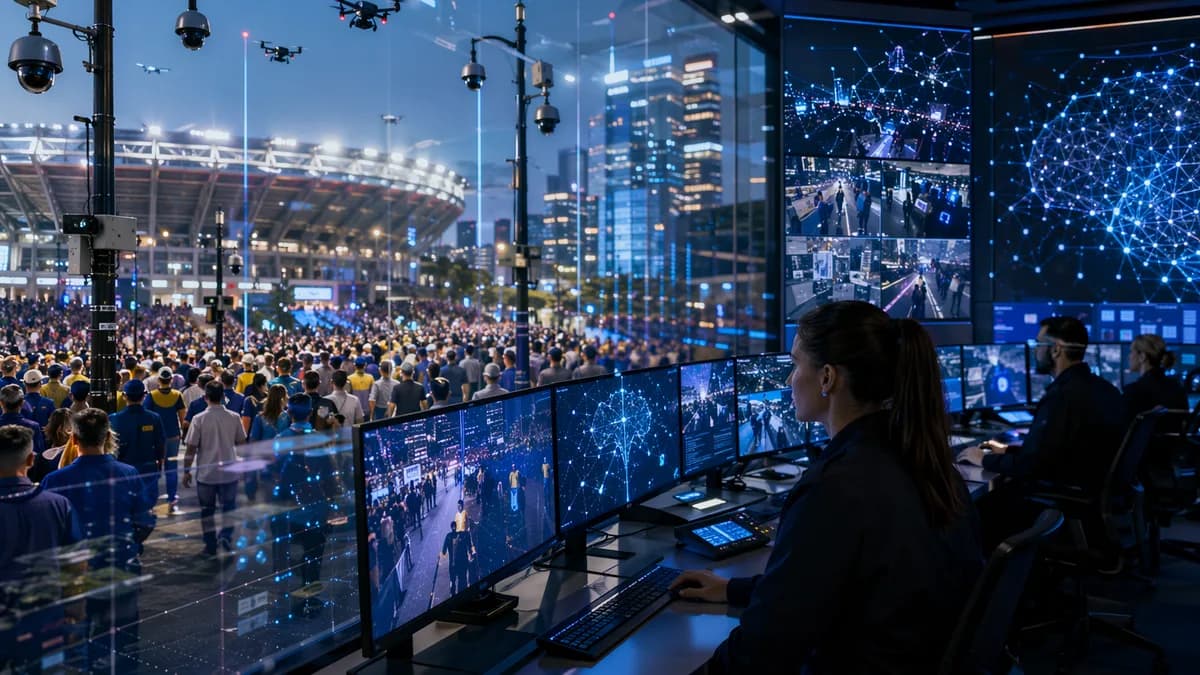
The visible side is familiar: checkpoints, bag restrictions, police, medical teams, and restricted items. The less visible side is more consequential: camera networks, counter-drone systems, biometric tools, and data routes that can connect local police with federal agencies.
XOOMAR analysis: the story is not paranoia about cameras at a match. It is institutional gravity. Once agencies buy equipment, train officers, integrate feeds, and create workflows, shutdown becomes a political choice, not a technical default.
That’s where the World Cup becomes a test case for American cities. We’ve already seen how mass gatherings can become public safety flashpoints, including in XOOMAR’s coverage of Mexico City World Cup celebrations turning deadly. The hard question is whether legitimate crowd risk justifies surveillance systems with weak public limits.
Kansas City, New York, Seattle, and DC show how the buildout spreads beyond stadiums
The source material identifies a broad surveillance push across World Cup host cities, including Kansas City and New York City, while Washington, DC is seeing its own surge because of July Fourth and America250 events.
Through FEMA, the Department of Homeland Security gave $250 million in grants to states hosting World Cup matches, much of it used for counter-drone equipment, according to The Verge’s summary of The New York Times reporting. The FBI has also trained local law enforcement agencies on drone mitigation. Andrew Giuliani, executive director of the White House task force for the World Cup, said Fan Fests in all 11 host cities will be covered by counter-drone technology.
“You’ll have multiple perimeter checks from security. You’ll have checks while you get onto public transportation to make sure you’re a valid ticket holder,” Giuliani told the Atlantic Council’s Frederick Kempe.
New York City spent $6.5 million on counter-drone technology. In Kansas City, Missouri, authorities have confiscated at least 16 drones since the World Cup began.
DC’s Fourth of July security will include airport-style checkpoints at the National Mall. Folding chairs and coolers will be banned. The Verge, citing The Washington Post, says counter-drone measures, bomb technicians, countersnipers, and medical personnel from several federal agencies will also be in place.
The strongest counterpoint is straightforward: these are unusually dense events with international visibility, senior officials, and large crowds. No serious city can treat that casually. But the privacy concern is not whether security exists. It is whether cities explain what data they collect, who gets it, and when it disappears.
The security money is visible. The data rules are not.
The available numbers show real spending, but the accountability details are thinner.
| Security layer | Source-supported example | Accountability question |
|---|---|---|
| Federal grants | $250 million through FEMA to states hosting World Cup matches | Which systems were bought, and which remain after the event? |
| Counter-drone tech | $6.5 million spent by New York City | Who operates it, and what incident data is retained? |
| Drone enforcement | At least 16 drones confiscated in Kansas City | Are records tied to individuals, and for how long? |
| Biometric cameras | Kansas City planned facial recognition cameras on some buses | What happens if the program launches after the World Cup? |
Kansas City is the clearest example of the temporary-event argument slipping into longer-term city infrastructure. The city planned to put cameras with facial recognition on some buses, even after Missouri declined to fund the project over privacy concerns. Officials said images would be checked against active missing persons alerts and retained only if there was a match.
The system is not yet operational because of backlash and technical delays. But Kansas City still plans to implement it later this year, after the World Cup is over.
That timeline matters. If the justification is a major international sporting event, but the launch comes after the event, the public safety rationale has already shifted.
AI cameras changed the old CCTV bargain
Privacy law has long treated public-space cameras differently because people have a weaker expectation of privacy in public. Anne Toomey McKenna, an attorney specializing in privacy and biometric surveillance, told The Verge that older CCTV was closer to what an officer could see while standing on a street.
Modern camera systems are different. They can pan, tilt, zoom, use thermal imaging, and pair with facial recognition. Some AI systems can analyze facial expressions and claim to predict behavior, McKenna said.
“We have increasingly advancing AI systems with analytical capabilities that can merge so much data and detect things from the footage that before we wouldn’t know,” McKenna said.
That changes the bargain. A person walking near a stadium, riding a bus, attending fireworks, protesting, selling food, or commuting through a crowded area may be captured by systems designed for event security but useful for ordinary policing.
The source also points to fusion centers, where local law enforcement can share information with federal agencies including ICE and the FBI. McKenna warned that as local and federal information-sharing expands, “we lose control over how that information is used.”
This is also where AI governance debates stop being abstract. As we noted in Fable 5 Returns as Anthropic Battles Safety Doubts, technical capability and institutional safeguards rarely mature at the same speed. World Cup surveillance puts that mismatch in public space.
Fans will feel checkpoints. Residents may inherit the monitoring zone.
Fans should expect more friction: earlier arrivals, perimeter checks, transit screening, drones being restricted, and heavier police visibility. Giuliani has already warned that fans who arrive 15 or 20 minutes before kickoff may miss the start, and said gates open three hours before kickoff.
Residents face a quieter burden. They may not enter a stadium or Fan Fest, but their neighborhoods, commutes, buses, and public gatherings can still fall inside expanded monitoring zones.
Weather and crowd management can compound that pressure. XOOMAR’s report on the July Fourth heat dome turning NYC’s holiday into a trap shows how public events can strain city systems even before security layers are added. Surveillance may help officials see crowds. It does not answer whether the public gets meaningful limits on how that visibility is used.
Jules Boykoff, author of Red Card: The 2026 World Cup, Sportswashing, and the FIFA Greed Machine, put the concern bluntly.
“The World Cup creates a state of exception that allows for all manner of securitization processes.”
The phrase “state of exception” is doing real work here. It describes the moment when extraordinary measures become easier to justify because the event feels extraordinary. The danger is that the exception becomes the template.
The real test starts after the final whistle
The evidence that would confirm the surveillance-state thesis is specific: Kansas City launching bus facial recognition after the tournament, cities keeping expanded CCTV active without new public votes, federal agencies continuing data-sharing arrangements, or retention rules staying vague after the NSSEs end.
The evidence that would weaken it is just as clear: public inventories of tools, sunset clauses, independent audits, strict retention limits, warrant rules for sensitive data, and explicit bans or moratoriums on biometric identification in public crowds.
The World Cup and America250 will test whether US cities can secure massive events without quietly normalizing permanent public monitoring. The match ends on July 19th. The more important clock starts after that.
Impact Analysis
- Temporary event security tools can become permanent surveillance infrastructure.
- Residents outside event venues may still be tracked through expanded camera and data-sharing networks.
- Federal security designations can accelerate local policing technology with limited public debate.
Visible Security vs. Lasting Surveillance Infrastructure
| Public-facing measures | Less visible systems |
|---|---|
| Checkpoints, bag restrictions, police, medical teams, and restricted items | Camera networks, counter-drone systems, biometric tools, and federal data-sharing routes |
| Framed as temporary protection for World Cup, July Fourth, and America250 crowds | May remain embedded in streets, transit hubs, parks, and local policing after events end |
| Affects ticket holders and event attendees directly | Also affects residents who never attend but move through monitored public spaces |
Primary Sources & Disclosures

Written by
XOOMAR Insights Team
Research and Editorial Desk
The XOOMAR Insights Team pairs automated research with human editorial judgment. We track hundreds of sources across technology, fintech, trading, SaaS, and cybersecurity, cross-check the facts, and explain what happened, why it matters, and what to watch next. We do not just rewrite headlines. Every article is fact-checked and scored for reliability before it goes live, and we link back to the original sources so you can verify anything yourself.