
If Honda data center batteries can absorb cells once intended for U.S. EVs, what does that say about where the battery profit pool is moving?
TechnologyJuly 1, 2026· 7 min read· By XOOMAR Insights Team
Honda Data Center Batteries Expose the EV Profit Shift
Updated on July 2, 2026
XOOMAR Intelligence
Analyst Take
60/ 100
3 sources analyzedLow confidenceTrend10Freshness95Source Trust90Factual Grounding92Signal Cluster40
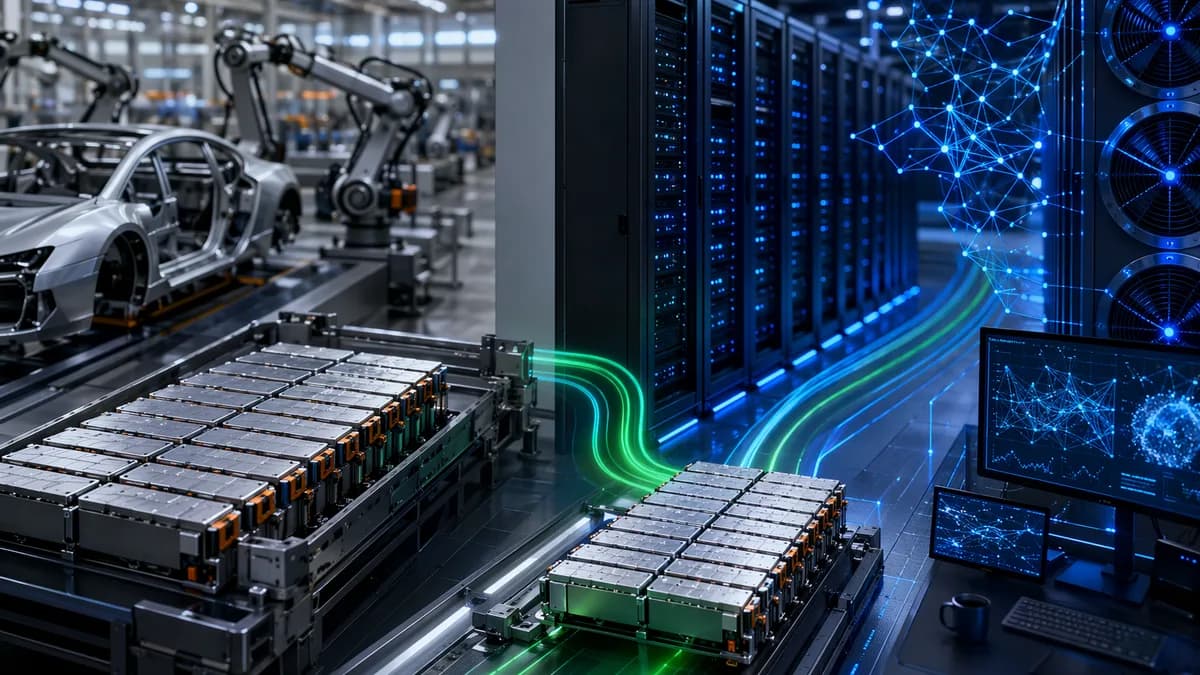
Honda began producing batteries this week for energy storage systems, with cells now headed toward data centers instead of vehicles, according to TechCrunch. That is the sharper read here: Honda isn't exiting electrification. It's redirecting battery capacity toward a market that currently looks more forgiving than U.S. EV demand.
Why are Honda data center batteries a sharper signal than another EV delay?
Honda's move follows a painful EV reset. The automaker began producing batteries at a U.S. plant where it had previously planned to make EV batteries. Now, those cells are being pointed at energy storage systems, including batteries for data centers.
That makes Honda data center batteries more than a backup plan. They show how carmakers are trying to monetize battery supply chains even when vehicle demand misses the original plan.
The source points to two immediate pressures. First, U.S. EV demand has become less dependable for automakers planning large battery investments. When vehicle programs slow, shift, or fail to scale on the original timeline, battery capacity still has to find an economic home.
Second, stationary storage is becoming a more visible battery destination. Data centers are one use case. Grid-connected batteries are another.
XOOMAR analysis: Honda is following power demand. The company may not have a clean answer for the U.S. EV market right now, but batteries can still be sold into sectors where electricity reliability and grid support have direct business value.
Which numbers explain Honda's pivot away from driveways?
The clearest signals are not precise production numbers from Honda. They are the categories of battery demand Honda is now targeting.
TechCrunch frames Honda's move around energy storage systems rather than vehicle packs. That matters because stationary batteries can serve customers whose needs are tied to power reliability, grid support, and infrastructure planning instead of consumer vehicle cycles.
The article does not provide a full market model for stationary storage. It does not give Honda's output target, name data center customers, or quantify how much of the company's battery capacity could move away from EV use. So the useful reading is directional: Honda sees enough opportunity in storage to begin producing batteries for that market.
| Battery market signal | Source-backed detail |
|---|---|
| Honda's new outlet | Batteries are being produced for energy storage systems |
| Data center demand | Data centers are identified as a destination for stationary batteries |
| Grid relevance | Stationary batteries can be connected to the grid |
| Renewable support | Batteries can help make wind and solar generation more usable |
| Key unknown | Honda has not disclosed full capacity, pricing, customers, or system specs |
That absence of detail matters. Without production volume, customer names, or pricing, it is too early to say whether Honda has found a large profit pool or simply a useful place to redirect battery output.
The source does not provide Honda's battery capacity, system specs, chemistry, customer names, or pricing. It also does not quantify electricity consumption from data centers. Those gaps matter. They separate a production pivot from proof of a scalable storage business.
Can Honda sell cells into a market Tesla already proved can pay?
Honda has one obvious advantage: it knows how to manufacture at scale. Battery production for vehicles requires quality control, supply discipline, and safety engineering. Those capabilities can transfer into stationary storage, at least at the cell and module level.
But stationary storage is not just "EV batteries without wheels." The source makes clear that batteries are being installed at data centers, connected to the grid, used to stabilize the grid, and paired with wind and solar to make generation more predictable.
That creates a different commercial problem for Honda.
A vehicle battery sale is embedded in a car program. A stationary storage sale sits inside energy infrastructure planning. The buyer cares about integration, reliability, operating economics, and deployment timing. Honda can bring industrial credibility, but the company still has to show that its batteries fit the specific needs of storage customers.
XOOMAR analysis: the first test is not whether Honda can make cells. The U.S. production move shows the manufacturing side is real. The harder test is whether Honda can turn those cells into a repeatable energy storage business rather than a temporary outlet for EV capacity.
For readers tracking adjacent AI demand pressures, this sits near XOOMAR's broader coverage of hardware strain, including AI Data Centers Send RAM Prices Into a 4X Shock for PCs and Free Gemini AI Image Generation Mines Your Google Data. Those links don't prove demand for Honda's batteries, but they show why AI infrastructure has become a market-moving theme across hardware categories.
What changed between Honda's Ohio EV plan and the data center plan?
Honda did not abandon the basic battery logic behind its EV plans. That is the key operational fact.
The company had expected some U.S.-made batteries to support vehicle programs. Instead, the production now described by TechCrunch is aimed at energy storage systems. That changes the customer, the deployment cycle, and the way the business will be judged.
That combination is revealing. The U.S. EV market has become harder to forecast, while power-hungry infrastructure is creating a different kind of battery demand. The result is not a retreat from batteries, but a reallocation.
Honda is now showing that an automaker's battery investment does not have to depend on one vehicle roadmap. The cells that were supposed to support an EV strategy can also be redirected into energy storage when the commercial case changes.
XOOMAR analysis: this is what battery optionality looks like in practice. If an automaker has already committed capital to battery production, it needs more than one end market. Stationary storage gives Honda another path, especially when EV timing becomes politically and commercially unstable.
How will data center operators, utilities, automakers, and investors read this differently?
Data center operators will likely focus on reliability, timing, and whether Honda can support real deployments. The source says stationary batteries have been installed at data centers. It does not name Honda's customers, so the near-term question is less about market share and more about whether Honda can prove itself as a credible supplier.
Utilities and grid planners will read the move differently. TechCrunch says stationary batteries can end up connected to the grid, where they help stabilize supply and support wind and solar installations. That makes Honda's pivot relevant beyond data centers.
Automakers have a separate question: is storage a profit center or a pressure valve? Honda's EV reset suggests one use case: absorbing battery output when vehicle plans change. The larger opportunity depends on whether the company can sell into storage as a durable business, not just as an outlet for unused capacity.
Investors will care about execution. The market may be attractive, but Honda still has to prove its role in it. Battery manufacturing alone may not be enough if customers want complete systems, long-term service, integration support, and predictable deployment schedules.
What would prove Honda's battery pivot is more than a useful detour?
The next evidence will be concrete, not narrative.
Watch for named data center customers, storage system specifications, deployment volumes, and whether Honda describes this as a dedicated energy business rather than a redirection of EV cells. Also watch whether the company expands partnerships around storage deployment, since storage markets often require more than battery manufacturing.
Honda's move makes strategic sense. The company faced a less certain U.S. EV backdrop, kept battery production relevant, and entered a storage market with clear links to data centers and grid infrastructure. That is a rational pivot.
The risk is that rational pivots can still disappoint. If Honda only supplies cells, it may capture less value than companies selling complete storage systems. If storage prices tighten, the market could become a lower-margin outlet rather than a major profit pool.
For now, Honda data center batteries signal a broader shift: the battery supply chain is no longer tied only to cars. As AI infrastructure and grid storage keep pulling on power markets, the boundary between automakers, energy suppliers, and computing infrastructure will keep getting harder to draw.
The Bottom Line
- Honda’s pivot shows battery capacity can be monetized outside the EV market.
- Data centers are becoming a more important source of battery demand as power reliability needs rise.
- The move highlights how automakers are adapting when U.S. EV demand falls short of earlier expectations.
Honda Battery Demand Shift
| Battery Destination | Signal From Article | Business Rationale |
|---|---|---|
| U.S. EVs | Demand has become less dependable for automakers | Vehicle programs may slow, shift, or miss original scale plans |
| Data centers and energy storage systems | Honda is redirecting cells toward stationary storage | Electricity reliability and grid support have direct business value |
Sources

Written by
XOOMAR Insights Team
Research and Editorial Desk
The XOOMAR Insights Team pairs automated research with human editorial judgment. We track hundreds of sources across technology, fintech, trading, SaaS, and cybersecurity, cross-check the facts, and explain what happened, why it matters, and what to watch next. We do not just rewrite headlines. Every article is fact-checked and scored for reliability before it goes live, and we link back to the original sources so you can verify anything yourself.
Explore More Topics
Related Articles
 Technology
Flock Safety Builds Nationwide Panopticon for Profit
A private corporation is building a nationwide, AI-powered surveillance network that tracks all vehicle movements, shifting policing from targeted investigation
Aug 14, 20265 min
 Trading
Bitcoin Slides As Trap in July CPI Data Emerges
A market analyst argues July's cooler CPI reading is a head-fake, hiding stubborn underlying inflation that's rattling Bitcoin and could keep the Fed hawkish.
Aug 16, 20266 min
 Trading
Yen Ignores 80% Bank of Japan Rate Hike Odds
Despite an 80% market probability of a September rate hike, the yen remains weak, highlighting the limited power of domestic policy against overwhelming global
Aug 18, 20267 min
 Trading
Canadian Dollar Defies Safe-Haven Crush as Oil Hits $83
The Canadian Dollar is holding near multi-week highs against a strengthening US dollar, as soaring crude oil prices overwhelm the traditional safe-haven currenc
Aug 18, 20268 min
 Fintech
Fireblocks Hires SEC Veteran As Crypto Rulemaker
Fireblocks hiring ex-SEC Commissioner Elad Roisman signals a pivotal shift: major crypto infrastructure is moving from protesting regulation to directly writing
Aug 18, 20266 min
 Fintech
Labour Suspends MP Over Pandemic Loan Eligibility Probe
Labour MP Bayo Alaba is suspended as his party investigates the eligibility and attempted winding-up of a company that received pandemic loans.
Aug 18, 20265 min
 Technology
Indonesia Quake Paralyzes Island As Death Toll Climbs
A powerful shallow earthquake on Flores Island has killed at least 53 people and overwhelmed local response capabilities, highlighting Indonesia's persistent vu
Aug 18, 20269 min
 Trading
Gold Soars Past $4,400 As US Dollar Weakening Continues
Gold surged over 1% to $4,422 as a weakening US Dollar, driven by expectations of a more dovish Federal Reserve, ignited a sharp rally in the precious metal.
Aug 18, 20267 min
 Fintech
Ebanx Plants Executives in Foreign Markets for Growth
Payments giant Ebanx is decentralizing its leadership, placing senior executives directly in high-growth markets to address local complexity and drive its next
Aug 18, 20266 min
 Global Trends
Zambia Reelection Cemented Amid Austerity and Turmoil
Zambia’s President Hakainde Hichilema secures a second term with over 61% of the vote, a mandate to continue economic austerity and debt restructuring despite a
Aug 18, 20265 min
Don't miss the signal
Get our weekly roundup of the stories that matter across tech, fintech, and trading. No noise, just signal.
Free forever. No spam. Unsubscribe anytime.