
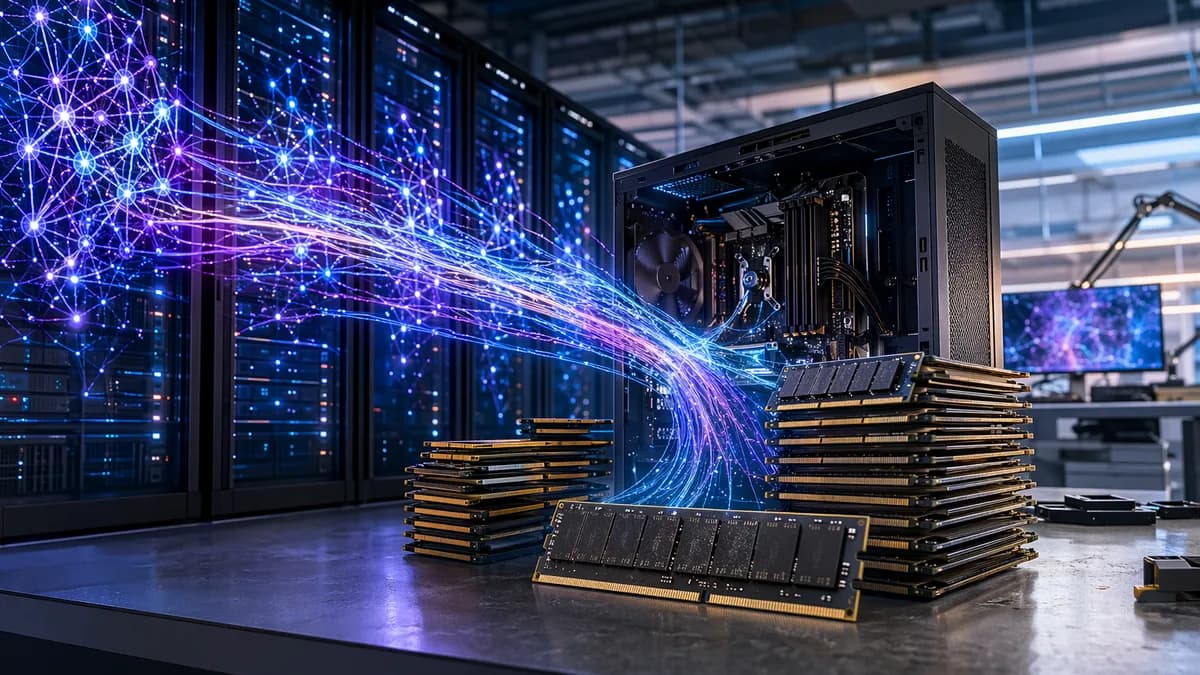
AI data centers are expected to absorb about 70% of all memory chips produced globally in 2026, and that is why RAM prices now look absurd to ordinary PC buyers.
TechnologyJune 28, 2026· 7 min read· By XOOMAR Insights Team
AI Data Centers Send RAM Prices Into a 4X Shock for PCs
Updated on June 29, 2026
XOOMAR Intelligence
Analyst Take
57/ 100
4 sources analyzedLow confidenceTrend10Freshness99Source Trust85Factual Grounding90Signal Cluster20
That number turns a boring upgrade part into a front-line AI supply-chain casualty. A 32GB DDR5 kit that cost about $100 to $120 around this time last year is now around $400, while a 32GB DDR4 kit that used to run $60 to $70 is now over $200, according to ZDNet. This is not just a retail markup story. It is a supply allocation story.
AI data centers are turning consumer RAM into collateral damage
PC buyers are paying for the AI buildout even when they are not buying AI hardware. They are just trying to add a DIMM kit, configure a laptop with more memory, or keep a low-cost device from feeling underpowered.
The pressure starts at the top of the market. AI infrastructure buyers need huge amounts of HBM, LPDDR5X, and server memory. ZDNet cites a single server rack consuming 20TB of HBM3E and 17TB of LPDDR5X, with that LPDDR5X alone equal to enough memory for a thousand laptops.
That demand pulls memory makers toward higher-margin enterprise products. Once Samsung, SK Hynix, Micron, and other suppliers tilt production toward AI customers, consumer RAM becomes the market’s release valve. Fewer cheap kits. More expensive upgrades. Less room for PC makers to hide component inflation.
For readers tracking the consumer spillover, this connects directly with XOOMAR’s related coverage of AI data centers turning RAM prices against cheap new PCs, Apple price hikes dumping AI data center costs on buyers, and the Apple RAM shortage threatening Macs.
The numbers behind the 4X RAM prices shock
The headline figure is brutal because it lands in familiar shopping terms. A common 32GB DDR5 kit moving from roughly $100 to $120 to about $400 means buyers are staring at a near 4X jump for a mainstream upgrade.
DDR4 has not offered much shelter. The older standard is also up sharply, with ZDNet citing a move from $60 to $70 for a 32GB kit last year to over $200 now.
The squeeze has also reached legacy memory. ZDNet says DDR2 prices rose about 60% in Q2 2026 alone, and TrendForce expects another 35% to 40% increase over the next quarter. That matters because some manufacturers tried to avoid higher DDR5 and DDR4 costs by stepping back to older memory technologies.
G.Skill cited “unprecedented high demand from the AI industry” as the reason behind skyrocketing prices.
The point is not that every memory product is interchangeable. HBM, LPDDR5X, DDR5, and DDR4 serve different roles. The problem is that they sit inside the same constrained production universe, where contract buyers, fab priorities, inventory levels, and PC-maker negotiations determine what actually reaches consumers.
Nvidia-class AI servers are squeezing ordinary DDR5 buyers
AI servers do not just need more memory. They need memory that can feed accelerators fast enough to keep expensive compute from sitting idle. That makes High Bandwidth Memory strategically valuable.
ZDNet’s Nvidia example shows the scale: a single Nvidia GB300 setup can contain enough LPDDR5X RAM for a thousand laptops. Multiply that by thousands of racks inside a data center, and consumer PC demand looks small next to AI infrastructure procurement.
Memory suppliers are behaving rationally. If AI customers will pay premium prices for server DRAM and HBM, manufacturers have little reason to flood the channel with cheap consumer kits. ZDNet also notes that Micron shuttered its consumer-facing Crucial memory brand earlier this year to focus on enterprise AI customers.
That single move says more than any slogan. The money is not in the budget desktop build. It is in the AI cluster.
PC makers, gamers, cloud buyers, and suppliers want different RAM markets
Consumers and gamers want the old market back: cheap 32GB kits, painless laptop upgrades, and affordable headroom for heavier apps. They are not getting it.
PC makers face worse choices. They can absorb higher component costs, raise prices, cut base specs, or push buyers into expensive memory tiers. None of those options feels good when buyers already expect more RAM from modern systems.
Cloud and AI infrastructure buyers sit on the other side of the table. For them, memory is tied directly to training, inference, and revenue-generating capacity. Paying more can still make sense if it unlocks more compute throughput.
Memory suppliers have their own incentive. After years of painful memory cycles, they are not likely to prioritize cheap consumer abundance while AI customers are competing for capacity. That is also why XOOMAR’s coverage of Blacklisted CXMT Pulls Apple Into Trump Memory Fight matters for readers watching how memory supply decisions can spill into consumer hardware.
Legacy RAM did not escape the blast radius
The strangest part of this cycle is that even old memory is getting dragged higher.
ZDNet says manufacturers looking for cheaper RAM have turned to DDR3, released in 2007, and DDR2, released in 2003. Those standards had mostly disappeared from consumer PCs, but they still served industrial equipment, medical devices, automotive systems, networking gear, and other legacy deployments.
Now that demand has returned, prices have spiked. The catch is that DDR2 is not a practical escape hatch for most modern users. ZDNet notes that DDR2 is not supported by Windows 11-era processors, so a pile of cheaper old modules would not solve the problem for anyone trying to build or upgrade a current PC.
There is another pressure point outside AI: helium. ZDNet reports that the 2026 war in Iran, repeated attacks, and the closure of the Strait of Hormuz have affected supplies from Qatar, contributing to the disappearance of a third of the world’s helium supply. Since helium plays a role in semiconductor manufacturing, that adds stress to an already tight market.
Higher RAM prices change how buyers should configure PCs
For consumers, memory decisions now carry more financial weight. Buying enough RAM upfront may be safer on laptops with soldered memory, because upgrades later may be impossible or more expensive.
For builders, timing matters. Waiting for sales can still help, but ZDNet’s most optimistic estimate for easing shortages is the second half of 2027. Even then, the article says prices could remain 60% to 100% above 2024 levels.
For small businesses and IT teams, the budgeting problem is sharper. Standardizing on higher-RAM machines gets harder just as heavier browsers, modern operating systems, and AI-enabled software make low-memory systems age faster.
Smartphone buyers are exposed too. ZDNet says smartphone prices have already increased by as much as 25%, with budget phones under $300 hit hardest. Some manufacturers now face a choice between raising prices and “spec shrinkflation,” cutting RAM and storage to hold sticker prices down.
Memory prices may not normalize until AI supply stops losing the race
RAM prices are likely to stay elevated while AI infrastructure buyers keep absorbing supply and memory makers keep prioritizing high-margin server products.
The clearest relief would come from new capacity, weaker AI demand, or a shift in production priorities. But ZDNet notes that new RAM plants take years before producing their first wafer, and even then, manufacturers are expected to prioritize AI customers.
The evidence to watch is concrete: whether 32GB DDR5 kits stop rising, whether DDR4 and DDR2 stabilize, whether PC makers restore richer base configurations, and whether memory suppliers signal more consumer allocation. Until then, the AI boom has moved from an abstract capital-spending story into everyday hardware pricing. RAM prices are where many buyers will feel it first.
The Bottom Line
- AI data centers are absorbing memory supply that ordinary PC buyers depend on.
- Basic PC upgrades are becoming much more expensive, with common 32GB kits rising sharply.
- Manufacturers prioritizing enterprise memory could keep consumer RAM prices elevated.
32GB RAM Kit Price Shift
| Memory type | Last year | Now | Driver |
|---|---|---|---|
| DDR5 | $100 to $120 | About $400 | AI data center demand pulling supply toward higher-margin memory |
| DDR4 | $60 to $70 | Over $200 | Reduced consumer RAM supply as manufacturers prioritize enterprise buyers |
Reported 32GB RAM Kit Prices
DDR5 last year low
$100
DDR5 last year high
$120
DDR5 now
$400
DDR4 last year low
$60
DDR4 last year high
$70
DDR4 now
$200
Sources
- [1] ZDNet
- [2] The DRAM shortage explained: AI, rising prices, and what’s next
- [3] Why Is RAM So Expensive Now? The Full Story Behind the 2026 Memory Crisis - DataWider
- [4] Bewildered enthusiasts decry memory price increases of 100% or more — the AI RAM squeeze is finally starting to hit PC builders where it hurts

Written by
XOOMAR Insights Team
Research and Editorial Desk
The XOOMAR Insights Team pairs automated research with human editorial judgment. We track hundreds of sources across technology, fintech, trading, SaaS, and cybersecurity, cross-check the facts, and explain what happened, why it matters, and what to watch next. We do not just rewrite headlines. Every article is fact-checked and scored for reliability before it goes live, and we link back to the original sources so you can verify anything yourself.
Explore More Topics
Related Articles
 Technology
Samsung's Galaxy Watch Ultra 2 Beats Apple Watch in Run Test
In a real-world 10K test, the Samsung Galaxy Watch Ultra 2 outperformed the Apple Watch Ultra 2 for a dedicated runner in three key areas, challenging Apple's p
Aug 10, 20267 min
 Technology
Your Phone Battery Myths Are Costing You Money
Most common phone charging tips are based on old battery tech and actively harm modern lithium-ion batteries, creating unnecessary anxiety and potential cost.
Aug 9, 20266 min
 Technology
Samsung Z Fold Ultra Confusion Masks Foldable Niche
Samsung's new Galaxy Z Fold 8 Ultra uses the 'Ultra' badge not for breakthrough innovation, but to defend its current foldable user base with polished specs ahe
Aug 8, 20266 min
 Technology
Apple Splits iPhone 18 Launch, Delays Base Model Until 2027
Apple is fracturing its iconic September launch, planning to debut only iPhone 18 Pro models this fall and holding the standard iPhone 18 until 2027.
Aug 12, 20267 min
 Fintech
Bank of England Bets on Crypto for UK Trade Finance
The Bank of England is building a single automated payment flow combining a CBDC and stablecoins, specifically to speed up trade finance and unlock working capi
Aug 12, 20266 min
 Fintech
Banks Revolt Against Regulator's Crypto 'Live Surveillance
Major US bank groups are fighting a new OCC rule demanding weekly, transactional-level reports on stablecoin activity, arguing the profound compliance burden co
Aug 12, 20266 min
 Technology
Australia Forces Tech Giants Pay News Publishers
Australia's major parties united to pass a law forcing digital platforms like Meta and Google to pay media companies for news content, shifting from negotiation
Aug 12, 20266 min
 Cybersecurity
Germany Scraps Postwar Spy Curbs After Security Lapses
Germany dismantles the core legal restrictions on its intelligence agencies established after WWII, a historic pivot from defensive caution toward proactive, of
Aug 12, 20265 min
 Fintech
Western Union Buys a Sinking Ship for $500 Million
Western Union's $500 million deal for remittance firm Intermex looks disastrous as revenue plunges 18%, revealing the company's frantic—and failing—defense agai
Aug 12, 20266 min
 Technology
AI's Founders Declare Open Models Unstoppable
Three AI pioneers argue that open-weight models are an irreversible reality, and the US must compete within that open world or risk ceding control to a closed e
Aug 12, 20266 min
Don't miss the signal
Get our weekly roundup of the stories that matter across tech, fintech, and trading. No noise, just signal.
Free forever. No spam. Unsubscribe anytime.