
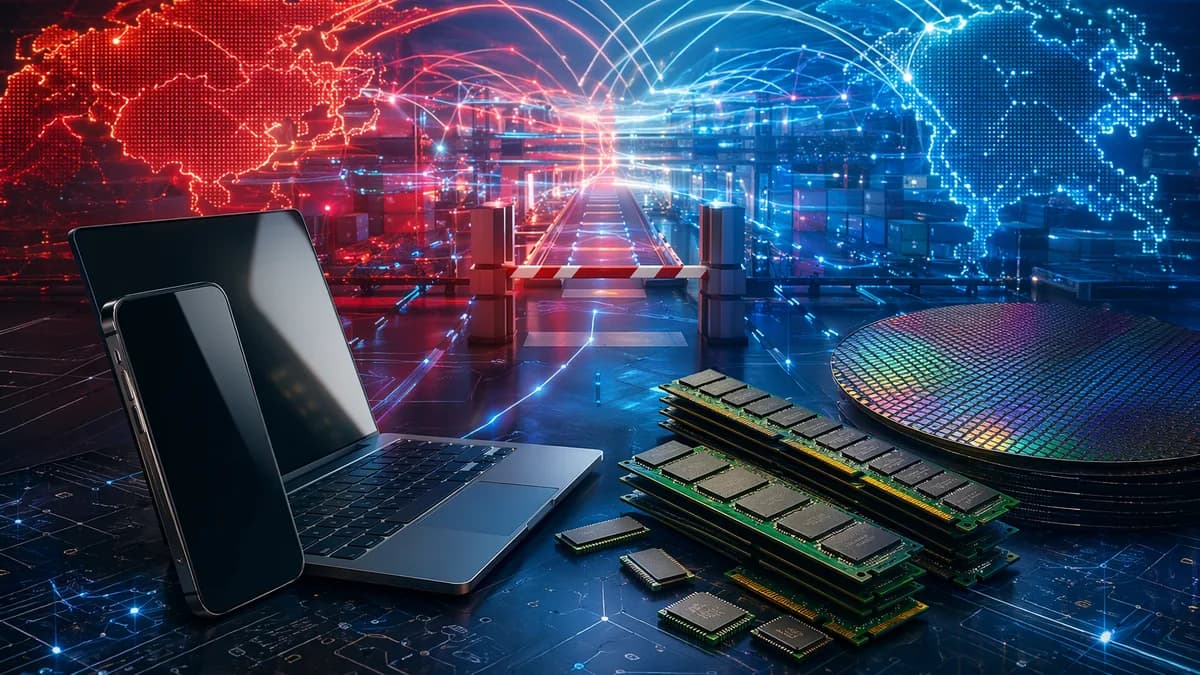
Apple CXMT is a supply-chain request with a political fuse: Apple can reportedly buy RAM from ChangXin Memory Technologies legally, but it wants the Trump administration’s blessing before touching a supplier the Pentagon has blacklisted over alleged ties to the People’s Liberation Army.
TechnologyJune 27, 2026· 7 min read· By XOOMAR Insights Team
Blacklisted CXMT Pulls Apple Into Trump Memory Fight
Updated on June 28, 2026
XOOMAR Intelligence
Analyst Take
69/ 100
4 sources analyzedMedium confidenceTrend10Freshness99Source Trust88Factual Grounding93Signal Cluster20
That distinction is the whole story. Apple is not asking because the law plainly blocks the purchase. It’s asking because the reputational and political cost could be brutal, especially while RAM and storage prices are already forcing hardware price hikes, according to The Verge.
Apple CXMT Request Turns a Memory Shortage Into a China Risk Test
Apple’s reported request converts a component-cost problem into a test of U.S. China policy. The company wants relief from memory-price pressure, but the alternative supplier sits inside Washington’s national-security risk zone.
The key legal point is narrow. CXMT is on the Pentagon’s Chinese Military Company Blacklist, also known as the 1260H list, but that status does not automatically ban Apple from buying its chips. The political point is much wider. A company tied by the Pentagon to China’s military is not a normal supplier for the most visible U.S. consumer-tech brand.
XOOMAR analysis: This is less about one batch of RAM and more about who pays when geopolitics enters the bill of materials. If Washington says yes, Apple gets more sourcing flexibility. If Washington says no, the memory shortage remains a direct cost problem for Apple and, potentially, its customers.
This follows the same pressure we covered in Apple Price Hikes Dump AI Data Center Costs on Buyers, where memory and storage inflation moved from supplier negotiations into retail pricing.
Memory Inflation Is Pushing Apple Toward Alternative RAM Suppliers
The reported Apple CXMT push comes after sharp increases in RAM and storage costs. The Verge says skyrocketing RAM and storage prices drove Apple to raise prices on almost all of its products this week.
Other supplied reporting adds the same basic picture: the broader tech industry is struggling to keep manufacturing costs down as memory demand stays hot. AI infrastructure buyers are taking a larger share of supply, which leaves consumer-device makers with fewer cheap options.
That matters because memory is not a niche part in Apple’s hardware stack. Macs, iPads, iPhones and other Apple devices all depend on predictable access to DRAM and storage. When those components rise quickly, Apple has three bad choices:
- Absorb the cost: Protect demand, pressure margins.
- Raise prices: Protect margins, test customers.
- Find new suppliers: Reduce pressure, accept operational and political risk.
Apple has already moved some of the burden to buyers. The company’s next move appears to be finding more room in procurement. For more on how AI-related demand is distorting the memory market for consumer hardware, see our analysis of how AI Data Centers Turn RAM Prices Against Cheap New PCs.
CXMT’s Pentagon Blacklist Status Creates a Problem Apple Can’t Engineer Away
ChangXin Memory Technologies, or CXMT, is a Chinese memory-chip supplier. The supplied sources describe it as a maker of commodity DRAM products, including DDR5, LPDDR5X, LPDDR4X, RDIMM and MRDIMM modules. The same material says it does not produce HBM, the premium high bandwidth memory used in AI accelerators.
That distinction limits the competitive read-through. Apple’s reported interest appears tied to mainstream memory used in consumer devices, not the AI-memory segment driving demand for high-end chips.
Still, CXMT’s blacklist status changes the optics. The Pentagon list reflects U.S. government concerns about alleged links to the People’s Liberation Army. Apple may be allowed to buy from CXMT, but it would be hard to explain why a U.S. tech champion is turning to a Pentagon-blacklisted Chinese supplier while Washington is trying to build more secure technology supply chains.
John Moolenaar, Republican chair of the House China committee, made the political risk explicit in comments to the Financial Times quoted by The Verge:
“Apple choosing to partner with a Chinese military company would be a grave mistake... Helping the [Chinese Communist Party] succeed in its plans to dominate critical supply chains will make our country’s tech industry and economy more dependent on China at a time when we must build secure tech supply chains with our allies,”
XOOMAR analysis: Apple can solve many supply-chain problems with scale, engineering discipline and supplier pressure. It can’t engineer away a congressional sound bite like that.
The Entity List Shadow Makes Approval Riskier Than a Simple Waiver
CXMT’s current status is not the only concern. The Verge reports that CXMT was on a list of proposed additions to the Commerce Department’s Entity List, but the move was held off because the White House was in trade negotiations with China.
That leaves Apple facing two separate risks.
| Issue | Current status from supplied material | Risk to Apple |
|---|---|---|
| Pentagon blacklist | CXMT is listed over alleged ties to the People’s Liberation Army | Reputational damage and political backlash |
| Entity List | CXMT was proposed for addition, but not added | Future trade restrictions could disrupt supply |
| Apple purchase legality | Apple is not currently barred from buying CXMT chips | Legal permission may not protect against public scrutiny |
The Entity List risk matters because it could turn today’s workaround into tomorrow’s supply disruption. Apple might secure approval, qualify parts, and still face a later policy shift that cuts off the channel.
That is why the request is not just procurement. It’s a bet on Washington’s future posture toward CXMT.
Washington, Apple Investors and Consumers Are Pulling in Different Directions
The U.S. government has no easy answer. National-security officials may see approval as weakening pressure on Chinese technology firms. Trade and economic officials may see a major American company struggling with input costs that are already feeding into consumer prices.
Apple’s incentives are clearer. Management wants supplier flexibility, more predictable memory access and protection against another round of cost pressure. Even if CXMT never becomes a major Apple supplier, the request could signal to existing memory vendors that Apple is searching for alternatives.
Consumers sit at the end of that chain. They don’t need to understand the 1260H list to feel the result. They see higher Mac or iPad prices, more expensive storage configurations, or fewer generous discounts.
Investors will watch both sides of the equation. A cheaper or more flexible memory source could support margins. A political fight over a blacklisted Chinese supplier could create a different kind of overhang.
Apple CXMT Has Three Plausible Paths From Here
The first path is a narrow approval. Washington could give Apple limited permission, attach conditions, and frame the decision as a one-off response to memory-market stress. That would give Apple some room without openly rewriting blacklist policy.
The second path is delay or rejection. In that scenario, Apple keeps leaning on existing suppliers, absorbs more cost, raises prices again, or adjusts product configurations to protect margins.
The third path is bargaining theater. Apple may use the CXMT request to pressure other memory suppliers, even if it never buys large volumes from the Chinese company.
The evidence to watch is specific: whether the Trump administration grants approval, whether Congress escalates criticism, and whether CXMT moves closer to the Entity List. If Apple gets a narrow waiver without major backlash, the thesis strengthens that supply-chain inflation can bend political red lines. If the request stalls or triggers a public fight, the lesson is colder: memory prices are now geopolitical prices too.
Impact Analysis
- Apple’s request shows how U.S.-China tensions can directly affect consumer-tech supply chains.
- Memory and storage inflation could translate into higher prices for Apple hardware buyers.
- A green light for CXMT would test how far Washington will let major U.S. companies rely on blacklisted Chinese suppliers.
Potential Outcomes of Apple's CXMT Request
| Scenario | Implication for Apple | Reader Impact |
|---|---|---|
| Washington says yes | Apple gains more sourcing flexibility for RAM amid memory-price pressure | Could help limit hardware price increases tied to component costs |
| Washington says no | Apple remains exposed to memory shortages and higher supplier costs | Customers may face more price pressure on devices |
Sources

Written by
XOOMAR Insights Team
Research and Editorial Desk
The XOOMAR Insights Team pairs automated research with human editorial judgment. We track hundreds of sources across technology, fintech, trading, SaaS, and cybersecurity, cross-check the facts, and explain what happened, why it matters, and what to watch next. We do not just rewrite headlines. Every article is fact-checked and scored for reliability before it goes live, and we link back to the original sources so you can verify anything yourself.
Explore More Topics
Related Articles
 Technology
Apple Splits iPhone 18 Launch, Delays Base Model Until 2027
Apple is fracturing its iconic September launch, planning to debut only iPhone 18 Pro models this fall and holding the standard iPhone 18 until 2027.
Aug 12, 20267 min
 Technology
Pentagon Bets $1.4B on China-Free Battery Breakthrough
The Pentagon issued a $1.4 billion loan to Sila Nanotechnologies to build next-generation batteries in the U.S., a direct move to break China's grip on critical
Aug 10, 20265 min
 Technology
Samsung's Galaxy Watch Ultra 2 Beats Apple Watch in Run Test
In a real-world 10K test, the Samsung Galaxy Watch Ultra 2 outperformed the Apple Watch Ultra 2 for a dedicated runner in three key areas, challenging Apple's p
Aug 10, 20267 min
 Technology
Honda's Profit Doubles After Worst Annual Loss Ever
Honda's quarterly profit more than doubled to $2.9 billion in a dramatic recovery, just months after posting its first-ever annual loss, driven by vehicle sales
Aug 9, 20264 min
 Technology
OpenAI Calls Apple Lawsuit 'Rotten to Its Core'
OpenAI has moved to dismiss Apple's trade secrets lawsuit, framing it as a baseless and reactive attempt to smear a competitor. The filing accuses Apple of tryi
Aug 8, 20266 min
 Trading
Why China's Yuan Is Stuck in Glue as Fed Tightens
The Chinese yuan is frozen in an extreme trading range, a direct result of the collision between Federal Reserve hawkishness and Beijing's economic stimulus eff
Aug 11, 20268 min
 Global Trends
Secret Service Decoy Lures Assassins Away From Trump
The Secret Service protects presidents through a constant, high-stakes shell game of decoy limousines, fake motorcades, and secret aircraft swaps designed to ma
Aug 12, 20267 min
 Cybersecurity
Germany Scraps Postwar Spy Curbs After Security Lapses
Germany dismantles the core legal restrictions on its intelligence agencies established after WWII, a historic pivot from defensive caution toward proactive, of
Aug 12, 20265 min
 Fintech
Western Union Buys a Sinking Ship for $500 Million
Western Union's $500 million deal for remittance firm Intermex looks disastrous as revenue plunges 18%, revealing the company's frantic—and failing—defense agai
Aug 12, 20266 min
 Technology
AI's Founders Declare Open Models Unstoppable
Three AI pioneers argue that open-weight models are an irreversible reality, and the US must compete within that open world or risk ceding control to a closed e
Aug 12, 20266 min
Don't miss the signal
Get our weekly roundup of the stories that matter across tech, fintech, and trading. No noise, just signal.
Free forever. No spam. Unsubscribe anytime.