
Honda’s quarterly profit more than doubled to 456.9 billion yen ($2.9 billion), a stunning reversal just months after the automaker posted its first ever annual loss according to ABC International.

TechnologyAugust 9, 2026· 4 min read· By XOOMAR Insights Team
Honda's Profit Doubles After Worst Annual Loss Ever
Updated on August 9, 2026
XOOMAR Intelligence
Analyst Take
57/ 100
2 sources analyzedLow confidenceTrend10Freshness98Source Trust85Factual Grounding92Signal Cluster20
The results for the fiscal first quarter ending June 30, 2026, show sales rising 13.5% to 6.06 trillion yen ($38 billion). The performance, driven by strong vehicle sales in the U.S. and India as well as lucrative motorcycle operations, sent Honda shares up 3.9% in Tokyo trading.
This surge follows a historic 423.9 billion yen ($2.7 billion) loss for the fiscal year ended in March.
From Red Ink to Record Profits in One Quarter
The magnitude of the swing is stark. Profit surged from 196.6 billion yen a year ago to 456.9 billion yen this quarter. Chief Financial Officer Masao Kawaguchi called the overall results "very healthy," crediting a favorable exchange rate as a key factor.
A weak yen during the quarter boosted the value of Honda's overseas earnings when converted back to its home currency. This external boost coincided with solid operational performance: car sales grew in Japan and the U.S., while motorcycle sales were strong in Brazil and India.
“For that, we must fully utilize our resources in that market,” Kawaguchi told reporters regarding China, a market where car sales are currently struggling.
He cautioned that tailoring models for Chinese buyers may still take another year or two.
The Turnaround Pillars: Ice and Fire
Honda's recovery rests on two divergent product lines: its core auto business and its powerhouse motorcycle division.
Motorcycles: The Cash Engine The company reported its motorcycle operations were "highly lucrative," a consistent bright spot. This division provides a steady profit stream less susceptible to the capital-intensive shifts rocking the auto industry.
Automobiles: Regionally Divergent The auto business showed a split personality. While U.S. and Indian sales provided strength, the Chinese market remains a stubborn challenge. This geographic imbalance forces Honda to run a dual strategy: milking strong markets while reinvesting to solve weak ones.
This follows a broader pattern of Asian economic realignment, similar to the currency dynamics seen in our report on the Secret US-Japan Deal Propels Korean Won to Top Asian Currency.
The company also raised its full-year profit forecast to 400 billion yen ($2.5 billion), up from a previous estimate of 260 billion yen.
The EV Retreat That Fueled a Comeback
XOOMAR Analysis: The source material points to a direct, painful link between Honda's prior loss and its electric vehicle ambitions. The company acknowledged that heavy costs for its EV plans contributed to the annual loss, as those plans "didn’t measure up to original ambitions."
The reasons were both political and commercial. The administration of U.S. President Donald Trump pulled back on EV incentives and funding for charging stations. Concurrently, analysts say many consumers weren't ready to go electric. Honda's response was drastic: it abandoned many of its plans for EV models.
This strategic retreat, while damaging to its long-term electrification image, appears to have stopped the financial bleeding in the short term. The quarterly results suggest resources were reallocated to support profitable, existing internal combustion engine vehicle lines.
XOOMAR Inference: The results imply Honda is now running a classic holding pattern: generating robust profits from its legacy business to buy time and capital for a later, more cautious move into electrification.
Earthquake Clouds an Otherwise Sunny Forecast
A new, unforeseen challenge has emerged. All Japanese automakers, including Honda, were impacted by a 7.1 magnitude earthquake in Kumamoto last week.
The quake temporarily halted some production lines and disrupted supply chains. Honda officials said they hope operations return to normal after the company's summer break later this month, but the exact impact on vehicle production is still unclear.
Natural disasters pose a recurring risk to Japan's industrial base, a reality underscore by events like those detailed in Surgeons Shield Patient During Japanese Hospital Quake.
What Honda's Profit Rebound Actually Means
The 456.9 billion yen profit is not just a number. It's a lifeline. It provides Honda with the financial buffer and investor confidence needed to navigate a transformed automotive landscape.
The Watch: The tension is now between the urgent and the important. The urgent is maintaining this profit momentum amid earthquake disruptions and a weak Chinese market. The important is figuring out a viable, capital-light path into electrification after its initial plans failed.
Kawaguchi's timeline for fixing China, "another year or two", indicates the company believes it has that much runway. The raised annual forecast suggests management agrees. Honda's story is no longer about survival from loss, but about what it builds with its hard-won profit.
The Bottom Line
- Honda's rapid recovery from its first-ever annual loss to record quarterly profits signals the company's resilience and effective crisis management.
- The results have immediate market impact, boosting investor confidence and sending Honda's shares up 3.9% in Tokyo trading.
- The divergent performance between Honda's struggling auto business in China and its lucrative global motorcycle division reveals where the company's current and future growth lies.
Honda's Financial Turnaround: Before & After
| Metric | Previous Fiscal Year | Latest Quarter (Q1 2026) |
|---|---|---|
| Profit/Loss | 423.9 billion yen loss | 456.9 billion yen profit |
| Sales (Quarterly) | Not provided | 6.06 trillion yen |
| Sales Growth (YoY) | Not applicable | 13.5% |
Honda's Quarterly Profit Surge
Q1 2025 (Previous Year)
billion yen196.6
Q1 2026 (Latest)
billion yen456.9
Sources

Written by
XOOMAR Insights Team
Research and Editorial Desk
The XOOMAR Insights Team pairs automated research with human editorial judgment. We track hundreds of sources across technology, fintech, trading, SaaS, and cybersecurity, cross-check the facts, and explain what happened, why it matters, and what to watch next. We do not just rewrite headlines. Every article is fact-checked and scored for reliability before it goes live, and we link back to the original sources so you can verify anything yourself.
Explore More Topics
Related Articles
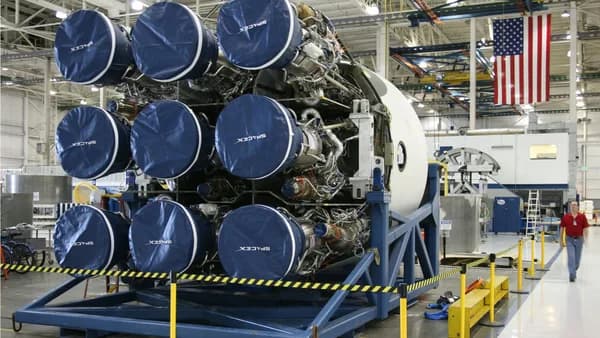 Technology
SpaceX Posts $540 Million Bitcoin Loss As Launch Earnings Soar
SpaceX reported a $540 million net loss driven by a bitcoin price slump, even while its core rocket and Starlink revenue blew past Wall Street forecasts.
Aug 4, 20264 min
 Technology
Lucid Delays Its Affordable EV to Avert 'Existential' Crisis
Lucid Motors delayed its vital $50k Cosmos EV by over a year, pivoting from mass-market dreams to survival mode with deep cuts and a risky bet on robotaxis.
Aug 5, 20265 min
 Technology
Amazon's Gas Plant Permits 33 Million Tons of CO2
Amazon's planned Texas data center, powered by a dedicated natural gas plant, has a permit to emit 33 million tons of CO2 annually, potentially making it the la
Aug 8, 20267 min
 Technology
DeepSeek Demands $8bn as China's AI Plays Catch-Up
DeepSeek is pushing to close an $8 billion funding round at a $74 billion valuation, a massive jump just weeks after its last raise, underscoring China's aggres
Aug 6, 20264 min
 Technology
Nintendo Hides $300M Tariff Refund From Buyers
Nintendo booked a massive $902 million quarterly profit, supercharged by a $300 million US tariff refund it has no plans to pass on to the customers who origina
Aug 6, 20267 min
 Cybersecurity
Silicon Dust Precedes Troops as Cyber War Becomes First Strike
Cyber operations are no longer a shadow war. They're now the first, required phase of modern military conflict, degrading an enemy's systems before traditional
Aug 9, 20266 min
 Global Trends
Nagasaki Mayor Labels Nuclear Deterrence a 'Fragile Gamble'
Nagasaki's mayor used the atomic bombing anniversary to call nuclear deterrence theory fragile and dangerous, arguing it makes a nuclear war more likely.
Aug 9, 20267 min
 Global Trends
Americans Face Empty Tables as Avocado Pipeline Shuts
America's avocado supply chain from Mexico, worth $3.65 billion annually, is frozen after the U.S. government suspended all operations—including safety inspecti
Aug 9, 20265 min
 Fintech
BlackRock Dominates Bitcoin ETF Flows With $693 Million Haul
BlackRock's iShares Bitcoin Trust attracted over 80% of all new money flowing into spot Bitcoin ETFs last week, highlighting a dramatic concentration of institu
Aug 9, 20264 min
 Cybersecurity
Adversarial Fashions Foil Surveillance Cameras
A researcher created a printed pattern that scrambles AI vision systems, making people and vehicles undetectable to automated surveillance cameras.
Aug 9, 20266 min
Don't miss the signal
Get our weekly roundup of the stories that matter across tech, fintech, and trading. No noise, just signal.
Free forever. No spam. Unsubscribe anytime.