
On the 81st anniversary of the atomic bombing of Nagasaki, the city's mayor used the somber occasion to launch a direct, scathing attack on the foundational logic of global nuclear arsenals, labeling deterrence theory a dangerous gamble that increases "the risk of a nuclear war" according to ABC International. This declaration at the Peace Park ceremony, attended by representatives from more than 90 countries, was not merely a plea for peace but a targeted political challenge, coming as Japan's government simultaneously moves to "further bolster the military's offensive capability."
Global TrendsAugust 9, 2026· 7 min read· By XOOMAR Insights Team
Nagasaki Mayor Labels Nuclear Deterrence a 'Fragile Gamble'
Updated on August 9, 2026
XOOMAR Intelligence
Analyst Take
58/ 100
4 sources analyzedLow confidenceTrend10Freshness98Source Trust85Factual Grounding96Signal Cluster20
XOOMAR Interpretation: Nagasaki's leadership is strategically weaponizing its horrific legacy. The timing transforms the annual memorial from a ritual of remembrance into a live policy critique, directly confronting the security doctrines that underpin alliances like the one protecting Japan itself. It's a moral argument delivered with geopolitical precision.
Nagasaki's Mayor Delivers a Brutal Rebuke to Nuclear Deterrence Theory
Mayor Shiro Suzuki's speech framed the day's remembrance around a singular, provocative thesis, the nuclear deterrence theory is "extremely dangerous and fragile." He categorically rejected the notion of nuclear weapons as a "necessary evil," branding them instead as an "absolute evil" that can never coexist with humanity.
His warning was explicit and devoid of diplomatic hedging. "To all leaders of the nuclear states and nations relying on nuclear deterrence, you must face the reality that the more you rely on nuclear deterrence, the more you increase the risk of a nuclear war," Suzuki said.
“The theory of nuclear deterrence is extremely dangerous and fragile. Nuclear weapons are not a ‘necessary evil’ but an ‘absolute evil,’ and can never coexist with humanity,”
This is a significant escalation in rhetoric. The critique moves beyond abstract pacifism to challenge the core strategic calculus of the United States, China, Russia, France, the UK, and implicitly, Japan's own security posture under the U.S. nuclear umbrella. The speech served as an on the ground rebuke to the very concept of extended deterrence that Tokyo officially depends on for its national security.
A Clash of Visions While the Nation Mourns
The ceremony became a stage for starkly contrasting visions of security. While Mayor Suzuki demanded the Japanese government adhere strictly to its three postwar non-nuclear principles, Prime Minister Sanae Takaichi offered a carefully calibrated, ambiguous response.
Takaichi, who supports nuclear deterrence, reiterated a policy of taking "a realistic and pragmatic approach" toward a world without nuclear weapons. Notably, she did not mention the Treaty on the Prohibition of Nuclear Weapons in her speech, a key demand from the mayor and survivors. She only stated that Japan "currently maintains" the non nuclear principles, a formulation that leaves the door open for future revision.
This tension is not academic. The anniversary coincided with Takaichi's government revising national defense policy to boost offensive military capability. As reported by the AP, "Speculation has risen about whether Takaichi, who supports nuclear dissuasion, may allow nuclear weapons to be brought into the country, going against the third non nuclear principle." Suzuki's speech was a preemptive strike against this very speculation.
The Fading Voices Fueling the Mayor's Urgency
The moral authority for Mayor Suzuki's stark warning rests with a rapidly vanishing group: the hibakusha, or atomic bomb survivors. Their demographic reality adds a layer of desperation to Nagasaki's message.
| Survivor Data | Figure |
|---|---|
| Current Number of Survivors | 91,105 |
| Percentage of Original Survivor Group | About a quarter |
| Average Age | Exceeding 86 years |
The source material explicitly notes that survivors "worry about fading memories, as the youngest of the survivors were too young to clearly recall the attack." This decline informs the city's diplomatic aggression. The window for policymakers to hear direct, living testimony from the only population on Earth to have suffered a nuclear attack is closing. Suzuki's blunt critique may stem from a belief that diplomatic niceties have failed and that time is running out to leverage this irreplaceable firsthand witness.
Survivor Sentiment: The source notes that survivors have "expressed frustration and criticized the Japanese government's support for nuclear deterrence for being insincere." Their protests in both Hiroshima and Nagasaki are a direct reaction to "growing concern about Takaichi's possible easing of the non nuclear principles." The mayor’s speech, therefore, functions as their amplified, official voice.
The Silent Stakeholder: Japan's Constitutional Identity
Beyond the immediate ceremony, the mayor's words land on a profound national fault line. By demanding the government uphold Japan's war-renouncing Constitution, Suzuki invoked the nation's postwar pacifist identity. This pits the moral legacy of the bombed cities against the "realist" security calculus of a nation facing a volatile regional environment.
XOOMAR Analysis: The conflict here is not just about weapons, but about national narrative. Can Japan remain a "peace nation" while sheltering under a nuclear umbrella and building offensive strike capability? Nagasaki's mayor argues these positions are fundamentally incompatible, asserting that relying on the "absolute evil" for security corrupts the nation's core principles. This creates an internal pressure point for the Takaichi government, forcing it to reconcile its security ambitions with a constitutional and historical identity that remains powerful for a significant segment of the populace.
The Unbearable Weight of Being the 'Second City' in the Nuclear Age
Nagasaki's historical position shapes its diplomatic tone. As the second city bombed, it represents a terrifying precedent: the normalization of nuclear use. Hiroshima was the shocking first. Nagasaki was the proof that the line, once crossed, could be crossed again within days.
This burden may fuel Nagasaki's more pointed, less abstract rhetoric. Its message isn't solely about the singular horror of a bomb, but about the chilling chain of escalation that two bombs represent. Suzuki’s warning that deterrence increases risk speaks directly to this history. From Nagasaki's perspective, the doctrine of mutual assured destruction (MAD) is not a stable theory but a proven failure, as the events of August 9, 1945, demonstrated that a nuclear threshold, once breached, leads to a second breach.
The mayor's urgency reflects a fear that the world has forgotten the lesson of Nagasaki specifically, that nuclear weapons are not just unusable, but repeatedly usable once the taboo is broken. His speech is an attempt to reclaim Nagasaki's specific historical lesson from the overshadowing memory of Hiroshima.
What Nagasaki's Warning Means for the Future of Arms Control
Mayor Suzuki's demands were concrete, moving the ceremony from symbolism to a diplomatic agenda. He called on the Japanese government to:
- Attend the Treaty on the Prohibition of Nuclear Weapons review conference later this year.
- Stick to the three non-nuclear principles.
These are actionable items. The first is a direct challenge to Japan's long standing refusal to engage with the ban treaty due to its reliance on the U.S. umbrella. The second is a defensive action aimed at halting a speculated policy shift by the Takaichi administration.
The Practical Test: The coming months will test the power of Nagasaki's voice. The world will watch whether Japan sends even an observer to the ban treaty meeting. More critically, when the government finalizes its new defense and security documents, the language around the third non-nuclear principle will reveal whether the warnings from the Peace Park were heeded or dismissed as idealistic.
The Vanishing Witnesses and the Looming Test of Memory
The mayor's forceful intervention is likely a recognition of a grim countdown. With the survivor population dwindling and aging past 86, the living, breathing link to the catastrophe is disappearing. The 91,105 hibakusha are the ultimate arbiters of the bombing's reality. Once they are gone, the testimony passes to archives, second generation stories, and institutional voices like the Nagasaki mayor's office.
This impending loss may necessitate a more confrontational, less sentimental diplomatic strategy. As firsthand memory fades, the institutional voice must amplify to maintain the moral authority of experience. Suzuki’s speech prefigures this future, where Nagasaki’s diplomacy may become even more pointed and policy focused, as it can no longer rely on survivors to embody the human cost.
The choice the mayor presents is stark, a world that listens to the hard earned, catastrophic logic of his city, or one that complacently marches toward the next, unthinkable ground zero. The test is not just for world leaders, but for Japan's own government, standing at the intersection of memory, morality, and a rapidly shifting definition of national security.
Impact Analysis
- The mayor's direct challenge to nuclear deterrence theory, delivered before representatives from over 90 countries, represents a high-profile geopolitical and moral escalation in nuclear disarmament debates.
- The rebuke directly contradicts the security stance of Japan's own government, which is bolstering its offensive military capabilities, creating a significant internal policy tension within a key U.S. ally.
- It marks a strategic shift for Nagasaki, transforming its annual memorial from a ritual of remembrance into a live, targeted critique of the foundational logic behind global nuclear arsenals and alliances.
Sources

Written by
XOOMAR Insights Team
Research and Editorial Desk
The XOOMAR Insights Team pairs automated research with human editorial judgment. We track hundreds of sources across technology, fintech, trading, SaaS, and cybersecurity, cross-check the facts, and explain what happened, why it matters, and what to watch next. We do not just rewrite headlines. Every article is fact-checked and scored for reliability before it goes live, and we link back to the original sources so you can verify anything yourself.
Explore More Topics
Related Articles
 Global Trends
Surgeons Shield Patient During Japanese Hospital Quake
Surgeons in Japan threw themselves over a patient during an earthquake mid-surgery, facing a split-second decision between finishing the operation or fleeing a
Aug 7, 20264 min
 Global Trends
13 Die as Japan Earthquake Traps People at Kumamoto Mall
A 6.8 Japan earthquake killed 13, forced 300,000 to shelter and turned a tsunami alert into a rescue fight in Kumamoto.
Aug 2, 20266 min
 Global Trends
Mall Floor Caves In as Japan Earthquake Kills 13 People
Rescuers are searching Aeon Mall after a deadly Japan earthquake collapsed part of the building and left people trapped.
Aug 2, 20266 min
 Global Trends
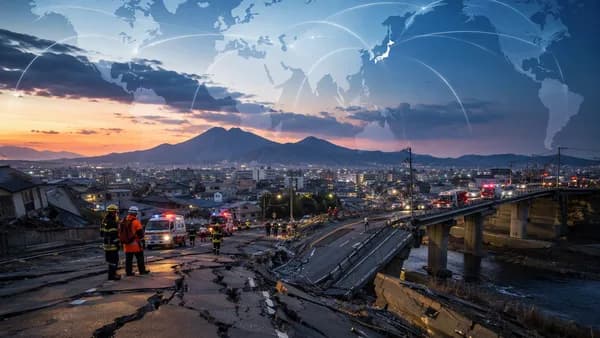
13 Dead as Japan Earthquake Rattles Kyushu's Lifelines
A 7.1 JMA quake killed 13 in Kumamoto, unleashed 100-plus aftershocks, and put Kyushu's infrastructure under the microscope.
Aug 1, 20267 min
 Global Trends
Mideast Powers Forge Pact Echoing NATO Mutual Defense
Saudi Arabia, Turkey, and Pakistan signed a pact vowing mutual defense like Article 5 of NATO, forming a Sunni bloc with a nuclear deterrent during a war with I
Aug 7, 20265 min
 Fintech
A Japan Logistics Giant Bets $38M on Crypto Payments
Japanese logistics giant AZ-COM Maruwa led a $38 million investment into stablecoin issuer JPYC and will use it to pay thousands of partners, marking one of Jap
Aug 9, 20264 min
 Future Fiction
The Unbind
In 2053, after the global rollout of fusion-powered resonant energy grids ends energy scarcity, geopolitical analyst Li Wei is tasked with monitoring global stability. Instead, she uncovers a growing subculture of "Unbinders" who voluntarily reject the wireless power field, revealing that true human connection may require a little friction.
Aug 9, 20269 min
 Cybersecurity
Silicon Dust Precedes Troops as Cyber War Becomes First Strike
Cyber operations are no longer a shadow war. They're now the first, required phase of modern military conflict, degrading an enemy's systems before traditional
Aug 9, 20266 min
 Technology
Windows 11 System Restore Rescues PCs in 60 Seconds
A step-by-step guide to enabling and using Windows 11's built-in System Restore, which can roll back system-breaking changes without affecting your personal fil
Aug 9, 20267 min
 Fintech
Nomura Risk Desk Powers $100M Private Credit Bet in Dubai
Nomura’s Laser Digital has taken a strategic stake in ZIGChain to become its risk oversight partner, targeting over $100 million in onchain private credit from
Aug 9, 20267 min
Don't miss the signal
Get our weekly roundup of the stories that matter across tech, fintech, and trading. No noise, just signal.
Free forever. No spam. Unsubscribe anytime.