
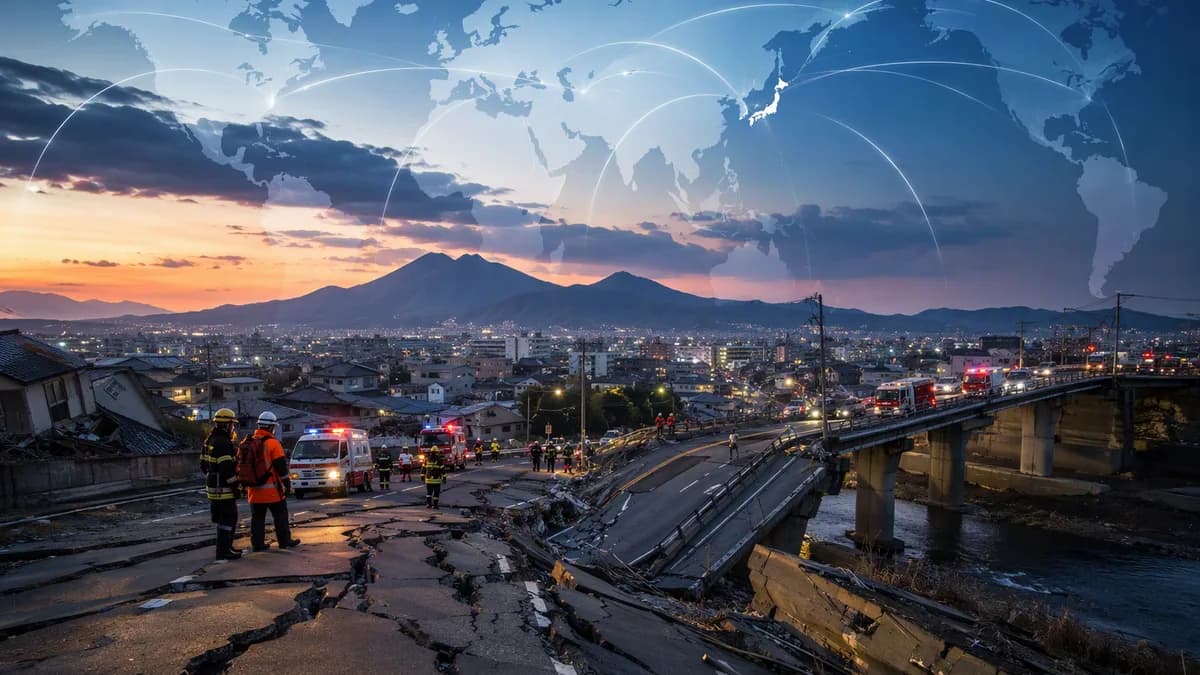
On Tuesday at 16:27 local time, the Japan earthquake in Kumamoto turned a normal afternoon on Kyushu into a rescue operation, a transport shutdown, and a test of how much stress even a highly prepared country can absorb at once.
Global TrendsAugust 1, 2026· 7 min read· By XOOMAR Insights Team
13 Dead as Japan Earthquake Rattles Kyushu's Lifelines
Updated on August 1, 2026
XOOMAR Intelligence
Analyst Take
60/ 100
4 sources analyzedLow confidenceTrend10Freshness96Source Trust92Factual Grounding94Signal Cluster40
The quake hit Kumamoto prefecture on Kyushu island, with the Japan Meteorological Agency reporting a 7.1 magnitude event and the US Geological Survey later measuring it at 6.8, according to BBC World. At least 13 people have died, rescue teams are searching collapsed sites, and the region faced more than 100 aftershocks on Wednesday.
That is the central signal beneath the headline. This is not just a casualty count. It is a live audit of malls, factories, rail lines, power systems, bridges, public alerts, and local disaster command.
Tuesday 16:27 in Kumamoto: the Japan earthquake became an infrastructure test
The quake struck Kumamoto prefecture at 07:27 GMT on Tuesday. Hundreds of thousands of people were told to move to evacuation shelters, while officials began assessing damage across transport, power, roads, and public infrastructure.
The geography matters. Kyushu is the third-largest of Japan’s four main islands and the second most populous. Kumamoto is also not new to seismic trauma. In 2016, powerful quakes in Kumamoto and neighboring Oita prefecture killed 278 people, according to NHK, as cited by the BBC.
That history changes how this earthquake will be read inside Japan. The immediate question is survival. The next question is whether rebuilt, repaired, inspected, or aging infrastructure performed as expected.
For readers tracking the casualty and rescue picture separately, see our related file: 13 Dead as Japan Earthquake Traps Survivors in Rubble.
Wednesday’s numbers: 7.1 by JMA, 6.8 by USGS, more than 100 aftershocks
The headline magnitude is already split between agencies: 7.1 from the JMA, 6.8 from the USGS. That does not mean one agency is “wrong.” Magnitude estimates often change as seismologists process more data.
Local damage also depends on more than magnitude. A quake’s depth, distance from population centers, ground conditions, and building performance can all shape the outcome. The source material does not confirm depth, so any deeper technical reading should wait.
Here is the verified operating picture so far:
| Item | Verified detail |
|---|---|
| Time | Tuesday, 16:27 local time (07:27 GMT) |
| Location | Kumamoto prefecture, Kyushu island |
| Magnitude | 7.1 reported by JMA, 6.8 later measured by USGS |
| Deaths | At least 13 people |
| Aftershocks | More than 100 on Wednesday; JMA warned more could follow |
| Power | 36,700 households without electricity, according to local officials |
| Rail | Trains suspended on Kyushu island, Japan Railways announced |
The phrase “cardiopulmonary arrest” also appears in reports. In Japan, it is often used in preliminary disaster reporting before a death is officially confirmed. That means casualty figures may change as rescuers and officials verify conditions at collapsed sites.
Aeon Mall and Yatsushiro show where the rescue clock is tightest
The most visible rescue operation is at Aeon Mall in Kumamoto. Mall president Akio Yoshida confirmed that three people died there and another three, all employees, were still missing. Officials said about 2,700 people were employed at the site.
Yoshida said four people were taken to hospital from the mall. One person was rescued from a restroom, and another person was in cardiopulmonary arrest.
“We sincerely apologise for this incident,” Yoshida said at a press conference on Wednesday.
A witness reported seeing an explosion and smoke after the quake and said the second floor collapsed. The mall’s operator told AFP that an explosion occurred after staff and customers had evacuated.
Another critical site is Nippon Paper’s Yatsushiro Plant, where police cited by NHK said a chimney reportedly collapsed. NHK reported that two people had no signs of life and nine others were unaccounted for. Reuters obtained an aerial photograph that appeared to show a broken and collapsed chimney.
These two sites now define the rescue challenge: large structures, trapped or missing people, unstable debris, and aftershocks that can turn every search operation into a second emergency.
Alerts moved fast, but useful guidance now matters more than alarm
Japan’s immediate warning chain moved quickly at the start. Trains were suspended on Kyushu island. Residents were told to evacuate. The JMA warned that more aftershocks could follow rather than treating the first quake as a finished event.
That warning is the practical center of the next phase. The danger is no longer only the original rupture. It is damaged structures, broken roads, unstable walls, suspended transport, power outages, and aftershocks that complicate rescue and inspection work.
For the aftershock dimension of the Japan earthquake, see our related coverage: 100 Aftershocks Turn Japan Earthquake Into Rescue Race.
XOOMAR analysis: the communication test now gets harder. Early warnings are blunt by design. Recovery guidance has to be more precise. Residents need to know which routes are open, which shelters are operating, where power remains out, and which buildings or roads to avoid. The source confirms road damage, rail suspension, power outages, and collapsed structures. It does not yet give a complete local map of access or shelter conditions.
Kumamoto Castle damage links this quake to Japan’s 2016 memory
The quake also damaged Kumamoto Castle, where historic walls at the 17th-century site tumbled. The symbolism is hard to miss because the castle was also damaged in 2016, when a 7.3 magnitude quake hit the region and parts of the 400-year-old structure collapsed, including turrets and curved walls.
A footbridge also collapsed in the Kumamoto region. The source says it is unclear whether anyone was injured or when the collapse happened. Traffic appeared to be moving on a parallel bridge.
This is where the Japan earthquake moves from emergency response into resilience assessment. A mall, a paper plant, a castle wall, a footbridge, roads, rail lines, and the power grid all registered stress in different ways. Some failures are life-threatening. Others are economic or logistical. Together, they show how a major quake fragments normal life across many systems at once.
Power cuts and rail suspensions are now verification problems
The current disruption is measurable but incomplete. 36,700 households are without electricity. Roads have been damaged. Japan Railways suspended trains on Kyushu island. What remains unclear from the supplied source is the full passenger impact of the rail disruption.
For residents, the priorities are immediate: shelter, credible updates, medical access where needed, and safe routes. For officials and operators, the task is inspection before restoration. A power line can be reconnected faster than public trust can be rebuilt after a premature reopening.
XOOMAR analysis: investors and businesses should treat the first damage snapshot as provisional. The source reports no market reaction, no supply-chain estimate, and no quantified industrial loss. What can be said is narrower but important: until rail, road, power, and plant inspections are complete, the economic read-through remains uncertain.
The next several days will decide whether this stays contained or widens
The next decision period is the immediate aftershock window, as the JMA warned more could follow. That is when aftershocks can endanger rescuers, worsen damaged structures, and delay the return of transport and power.
The evidence that would confirm a contained scenario is clear: missing people accounted for, no major structural failures from aftershocks, power restored, rail inspections completed, and evacuation orders narrowed. The evidence that would weaken it would be new collapses, a rising confirmed death toll, prolonged outages, or wider transport damage.
Japan will recover from this quake. The harder question is what inspectors, operators, and disaster officials find after the shaking stops. Preparedness is not a certificate a country earns once. In Kumamoto, it is being tested building by building, track by track, aftershock by aftershock.
Impact Analysis
- The quake has killed at least 13 people and triggered urgent rescue searches at collapsed sites.
- More than 100 aftershocks are keeping pressure on residents, emergency services, and infrastructure.
- The disaster tests Japan’s transport, power, road, and public alert systems in a region scarred by deadly 2016 quakes.
Japan Earthquake Measurements
| Source | Reported Magnitude | Context |
|---|---|---|
| Japan Meteorological Agency | 7.1 | Initial reported magnitude for Kumamoto quake |
| US Geological Survey | 6.8 | Later measurement cited by BBC World |
Reported Earthquake Magnitudes
JMA
magnitude7.1
USGS
magnitude6.8
Sources

Written by
XOOMAR Insights Team
Research and Editorial Desk
The XOOMAR Insights Team pairs automated research with human editorial judgment. We track hundreds of sources across technology, fintech, trading, SaaS, and cybersecurity, cross-check the facts, and explain what happened, why it matters, and what to watch next. We do not just rewrite headlines. Every article is fact-checked and scored for reliability before it goes live, and we link back to the original sources so you can verify anything yourself.
Explore More Topics
Related Articles
 Global Trends
13 Dead as Japan Earthquake Traps Survivors in Rubble
At least 13 are dead after the Kumamoto quake. Crews are digging through a collapsed mall and paper mill for survivors.
Jul 31, 20266 min
Global Trends150,000 Told to Evacuate as Japan Earthquake Injures Dozens
A 7.1 Japan earthquake injured dozens, triggered brief tsunami fears, and pushed 150,000 people toward shelters.
Jul 28, 20265 min
 Global Trends
100 Aftershocks Turn Japan Earthquake Into Rescue Race
More than 100 aftershocks hit Kyushu after a 6.8 quake killed 13, turning rescue work into a race against time.
Jul 29, 20265 min
 Trading
Yen Intervention Shock Knocks USD/JPY Into BOJ Test
A five-yen USD/JPY plunge put intervention risk back on the table and left the BOJ one night to make the yen bounce stick.
Aug 1, 20268 min
 Trading
UPS Earnings Crush Volume Myth With Amazon Retreat
UPS cut lower-yield Amazon packages, yet Q2 profit rose 21% as pricing and visibility turned fewer shipments into better margins.
Aug 1, 20266 min
 Fintech
Privacy Fight Thrusts EthSystems Into Ethereum’s Bank Race
EthSystems says privacy, not scale, is the blocker keeping banks off public Ethereum.
Aug 1, 20268 min
 Trading
Dollar Bulls Blink as US Dollar Index Slips Before Fed
DXY slipped to 101.30 after bulls failed at resistance, leaving the Fed to decide whether the dollar rally resets or cracks.
Aug 1, 20268 min
 Technology
4GB Graphics Cards Return as Radeon RX 9050 Sets Trap
AMD's RX 9050 4GB shows how low-end buyers may get modern GPU branding with VRAM limits that strain new games.
Aug 1, 20267 min
 Technology
Founder Burnout Gets Evicted at London's Hacker House
Lift House is betting founders build better when sleep, food, and community count as strategy, not weakness.
Aug 1, 20268 min
 Global Trends
Peru Plane Crash Kills 13 on Nazca Lines Tour Flight
A Nazca Lines tourist flight crashed in Peru, killing all 13 aboard and putting Aerodiana under investigation.
Aug 1, 20265 min
Don't miss the signal
Get our weekly roundup of the stories that matter across tech, fintech, and trading. No noise, just signal.
Free forever. No spam. Unsubscribe anytime.