
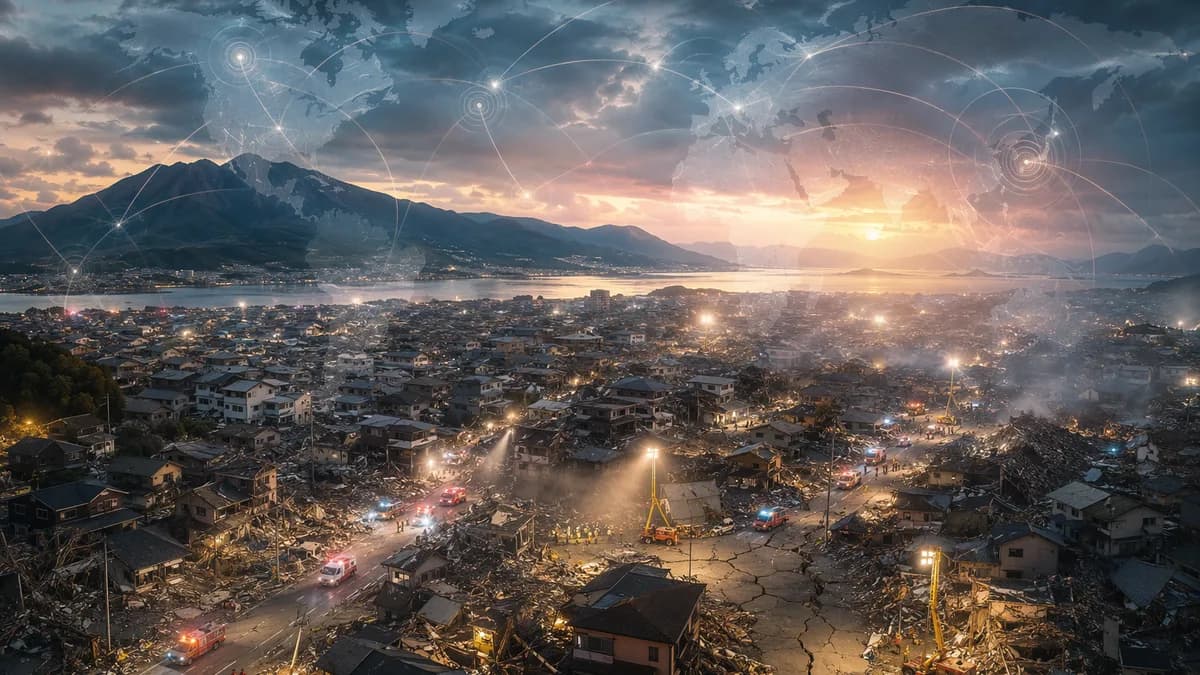
Japan’s Kyushu quake has become an aftershock-and-rescue emergency, with more than 100 tremors following Tuesday’s deadly strike and crews still searching collapsed buildings in dangerous heat. The Japan earthquake aftershocks followed a quake measured by the US Geological Survey at magnitude 6.8, which killed at least 13 people in the south-western Kyushu region, according to BBC World.
Global TrendsJuly 29, 2026· 5 min read· By XOOMAR Insights Team
100 Aftershocks Turn Japan Earthquake Into Rescue Race
Updated on July 29, 2026
XOOMAR Intelligence
Analyst Take
67/ 100
4 sources analyzedLow confidenceTrend10Freshness94Source Trust92Factual Grounding89Signal Cluster60
Thousands of people are in evacuation centres, many homes remain without power, and officials are warning residents to stay alert for more severe shaking. The Japan Meteorological Agency said the next few days carry the highest risk.
"For the next week or so, especially the next two to three days, we would like people to watch out for potential earthquakes with a maximum seismic intensity of 7," a JMA official said.
Japan earthquake aftershocks turn rescue work into a race against time
The central risk now is not only the quake that already hit, but what repeated shaking can do to damaged structures and trapped survivors. Rescue teams are digging through rubble at two major sites in Kumamoto prefecture: Aeon Mall in Kashima town and a paper factory in Yatsushiro City.
Japanese Prime Minister Sanae Takaichi said the operation was "truly a race against time." On Wednesday, she added: "Although more than 20 hours have passed since the earthquake, there are those still in need of help."
At Aeon Mall, a portion of the second floor collapsed, and the building suffered an explosion in the hour after the quake. Footage showed white smoke rising as people ran into the car park, with parts of the exterior blown away and steel beams exposed.
Aeon Mall president Akio Yoshida said three people were killed in the mall explosion. Another three people, all mall workers, remained missing. Officials said about 2,700 people were employed at the mall.
"We sincerely apologise for this incident," Yoshida said at a press conference on Wednesday.
The paper factory in Yatsushiro City is another focus of the emergency response. NHK reported that two people there were found with no signs of life and nine others were unaccounted for.
For readers tracking the first hours of the disaster, XOOMAR’s earlier file, 150,000 Told to Evacuate as Japan Earthquake Injures Dozens, gives context on how quickly the alert expanded.
Seismic intensity 7 warning puts damaged buildings under fresh pressure
The JMA warning is especially serious because it refers to Japan’s seismic intensity scale, not simply another magnitude estimate. Magnitude measures the energy released by a quake. Japan’s intensity scale reflects how violent the shaking is at a specific location, which is what matters for buildings, roads, bridges and rescue crews working inside unstable sites.
That distinction matters here. The quake’s magnitude has already been reported differently by agencies: JMA measured it at 7.1, while the US Geological Survey later placed it at 6.8. The BBC notes that magnitude figures are often updated as seismologists obtain and analyse new data.
| Measurement | Reported figure | Why it matters |
|---|---|---|
| JMA magnitude | 7.1 | Japan’s domestic initial assessment |
| USGS magnitude | 6.8 | Later estimate from the US agency |
| JMA intensity warning | Maximum seismic intensity of 7 | Measures local shaking severity and potential damage risk |
The quake had a shallow epicentre, about 10 km deep and roughly 20 km south of Kumamoto city. Shallow quakes can produce stronger surface shaking near the epicentre, which is why the aftershock warning is not routine background noise.
The strongest counterpoint is Japan’s building resilience. The Guardian reported that relatively few buildings collapsed despite the quake’s intensity, citing strict construction standards and earthquake resistance requirements that have been raised multiple times over recent decades.
That does not erase the immediate danger. Buildings already cracked, burned, flooded, or partly collapsed are more vulnerable than intact structures. NHK footage showed cracked roads and bridges, several buildings on fire, and transport disruption, including suspended train services.
Heat, power cuts and missing workers complicate Japan’s quake response
The rescue effort is being squeezed by three pressures at once: unstable rubble, disrupted utilities and dangerous heat. Officials advised rescuers and survivors to guard against heatstroke as temperatures hit about 35C (95F).
Defence Minister Shinjirō Koizumi said on X that about 300 air conditioning units would be flown to Kumamoto and distributed in the worst-hit areas. More than 4,600 personnel have been deployed to help rescue efforts, Takaichi said.
The human accounts explain why officials are pushing residents to stay alert. Hiroko Ogata, 75, told the BBC she was at the restaurant she runs in Yatsushiro City when the quake struck.
"All of a sudden there was a big jolt, and I was surprised and scared... I have lived here for 75 years, but I have never experienced such a big quake. I thought I would die."
American tourist Chantel Mohar, who was in Kumamoto with her family, said phones on their tourist bus sounded earthquake alerts before the shaking. "There was just a lot of rocking and confusion," she told the BBC’s Newsday programme.
Analysis: The Japan earthquake aftershocks are now the main variable shaping the next phase of the emergency. If the strongest aftershocks stay below damaging intensity, rescue crews can work faster and inspectors can clear more sites. If a severe aftershock hits near already damaged buildings, the toll and infrastructure disruption could change quickly.
Readers following wider emergency coverage can also see XOOMAR’s separate report on Tropical Storm Bertha Soaks Texas After Louisiana Hit. In Japan, the near-term watch items are narrower and more urgent: revised casualty figures, updates on the missing at Aeon Mall and the Yatsushiro factory, power restoration, transport status, and whether the JMA’s warning period brings another severe round of Japan earthquake aftershocks.
Impact Analysis
- More than 100 aftershocks are increasing the danger for damaged buildings and rescue crews.
- Search teams are racing to reach people still trapped more than 20 hours after the quake.
- Thousands remain displaced as power outages and extreme heat complicate recovery.
Reported Human Toll From Kyushu Quake
Total killed
people13
Aeon Mall workers missing
people3
Sources

Written by
XOOMAR Insights Team
Research and Editorial Desk
The XOOMAR Insights Team pairs automated research with human editorial judgment. We track hundreds of sources across technology, fintech, trading, SaaS, and cybersecurity, cross-check the facts, and explain what happened, why it matters, and what to watch next. We do not just rewrite headlines. Every article is fact-checked and scored for reliability before it goes live, and we link back to the original sources so you can verify anything yourself.
Explore More Topics
Related Articles
 Global Trends
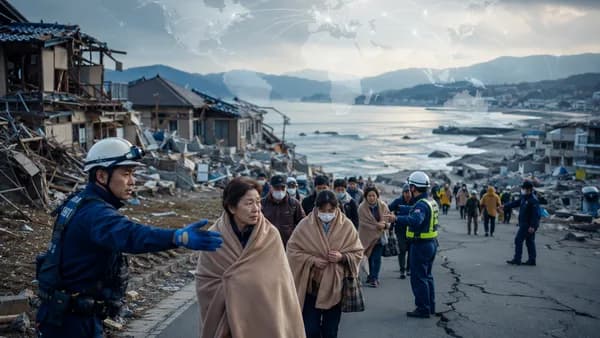
150,000 Told to Evacuate as Japan Earthquake Injures Dozens
A 7.1 Japan earthquake injured dozens, triggered brief tsunami fears, and pushed 150,000 people toward shelters.
Jul 28, 20265 min
 Global Trends
£100 a Story Offer Drags CT Group Into Press Cash Storm
CT Group was filmed discussing £100 payments for published stories, raising fresh questions over hidden lobbying in UK newspapers.
Jul 26, 20267 min
 Global Trends
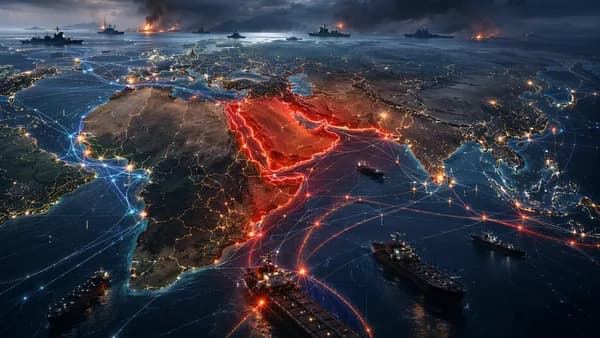
Houthi Attacks Turn Saudi Oil Escape Route Into Trap
Houthi attacks are squeezing Saudi Arabia’s Red Sea oil route just as Hormuz falters, raising the risk of wider supply shocks.
Jul 26, 20268 min
 Trading
Swiss Franc Slips as Inflation Math Frees SNB's Hand
Moderate inflation pass-through gives the SNB room to tolerate a weaker franc, sharpening the bull case for EUR/CHF.
Jul 29, 20268 min
 Technology
Kremlin Targets Telegram Founder Durov in Terror Case
Russia accused Telegram founder Pavel Durov of facilitating terrorism, turning a moderation fight into a Kremlin pressure campaign.
Jul 29, 20266 min
 Technology
AI-Generated Children's Books Ignite Privacy Fights
Personalized AI kids' books are becoming family flashpoints over sloppy stories, creepy images, and children's privacy.
Jul 29, 20268 min
 Global Trends
FIFA Stake Sale Ignites Fight for World Cup Control
FIFA’s stake sale plan has turned World Cup funding into a control fight, with the FA alarmed and UEFA rushing into emergency talks.
Jul 29, 20268 min
 Trading
GBP/USD Bears Threaten 1.3300 Before Fed BoE Showdown
GBP/USD’s bounce is still fragile below 1.3353, with Fed and BoE decisions set to test whether bears keep control near 1.3300.
Jul 29, 20267 min
 Future Fiction
The City That Asked Before Moving
In heat-struck Ahmedabad in 2039, Leela Vyas loses her bus route to an AI traffic system, then discovers a stranger job: representing her neighborhood in negotiations with the city’s adaptive intelligence. Across five decades, as AI reshapes work, family, streets, and memory itself, Leela learns that the future of daily life depends less on smarter machines than on better questions.
Jul 29, 202612 min
 Global Trends
40C Heat Pushes Bordeaux Mega-Fire Back to the Brink
A 40C heat wave and winds could undo firefighting gains near Bordeaux after 220,000 evacuations.
Jul 29, 20268 min
Don't miss the signal
Get our weekly roundup of the stories that matter across tech, fintech, and trading. No noise, just signal.
Free forever. No spam. Unsubscribe anytime.