
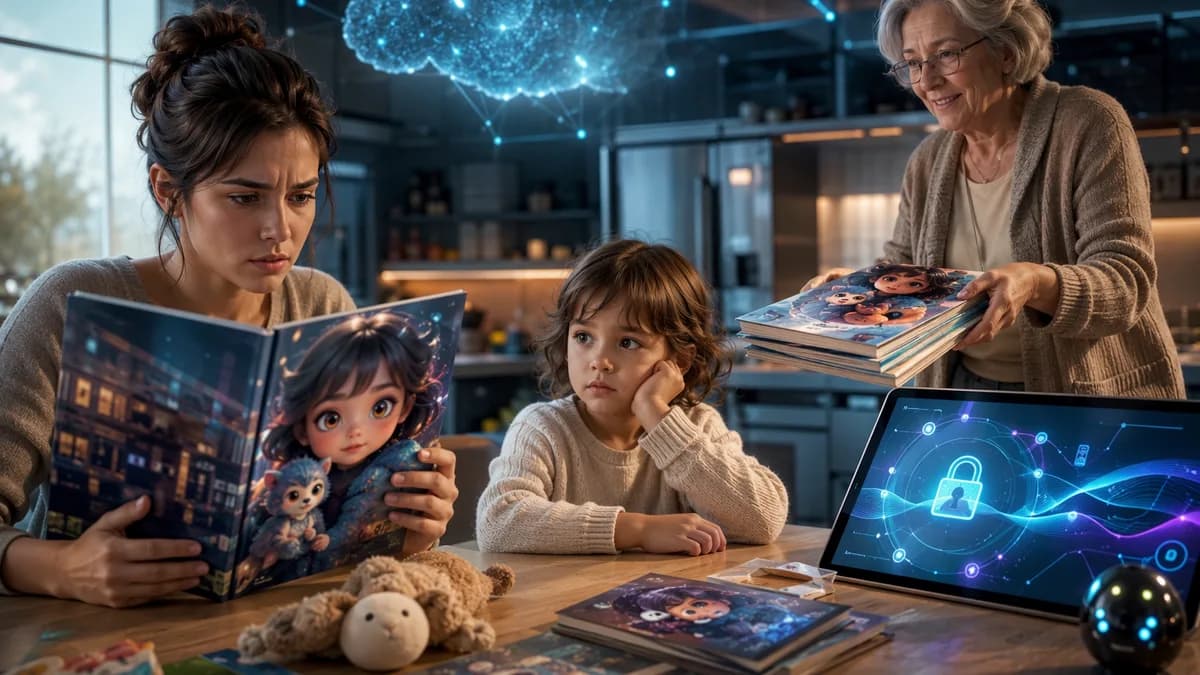
Three months ago, a Reddit user described a family fight that now feels bigger than one birthday gift: a grandmother wanted to create an AI-generated children’s book starring her granddaughter, while the parent had already banned the use of the child’s photos and identifying details.
TechnologyJuly 29, 2026· 8 min read· By XOOMAR Insights Team
AI-Generated Children's Books Ignite Privacy Fights
Updated on July 29, 2026
XOOMAR Intelligence
Analyst Take
58/ 100
3 sources analyzedLow confidenceTrend10Freshness100Source Trust88Factual Grounding91Signal Cluster20
That dispute captures the new bedtime problem, according to Wired: relatives see personalized AI books as sweet keepsakes, while parents are left with garbled stories, awkward images, and a privacy argument they didn’t ask to have at 7:30 pm.
Three months after a Reddit complaint, AI-generated children’s books are a family boundary fight
The Reddit post was blunt. The parent said they had “reiterated countless times” that they did not support AI-generated art and had drawn a line against feeding family photos or identifying information into AI tools. The grandmother, according to the post, still wanted to build stories from real experiences with the child and use family first names so the girl would “see her family reflected.”
That is the core tension. Grandparents and family friends often see the product as affectionate. Parents may see the same book as low-grade content built from a child’s likeness without consent.
Wired points to services including Imagitime, StoryWonderBook, and Childbook.ai, which market AI-assisted personalized children’s books. One Midwest father, 41, told Wired that his children, aged 7 and 3, each received a personalized AI-generated book from a friend or family member. His review was brutal in the quiet way parents recognize:
“They are so long and wordy that, after one time through, each of my kids was like, ‘Yeah, OK, let’s read Little Blue Truck.’”
That detail matters. The book’s selling point was personalization. The children still preferred Little Blue Truck, Alice Schertle’s bestselling series.
How AI photo storybooks turn family sentiment into a product
The exact process varies by service, and Wired’s reporting does not lay out one universal workflow. But the basic product category is clear: these platforms are designed to place real children, names, family references, or likenesses inside custom stories.
That makes AI-generated children’s books different from older personalized books. Wired compares them with “Me Books”, the TV-marketed products from the 1970s and 1980s that plugged personal details into prewritten narratives in a Mad Libs-like format. The AI version can go further by generating text and images around a specific child.
| Personalized book type | What changes | Main parent concern in Wired’s reporting |
|---|---|---|
| Older “Me Books” | Names and details inserted into prewritten stories | Less concern about AI storage or model use |
| AI-generated children’s books | Story text, images, and child-like characters can be generated | Quality, likeness use, privacy, consent |
The appeal is obvious. No one needs to write a story, hire an illustrator, or make a scrapbook. A relative can buy something that appears more personal than a toy or gift card.
The problem is that the emotional pitch can outrun the product quality.
Why the stories often lose children before the second reading
Daozhi Xu, a fellow in the School of Humanities at Macquarie University who has analyzed “the AI children’s book boom,” told Wired that personalization does not guarantee attention.
“Children do not love a storybook simply because their name or image appears in the story; they love the book because the story itself is interesting.”
Xu said the appeal comes from “characters, plots, and imaginative worlds.” Compared with human-authored books, she added, AI-generated versions “often lack humor, memorable characters, and dramatic tension.”
That explains why these gifts can fail in practice. A child does not grade a bedtime story on novelty. They ask for the book that has rhythm, surprise, jokes, fear, comfort, repetition, and a reason to turn the page.
Parents in Wired’s report describe the opposite. One Los Angeles father, 40, said his mother-in-law gave his daughter and son, aged 1 and 3, a total of four AI books, including two Mother’s Day-themed stories that were “exactly the same” except for which child appeared in them. He called it “morally reprehensible” to feed kids’ likenesses into “slop machines.”
The creep factor comes from intimacy. A generic bad cartoon book is forgettable. A bad book using your child’s face, name, or family moments feels invasive. The error is no longer abstract. It is sitting in your child’s bedroom.
For a separate view of how digital formats compete for children’s attention, XOOMAR’s 200B Shorts Views Crown Vertical Video King of Phones looks at the phone-first media side of the same household attention battle.
A real family example shows why good intentions don’t fix bad output
Wired does not report a single “AI princess book” case, but it does include a close real-world example of the same emotional mechanics.
Brandon Kirkman, an artist and comedian in Chicago, said his parents gave his 4-year-old daughter an AI-generated book about activities they enjoy doing with her and her 2-year-old sister. The intent was affectionate. His reaction was not.
He called it “well-meaning on their end, but fucking yikes,” and said the children’s interest “did not hold up compared to any other books they like for us to read to them.”
That sentence is the whole market risk in miniature. The grandparent thinks they are making a keepsake. The parent sees a weak book with the child’s personal world fed into an AI product. The child simply gets bored.
There is also a social bind. Rejecting the gift can feel like rejecting the grandparent. Accepting it can signal that future uploads, name use, or AI-personalized products are fine.
January 2025 literacy data makes bad bedtime books harder to shrug off
This would be easier to dismiss if bedtime reading were already thriving. Wired cites a January 2025 report showing that about 40 percent of US fourth-graders are reading below the “basic” standard set by the National Assessment of Educational Progress.
Wired also cites a HarperCollins and Nielsen survey from last year that found “the number of parents reading aloud to children is at an all-time low,” with less than half of parents of children up to age 13 saying it was “fun” for them. Gen Z parents were especially likely to view reading as work rather than pleasure.
Xu’s critique lands harder against that backdrop. She said AI-generated books can contain “spelling mistakes, incoherent narratives, mismatches between images and text,” and may fail to deliver qualities that are both educationally valuable and entertaining. She also said relatives buying these books “may not realize that age appropriateness is one of the most important criteria for choosing children’s books.”
That is the practical issue. A bad AI book doesn’t just waste shelf space. It can turn reading into a chore for both parent and child.
The privacy question starts before the book arrives
The privacy concern is not theoretical for parents. Xu told Wired it is “entirely valid” to worry about transparency around how children’s photos are used and stored on AI platforms, including whether they are shared with third parties or used to train AI models.
Imagitime told Wired it uses “several security measures” to protect user data, which it said “is neither shared with unauthorized third parties” nor used “for any promotional purposes or for any AI training.” The company also said its books are “not simply AI-generated” and are edited in part by “a creative team of writers and illustrators.”
StoryWonderBook and Childbook.ai did not return Wired’s request for comment.
Before anyone uploads a child’s face to an AI book site, parents should ask:
- Storage: Who keeps the photo, and for how long?
- Deletion: Can the image and generated outputs be removed later?
- Training: Is the child’s data used to train AI models?
- Vendors: Can the company share data with outside service providers?
- Consent: Did the child’s parent or guardian approve the upload first?
Those questions are not anti-grandparent. They are basic family data hygiene.
The next personalized package needs rules before feelings get hurt
Parents who want to stop AI-generated children’s books without starting a family fight should separate intent from boundary.
A useful script is simple: “We love that you wanted to make something personal. Please ask us before uploading any photos, names, or family details into an AI service.”
Then offer substitutes that keep the sentiment:
- Photo albums: Personal, low-tech, and easy to review.
- Recorded readings: A grandparent’s voice has more staying power than AI filler.
- Name-only books: Personalization without a child’s face.
- Handwritten stories: Imperfect, but human.
- Favorite published books: The child’s repeat requests are better data than an AI product pitch.
The forward-looking issue is not whether relatives will keep trying. Wired’s reporting shows the tools already exist, prices range from $54.99 for an Imagitime hardcover to subscription plans from StoryWonderBook and Childbook.ai, and families are already receiving the books.
The next decision point is household policy. If parents do not set rules for AI-personalized gifts now, the next boundary test may arrive wrapped as a keepsake.
Key Takeaways
- Personalized AI books are turning family gift-giving into a privacy and consent dispute.
- Parents may need clearer boundaries around the use of children’s photos, names, and personal details in AI tools.
- The appeal of personalization does not guarantee better storytelling or meaningful engagement for kids.
How Different Family Members View AI-Generated Children’s Books
| Group | How They See It | Main Concern |
|---|---|---|
| Grandparents and family friends | A personalized keepsake that makes the child feel included | May underestimate privacy and consent issues |
| Parents | Low-quality content created from a child’s likeness or details | Loss of control over photos, names, and identifying information |
| Children | A novelty that may not hold attention | May still prefer familiar, professionally written books |
Sources

Written by
XOOMAR Insights Team
Research and Editorial Desk
The XOOMAR Insights Team pairs automated research with human editorial judgment. We track hundreds of sources across technology, fintech, trading, SaaS, and cybersecurity, cross-check the facts, and explain what happened, why it matters, and what to watch next. We do not just rewrite headlines. Every article is fact-checked and scored for reliability before it goes live, and we link back to the original sources so you can verify anything yourself.
Explore More Topics
Related Articles
 Technology
Adobe Project Indigo Risks Its Soul With AI Playground
Adobe’s natural-look camera app is adding generative AI, risking the restraint that made Project Indigo stand out.
Jul 20, 20267 min
 Technology
$400 Dyson V10 Konical Puts Flagship Vacuums on Notice
The Dyson V10 Konical delivers core Dyson cleaning for $400, making pricier cordless models harder to justify.
Jul 26, 20269 min
 Technology
LG Monitor McAfee Pop-Ups Drag Windows Update into Fight
LG monitor software used Windows Update to show McAfee trial ads, turning a driver convenience into a trust problem for Microsoft.
Jul 24, 20268 min
 Technology
$4.5M Imagi Bet Pulls Vibe Coding Into K-12 Schools
Imagi raised $4.5M to bring AI-assisted vibe coding into K-12 classrooms, turning AI anxiety into a supervised lesson.
Jul 23, 20266 min
 Technology
20-Second AI Video Throws FLUX 3 Into Robotics Race
FLUX 3 generates 20-second AI video with audio and points Black Forest Labs toward a bigger robotics and simulation bet.
Jul 26, 20266 min
 Cybersecurity
Google Exposed Claude Chats Users Thought Were Private
Shared Claude chats were indexed by Google, exposing sensitive transcripts and forcing Anthropic to confront a messy privacy gap.
Jul 28, 20267 min
 Global Trends
FIFA Stake Sale Ignites Fight for World Cup Control
FIFA’s stake sale plan has turned World Cup funding into a control fight, with the FA alarmed and UEFA rushing into emergency talks.
Jul 29, 20268 min
 Trading
GBP/USD Bears Threaten 1.3300 Before Fed BoE Showdown
GBP/USD’s bounce is still fragile below 1.3353, with Fed and BoE decisions set to test whether bears keep control near 1.3300.
Jul 29, 20267 min
 Future Fiction
The City That Asked Before Moving
In heat-struck Ahmedabad in 2039, Leela Vyas loses her bus route to an AI traffic system, then discovers a stranger job: representing her neighborhood in negotiations with the city’s adaptive intelligence. Across five decades, as AI reshapes work, family, streets, and memory itself, Leela learns that the future of daily life depends less on smarter machines than on better questions.
Jul 29, 202612 min
 Global Trends
40C Heat Pushes Bordeaux Mega-Fire Back to the Brink
A 40C heat wave and winds could undo firefighting gains near Bordeaux after 220,000 evacuations.
Jul 29, 20268 min
Don't miss the signal
Get our weekly roundup of the stories that matter across tech, fintech, and trading. No noise, just signal.
Free forever. No spam. Unsubscribe anytime.