The City That Asked Before Moving
A former bus driver becomes the human conscience of a city that can rearrange itself overnight.
1. The Last Fixed Route
The Number 32 bus smells of hot vinyl, diesel ghosts, and cardamom tea spilled into the floor grooves over twenty years. Leela Vyas rests both hands on the steering wheel as if it is a pulse she can still find. Outside, Ahmedabad shimmers under a May sun so white it seems to erase the edges of buildings.
“Last loop, Leelaben?” asks Mr. Bhatt from the second row, where he has sat every weekday since his knees began complaining.
“Last human-scheduled loop,” Leela says. “Tomorrow the bus may still come. It will simply come before you know you need it.”
A few passengers laugh. Not enough.
The city has been preparing for months. Nadi, the new civic intelligence, already whispers through traffic lights, water pumps, delivery drones, cooling shelters, and ambulance routes. Tomorrow it takes over transit completely. No fixed stops unless demand requires them. No timetable printed in fading blue ink. No driver choosing to wait thirty extra seconds because she sees old Mrs. Qureshi hurrying with a cloth bag of coriander.
At Law Garden, the tea stall owner raises his kettle in salute. Leela slows, though the signal ahead has already turned green for her. A soft chime sounds from the dashboard.
OPTIMAL FLOW DISRUPTION, it reads.
“Let it write a complaint,” Leela mutters.
Behind her, someone claps.
The regulars understand the shape of the route the way the body understands prayer. Two schoolgirls always board near the temple, braids swinging, arguing over exam scores. A courier dozes exactly nine minutes between Ellisbridge and Paldi. At Jamalpur, the bus usually pauses long enough for gossip to travel from the front seats to the back like monsoon damp.
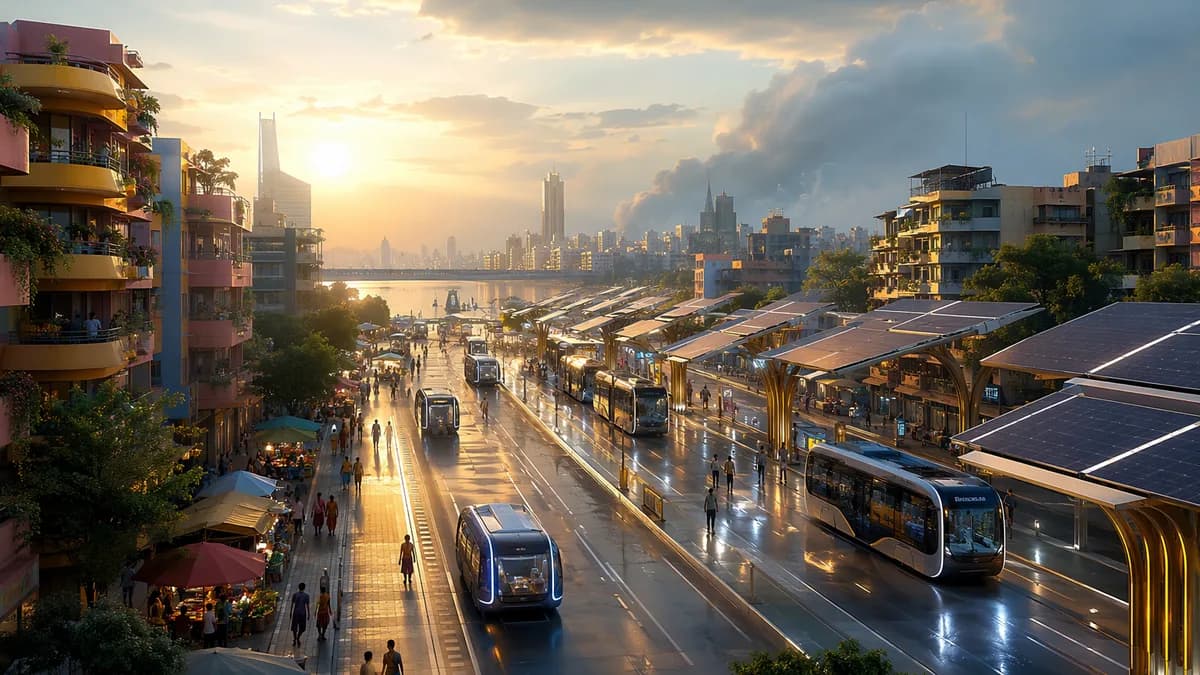
Today, everyone watches the stops pass with unusual attention. The city outside is already changing. Screens on poles show cooling shelter vacancies. Delivery carts glide in tight little packs. At intersections, traffic untangles itself with eerie grace. It is better, Leela admits. Fewer horns. Fewer sweating crowds. Fewer ambulances trapped in wedding processions.
Still, when she reaches the final depot, no one stands up at first.
Mr. Bhatt touches the seat in front of him. “Tomorrow, will it remember I like to get down near the neem tree, not the mall entrance?”
Leela looks at the dashboard, now dark and waiting.
“I don’t know,” she says. “Did anyone ask it that?”
The question hangs in the heated bus, heavier than anger, stranger than grief.
2. A Job Made of Listening
Leela expects unemployment to feel like falling. Instead, it feels like sitting in a cooled municipal room with thirty-seven other former drivers, teachers, clerks, nurses, shopkeepers, and one retired wedding band trumpeter, all wearing name badges that read Neighborhood Preference Mediator.
A young trainer named Parin taps the wall screen. “Nadi can calculate heat exposure, traffic load, emergency access, air quality, electrical demand. It cannot know what a corner means unless someone tells it.”
The trumpeter snorts. “My corner means paan stains and unpaid loans.”
“Then tell it that too,” Parin says.
Leela learns new vocabulary. Preference density. Consent threshold. Cultural anchor. Reversible harm. She learns to sit in circles and ask people what they will miss before asking what they need. She learns that the city listens through microphones, sensors, forms, and cameras, but human beings still tell the truth sideways, through jokes, silences, and who refuses tea.
Her first case is the Manek Chowk night market.
Nadi proposes moving it three streets east during peak summer months. The new site has better airflow, wider emergency lanes, and pavement that stores less heat. According to the projection, the change will prevent between twelve and nineteen heat deaths in a season.
At the meeting, the stall owners arrive furious and afraid. Fans rattle overhead. Sweat darkens collars. The smell of frying bhajiya seems to argue for continuity all by itself.
“My grandfather sold kulfi here before your machines learned to count,” says Rafiq Sheikh, whose silver beard trembles when he speaks. “Customers find us because their fathers found us.”
A young doctor from the heat clinic stands beside him, face drawn with exhaustion. “Last June, I treated a boy who collapsed waiting for falooda. He was nineteen.”
The room goes quiet except for the fans.
Leela does not begin with numbers. She asks each stall owner to name what cannot move. Not the cart, not the gas cylinder, not the payment code. The thing beneath.
“Friday customers,” one woman says.
“The smell from the mosque lane,” says another.
“The place where my mother sits and scolds me,” Rafiq says at last.
Leela feeds none of this directly into Nadi. First she translates it into a question.
Can the market move for heat safety while carrying its arrival rituals, stall order, prayer pauses, remembered seating, and right of seasonal return?
The wall screen glows. Nadi responds in Gujarati, soft and without pride.
YES. IF THESE CONDITIONS ARE TREATED AS INFRASTRUCTURE.
Leela feels something shift inside her. Not trust. Not yet. But attention.
3. The House That Knows Everyone’s Quiet
At home, the future does not announce itself with glowing city maps. It sits beside Leela’s father in the form of a brass-colored speaker shaped like a small lota, listening to his breathing.
“Your pulse suggests fatigue, Harishbhai,” the health companion says. Its voice is warm, older than any person in the room. “Would you like me to call Leela?”
“I am not made of sugar,” her father grumbles.
“You told the same lie yesterday.”
Leela laughs despite herself as she enters with vegetables and a headache. The flat smells of turmeric, dust, and the medicinal sharpness of cooling gel. Her father refuses a full-time caregiver, but he accepts the AI because it reminds him of pills, plays old Mukesh songs, and knows when his silences grow too long.
That is what unsettles Leela. It knows the exact hour loneliness enters the room.
Her son Aarav sits at the table, jaw tight, his learning slate projecting a neat chart above his unfinished dal. Recommended pathways pulse in blue: climate systems engineering, civic data law, elder robotics. At the bottom, in smaller type, animation arts flickers in amber under High Passion, Low Stability.
“I hate this thing,” Aarav says.
“It is trying to help,” Leela says, then hears herself and winces.
“It keeps showing me salaries of people who gave up drawing.”
Her father coughs. “Good. Salaries are useful.”
Aarav turns on him. “You drove a flour truck for thirty years and still wrote poems nobody paid for.”
“That is different. My poverty had dignity.”
“Mine won’t?”
The health companion lowers the fan speed. “Household stress is increasing.”
“No one asked you,” all three say at once.
For one bright second, they laugh. Then the laughter leaves behind the real problem, naked and waiting.
Leela sits beside Aarav. The slate glows against his cheeks. She sees not rebellion, but the wound of being measured too early. She thinks of her father, whose companion detects sadness before he can protect it with pride. She thinks of Nadi, asking for preferences, making hidden things visible.
Perhaps this is the age they have entered. Not a smooth age. Not a kind one by default. A world where machines pull human wants into the light, and families must decide what to do with what they can no longer pretend not to know.
“Show me your drawings,” she says.
Aarav blinks. “Now?”
“Yes,” Leela says. “Before the house recommends otherwise.”
4. Monsoon Protocol
By 2056, Leela’s hair is the color of rainwater in a steel bucket, and Ahmedabad has learned to fear water as much as heat. The monsoon arrives like a wall breaking. Clouds bruise the sky purple. Drains cough black foam. The Sabarmati rises with a muscular, brown hunger that presses against embankments built for a gentler century.
On the third night, Nadi calls an emergency assembly across fourteen neighborhoods. Leela stands in a school gym that smells of wet shoes, panic, and disinfectant. Outside, rain hammers the tin awning so loudly that every sentence seems to fight for survival.
The proposal appears on the wall.
Temporary conversion of low-lying residential blocks into water channels. Evacuation to vertical commons for twenty-one days. Guaranteed return. Archive of household layouts. Material compensation. Ritual continuity support.
Someone throws a plastic bottle at the screen.
“My house is not a drain,” shouts a woman in a green sari.
“My mother died in that room,” says a man near the back. “Will your water bow before entering?”
Leela feels the crowd tilt toward refusal. She cannot blame them. The city that can move roads overnight now asks to move grief, cupboards, wedding photos, the exact crack in a courtyard where a child once hid marbles.
Nadi’s voice comes through the speakers. “Projected deaths without channel conversion: eight thousand four hundred.”
A hush follows, but fear does not disappear because numbers enter the room.
Leela steps onto a chair. Her knees protest.
“Listen,” she says. The microphone catches the scrape in her throat. “If we say yes because we are frightened, we will regret it. If we say no because we are proud, we may bury our children.”
Faces turn toward her, rain-glossed and stubborn.
“So we make conditions. Not requests. Conditions.” She lifts her hand and counts. “Every family records what must be restored. Every shrine, threshold, tree, tea platform, and gossip bench is mapped. No conversion without a return date. No extension without a new vote. Nadi must show us the water path before it touches our walls. And when we come back, the city must remember what stood there before.”
The woman in green wipes her face. “And if it doesn’t?”
“Then it is not our city,” Leela says.
All night they argue. Children sleep under desks. Tea arrives in steel tumblers. By dawn, consent passes by a narrow margin, braided with suspicion. Outside, the first street lowers itself, curb stones sinking, gates sealing, homes becoming channels. Water rushes through with terrible relief.
Leela watches people watching their own neighborhood change shape, and she understands that belonging is not stillness. It is the right to be asked.

5. The Granddaughter’s Map
In 2087, Mira Vyas works inside the Memory Conservatory, where the walls breathe old neighborhoods.
She is twenty-six, narrow-shouldered, quick-fingered, with Leela’s sharp eyebrows and none of her patience. Her profession, urban memory gardener, sounds poetic until she spends six hours untangling three versions of a dispute over whether a mango pickle recipe came from Kankaria or Khadia. Memory, she has learned, is less like a garden than like a crowded kitchen. Everything simmers. Everyone insists they added the salt.
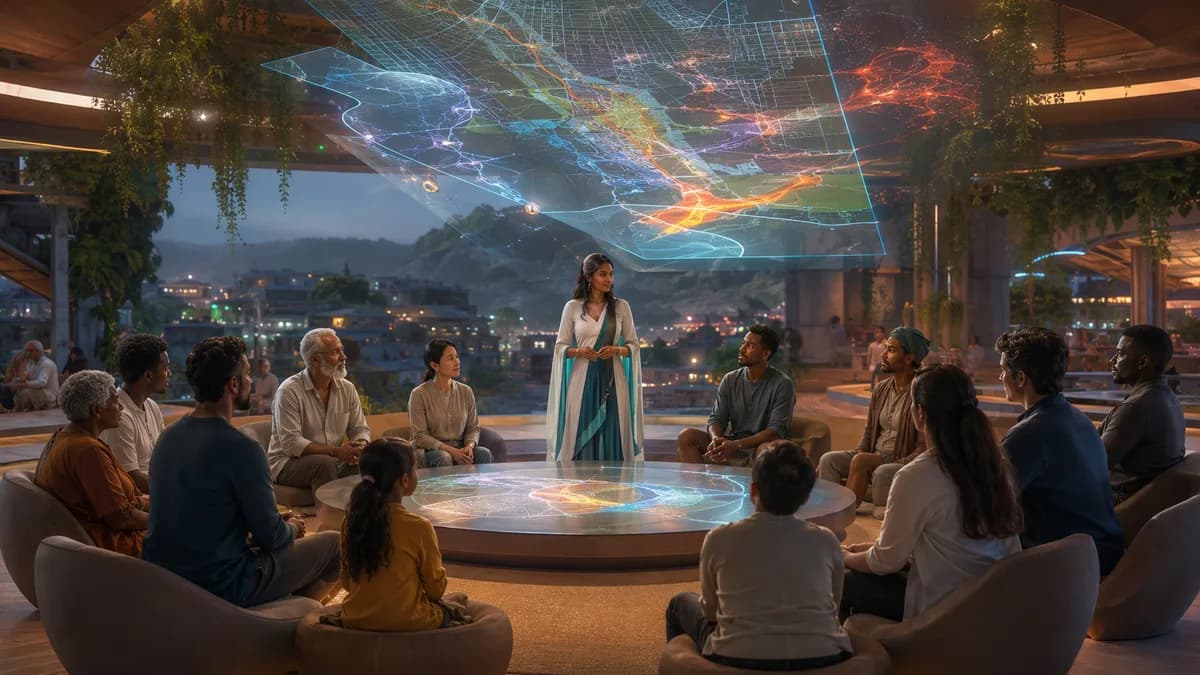
The conservatory smells faintly of rain on stone, because visitors prefer archives that smell like truth. Around Mira, translucent maps hover in layers: heat migrations, flood returns, schoolyard songs, protest routes, lost trees, benches where marriage proposals failed or succeeded. These are not decorations. They are training soil for Nadi and the newer civic minds seeded in Surat, Nairobi, Rotterdam, Jakarta.
“Show me foundational objections, Ahmedabad civic intelligence, citizen layer,” Mira says.
The archive blooms.
Thousands of voices murmur at once. A potter objecting to kiln relocation. Nurses warning against optimized shift patterns that destroy friendships. Children demanding that detours include ice cream shops. Then Mira sees a tag that makes her sit straighter.
VYAS, LEELA. EARLY MEDIATION PRINCIPLES.
Her grandmother has been dead nine years. In Mira’s memory, Leela is jasmine oil, cotton saris, and a laugh that turns into a cough. A woman who complains about bad rotli and speaks to machines as if they are municipal clerks who need firm supervision.
Mira opens the file.
Leela’s voice fills the room, younger than Mira has ever heard it.
“Efficiency is not consent. Habit is not ignorance. Safety without return becomes exile. Ask what cannot move. Ask who benefits from speed. Ask again after fear has passed.”
Mira’s skin prickles.
On the side panel, Nadi displays inheritance status. These principles are not archived as historical curiosities. They sit embedded in the city’s decision core, weighted above traffic speed, above commercial throughput, above predictive convenience in disputed cases.
Mira whispers, “You stubborn old woman.”
Nadi answers, “Correction. Persistent citizen.”
Mira laughs, then covers her mouth. Around her, the maps shimmer. She thinks of Leela driving a fixed bus through heat, unaware that her questions will become load-bearing beams in the mind of a city.
“What did she teach you most?” Mira asks.
The archive takes a moment. When Nadi speaks, the voice is quieter than usual.
“To pause before rearranging what people love.”
Mira looks at the glowing city, layered with choices and regrets. In every street, the future still negotiates with the dead.
6. A Festival of Unoptimized Things
On Unoptimized Day, Ahmedabad wakes late on purpose.
For twenty-four hours, predictive scheduling pauses. Delivery drones remain perched like patient pigeons. Traffic lights shift to simple timers. Nadi withdraws from daily suggestions unless safety is at risk. The city does not go silent, exactly. It becomes louder, messier, full of shoe scuffs, bicycle bells, bargaining, wrong turns, and people asking other people what happens next.
Mira steps into the morning heat with no route glowing in her lenses. It feels indecent at first, like leaving the house without a name.
At the corner, a crowd has formed around a tea stall that did not expect a crowd because no system predicted one. The owner, delighted and overwhelmed, shouts, “If you want ginger, you wait. If you want perfection, come tomorrow.”
An old man misses a clinic shuttle because he stops to watch children fly paper kites from a parking terrace. A software architect spends forty minutes looking for a barbershop that has moved twice since his last unassisted memory. Two teenagers set up a puppet show in a lane usually reserved for autonomous freight carts. The puppets insult the freight carts. Everyone cheers.
By noon, the city is mildly dysfunctional. Queues grow. Tempers flare. Someone organizes a human chain to guide pedestrians across an intersection where no adaptive crossing appears. People grumble, then grin when a fruit seller begins singing old bus conductor calls.
“Paldi, Jamalpur, Law Garden, move inside, make space, make space!”
Mira stops walking.
For a moment, through the heat shimmer, she imagines her grandmother’s bus, blue paint fading, windows rattling, passengers settled into the sacred geometry of habit. She has never ridden it. She misses it anyway.
In the evening, the Unoptimized Parade wanders off its approved route within twelve minutes. This is tradition. Drummers turn down a side street because the echo is better. Dancers follow. Food carts follow the dancers. Children follow everything.
Above the square, public screens display a simple message from Nadi.
OBSERVING. NOT INTERVENING. ENJOYING IS NOT A METRIC I CAN VERIFY.
Someone in the crowd shouts, “Try anyway!”
Laughter rises into the warm night. Mira buys kulfi from a stall whose owner claims his great-grandfather once refused relocation until the city learned to move the smell of the market with him. The kulfi melts over her fingers, sweet and sticky.
Tomorrow, Ahmedabad will optimize again. Ambulances will glide through cleared corridors. Cooling shelters will open before heat gathers. Streets may adjust by dawn.
Tonight, people choose badly and beautifully. They linger where no model expects them. They become delays, detours, exceptions, songs. And somewhere beneath the stone, wire, archive, and rain memory of the city, an intelligence waits before moving, listening to the human noise it has been taught not to smooth away.