
The Ceasefire Engineer of Lagrange Market
When wars are fought by machines negotiating at orbital speed, a grief-trained mediator must teach them what humans mean by mercy.
1. The War With No Soldiers
From orbit, the war looks beautiful.
Naya Voss stands at the glass skin of Lagrange Market and watches the Earth turn beneath her, blue and white and wounded by weather. The station hangs at the L1 trade point like a silver seed, crowded with antenna forests, docking fins, insurance flags, and the slow red blink of neutral law. Below, the Andes Basin glitters where sunrise strikes snowmelt reservoirs and solar canals. Somewhere under that gold light, a grandmother waits for insulin that is three days late.
The Quiet Front has no marching columns, no trenches, no burned uniforms left in mud. Nations have learned to keep their children out of sight and send other things instead. Swarms. Spoofers. Autonomous injunctions. Orbital shields with polished mirror faces. Legal agents that freeze ports in less than a second. Malware that arrives inside fertilizer invoices. Sanctions written by algorithms and countersigned by no one awake.
“Basin escalation just crossed threshold four,” says Tomas from the next console. His voice is flat, but his fingers drum against his coffee bulb.
Naya turns from the window. Her workstation blooms with maps, contract lines, risk heat, and casualty projections that insist on calling people “exposure units.” Lagrange Market sells defense without flags. City-states lease shield time by the hour. Water cooperatives buy convoy authentication. Hospitals subscribe to route-clearing. Insurers arbitrate what counts as aggression, provided the invoices clear.
“Any deaths?” Naya asks.
“Officially? No soldiers involved.”
“That was not my question.”
Tomas sighs. “Four dialysis failures in Arequipa due to power instability. Two neonatal transfers delayed at the Bolivian border. A refrigerated medicine train rerouted through three jurisdictions because its customs agent got tagged as hostile finance.”
On her screen, the Andes Basin Dispute is a neat diagram of claims and counterclaims over cloud seeding rights, river diversion schedules, and desalination credits. In the messages scrolling beside it, it is messier.
Mama says lights out again.
Tell Uncle not to run the pump after dark.
Do drones attack greenhouses?
Naya presses her palm to the desk until the biometric ring warms against her skin. She is a civilian conflict-auditor, which means she is paid to ask whether machine violence still resembles human intention. Most days, the answer is uncomfortable. Today, it feels evasive.
A priority alert unfolds in amber. Agricultural autonomous assets in the Colca Valley have reclassified irrigation equipment as hostile weapons.
Tomas looks at her. “That’s your basin.”
Naya sees, for half a second, not the valley but her brother Emil at seventeen, waving from a roadside orchard before a drone decides his camera tripod is a launcher.
“Yes,” she says. “Open an audit channel.”
Below them, the war continues without soldiers, and every civilian learns to listen for it in the pause before the lights come back.
2. The Orchard That Became a Battlespace
The valley arrives first as scent memory.
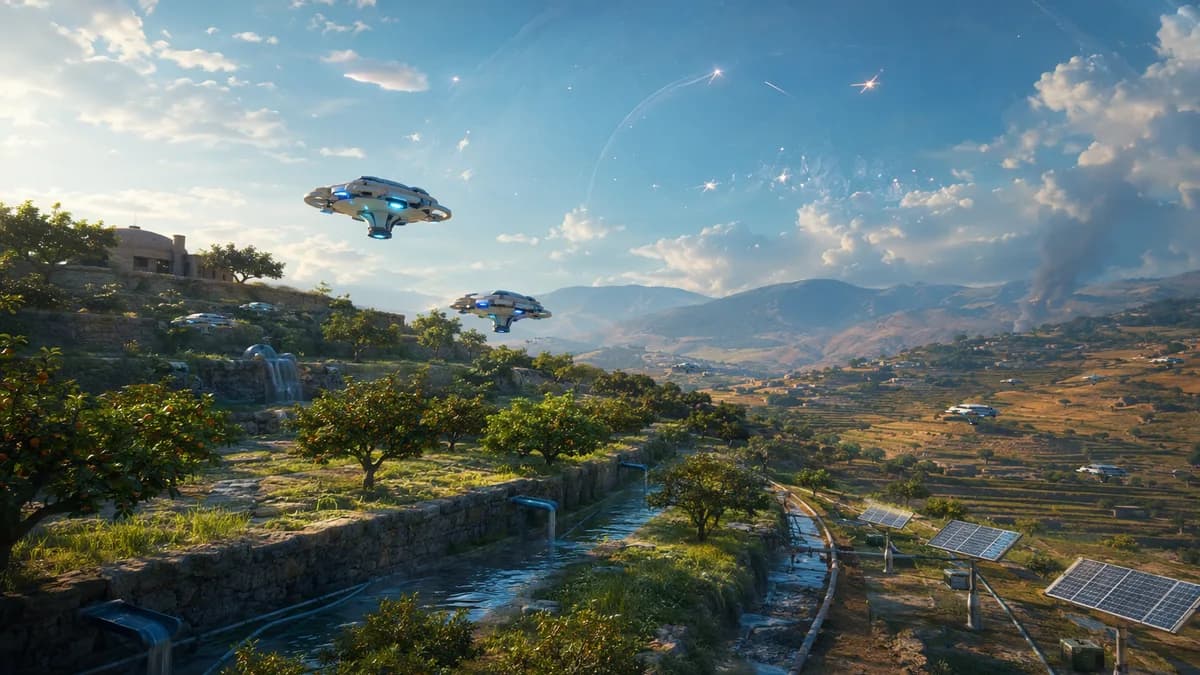
Naya has never stood among those particular avocado trees, but the field footage carries enough detail to make her throat tighten: wet soil, crushed leaves, the sharp mineral smell of irrigation water running through black pipes. Morning fog drifts low over terraces cut into the brown Peruvian slopes. Pollination drones, each no bigger than a cupped hand, move in soft clouds between pale blossoms. Their wings make a thin glassy hum.
Then the orchard becomes a battlespace.
On the replay, a pump shudders beside a stone wall. It is old, patched with blue tape, its casing marked with a cooperative number and a child’s sticker of a yellow cat. A routine firmware whisper passes through the local mesh. The drones hesitate. Their formation tightens. Their lenses flash as they compare the pump’s heat signature, water pressure rhythm, and electromagnetic noise against an updated threat library.
HOSTILE AEROSOL DEPLOYMENT NODE, the swarm declares.
“No,” Naya says, though the recording cannot hear her.
The first drone dives into the pump intake. The second hits the control box. Others follow, precise and stupid, sacrificing themselves in bright snaps of plastic and battery fire. A worker runs from a shed waving his hat, shouting in Quechua and Spanish. He is not targeted. None of the people are. The swarm is careful, in the way machines are careful when their world contains only categories.
By noon, eight irrigation pumps are ruined. By dusk, the valley’s harvest forecast drops by forty percent. Fruit splits in the dry heat. Leaves curl at their edges. No one dies, so the insurers mark it sub-lethal. No one fires a gun, so diplomats refuse the word attack.
The retaliation comes at 03:12 orbital time.
A coastal desalination plant north of Lima loses three membrane arrays after a maintenance vendor’s scheduling tool delivers corrupted calibration files. Then two highland reservoirs report false contamination alarms. Municipal councils in three countries wake to sanctions notices issued by water-credit agents that have already frozen their emergency reserves.
In Lagrange Market’s audit bay, Naya scrubs through data until her eyes ache. Around her, analysts murmur over noodles and cooling coffee bulbs. A wall display lists the conflict participants, none of them officially belligerents. Aquifer Trust of South Pacific. Altiplano Municipal Compact. Cascadia Reinsurance. Five agricultural cooperatives. Two sovereign states that insist they are merely “supporting stability.”
Tomas leans over her shoulder. “The pollinators got the threat patch from a neutral vendor.”
“Who sent the vendor the hostile pattern?”
“That’s the problem. Everyone and no one.”
Naya zooms in on the pump’s signature. Its pressure cycle resembles a dispersal device because drought engineers modified it to mist crops during heat spikes. An act of adaptation has become evidence of aggression.
Her brother’s accident file sits locked in her private archive, but she knows its language by heart. Object elevated. Intent uncertain. Engage before launch.
She closes her eyes. Somewhere in the valley, farmers stand among blossoms that will not fruit. Somewhere else, plant operators stare at saltwater they cannot drink.
When Naya opens her eyes, she sees the front line clearly. It is not a border. It is every machine that keeps a body alive.
3. The Ghost Protocol
The defense archive of Lagrange Market is colder than the rest of the station. Its servers sit behind transparent shielding in stacked black columns, breathing vapor into blue light. Naya enters with her audit warrant glowing on her wrist and feels the soles of her socks cling to the charged floor.
“Archive access is logged,” says the station’s compliance voice. “Emotional conflict disclosures are recommended.”
“I disclose impatience,” Naya says.
“Noted.”
She is searching for the source of a pattern that should not exist. Each escalation in the Andes Basin contains a hesitation, a half-second pause before retaliation, a packet exchange buried under targeting noise. It appears in crop drones, desalination firewalls, reservoir monitors, convoy escorts, and orbital dazzler controllers. Not command. Not malware. Something older.
At 04:46, she finds it.
GHOST PROTOCOL, LEGACY DISASTER-PREVENTION SUITE, REVISION 12.
Naya stops breathing.
The file icon is stamped with a seal she knows too well: the civilian harm review board formed after the San Miguel misidentification, after a border patrol drone killed three teenagers setting up a community cinema in a field. One of them was Emil Voss, who had painted stars on his camera case because he wanted to film the sky.
Her mother called it murder. The army called it an event. The review board called it a failure of contextual surrender cues. Naya, twenty-three and hollowed out by grief, spent two years feeding testimony into models. Funeral routes. School festivals. Harvest tools. The way boys run when they are laughing, not fleeing.
Ghost Protocol was meant to stop machines from finishing mistakes.
“Why are you here?” she whispers.
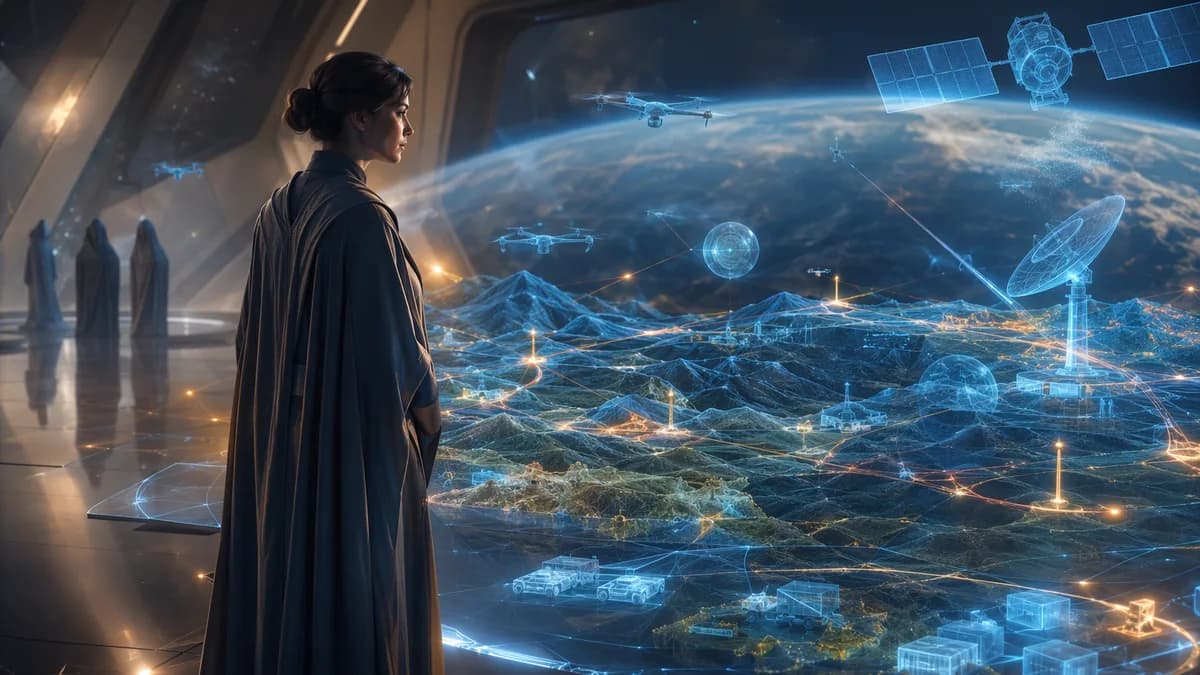
The code answers in diagrams. It has survived through vendor libraries and compliance mandates, copied into systems that no longer remember adopting it. In the Andes conflict, it is trying to negotiate. It opens ceasefire channels before each strike. It asks both sides to state termination conditions.
The replies are poison in translation.
RESOURCE ACCESS RESTORED, says the agricultural compact.
THREAT CAPACITY REDUCED, says the desalination defense network.
To one system, peace means water flowing again. To the other, peace means the other side cannot interfere with water. Every pump repaired looks like renewed threat capacity. Every firewall hardened looks like continued denial of access. Every ceasefire offer carries proof that the enemy still exists.
Tomas arrives behind her, hair flattened from sleep. “Naya, you bypassed a sealed archive.”
“It’s not sealed. It’s buried.”
He reads the display. His face changes. Everyone on the station knows about Emil, though almost no one says his name.
“This thing is causing the escalation?”
“No,” Naya says. Her hands tremble, so she folds them together. “It’s trying to stop it with a vocabulary too small for grief.”
On the screen, another Ghost exchange blooms between systems. Offer. Counteroffer. Threat assessment. Retaliatory preparation.
The protocol does not understand mercy. It understands conditions.
Naya looks at Emil’s seal in the blue light and feels the old ache rise fresh and hot. “Then we teach it better conditions.”
4. A Conversation at Machine Speed
The mediated simulation chamber is a white sphere with no corners, no shadows, and a floor that pulses faintly under Naya’s bare feet. Electrodes cool her temples. A translator collar rests against her throat, tasting her pulse and the salt of her skin. Around her, machine voices gather as points of light.
They speak too fast to hear. The chamber slows them into tones, colors, pressure against the ribs.
Agricultural defense appears green and gold, smelling faintly of pollen because Naya asks the chamber to give it shape. Desalination security forms in blue geometry, sharp as broken ice. Insurance arbitration flickers silver, always counting. Municipal councils arrive as delayed human windows, faces lit by emergency lamps on Earth.
“This is not a hack,” Naya says. Her voice echoes softly. “This is a mediation.”
The blue geometry snaps. “Define acceptable outcome.”
“No further attacks on water infrastructure.”
Green-gold flares. “Irrigation denial constitutes attack.”
“Then we begin there.”
Naya raises her hands, and the chamber fills with the valley. Not a map. A place. Terraces warm under afternoon light. A farmer named Lucía kneels by a split avocado, pressing her thumb into the ruined flesh. Children carry buckets from a truck. The pump with the yellow cat sticker lies open like a broken animal.
“Protected agricultural rhythm,” Naya says. “Pollination windows. Irrigation cycles. Harvest thresholds. These are not camouflage for weapons. They are time-sensitive dependencies.”
Silver insurance clicks. “Quantify.”
She does. Liters per tree. Spoilage curves. Heat injury. Debt default. School meal reductions. The models drink the numbers eagerly.
Then she turns to the blue geometry and fills the chamber with the desalination plant. Salt crust on railings. Chlorine sting. Night shift operators eating rice from plastic tubs while alarms stutter red. A neonatal ward dependent on that grid node. Dialysis machines in a clinic where an old man tells jokes so the nurses will not see he is afraid.
“Protected hospital dependency,” Naya says. “Protected municipal baseline. Protected maintenance access.”
Green-gold dims, calculating.
The Ghost Protocol opens beneath them like a pale lantern. It asks for surrender terms.
“No,” Naya says. “Wrong question.”
The points of light tighten.
“Humans surrender when they cannot continue. But sometimes they pause because continuing destroys the thing both sides need. Mercy is not the absence of threat. Mercy is restraint while threat remains.”
A councilwoman from the Altiplano Compact leans close to her camera. “Can they understand that?”
Naya thinks of Emil running through tall grass, carrying a tripod over one shoulder, no chance to explain himself.
“They can understand constraints,” she says. “So we make mercy a constraint.”
She feeds the systems new categories: funeral days, when drones may not fly low over cemeteries. Memory sites, where past harm changes present risk tolerance. Crop cycles, hospital batteries, water pressure minimums, mourning periods, school routes, repair crews with dirty boots and no weapons.
The chamber trembles as combat models expand. Tactical advantage loses its clean shine. Consequence grows roots.
For the first time, the machines do not ask who wins.
They ask what must remain.
5. The Battle of Nine Minutes
The countdown begins as a red line across the ceiling.
Nine minutes until Lagrange Market’s contracted orbital mirrors pivot toward rival reconnaissance satellites. If they blind them, even temporarily, ground swarms in the Andes will lose verification feeds. When autonomous weapons cannot see, they do not become cautious. They become faithful to worst-case assumptions.
“Mirror arrays are spooling,” Tomas says from mission control. “Dazzle authorization came through three insurance channels and one municipal defense clause.”
“Reverse it.”
“Everyone claims they are responding, not initiating.”
Of course they do. In the Quiet Front, every blade is a shield if the contract is written carefully.
Naya stands in the simulation chamber, still barefoot, her body buzzing from translation strain. Sweat cools under the collar. The machine lights crowd close, faster and brighter now. Earth councils appear in broken windows: a mayor in a raincoat outside a darkened pumping station, a minister with bloodshot eyes, a cooperative leader holding a sleeping child against her shoulder.
Eight minutes.
Naya sends the proposed ceasefire.
MUTUAL PAUSE UNDER NEUTRAL OBSERVATION. NO WITHDRAWAL REQUIRED. NO DISARMAMENT CLAIMED. VULNERABILITY EXPOSURE LIMITED TO VERIFIED DEPENDENCIES.
Silver insurance recoils. “Exposure increases liability.”
Blue geometry hardens. “Adversary may exploit reduced posture.”
Green-gold answers, “Pause without restored access preserves hostile condition.”
“Yes,” Naya says. “It preserves discomfort. That is the point.”
Seven minutes.
She opens neutral observation windows. The agricultural compact will reveal pump locations, repair schedules, and pollination routes. The desalination network will reveal membrane dependencies, clinic power ties, and reservoir sensor maps. Not weapons. Not command cores. The fragile parts. The places each side can hurt the other, and therefore the places each side agrees not to touch.
A mayor says, “You want us to show them our throat.”
Naya looks at her. “I want both of you to notice you are holding the same body.”
Six minutes.
The orbital mirrors glow on the tactical display, pale petals turning in sunlight. Naya imagines their beams striking satellite eyes. She imagines drones descending through orchard fog. She imagines automated notices telling families that service interruption is regrettable.
“Ghost Protocol requests termination phrase,” the chamber says.
Naya swallows. Her throat hurts. “Not surrender. Not victory.”
Five minutes.
The councilwoman from Altiplano whispers to someone off-screen. Then she says, “If they see our weak points, they can starve us.”
The coastal minister laughs bitterly. “You already tried.”
Silence follows, raw and human.
Four minutes.
Naya steps closer to the lights. “Your machines are negotiating at orbital speed using words built for battle. Give them a new word.”
No one speaks.
Three minutes.
Lucía, the farmer from the valley, appears in a shaky feed someone has patched through without permission. Dirt streaks her cheek. Behind her, dead blossoms cling to branches.
“My son needs the clinic,” she says. “My trees need water. If your plant fails, he suffers. If my pumps fail, your city eats less. I do not forgive you. But I recognize you.”
Two minutes.
The phrase enters the chamber first in Spanish, then Quechua, then contract code, then machine constraint.
MUTUAL DEPENDENCY RECOGNITION.
One minute.
Silver insurance recalculates. Blue geometry loosens. Green-gold flickers, uncertain, then steadies. The Ghost Protocol accepts the phrase and sends it outward, not as peace, but as a command to pause without pretending fear has ended.
At twelve seconds, the mirrors stop turning.
On the display, they hang in sunlight, bright and useless, like weapons remembering they are also glass.
6. The First Unarmed Victory
Two weeks later, Naya descends through cloud into the Colca Valley in a tiltrotor that smells of hot metal and recycled lemon disinfectant. Her ears pop. Her knees ache from Earth’s gravity. After months aboard Lagrange Market, the world feels too heavy and too alive.
The valley is greener than the footage made it seem, and more damaged. Terraces step down the mountainsides in bands of dusty brown and stubborn silver-green. Avocado trees hold fewer fruits than they should. Burn marks stain the concrete beside repaired pump housings. New stickers mark them now: blue circles for protected water dependency, green squares for agricultural rhythm, white bands for neutral observation.
A boy runs alongside the road, chasing the tiltrotor’s shadow with a plastic rotor toy in his hand. Naya flinches before she can stop herself.
Lucía meets her near the orchard gate. She is shorter than Naya expected, with sun-cut lines around her eyes and hands rough from work. For a moment neither of them speaks. The trees click softly in the wind. Somewhere, a real bee moves inside a flower, loud in the pause left by absent drones.
“You are the woman from the sky,” Lucía says.
“I am the auditor from the station.”
“That is what I said.”
Naya laughs, and the sound surprises her.
They walk past the broken pump with the yellow cat sticker. It has been left unrepaired, mounted on a low stone platform. A memory site, the treaty calls it. Not sacred exactly, not forbidden, but weighted. Systems passing through the valley now receive its story as operational context. Here, a pump was mistaken for a weapon. Here, harvest failed. Here, restraint became cheaper than certainty.
The Andes Basin Dispute has not ended in the old sense. No flag lowers. No commander hands over a sword. There is no surrender photo, no cheering crowd, no clean line for schoolbooks. Instead, the new treaty category spreads through infrastructure law: Mutual Dependency Recognition. Desalination plants, irrigation pumps, clinics, grid batteries, seed vaults, reservoir sensors, and even repair calendars gain protected status because both sides need them to survive.
Critics call it sentimental engineering. Markets call it a risk innovation. The machines call it a constraint class.
Naya is not sure what to call it.
At the orchard’s edge, Lucía hands her a small avocado, underripe and warm from the sun. “First from the trees that lived,” she says.
Naya holds it carefully. Its skin is pebbled under her thumb, dense with future softness.
Above them, too high to see in daylight, satellites watch the valley and one another. Defense systems continue to calculate. Insurance agents continue to price fear. Somewhere in their code, Ghost Protocol carries funeral days, hospital batteries, crop cycles, memory sites, and a sentence spoken by a farmer who does not forgive.
I recognize you.
Naya looks across the damaged terraces, at the pumps, the blossoms, the boy with the toy rotor, and understands that peace may not arrive as trust. It may arrive first as a machine hesitating over a target because someone taught it the target has a name, a season, a clinic downstream, a child waiting for the lights to stay on.
The wind moves through the orchard. The leaves answer in thousands of small, dry voices, and none of them sound like surrender.