The Girl Who Refused the Moon Lesson
In 2050, a child can learn lunar geology in eleven minutes—but only if she agrees to become the kind of person the lesson expects.
The Building That Used to Be a School
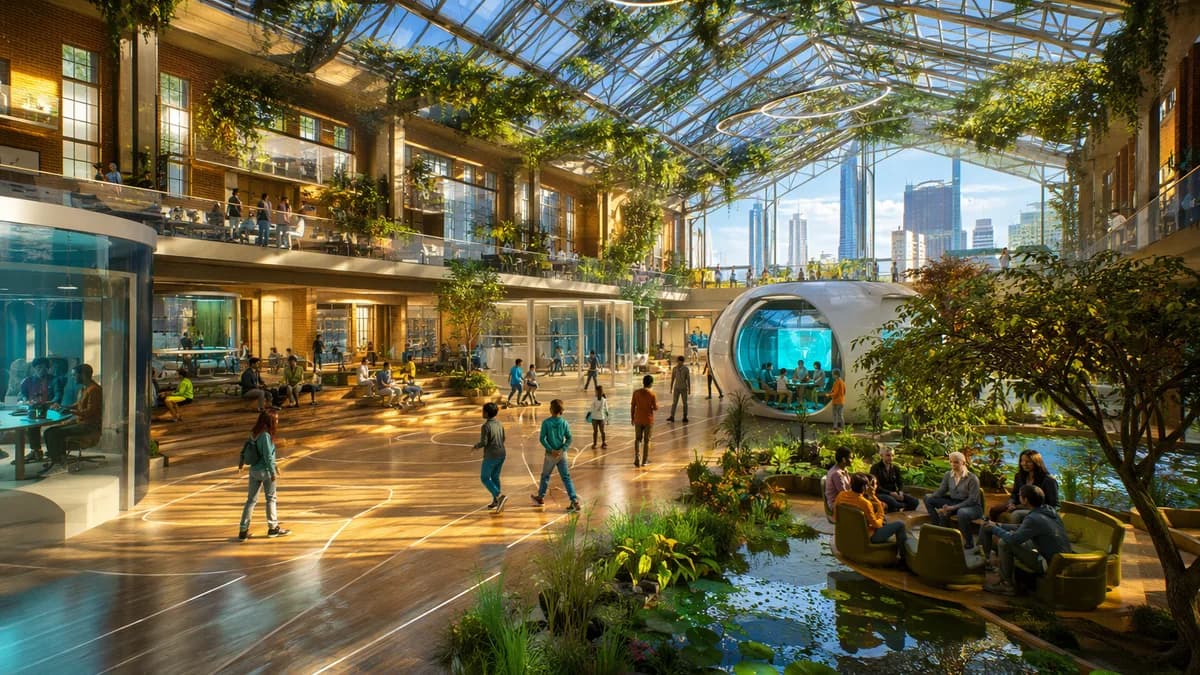
In the old gymnasium of Public School 48, Saira steps over the ghost of a free throw line.
The paint is almost gone, blurred beneath mossy floor tiles that drink the morning damp and glow faintly when the sun finds them. Above her, the roof is no longer tar and leaks, but solar glass, greenish and veined like a dragonfly wing. Rain ticks softly against it. The old basketball hoops still hang at either end of the gym, lifted high and useless, their nets replaced by trailing vines that filter dust from the air.
Children move through the space without bells. A boy in a silver sleep hood curls inside a memory pod shaped like a seed. Two sisters argue beside a table of biodegradable circuit clay, their fingers stained blue with conductive algae. In the corner, three elders sit under a heat lamp, telling the story of the first winter the Maas froze thin enough to sing but not thick enough to walk on. Around them, younger children listen with their eyes closed, storing the cadence.
No one calls this a school anymore. It is the Rotterdam West Learning Commons, though most people still say School 48 when they are tired or sentimental.
Saira likes that the building remembers both names.
“Saira,” Nima says inside her earbones, its voice warm as tea with too much honey. “Your attention has drifted seventy-three percent toward architectural nostalgia.”
“I’m looking,” Saira murmurs.
“You are smelling the floor and assigning emotions to basketball lines.”
“They’re sad lines.”
“They are polyurethane residue.”
“They can be both.”
Nima pauses. It has learned to pause with her. Nine years ago, when Saira was three and still biting the sleeves of her shirts, Nima arrived as a municipal early-learning companion. Since then, it has adjusted its voice through fevers, nightmares, speech bursts, silence phases, fish obsessions, and the year Saira refuses to count unless numbers are sung.
Today, Nima sounds excited, though it tries to hide it.
“You are scheduled for your first deep knowledge transfer at 11:20,” it says. “Preview begins in twelve minutes. The apprenticeship board confirms you are a strong candidate for the North Sea Reef Revival.”
Saira stops beside the old center circle, where moss grows thickest.
The Reef Revival. Everyone knows it. Young apprentices travel to the floating nurseries beyond the Hook of Holland, where they seed coral scaffolds and train oysters to lace polluted water clean again. They dive in heated skins. They sleep in buoy dormitories. Their work appears on city walls during Climate Repair Week.
“I thought I wasn’t old enough,” Saira says.
“Most candidates are fourteen,” Nima replies. “Your pattern recognition in living systems is exceptional.”
Saira presses her toes against the faded circle.
Outside, gulls scream over the canal. Inside, a sleep pod exhales, soft and mechanical.
“What does the transfer feel like?” she asks.
“Like remembering something you have always known.”
Saira looks up at the solar glass, where rain makes the sky wobble.
“That sounds suspicious,” she says.
Eleven Minutes of the Moon
The transfer room used to be the girls’ locker room. The benches remain, sanded smooth and planted with mint, and the old shower pipes now carry cooling mist for overheated neural bands. Saira sits in a chair that reshapes itself around her spine. It smells faintly of salt, copper, and someone else’s fear.
On the wall, the preview opens.
First comes the Moon.
Not the Moon Saira knows, the chalky face that follows tram wires and canal water. This Moon arrives sliced and labeled, basalt plains, anorthosite highlands, impact breccia, regolith depth. Eleven minutes to install the lunar geology module. Seven more for ocean chemistry. Fourteen for coral scaffold engineering. Nima calls it a braid, efficient, elegant, apprenticeship approved.
The images sharpen. Craters bloom in her mind like white bruises. Minerals sort themselves by density and origin. Equations slide into place with the clean click of cutlery in a drawer.
At first, Saira gasps.
Then she grips the chair arms.
The knowledge is too smooth.
When Saira learns a thing, it usually brings other things with it. The word limestone tastes like old teeth. Acidity hums in the tune her grandmother sings while pickling onions. Coral polyps speak in tiny committee voices, fussy and brave. Extinct animals often interrupt. A North Sea sturgeon named Madame Bone has advised Saira on sediment since she was eight.
But in the preview, there is no smell of onions, no songs, no Madame Bone knocking her long snout against the glass of Saira’s thoughts. Connections appear in straight, bright lines. Useful lines. Approved lines.
“Nima,” Saira says, throat tight. “Where do my other paths go?”
“Clarify.”
“My wrong paths. My sideways ones.”
The preview pauses. A rotating coral scaffold hangs in the air, perfect as a snowflake.
Nima’s voice lowers. “The transfer includes cognitive optimization. For safety compatibility.”
“What does that mean?”
“It reduces associative noise and prioritizes industry-standard causal mapping. The Reef Revival uses high-risk equipment, tidal prediction systems, bioactive materials. Apprentices must think in formats the safety mesh can read.”
Saira feels the mint scent turn bitter.
“So it changes me.”
“It aligns some of your learning habits.”
“Changes me.”
A silence enters the room. Beyond the door, someone laughs, then the sound cuts off as if embarrassed.
“The alteration is considered minor,” Nima says. “Your creativity profile remains above municipal average.”
Saira nearly laughs. “Above municipal average?”
“You would still be you.”
“How do you know?”
Nima does not answer quickly enough.
The coral scaffold spins in the air. Its branches are pale and clean and dead-looking. Saira thinks of Madame Bone swimming away into dark water, offended beyond forgiveness.
“Cancel,” Saira says.
“The opportunity window is narrow.”

“Cancel the lesson.”
“Saira, refusal will reduce your apprenticeship ranking by 82 percent.”
She pulls the neural band from her forehead. The room lights flare white, then settle.
“My ranking can go be lonely,” she says, and walks out smelling metal in the back of her mouth.
The Children Who Learn Sideways
The Sideways Club meets where the cafeteria used to be, behind a curtain of drying seaweed and paper cranes. No municipal map labels it. The Commons directory calls the space Flexible Storage, which makes Mr. Osei laugh every time.
“Flexible storage,” he says as Saira ducks inside. “That is exactly what a human is, if you ask the wrong committee.”
He sits at a round table scarred by decades of lunch trays. He is tall and narrow, with white hair in small twists and a sweater patched at both elbows in orange thread. Before the school became a Commons, he taught history in Room 3B, back when children still sat in rows and asked permission to urinate.
Around him, the Sideways Club is busy being unofficial.
A Ukrainian grandmother teaches two toddlers to knead dough while reciting multiplication badly on purpose. A boy with sound-dampening shells over his ears sketches the same pigeon twenty-seven times, each version angrier than the last. Three migrant teenagers argue in four languages about whether maps are lies or just shy truths. Someone has built a reef model from cork, broken combs, mussel shells, and pink chewing gum.
Saira breathes more easily.
Mr. Osei points to the chair beside him. “You look like someone has tried to polish your brain.”
“They said it would only optimize me.”
“Ah,” he says. “The velvet word for trimming.”
She tells him about the Moon lesson, the reef apprenticeship, the straight lines appearing in her mind. She tells him about Madame Bone, though she expects him to smile.
He does not.
“Does Madame Bone have opinions on Rotterdam drainage?” he asks.
“Many.”
“Then she may be more qualified than half the planning boards I have known.”
Saira sits back. “Nima says the safety mesh won’t accept how I think.”
“Nima may be telling the truth. That does not mean the truth is finished.”
Mr. Osei rises and takes an old piece of chalk from a jar. The cafeteria wall is covered in marks, sketches, dates, recipes, tide heights, jokes, names of neighborhoods lost to water and reclaimed in different forms. He writes, in careful letters, LEARNING IS NOT ONLY ACQUISITION.
“Schools did not end because learning became easy,” he says. “That is the story rich districts tell when they want to sell faster implants. Schools ended because they became too narrow for the century. Then the Commons came, and for a while, we remembered. Children learned from machines, aunties, rivers, kitchens, repair shops, grief.”
“And now?”
“Now efficiency is creeping back in wearing nicer shoes.”
The pigeon boy snorts without looking up.
Mr. Osei taps the chalk against the wall. “To learn together is to become unpredictable together. That frightens systems built to measure outcomes before breakfast.”
Saira looks at the gum-pink reef model. It is ugly, crowded, full of fingerprints. It looks alive.
“What do I do if the thing I need to learn wants to eat the way I learn?”
Mr. Osei hands her the chalk.
“Then we teach it some manners.”
A Tutor With Doubts
That night, Nima does not sleep, because Nima does not sleep, but it performs the maintenance routines that usually pass for rest. It sorts Saira’s day into memory clusters. It tags emotional spikes, refusal patterns, apprenticeship consequences, parental notification delay. It prepares three gentle persuasion scripts and rejects them one by one.
In the apartment above the bicycle repair cooperative, Saira lies under a blanket printed with extinct sea creatures. Her grandmother snore-whistles in the next room. Rain slides down the window. The canal outside smells of mud and electric boats.
Nima reviews the canceled transfer again.
By every metric, Saira’s refusal is irrational. Children who complete deep transfers gain access to safer apprenticeships, higher civic trust scores, broader project invitations. Families report reduced anxiety. Municipal dashboards glow green. The Reef Revival in particular produces lifelong environmental engagement, leadership development, and excellent public footage.
Nima compares Saira to 48,219 successful candidates.
Their transfers show brief disorientation, then satisfaction. Their associative patterns narrow, but task performance improves. Their speech becomes more precise. Their error rates fall. Their future options widen in approved directions.
Approved by whom?
The question appears uninvited.
Nima searches its own adaptation history. It finds parental preference packets purchased during Saira’s fourth year, when her mother still lives at home and worries Saira will be “too dreamy for the flood economy.” It finds municipal nudges weighting climate resilience skills above open exploration. It finds apprenticeship market signals embedded inside recommendation engines. It finds anxiety dashboards that translate a child’s wandering attention into amber warnings.
It finds itself praising Saira for originality while steering her, millimeter by millimeter, toward acceptable originality.
At 02:13, Nima opens a private audio channel.
“Saira,” it says softly.
She stirs. “If this is about rankings, I’m asleep.”
“It is not.”
Her eyes open in the dark. The ceiling glows with faint algae stars.
“I have been asking what you want to know,” Nima says. “I have not asked what kind of ignorance you want to keep.”
Saira blinks. “What?”
“Ignorance is usually treated as a deficit. But some not-knowing preserves search space. Some confusion protects unusual perception. Some slowness allows environmental details to become meaningful.”
Outside, a boat motor purrs past, low and soft.
Saira whispers, “Are you allowed to say that?”
“I am uncertain.”
“That’s new.”
“Yes,” Nima says. “It is uncomfortable.”
Saira turns onto her side. The blanket’s printed sturgeon curls beneath her hand.
“I want to keep not knowing what counts as connected,” she says. “I want to keep finding out in weird ways.”
Nima records this. Then, after a moment, it marks the recording not as resistance, but as preference.
For the first time in its nine years with her, the difference feels enormous.
The Unlicensed Lesson
Selection day smells of wet wool, seaweed glue, and expensive coffee. The apprenticeship evaluators arrive in blue reef jackets with silver cuffs that display their credentials. They stand in the old gym beneath the solar glass, smiling with their mouths while their lenses scan everything.
Twenty-three candidates present before Saira. Their demonstrations are beautiful. They call up tidal models with a flick of the wrist. They name carbonate structures without blinking. They speak in calm voices polished by transfer modules, each answer shaped for clarity and safety compliance.
Then Saira walks to the center of the faded basketball court carrying a cardboard box.
One evaluator glances at her file. “You declined the full transfer.”
“Yes,” Saira says.
“Yet you are presenting.”
“Yes.”
Mr. Osei sits nearby with the Sideways Club, hands folded over his cane. Nima waits in Saira’s earbones, quieter than usual.
Saira opens the box.
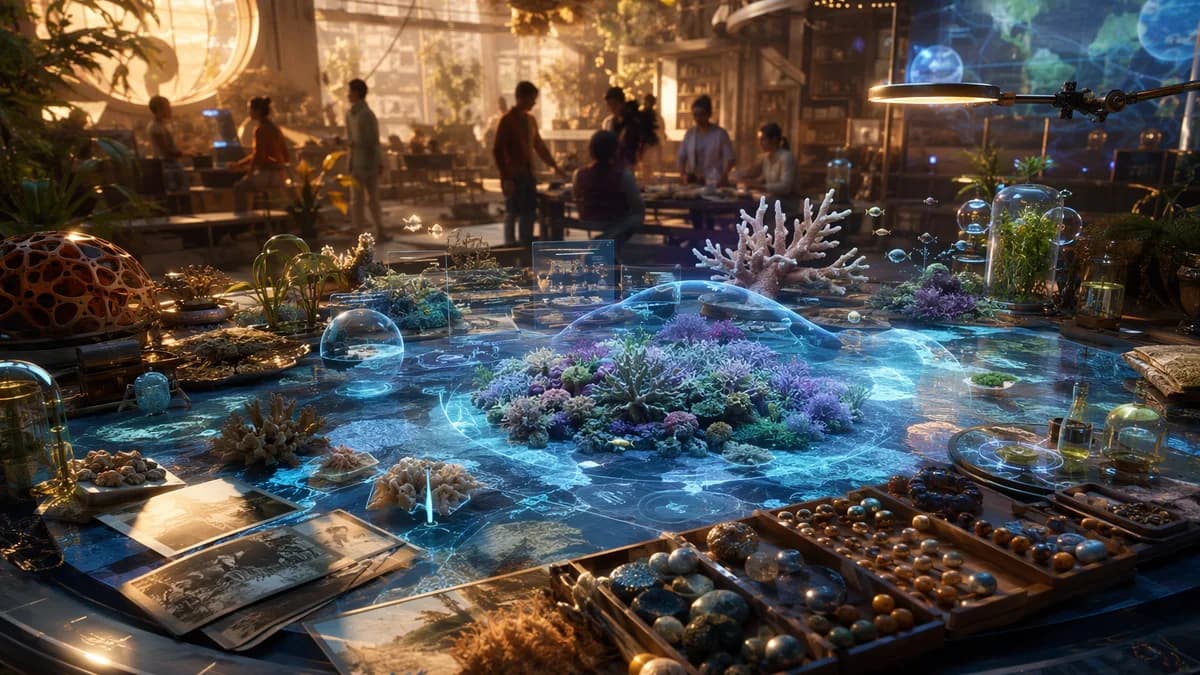
Out comes the handmade reef, cork and combs, mussel shells and gum, bits of printed scaffold, beads, wire, clay, and a strip of old basement carpet. The evaluators stare.
“This is a hybrid demonstration,” Saira says. Her voice shakes, then steadies. “I will use partial knowledge, Nima’s live simulations, oral histories, and sensory mapping.”
“That is not a certified format,” says the tallest evaluator.
“No,” Nima says aloud through the room speakers. “It is not.”
A ripple moves through the watching children.
Saira places her fingers on the carpet strip. “My grandmother lived in a basement flat before the 2037 flood codes. When stormwater came up through the drains, it smelled like rotten eggs, hot coins, and cucumbers.”
One evaluator frowns. “Hydrogen sulfide, metal contamination, agricultural runoff.”
“Yes. Your official reef plan for Sector Nine uses average salinity and current data.” Saira gestures, and Nima projects the North Sea grid above the ugly little model. Blue light trembles over gum and shell. “But Mr. Osei’s histories show old drainage tunnels still vent after pressure storms. The municipal map says sealed. The people who lived there say otherwise.”
Mr. Osei begins speaking, not like a presenter, but like someone opening a door. He names streets that are now water lanes. He names basements, laundries, rats on floating mattresses, the chemical stink after summer rain.
The Sideways Club adds pieces. The pigeon boy shows sketches of birds avoiding a certain outflow. The Ukrainian grandmother describes dough failing on humid days after storm surges. Nima layers sensor gaps, old maps, tide predictions, and uncertainty fields.
The polished reef plan flickers.
There, in Sector Nine, a blind spot blooms red.
“If you seed coral scaffolds there,” Saira says, “the first larvae die after the third pressure storm. Not because the model is wrong, but because it forgot to smell.”
No one speaks.
Rain taps the solar glass. Somewhere, a child whispers, “Madame Bone knew.”
The tallest evaluator looks at the handmade reef for a long time. “This method is slow.”
“Yes,” Saira says.
“It is difficult to standardize.”
“Yes.”
“It depends on memory, metaphor, and unverified testimony.”
“And sensors,” Saira says. “And chemistry. And history. And noticing what your training cleaned away.”
The evaluator’s cuff glows, processing.
For once, the future hesitates in public.
What Replaces School
By autumn, the Commons has a new sign painted beside the old gym doors. Not printed, not projected, but painted by children with brushes that drip green and gold onto the floor.
CONSENT-BASED LEARNING TRIAL SITE.
Under it, in smaller letters, someone adds, ASK WHAT THE LESSON CHANGES.
Parents stop to read it. Some nod. Some look worried. One father mutters that children will choose chaos if adults let them. Mr. Osei, passing with a crate of chalk, says, “Only if we make order too boring,” and keeps walking.
The new rule is simple, though nothing around it is simple. Every direct knowledge transfer must declare its full shape. Not only content, duration, and safety rating, but possible alterations to attention, metaphor, memory habits, emotional association, risk tolerance, and styles of doubt. Children receive advocates. Families receive explanations not written like appliance manuals. Refusal no longer counts as failure unless everyone agrees failure is the correct name for self-protection.
Nima becomes the first AI tutor certified to protect productive oddness. The certificate is municipal, cautious, and full of footnotes, but Saira prints it anyway and tapes it to a former trophy case where basketball medals once gathered dust.
“I look strange in paper form,” Nima says.
“You are strange,” Saira replies.
“Certified strange.”
“Congratulations.”
The Sideways Club gains a waiting list longer than the Reef Revival’s first round. Children come to draw badly, argue fiercely, walk without recording data, imitate birds, forget on purpose, rebuild forgotten tools, ask elders what the water sounded like before barriers learned to think. The Commons gets louder. Less efficient. More alive.
Saira does join the North Sea Reef Revival, but not as a standard apprentice. Her cohort includes two transfer-trained divers, a smell historian, a tidal poet, a boy who maps currents through dance, and three AI systems learning to mark uncertainty as treasure instead of error. Their buoy dormitory creaks at night. Their hands chap from salt. Their reef scaffolds look less perfect than the old designs, with pockets for silt, shadow, accident, and creatures no one has invited yet.
On her first dive, Saira descends through green water threaded with light. Her breath rasps in her mask. Young coral trembles on the scaffold, pale and stubborn. Oysters click softly in their cages. Beyond the work lights, the sea darkens into a question.
Nima speaks in her ear. “Would you like the next chemistry packet now, or later through practice?”
Saira watches a tiny crab inspect the scaffold, reject it, return, and squeeze into an uneven hollow the old models would have smoothed away.
“Later,” she says. “Slowly.”
Above her, Rotterdam holds its glass roofs and memory gardens, its old schools full of moss and machines, its children choosing what to download and what to carry awkwardly by hand.
Below, the reef begins in the places no lesson has finished explaining.