The Night the Grid Became Weather
When fusion power turns electricity into a borderless resource, a former oil diplomat must learn how to negotiate with neighborhoods instead of nations.
A Diplomat Without a Commodity
Laleh Nouri arrives in Mombasa with two linen suits, a cracked leather document case, and the reflex to read a room as if somebody is hiding a barrel price inside it.
The air outside the airport smells of salt, diesel algae, wet concrete, and cloves. Above the arrivals road, a line of buses waits under the pale shimmer of an induction canopy. No cables, no pumps, no fuel tenders. The buses breathe softly, doors folding open and shut, taking in passengers and power at the same time.
Her driver, a woman with silver braids and a dashboard full of plastic saints, catches Laleh staring.
“First time under a public beam?” she asks.
“First time admitting it,” Laleh says.
The woman laughs and pulls into traffic. “You diplomats used to pretend the sky was empty.”
Laleh smiles because it is easier than explaining. For twenty years, she has negotiated for a country whose wealth once rose from under black desert rock. She remembers conference halls where men tapped polished tables and spoke of stability while tankers waited in straits, where every handshake carried the weight of scarcity. Her father called oil a language. Learn its grammar, he told her, and no one can make you poor.
Now her country sells membrane design, sand-battery architecture, desalination management, and energy ethics curricula for children. Its universities are full, its ports busy, its old flare stacks turned into museums. Yet when Laleh looks at the glowing grid map on her wrist, with orbital relays moving power across the Indian Ocean like cloud shadows, she feels she is negotiating from a vanished map.
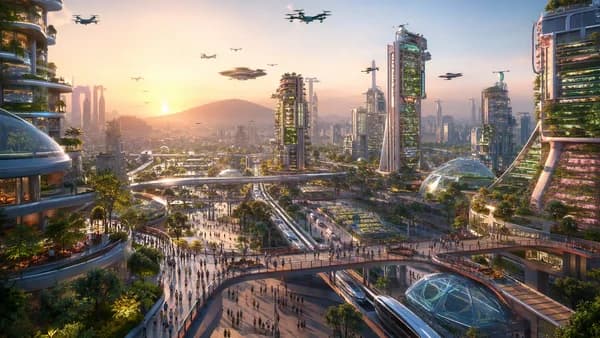
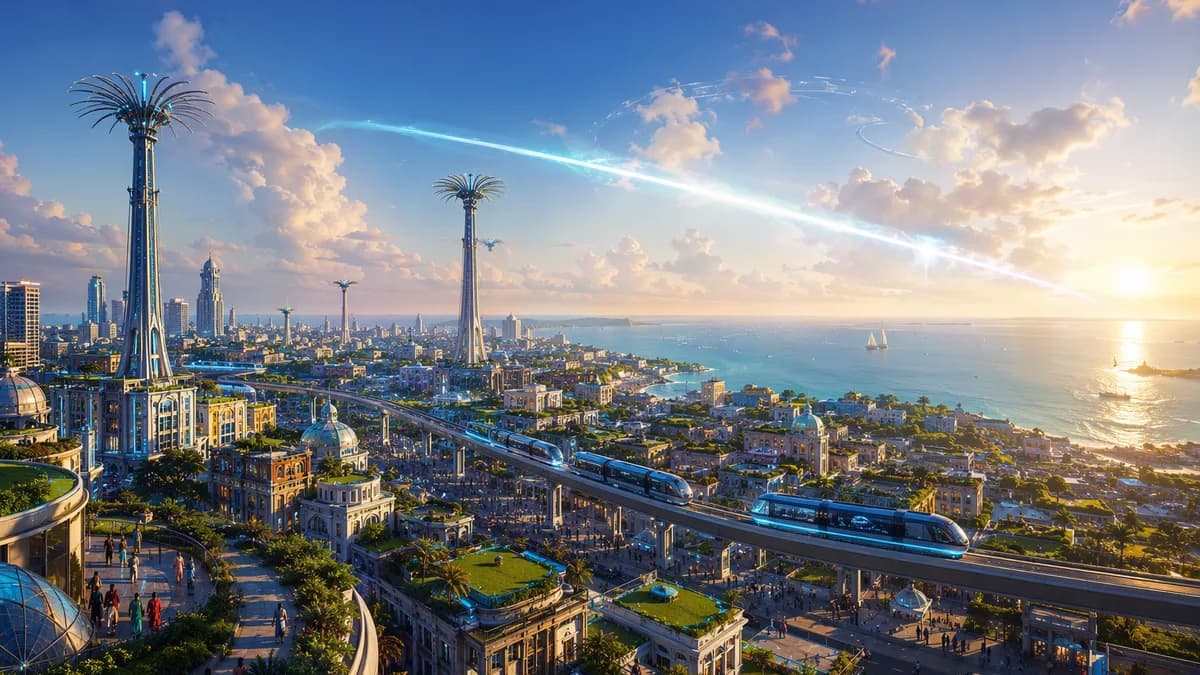
The city rises around her, coral stone and glass, balconies hung with laundry, prayer calls threading between the hum of cooling towers and the distant slap of waves. On rooftops, gardens glow faint violet under morning grow lamps, still finishing their night cycle. Water trickles everywhere. Not the guarded water of her childhood, counted by tanker and decree, but public water, spilling from fountains where children rinse mango juice from their wrists.
The First Assembly of the Open Watt Treaty begins tomorrow. Laleh has come as senior envoy for a nation learning to speak without the authority of a commodity.
At a traffic circle, a mural covers the side of a school. It shows a hand cupping a sun, not owning it, just holding the light long enough to share.
Laleh presses her palm against the warm window glass. The city moves under a sky full of invisible power, and she wonders what leverage means when the thing everyone needs no longer belongs to anyone.
Breakfast Under the Beam
Her cousin Samira lives in a narrow blue house in Tudor Creek, where mangrove roots grip the mud like old fingers and floating walkways rise and fall with the tide. The house smells of cardamom coffee, fried cassava, and damp rope. A ceiling fan turns lazily, fed by a receiver tile no larger than a prayer mat on the roof.
“You look tired,” Samira says, kissing both of Laleh’s cheeks.
“I have been tired since 2032.”
“Then eat. We have upgraded tiredness here. It comes with coconut chutney.”
At the breakfast table, Samira’s husband, Juma, spreads seaweed jam on toast while their youngest daughter, Nia, complains that the school’s rooftop beans are growing too fast under the new night lamps.
“They squeak,” Nia says. “At night. Like mice.”
“Plants do not squeak,” her brother Idris says.
“These ones do. They are beam beans.”
Outside, a bus glides to a stop in front of the community clinic. The pavement beneath it pulses blue for six seconds, then fades. The driver does not look down. A woman steps aboard carrying a basket of fish packed in chilled kelp foam. Two boys in football shirts lean their bicycles against a charging rail and run off barefoot toward the water.
Nothing looks miraculous. That is what unsettles Laleh most.
In the old energy expos, abundance came dressed in spectacle, chrome domes, glowing models, ministers cutting ribbons before cameras. Here, abundance is a grandmother boiling water without checking a meter. It is a row of induction stoves in the alley, where neighbors cook together because nobody worries whose bill will swell. It is a fountain at the corner, seawater drawn from the creek, filtered through ceramic membranes, chilled just enough to bead on metal cups.
After breakfast, Samira takes Laleh to the roof. The garden is dense with spinach, basil, tomatoes, and dwarf bananas, leaves wet from mist lines. A low violet glow still clings under the canopy.
“We grow at night when the air is cooler,” Samira says. “People sleep later now. Markets open after evening prayers. Bakers work before dawn because heat is free then. Weddings last until morning, unless the elders complain.”
“Do they?”
“Of course. Energy changed, not elders.”
Below, someone laughs. A radio plays taarab, soft strings and a woman’s voice floating above the creek. Laleh feels the tile under her feet, faintly warm, drinking power from a beam she cannot see.
Samira touches a tomato blossom with one finger. “People say free power makes life faster. Sometimes. But mostly it lets us choose our own clock.”
Laleh looks at the harbor, where cargo drones hover like patient gulls. She thinks of treaties written around pipelines, ports, choke points, reserves. Down here, power has become breakfast timing, garden humidity, the hour when a child does homework under a lamp that never argues with the family budget.
The New Borders Are Quiet Ones
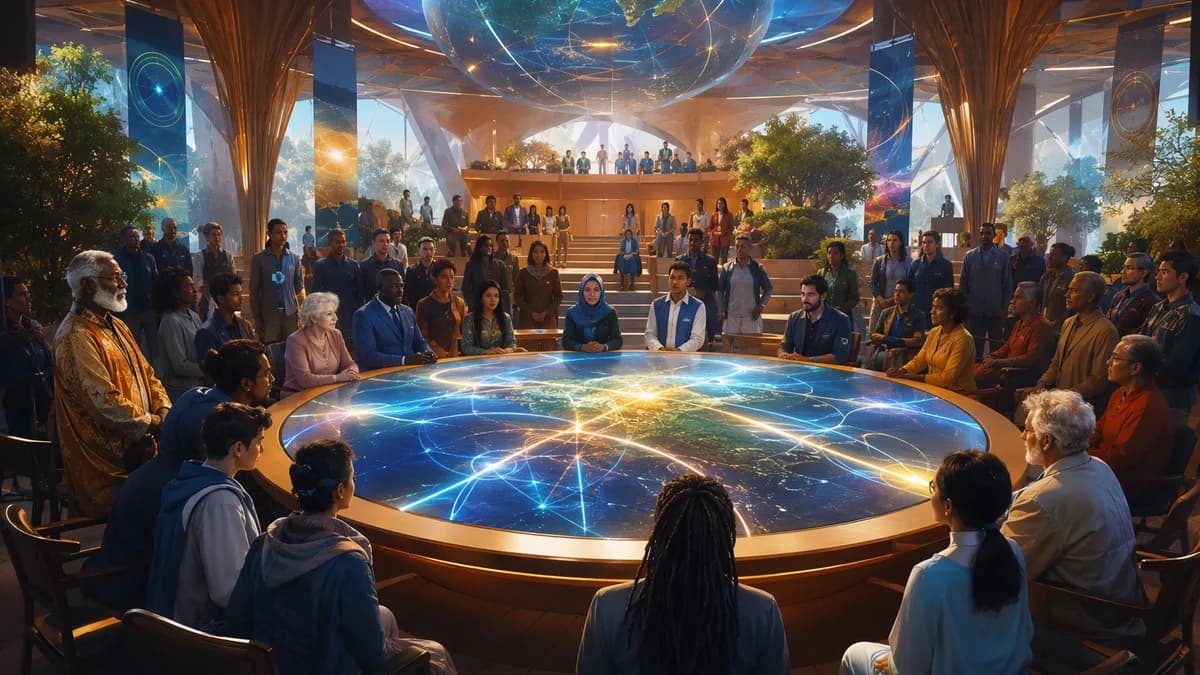
The treaty hall is built in an old customs warehouse by the harbor. Its coral walls are thick enough to remember empire, and its roof is new enough to receive orbital power through a skin of transparent mesh. Delegates sit beneath slow fans, translation buds tucked into their ears, nameplates glowing in six scripts.
Laleh expects arguments over control. She gets them, but not in the language she knows.
The Brazilian delegation wants emergency priority guarantees for rainforest fire suppression. The Pacific Island Coalition demands orbital maintenance seats, not advisory access, because relay drift can drown their communications before anyone in Geneva notices. The East African Grid Union insists that beam corridors must not pass through monsoon research bands without local approval.
“No one owns sunlight,” says a Finnish minister, thin and sharp as a folded knife.
“No,” replies a woman from the Maldives, “but someone always owns the mirror.”
Laleh takes notes. Around her, the old geography has been replaced by a quieter one. Not pipelines, but sky lanes. Not refineries, but receiver fields. Not embargoes, but algorithmic priority during storms, droughts, and heat waves.
Then the gallery doors open, and the cooperatives enter.
They do not wear national colors. They wear fishermen’s caps, school uniforms, beadwork, clerical collars, mechanic gloves, mourning white. A farmer from inland Kenya speaks first, her palms flat on the lectern.
“We demand the right to refuse imported power during soil-rest weeks,” she says. “Our restoration zones require darkness, insect cycles, cooler ground. Your abundance is heating the beetles out of our fields.”
A Maori organizer follows. “Our migration festival includes three nights of blackout. No beams, no public projections, no sky advertisements, no machine music. We walk by fire and memory. The treaty must recognize refusal as a right, not a malfunction.”
A hush settles. Laleh feels it press against her ribs.
A European security adviser leans toward his microphone. “With respect, refusing clean power during peak supply is inefficient.”
From the gallery, an old man calls, “So is grief. Yet we keep it.”
A ripple of laughter, then applause.
Laleh looks down at her prepared statement. It praises interoperability, stabilization, energy diplomacy, technical transparency. Good words. Dead words, suddenly.
During the break, she stands near the harbor windows while rain taps the glass. A young delegate from a coastal cooperative approaches her, eyes bright behind round lenses.
“You are Nouri,” he says. “Oil treaties.”
“Formerly.”
“Then you know what happens when communities are told a resource is too important for them to govern.”
Laleh watches a receiver buoy blink through the rain.
“Yes,” she says. “I know exactly what happens.”
A Storm Tests the Treaty
The cyclone arrives at night, not as a single thing but as a crowd of violences. Wind claws at shutters. Rain hits the streets so hard it becomes smoke. Sirens wail from the harbor, low and animal. Across Laleh’s wrist screen, receiver fields along the coast flicker amber, then red.
By midnight, three coastal arrays are down. Two floating farms lose stabilization. A children’s hospital near Likoni switches to reserve power. The orbital grid begins rerouting energy through civilian microgrids, and the treaty assembly becomes an emergency room.
“Who has live maps?” someone shouts.
A teenager in a yellow raincoat climbs onto a table, dripping water onto diplomatic tablets.
“I do,” she says. “Move.”
Her name is Amani. She is seventeen, with a shaved head, silver nose ring, and a repair mapper’s rig strapped to her back. Her fingers dance through the air, pulling up a three-dimensional map of Mombasa in blue, green, and pulsing red. Neighborhood batteries. Rooftop receivers. Clinic loads. Broken lines. Living lines.
“You,” she says, pointing at Laleh. “You speak Arabic, Farsi, English, and treaty nonsense, yes?”
“Among others.”
“Good. Call these people and make them trust each other faster.”
For the next six hours, Laleh does not negotiate with nations. She negotiates with a mosque committee whose basement batteries can keep a neonatal ward warm. She speaks with a hotel manager willing to darken two towers if the kitchen can keep cooking for evacuees. She listens to fisherwomen on a flooded pier argue that the floating kelp farms must stay powered, not for profit, but because the storm surge will tear them loose and smash the seawall.
Amani keeps mapping.
“Old Town can dim forty percent,” the girl says. “They are already doing it.”
“Did we ask?”
“They did not wait.”
On the map, neighborhoods soften from green to pale blue as lights go out by choice. Power flows around them, toward the hospital, toward pumps, toward emergency desalination units roaring beside brown floodwater.
At 3:10 a.m., Laleh calls Samira. The line crackles.
“We are fine,” Samira says. Children murmur behind her. “Our block is dimming. Nia says it feels like camping.”
“Tell Nia the hospital can hear her.”
Samira goes quiet. Then, softly, “I will.”
By dawn, the cyclone moves inland. Mombasa drips under a bruised sky. In the treaty hall, people sleep on the floor between cables and empty coffee cups. Amani sits beside Laleh, knees drawn up, staring at the map.
“You were good,” the teenager says.
“I mostly asked people to give things up.”
“No,” Amani says. “You asked them where their light could go.”
Laleh looks at the city, its voluntary darkness still visible in the data, and feels an old part of herself loosen.
The Gift That Cannot Be Owned
Three days after the storm, the old bloc makes its proposal.
They call it the Strategic Reliability Framework. The words arrive polished, harmless, and cold. A ring of wealthy states will fund orbital hardening, relay defense, and rapid disaster response. In return, they receive scheduling privileges, security vetoes, and the right to deny beam access to hostile actors.
Laleh hears the old world clear its throat.
The speaker is a man she knows from another century of meetings. His hair is whiter now, his smile the same. “Abundance must be protected,” he says. “A gift this large cannot be left vulnerable to sentiment.”
Around the hall, delegates shift in their seats. Everyone has seen the storm damage. Everyone has watched civilian grids carry what official corridors could not. Fear moves through the room like a draft under a door.
Laleh stands before she is certain what she will say.
“My country was once rich because energy was trapped in certain places,” she begins. Her voice sounds steadier than she feels. “We learned to confuse geology with wisdom. We learned to call dependence partnership, and control stability.”

The hall quiets.
“The fusion beam network is not oil. It is not a canal, not a pipeline, not a fleet. If we turn it into an alliance weapon, we will rebuild scarcity inside abundance. We will make the sky another border post.”
The old bloc’s speaker watches her with narrowed eyes.
Laleh opens the amendment on her tablet and sends it to the chamber wall. Text blooms above them in blue light.
Energy access shall be recognized as a planetary commons. Routing protocols shall include cultural consent, ecological rest periods, disaster priority by need, and the right of communities to define conditions of reception, provided essential life systems remain protected.
A murmur rises, sharp and uncertain.
A delegate from a storm-battered island stands. “How do you code consent?”
Amani, sitting in the gallery with the repair crews, calls down, “You ask before you beam.”
Laughter breaks the tension, but not the seriousness.
The debate lasts nine hours. Engineers warn of complexity. Cooperatives warn of erasure. Military advisers warn of sabotage. Nurses from Likoni describe the night the neighborhoods dimmed. A farmer describes beetles returning after two dark weeks. A rabbi speaks of Sabbath. An imam speaks of mercy. A data architect from Seoul shows how local calendars can live inside routing software without endangering emergency systems.
When the vote comes, Laleh grips the edge of her desk.
The amendment passes by twelve votes.
Not because the hall has become idealistic. Laleh sees no innocence in their faces. It passes because the storm has taught them that abundance fails when it arrives like command. Power can flood as surely as water. Light can trespass. Even a gift becomes violence if no one may open the door on their own terms.
Afterward, the old bloc’s speaker approaches her.
“You have made energy political forever,” he says.
Laleh looks past him to the harbor, where repair crews move under a clearing sky.
“No,” she says. “We finally admitted it was.”
A City Chooses the Stars Carefully
Months later, Mombasa turns off the visible night.
The planned darkness begins at 8:00 p.m. precisely, though nothing about it feels mechanical. Hospitals remain powered behind shielded walls. Harbor beacons keep their narrow safety pulses. Ventilators breathe, vaccines chill, flood sensors blink beneath bridges. But streetlamps fade. Balcony strips go dark. Rooftop grow cycles pause. The induction lanes sleep.
For a moment, the city seems to inhale.
Laleh stands on the beach with Samira’s family and half the neighborhood. Sand cools under her bare feet. The ocean is a black animal moving in the dark, breathing foam. Around them, people whisper as if inside a library. Someone’s baby fusses, then quiets at the sound of waves.
Nia tugs Laleh’s sleeve. “Is it broken?”
“No,” Laleh says. “It is chosen.”
Above them, the sky deepens. First a few stars appear, scattered and shy. Then more. Then so many that the children begin shouting.
“There!”
“What is that cloud?”
“That is not a cloud,” Idris says, trying to sound older than he is.
The Milky Way reveals itself slowly, a pale river poured across the dark. Laleh has seen it in desert camps long ago, before flare light and security perimeters swallowed the horizon. She remembers her father pointing upward, telling her that traders once crossed by those lights, trusting distance, patience, and memory.
On the beach, old women sing softly. Teenagers hold up blank phones, laughing because there is nothing to record. A fisherman named Baraka tells children the Swahili names for stars he learned from his grandmother and forgot for thirty years because the city became too bright to need them.
Amani appears beside Laleh, taller somehow, her repair rig replaced by a simple shawl.
“Routing held,” she says. “Only three complaints.”
“Only three?”
“One man said darkness is bad for ice cream sales. He has been overruled by the galaxy.”
Laleh laughs, then falls quiet.
She thinks of the treaty servers carrying calendars of fasting nights, turtle nesting seasons, monsoon alerts, surgical schedules, school festivals, mourning weeks, and storm paths. She thinks of power moving around human meaning instead of flattening it. She thinks of her own country, still learning to be useful without being feared.
Clean energy has not ended politics. It has entered kitchens, prayers, reefs, sleep, grief, childhood. It has made sovereignty smaller and wider at once, less like a flag over a ministry and more like a family deciding when to turn down the lights.
Nia leans against her hip, face lifted to the stars.
“If we can ask the sky for power,” the child says, “can it ask us for anything?”
Laleh looks up at the bright river overhead. The darkness around them feels full, not empty.
“I think,” she says, “we are just beginning to hear the question.”