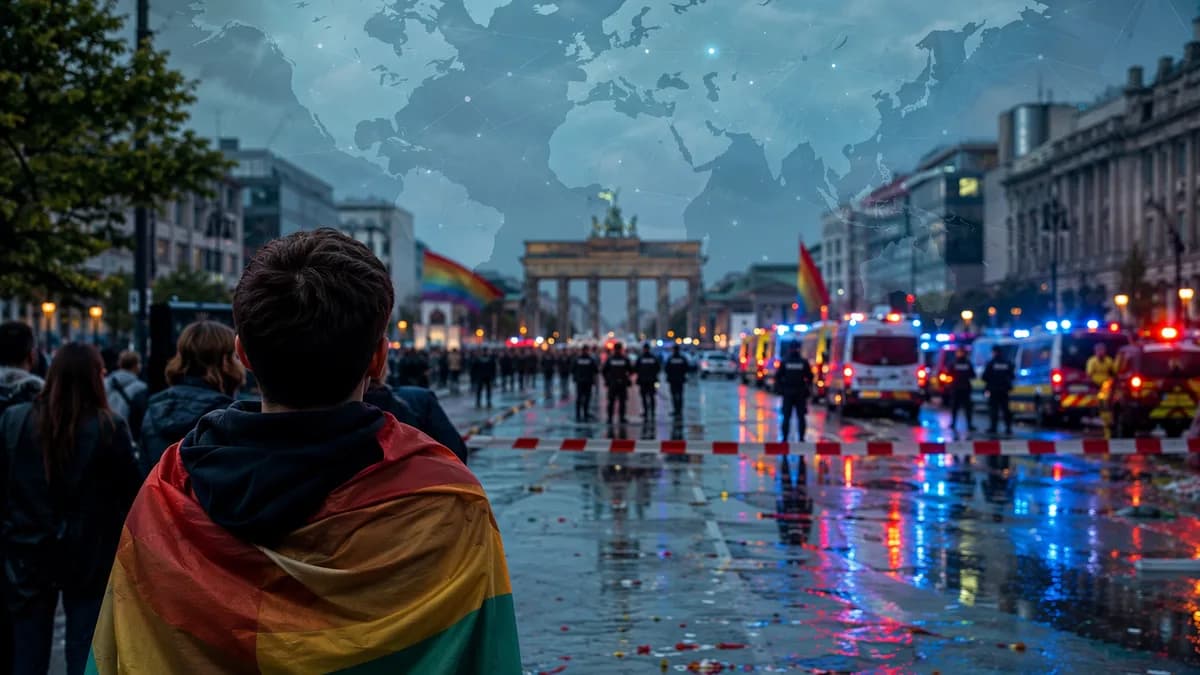
On Saturday at about 22:00 local time, a white vehicle struck crowds at Berlin Pride, turning one of the city’s most visible public celebrations into an active manhunt and a test of how open events defend themselves without becoming closed zones.
XOOMAR Intelligence
Analyst Take
The Berlin Pride ramming attack killed one woman and injured 16 others, according to BBC World. Police said the suspect remains at large, identified him as 21-year-old Abdul B, and described him as having connections to Islamist circles. No arrest has been made. No motive has been confirmed.
That distinction matters. The method, the setting, and the suspect profile all raise obvious questions, but none answers the central one: why this happened. Until police establish intent, planning, and target selection, the case sits in a dangerous gap between confirmed violence and unconfirmed explanation.
At 22:00 on Saturday, Berlin Pride became a live security emergency
The attack happened during Christopher Street Day, Berlin’s annual Pride event, after hundreds of thousands of people had gathered around Tiergarten park, near the Brandenburg Gate. Police received a report that a white vehicle had driven into crowds.
Some people were also stabbed in the incident, according to the available police account cited by the BBC. Shortly afterward, the Pride event was cancelled.
Organisers moved quickly from celebration to evacuation. A performance ended abruptly. People on stage told the crowd the event was over and directed attendees toward exits.
The word "Evacuation" was projected onto a large screen on the stage.
Unverified social media footage reportedly showed large crowds leaving as emergency vehicles arrived. The useful point here is not the footage itself, which should be treated carefully unless verified. It is the operational reality it reflects: once a dense public event shifts into emergency mode, crowd movement becomes part of the incident.
For readers following the developing timeline, XOOMAR has also collected the initial known facts in Deadly Berlin Pride Attack Sends Police Hunting Suspect and the first incident report in Vehicle Hits Berlin Pride Event, Triggering Manhunt.
By 01:00, the casualty count and abandoned vehicle sharpened the investigation
At about 01:00 local time, police confirmed that one woman had been killed and 16 others injured. A short time later, police said they had found the vehicle believed to have been used in the attack. It had crashed into a tree.
That discovery appears central to the investigation. XOOMAR analysis: the car is likely the most important physical link between the crowd strike, the suspect, and any other person who may have fled the scene. The source material says police believe Abdul B is connected to the vehicle found abandoned in the park.
At about 03:30, police said on X that they had identified a suspect with Islamist links. That is a serious detail, but it is not the same as a confirmed motive. The BBC report states clearly that no motive has been suggested.
The search then widened across the entire city. Thousands of police joined the operation, including officers from surrounding German states.
| Confirmed from source material | Not yet established |
|---|---|
| One woman killed | Confirmed motive |
| 16 others injured | Whether the attack was planned |
| White vehicle struck crowds | Whether Pride was targeted because it was Pride |
| Vehicle found crashed into a tree | Whether there are additional suspects |
| Abdul B named as suspect | Whether Islamist links explain the attack |
| Police say he may be armed and dangerous | Whether all injuries came from the vehicle or stabbing weapons |
This is where public communication becomes delicate. Police need help from witnesses, but they also need to avoid filling gaps with assumptions. In a case like this, a premature label can travel faster than evidence.
At 03:30, the suspect profile raised pressure without answering motive
Police named the suspect as Abdul B. His full surname has not been used because German law restricts naming suspects at this stage. Police released his image and said he was believed to be wearing a black hooded top and white trousers at the time of the attack.
They also warned the public not to approach him. He is believed to be armed and dangerous.
The source material adds another uncertainty: police said one or more people may have fled the vehicle used in the attack. That means the manhunt may not be limited to one person, although Abdul B is the named suspect.
This uncertainty changes the stakes. If investigators confirm there were multiple people in the vehicle, the case could move from a single-suspect attack toward a broader inquiry into coordination. If they do not, the focus remains on whether Abdul B drove, why the vehicle entered the crowd, and how the reported stabbing injuries fit into the sequence.
The Berlin Pride ramming attack therefore has two parallel tracks: capture and classification. Capture is immediate. Classification is slower. A case involving deliberate targeting, political motive, anti-LGBTQ hostility, intoxication, panic, or another criminal context would carry very different legal and social consequences. The current source material does not prove which path applies.
Ahornsteig exposed the hard math of open crowd routes
Police said people were hit on Ahornsteig, a long path through Tiergarten park, largely in a forested area. The event route had moved through the city, through Tiergarten, past the Victory Column, and toward the Brandenburg Gate.
The numbers already show the scale of the risk:
- Time: About 22:00 local time on Saturday.
- Place: Ahornsteig in Tiergarten park, near Berlin’s central landmarks.
- Crowd: Hundreds of thousands had gathered for Christopher Street Day.
- Casualties: One woman killed, 16 injured.
- Vehicle: A white vehicle, later found crashed into a tree.
- Response: Search widened to the entire city, with thousands of police involved.
XOOMAR analysis: vehicle risk at a large public gathering is less about one single weak point than about geometry. Wide approaches, crowd density, emergency lanes, barriers, trees, paths, and exits all interact. A short vehicle movement can still cause mass harm if the route intersects with a packed crowd.
That does not mean every Pride event can or should become a sealed perimeter. Pride depends on visibility, movement, and access. Turn it into a closed checkpoint and something essential is lost. Leave every approach exposed and the city accepts a risk it can no longer plausibly ignore.
Pride organizers and police now face different pressures from the same facts
For LGBTQ attendees, the attack will not be processed as a neutral traffic incident unless the evidence eventually supports that. It happened at Pride. It killed a woman. It injured 16 others. Police say the suspect has Islamist links and may be armed. Those facts alone are enough to produce fear, even before motive is known.
Organisers face a brutal trade-off. Pride is meant to occupy public space openly. After a ramming and reported stabbings, they will be pushed toward more barriers, tighter route controls, clearer evacuation instructions, and stronger coordination with police. Those measures may reduce risk, but they can also make the event feel more surveilled and less free.
Police and city officials have a different burden: show competence without scapegoating before the facts are in. That means updating the public, correcting bad information quickly, and explaining what is known without overstating what the suspect’s alleged connections prove.
The strongest immediate public message is the narrowest one: do not approach the suspect, provide information to police, and wait for evidence before assigning motive.
The next decision point is whether evidence confirms intent
The Berlin Pride ramming attack now turns on evidence that has not yet been made public. Police have a named suspect, a recovered vehicle, casualty figures, a location, and reports of stabbing injuries. They do not yet have a public arrest, a confirmed motive, or a full account of whether more than one person fled the vehicle.
That leaves Berlin with two tests.
The first is operational: find Abdul B and determine whether anyone else was involved. The second is civic: protect future open events without letting fear shrink them. Security upgrades may be necessary, but they should follow evidence rather than panic.
The next credible signals will be concrete ones: an arrest, clarification on additional suspects, a clearer account of the stabbing injuries, and police evidence showing whether this was deliberate targeting of Pride or another form of criminal violence. Until then, the responsible reading is sharp but restrained: Berlin has suffered a deadly attack at Pride, and the facts are still catching up to the fear.
The Stakes
- The attack turned one of Berlin’s largest public celebrations into a major security emergency.
- Police have identified a suspect but have not confirmed a motive, leaving key questions unresolved.
- The incident raises difficult questions about protecting open public events without restricting access.
Reported Casualties in Berlin Pride Ramming Attack
Primary Sources & Disclosures

Written by
XOOMAR Insights Team
Research and Editorial Desk
The XOOMAR Insights Team pairs automated research with human editorial judgment. We track hundreds of sources across technology, fintech, trading, SaaS, and cybersecurity, cross-check the facts, and explain what happened, why it matters, and what to watch next. We do not just rewrite headlines. Every article is fact-checked and scored for reliability before it goes live, and we link back to the original sources so you can verify anything yourself.