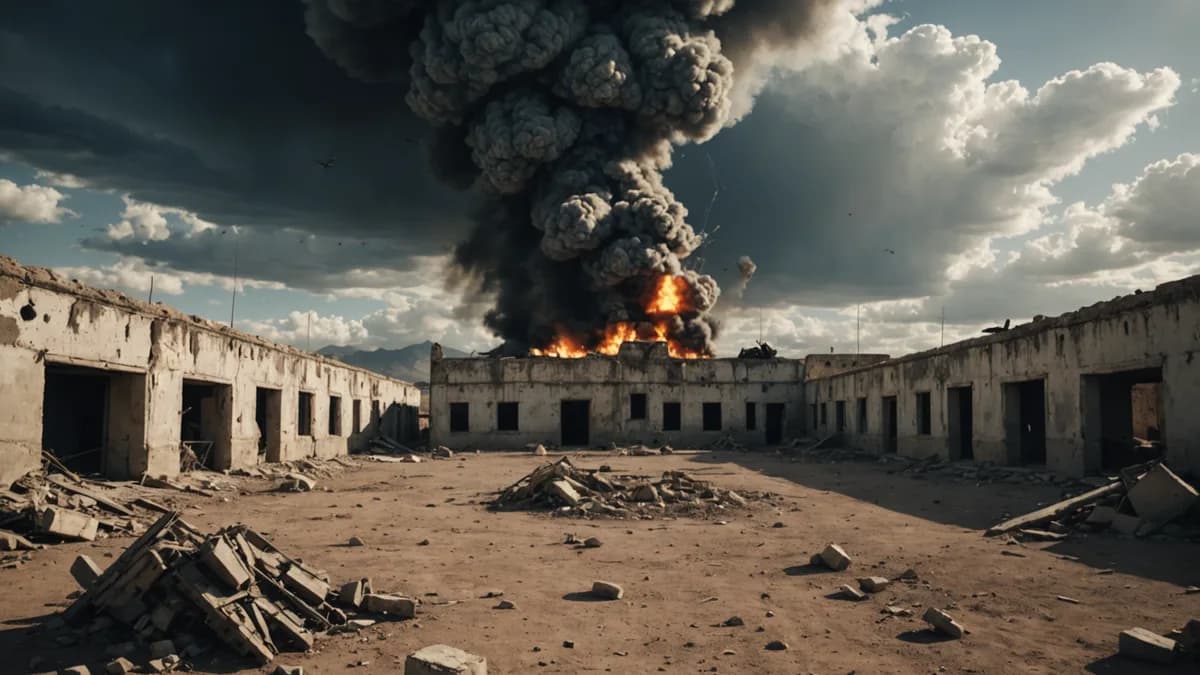
An explosion at a Bolivian military barracks has killed at least two people, with local officials reporting a death toll that could be as high as 15. The blast, which involved stored pyrotechnic material, injured at least 58 people and forced the evacuation of surrounding homes.
XOOMAR Intelligence
Analyst Take
According to BBC World, the detonation occurred around 2:30 PM local time on Friday at the RAM-2 "Bolívar" General Maintenance Center in Viacha, a town located about 30 kilometers from La Paz.
Health director Rita Nebraska told local television the death toll is believed to be "between 10 and 15." Conflicting reports from different agencies have created confusion, with police initially confirming two fatalities and 59 injured, while Deputy Police Commander Roger Roca noted seven people remain missing.
Secondary Blast Risk Paralyzes a Town
Emergency crews face a second, immediate danger.
Firefighters had cautioned that a heat source was still present at the site, creating the possibility of another explosion.
Viacha health director Rita Nebraska urged residents to remain at least 150 meters away from the area.
The shock wave from the initial blast shattered windows and damaged dozens of nearby homes. Police spokesman Roger Roca told AFP the material involved was fireworks that were part of the defense ministry's official inventory.
Authorities have secured a wide perimeter. Rescue workers are now searching rubble for the missing while managing the injured. Eight people with serious chest trauma were transferred to hospitals in La Paz and El Alto, while six minors were treated for lacerations.
Conflicting Casualty Counts Sow Public Distrust
In the hours after the explosion, official statements have contradicted each other, highlighting a breakdown in early crisis communication.
Viacha Mayor Jenrry Patzi Mercado told UNITEL television, "We have more than 50 injured and unfortunately we have deaths." However, a preliminary report from the La Paz Departmental Health Service (SEDES) later stated at least 52 were injured but reported no deaths at that time.
This discrepancy between municipal, health, and police sources leaves the public with no single authoritative account. The chaos is reminiscent of the early information vacuum seen in other sudden tragedies, like the Himalayan Flood Toll Climbs As Glacial Collapse Blamed.
XOOMAR Analysis: The inconsistent fatality numbers aren't just statistical noise. They point to a fragmented emergency response where different agencies are processing different information streams without a unified command center to verify and release data. This erodes public trust at a critical moment, similar to the distrust sown by conflicting reports in major trials.
Investigation Zeroes In on Storage Protocols
With no claim of responsibility, scrutiny is falling squarely on the military's safety procedures.
Defense Minister Ernesto Justiniano confirmed the blast originated where "pyrotechnic material" was stored. The facility is described as a maintenance center for an artillery regiment, raising immediate questions about why significant quantities of fireworks were kept there.
The investigative focus will now center on a few critical unknowns:
- Storage Conditions: What volume of material was present, and under what safety protocols?
- Chain of Custody: Who had access, and was the inventory properly logged?
- Trigger Event: Was the detonation caused by accident, negligence, or an external factor like fire? The search for a trigger echoes the investigative challenges seen after other infrastructure disasters, such as the rescue of a worker trapped in a flooded tunnel.
Local officials have declared three days of mourning. The national government now faces pressure to conduct a transparent investigation. This incident will likely trigger a mandatory safety audit of similar military depots across Bolivia, examining risks to both personnel and adjacent civilian populations.
The coming days will test the military's ability to be transparent about its own failings. For the families of the victims and missing, the wait for answers has just begun. As we've seen in other crises, from infrastructure failures to acts of nature, the official response in the first week often defines the long-term political and social fallout, much like the fallout from a high-profile mistrial.
Impact Analysis
- The significant casualties highlight a serious failure in the safe storage of military-grade pyrotechnics.
- A secondary blast risk has forced a widespread evacuation, paralyzing the town of Viacha and its emergency response.
- Conflicting official casualty reports are eroding public trust in the government's crisis management capabilities. This breakdown mirrors the societal tensions that can arise from major policy shifts, such as local bans on language in public arts.
Reported Casualties from Bolivian Barracks Blast
Primary Sources & Disclosures

Written by
XOOMAR Insights Team
Research and Editorial Desk
The XOOMAR Insights Team pairs automated research with human editorial judgment. We track hundreds of sources across technology, fintech, trading, SaaS, and cybersecurity, cross-check the facts, and explain what happened, why it matters, and what to watch next. We do not just rewrite headlines. Every article is fact-checked and scored for reliability before it goes live, and we link back to the original sources so you can verify anything yourself.