A Chinese hydropower worker trapped deep inside a flooded tunnel and a Nepali woman buried in her collapsed home were pulled alive from the wreckage of last month’s catastrophic Himalayan floods this weekend. The separate rescues 10 days after the disaster have injected fragile hope into a grim search where more than 5,000 people remain missing and the death toll has passed 1,331 according to Al Jazeera. They are the third and fourth survivors recovered in the last two days.
XOOMAR Intelligence
Analyst Take
Lu Haitao, the Chinese worker, was freed on September 5 from 225 meters inside a tunnel at the Trishuli-3A hydroelectric project in Rasuwa district. A joint team of Nepali soldiers and South Korean disaster specialists carried him out. He appeared stable but mildly hypothermic when airlifted to Kathmandu for treatment.
Speaking to Chinese state television, Lu described a desperate, repeated effort to be seen before the rescue.
“I called out to rescue crews whenever I glimpsed their torchlight in the tunnel, only to go unheard each time, until a beam finally swept over me. I couldn’t believe it.”
Hours earlier, in the neighboring Nuwakot district, rescuers dug 64-year-old Chandika Kumari Shrestha from her collapsed, mud-filled home. She was given water at the scene before being airlifted to the capital.
A Narrowing Search Window Amidst Flood-Wrecked Terrain
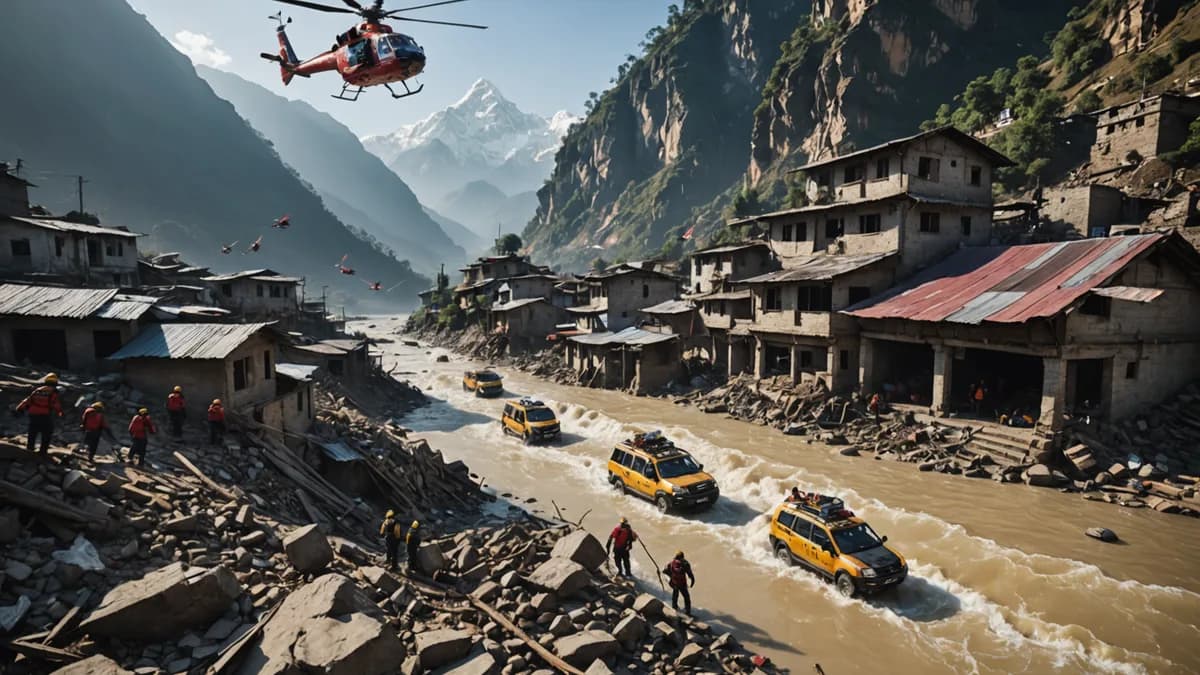
The miraculous recoveries highlight both the extreme difficulty and the stubborn urgency of the rescue phase. The flood, triggered by a glacial collapse on August 26, scoured river valleys, wrecking infrastructure and isolating entire communities. The search for thousands still missing hinges on two distinct, treacherous fronts.
For remote mountain villages, access remains the primary battle. Washed-out roads and bridges mean most rescues and supply deliveries are helicopter-dependent missions. Shrestha’s rescue from Nuwakot is a case study in this painstaking, localized effort, digging survivors from individual homes cut off from ground support.
For the hydropower construction sites, the challenge is technical and claustrophobic. About 900 workers are missing from 12 hydropower projects across Nepal, with roughly 500 believed trapped inside various tunnels. Specialized teams from India, China, South Korea, and the U.S. are now navigating these dark, flooded, and debris-choked passages. The fact that four people have been found alive in tunnels nine and ten days after being trapped suggests the search window for these sites, while narrowing, is not yet fully closed. As we noted in our initial report, this was caused by a Himalayan flood resulting from a glacial collapse.
Rain continues to hamper operations. Al Jazeera’s correspondent reported that rainfall on Saturday slowed the search in Rasuwa, highlighting the operation’s vulnerability to the very weather that caused the disaster.
The Hunt for 500 Souls in the Dark
The rescue mission’s most concentrated, high-stakes focus is now the network of destroyed hydropower tunnels. The survivor pulled from the Trishuli tunnel this week reportedly told rescuers that other workers were still alive further inside, according to the Nepali army. This claim has made the Trishuli 3A site a priority.
Breakdown of the Missing Worker Crisis Workers Missing at Hydropower Sites: ~900 Estimated Trapped in Tunnels: ~500 Total Foreign Nationals Missing (Countrywide): 589 Recent Tunnel Survivors (Sept 4-5): 3
The multinational nature of the missing reflects Nepal’s hydropower sector. Among the 5,000 people missing countrywide are 589 foreign nationals. The successful rescue of a Chinese worker by a joint Nepal-South Korea team underscores the international collaboration now on the ground, which also includes a 15-member Australian drone unit deployed this week.
Nepal’s Information and Communications Minister Bikram Timilsina said authorities remain hopeful that more people would be found alive. "We are waiting for the rescue of more and more people," he said.
What Rescue Now Means for Himalayan Infrastructure
These late-stage rescues force a difficult calculation. Every saved life is a profound victory, but the logistics are immense and the timeline is brutal. Rescue teams are racing against time, weather, and the physiological limits of those possibly still trapped in air pockets without food or clean water.
For global observers, the disaster spotlights the grave risks of intensive infrastructure development in fragile, geologically volatile mountain regions. The flash flood didn’t just hit villages, it targeted the economic arteries Nepal is building in its river valleys. The aftermath is a dual humanitarian and industrial crisis, with hundreds of construction workers among the missing. The region faces other related climate threats, as seen in the recent Chinese warnings about a potential barrier lake collapse.
The immediate watch is on the weather and the tunnels. Continued rain could halt subterranean searches and further destabilize debris. The next 48 hours are critical for any remaining survivors in the hydropower complexes. After that, the massive operation will unavoidably shift from rescue to recovery for the thousands of families awaiting news.
The Stakes
- The rescues bring rare hope to a disaster with over 1,331 deaths and 5,000 still missing, highlighting the human cost of climate-related glacial collapses.
- They underscore the extreme, ongoing challenges in accessing isolated, flood-wrecked mountain terrain, complicating aid and recovery efforts.
- The international cooperation in the rescue, involving Nepali, Chinese, and South Korean teams, demonstrates the global response needed for such large-scale humanitarian crises.
Primary Sources & Disclosures

Written by
XOOMAR Insights Team
Research and Editorial Desk
The XOOMAR Insights Team pairs automated research with human editorial judgment. We track hundreds of sources across technology, fintech, trading, SaaS, and cybersecurity, cross-check the facts, and explain what happened, why it matters, and what to watch next. We do not just rewrite headlines. Every article is fact-checked and scored for reliability before it goes live, and we link back to the original sources so you can verify anything yourself.