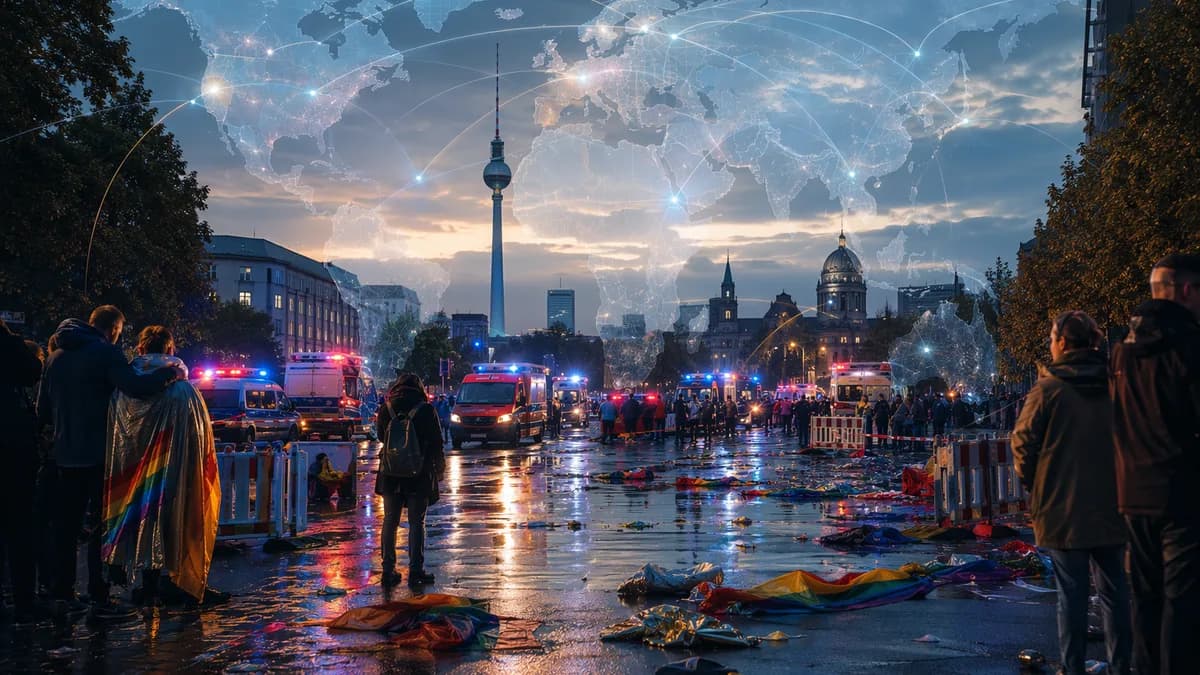
Can Berlin protect Pride as a public act of visibility when the Berlin Pride attack has left one person dead, 16 injured, and a named suspect still at large?
XOOMAR Intelligence
Analyst Take
That is the question beneath the immediate manhunt. A vehicle drove into a crowded Pride event in Berlin, killing one person and injuring 16, while police identified the suspect as 21-year-old Abdul B and released his image, according to BBC World. Police have also located a vehicle suspected of being used in the attack inside the city’s Tiergarten park.
The facts are still moving. The suspect has not been found. Motive has not been legally established. But the political and social meaning of the attack is already taking shape, because Pride is not just a parade on the city calendar. It is a public claim to safety, visibility, and equal citizenship.
The hard test for Berlin now is not only whether police can catch the suspect. It is whether authorities can explain, quickly and credibly, what happened, what they know, what they don’t know, and how they will protect people who were targeted while gathering in public.
As we reported in our Berlin Pride ramming attack coverage, the immediate story is the attack itself. The deeper story is whether Berlin’s institutions can keep public trust while the facts remain incomplete.
Can Berlin treat the Pride attack as both an active manhunt and a public safety crisis?
The Berlin Pride attack sits in a dangerous gap: police have named a suspect, but they have not found him. That gives the public a sense that investigators have made progress, while also confirming that the threat picture has not fully closed.
Police naming Abdul B narrows the investigation. It also raises the stakes. Once a suspect’s identity is public, every hour without an arrest invites pressure, rumor, and fear, as other long-running fugitive cases show. That does not mean the suspect is legally guilty. It means Berlin has entered the phase where investigative discipline and public reassurance have to move at the same time.
DW reported that Germany’s Interior Minister Alexander Dobrindt said he was “deeply shaken” and called the ramming a “heinous attack on people celebrating peacefully.” Chancellor Friedrich Merz also condemned the incident.
“What a heinous act in Berlin. Hundreds of thousands of people from all over the world were peacefully celebrating at Christopher Street Day. They wanted us to treat each other with kindness and tolerance. This is an attack on our society,” Merz wrote on X, according to DW.
That language matters. It frames the attack as more than a criminal incident. But investigators still need evidence, not just political condemnation. Police will have to establish whether the vehicle was deliberately driven into the crowd, whether others were involved, whether there were additional weapons, and whether hate, ideology, or another motive drove the attack.
XOOMAR analysis: the case will likely be judged on two clocks. The first is the police clock, which moves through evidence, warrants, search areas, and forensic confirmation. The second is the community clock, which moves much faster. For people who were at Pride, or who saw the images afterward, delay feels like exposure.
How does a named suspect who remains missing change the pressure on police?
A named suspect who has not been located creates a credibility test for law enforcement. The public hears “identified” and expects “arrested” to follow quickly. When it doesn’t, the gap becomes its own story.
The likely investigative priorities are straightforward, even if the work is not:
- Witnesses: separating direct observations from panic, repetition, and secondhand claims.
- Video: collecting footage from phones, CCTV, traffic cameras, nearby businesses, and transport hubs.
- Vehicle evidence: processing the suspected vehicle found in Tiergarten park.
- Movement tracking: reconstructing how the suspect may have left the area.
- Digital traces: checking communications, devices, rental or ownership records, and online activity where legally available.
- Coordination: sharing alerts across Berlin districts and, if needed, with border authorities.
CNN reported that the van drove through the park shortly before 10 p.m., struck several people, then was later found crashed into a tree and abandoned. CNN also cited a Berlin police statement saying one or several people were thought to have exited the vehicle after impact, and that “several people are reported to have been injured by stabbing weapons.”
That last point is crucial. If confirmed, the investigation is not limited to a vehicle ramming. It becomes a more complex attack sequence. Police then have to determine whether the same suspect was involved in both alleged phases, whether other people were present, and whether reports of stabbing weapons reflect confirmed injuries or early eyewitness accounts.
DW reported that police were investigating whether the attack had a second phase, citing reports that several people were injured with “stabbing weapons.” Police spokesman Florian Nath cited eyewitness accounts of multiple people suffering stab wounds, while other accounts described a man dressed in black carrying a machete.
This is where public communication can either calm or inflame. Authorities need to say what is confirmed, what is being investigated, and what remains unverified. If they say too little, rumor fills the vacuum. If they say too much too early, they risk contaminating witness accounts or misdirecting the public.
The tension resembles other politically charged investigations, where process details become public trust issues. In a different context, our coverage of Police Probe £500k Reform UK Donations via Tice Firm showed how quickly public attention shifts from the alleged act to the credibility of the inquiry. Berlin now faces that same dynamic under far higher emotional pressure.
Which numbers does Berlin need to publish before speculation hardens?
The confirmed numbers already show the scale of the Berlin Pride attack. One person is dead. 16 others are injured. DW reported that fire brigade spokesman Dominik Pretz said three of the injured suffered life-threatening injuries and eight were seriously injured. CNN reported that more than 2,200 police officers had been on duty in Berlin since Saturday morning to protect the Pride parade and other LGBTQ+ events, citing Reuters.
Those figures are serious, but they are not enough for accountability.
Berlin now needs a clearer public data trail:
| Data point | Current status from supplied sources | Why it matters |
|---|---|---|
| Deaths | 1 confirmed | Establishes severity and legal stakes |
| Injured | 16 confirmed | Measures immediate human impact |
| Life-threatening injuries | 3, according to DW | Shows whether the toll may worsen |
| Serious injuries | 8, according to DW | Helps assess medical burden |
| Police deployment | More than 2,200, according to CNN citing Reuters | Sets a benchmark for security planning |
| Suspect status | Named, not found | Defines the active risk and public anxiety |
| Vehicle status | Located in Tiergarten park | Anchors the forensic inquiry |
| Motive | Not confirmed in supplied sources | Prevents premature labeling |
| Witness count | Not provided | Leaves a major evidence gap |
| Response time | Not provided | Limits assessment of emergency performance |
The missing numbers matter as much as the known ones. How many witnesses have been interviewed? How many emergency calls came in? When did police first receive the alert? How long did it take to clear the area? Were any warrants issued? Has there been any arrest connected to the attack? Did police recover weapons?
Without those answers, public debate will jump ahead of evidence.
The outline of the incident is already charged because it happened at Christopher Street Day, Germany’s name for Pride events, and because city leaders have framed it as an attack on open society. But motive is not something to infer from venue alone. A Pride crowd can be targeted for anti-LGBTQ+ reasons, ideological reasons, opportunistic reasons, or a combination investigators have not yet established.
That distinction is not pedantry. It is the difference between community recognition and prosecutable fact.
Why will LGBTQ+ groups, police, city leaders, and witnesses read the same attack differently?
Every stakeholder sees a different failure point.
LGBTQ+ organizations will focus first on safety and recognition. For them, the fact that the attack struck a Pride gathering is central. Even before motive is confirmed, the community impact is real. A public celebration became a scene of death, injury, and fear.
Police will stress procedure. They have to identify suspects, protect evidence, test witness accounts, and avoid public claims that a court cannot later support. Their strongest position is precision. Their weakest position is silence that looks like drift.
City leaders will face accountability questions. Berlin Mayor Kai Wegner described the incident as “an attack on our free and open society,” according to DW. He also said, “We will not allow our way of life and our way of living together to be taken from us.”
Witnesses will shape the public memory. CNN quoted one eyewitness describing “a dull bang” before people understood what had happened amid music, party noise, and confusion. That sensory detail will travel because it captures the rupture: celebration turning into evacuation.
Social media now cuts both ways. Firsthand clips can help police reconstruct movement, timing, vehicle path, and possible suspects. The same clips can also spread misidentification, graphic imagery, and panic. Once a suspect image circulates, the risk of vigilante claims rises. Once motive speculation begins, targeted harassment can follow.
The strongest response gives space to fear without turning fear into evidence. That is difficult after an attack at Pride. It is also necessary.
Can a city known for queer visibility afford to treat Pride security as routine?
Berlin’s reputation as a major queer capital does not make it immune to violence. If anything, visibility can increase the security burden because Pride creates a concentrated, symbolic public target.
The supplied sources do not provide hate crime trend data for Berlin or Germany, so any numerical comparison would be unsupported here. That absence is itself a problem. After an attack like this, officials should be ready to publish relevant context, including prior threats to Pride events, reported anti-LGBTQ+ incidents around major gatherings, and any known warnings tied to this year’s event.
Pride has long carried two meanings at once: celebration and protest. In major European cities, the celebration side can dominate the visuals: floats, music, crowds, flags, politicians, sponsors. But the protest side never disappears, because the act of gathering openly remains contested.
CNN reported that around 80 floats participated in the parade before the incident. Merz referred to “hundreds of thousands of people from all over the world” celebrating at Christopher Street Day. Those numbers show why Pride security cannot be treated like ordinary event management. Crowd size, symbolism, alcohol, nightlife, transport chokepoints, and public route exposure all increase the complexity.
XOOMAR analysis: the sharper lesson is not that Berlin is uniquely unsafe. It is that cities with strong queer visibility need stronger assumptions about threat. Pride security has to account for targeted violence, extremist interest, opportunistic assault, vehicle access, medical surge capacity, and rapid public alerts. Crowd control alone is not enough.
Will the Berlin Pride attack force cities to redesign how LGBTQ+ crowds are protected?
The next phase should be practical. People attending Pride events will want clearer safety information, faster alerts, and evidence that authorities can respond without turning public celebration into a fortress.
Event organizers should press for concrete answers before future gatherings:
- Route design: where vehicles can enter, where barriers are needed, and where escape routes remain open.
- Volunteer training: how stewards report threats, guide crowds, and avoid spreading unverified information.
- Emergency exits: how large crowds move away from danger without crushing into bottlenecks.
- Reporting channels: how attendees send footage or tips without flooding police with duplicates.
- Post-incident communication: who speaks, how often, and with what confirmed facts.
- Medical staging: where ambulances can enter when crowds are dense and streets are blocked.
Political pressure will likely intensify around three questions. Was the police deployment enough? Were vehicle access controls adequate? Did authorities have any prior warning about the suspect or related threats?
The evidence that would strengthen Berlin’s response is clear: a swift arrest, a precise timeline, confirmed details on whether weapons were used, transparent injury updates, and a careful explanation of motive once investigators can support it. The evidence that would weaken confidence is also clear: prolonged uncertainty, contradictory official statements, unexplained gaps in response time, or a failure to account for how a vehicle reached a crowded Pride area.
If the suspect remains at large for long, the story will expand beyond one attack. It will become a test of whether Berlin can defend the public freedom Pride is meant to display.
Impact Analysis
- The attack raises urgent questions about public safety at Pride and other major civic gatherings.
- A named suspect still at large keeps pressure on Berlin police to act quickly and communicate clearly.
- The incident could affect how LGBTQ+ visibility events are secured and perceived in Germany.
Berlin Pride Attack Casualties
Primary Sources & Disclosures

Written by
XOOMAR Insights Team
Research and Editorial Desk
The XOOMAR Insights Team pairs automated research with human editorial judgment. We track hundreds of sources across technology, fintech, trading, SaaS, and cybersecurity, cross-check the facts, and explain what happened, why it matters, and what to watch next. We do not just rewrite headlines. Every article is fact-checked and scored for reliability before it goes live, and we link back to the original sources so you can verify anything yourself.