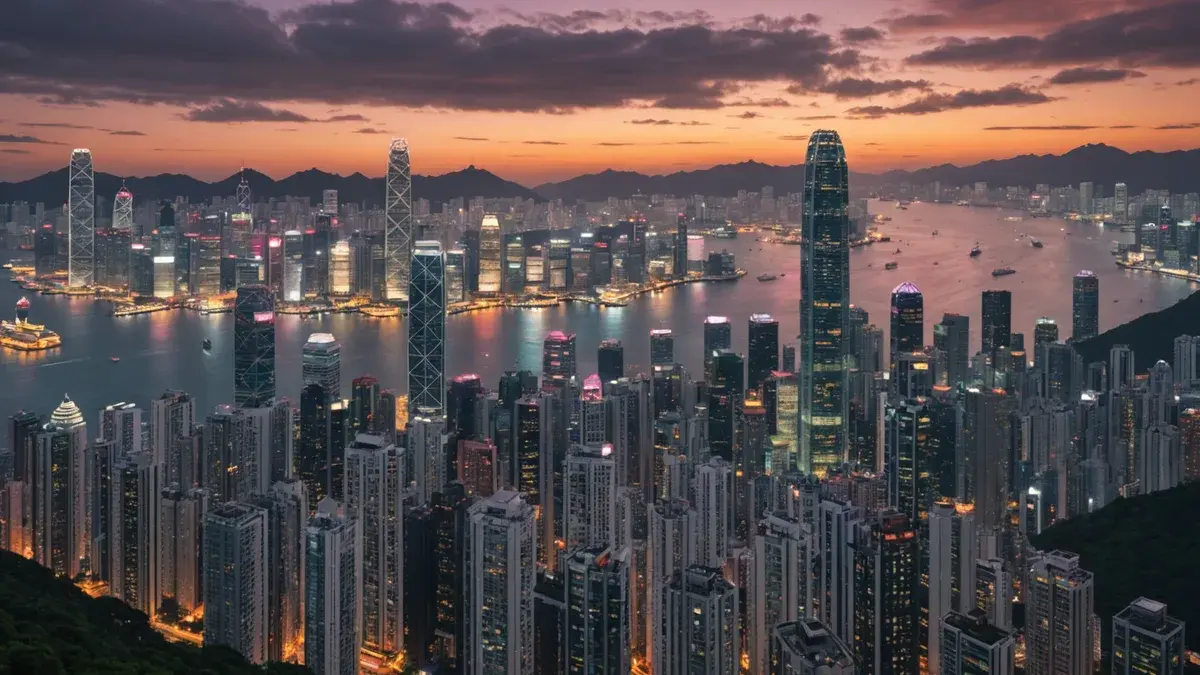
Tung Chee-hwa, the man tasked with navigating Hong Kong’s historic return to China in 1997, has died at the age of 89, according to BBC World. His death on September 8, 2026, closes the chapter on the city’s inaugural post-colonial leadership, a period now defined not by a smooth transition but by a relentless cycle of economic, health, and political crises that exposed the fundamental tensions of governing under the "one country, two systems" model.
XOOMAR Intelligence
Analyst Take
His legacy is that of an unlucky founding father, a loyalist chosen by Beijing who was handed an impossible assignment: to steer a newly autonomous territory through a perfect storm of disasters that would ultimately overwhelm his administration and foreshadow the city’s political trajectory for decades.
A Tenure Begun in Crisis, Defined by Survival
Tung, 59 when he took power, had no real political experience. A shipping scion who graduated from Liverpool University and worked for General Electric, his ascent began in 1992 with an appointment to the last British governor’s executive council. Beijing’s confidence was cemented by a very public act: in January 1996, then-president Jiang Zemin walked across a packed room at the Great Hall of the People to shake his hand, a photographed gesture that signaled the top job was his.
That confidence was immediately tested. The Asian Financial Crisis struck within months of the July 1997 handover, sending home prices into a tailspin. This wasn't merely a cyclical downturn. It was a catastrophic blow to the asset-based wealth of Hong Kong's middle class and a direct assault on the territory's economic confidence at the moment of its political rebirth.
A Government Under Siege by Disease and Distrust
The economic shock was compounded by a series of public health emergencies. A bird flu outbreak from 1997 to 2002 was followed by the devastating 2003 SARS outbreak, which killed nearly 300 people. These outbreaks strained public services, terrified the populace, and battered the economy. They also exposed Tung’s political shortcomings. A man nicknamed "7-11" for his long work ethic also earned the derisive moniker "Old Dumb Tung" for perceived indecisiveness and distrust of the media. His administration was accused of being slow and clumsy in its pandemic response.
Financial Contagion: The property crash and currency pressures of the Asian crisis. Biological Contagion: The dual epidemics of H5N1 and SARS that crippled public life. Political Contagion: A growing public disillusionment with governance as each crisis compounded the last.
This trifecta created a climate where a policy failure or a perceived overreach could trigger a massive societal reaction. That reaction arrived in July 2003.
The 2003 Protests: When Half a Million Marched Against the Future
Tung’s biggest political challenge took place in July 2003 during his second term, when half a million Hongkongers took to the streets. They were protesting a proposed national security law, known locally as Article 23 legislation, which many feared would erode the civic rights promised under the Basic Law. The scale was unprecedented. It was the largest demonstration since the 1997 handover and revealed a deep, simmering anxiety.
The government’s response was to shelve the legislation. This concession, however, did not restore Tung’s authority. It shattered it. The protest showed that a critical mass of Hong Kong’s population was willing to mobilize peacefully to defend their interpretation of the "two systems" promise. It also demonstrated to Beijing that Tung had lost control. By March 2005, he resigned two years early, citing declining health. While officially a health issue, the political pressure was undeniable. As we reported in our analysis of Norway's Beloved 'People's King' Dies at 89, the death of a foundational leader forces a society to reassess its founding era. Tung's resignation served a similar function, closing the initial, turbulent chapter of the SAR.
The Three-Way Tug-of-War During Tung's Reign
Tung’s tenure was shaped by a constant struggle to balance three competing forces, a dynamic that defined his rule and continues to shape Hong Kong politics today.
Beijing’s View: The Loyal Implementer. From the capital’s perspective, Tung was a reliable ally. His family’s shipping business had been rescued by state-run banks in the 1980s, creating a clear bond of loyalty. He was the chosen administrator for the untested "one country, two systems" experiment. However, his inability to manage domestic dissent or maintain economic stability during crises likely led to Beijing’s view of him as loyal but ineffective. A December 2004 public dressing-down by then-president Hu Jintao for poor performance was a stark indicator of this frustration.
The Tycoons’ View: From Confidants to Critics. Hong Kong’s business elite initially saw Tung, one of their own, as a safe pair of hands to protect their interests and maintain stability. The property crash and economic turmoil directly threatened those interests. The political instability of the 2003 protests further unnerved a class that values predictability above all. Their support, while never fully withdrawn, certainly wavered.
The Public’s View: A Symbol of Disconnected Governance. For the emerging protest generation, Tung became the face of a paternalistic, Beijing-aligned administration that was out of touch with popular aspirations. The crises eroded living standards, while the push for Article 23 confirmed fears about eroding freedoms. His rule, marked by policy gaffes and a bunker mentality, sparked a political awakening and tactical playbook that would be used in protests for years to come.
From Shelved Law to Imposed Law: The Unbroken Thread
The most direct line from Tung’s era to the Hong Kong of today runs through the issue of national security. The Article 23 legislation he was forced to abandon in 2003 was ultimately imposed by Beijing in 2020. Authorities argued the Hong Kong national security law was necessary for stability. Critics called it "the end of Hong Kong." The law accomplished what Tung could not, effectively criminalizing the type of mass dissent that defined his later years.
This trajectory is critical. Tung’s struggles revealed that procedural governance and economic management alone could not resolve the core tension at the heart of Hong Kong’s autonomy. His era, beginning with the optimism of the handover, ended with the territory’s political debates becoming existential. The demands moved from protesting a specific law to calls for universal suffrage, culminating in events like the 2014 Umbrella Movement. The tripartite struggle he navigated between Beijing’s directives, business interests, and public opinion became more acute and less manageable for his successors.
XOOMAR Analysis: Tung’s period proves that economic well-being, even when restored after a crisis, is insufficient to guarantee political stability in a society negotiating complex questions of identity and autonomy. His tenure established the governance template: any chief executive must serve three masters, and when their demands conflict, the result is political paralysis or rupture.
The Founder's Shadow: A Cautionary Tale for Hong Kong's Future
History may judge Tung Chee-hwa more kindly than contemporary opinion did. He was dealt a brutal hand: a global financial crisis and dual pandemics were not of his making. He governed in a transitional period where the rules were still being written, and he faced a populace with sky-high, and perhaps unrealistic, expectations for the preservation of its pre-handover way of life.
His era of perpetual crisis management will be studied as a cautionary tale. It showed that the "high degree of autonomy" promised to Hong Kong is exceptionally difficult to exercise when external shocks overwhelm the local administration and when core aspects of that autonomy, like legislative efforts on security, are viewed with deep public suspicion. The fundamental question his tenure posed remains unanswered and has grown more pointed: On what specific matters can Hong Kong truly govern itself, and where do Beijing's red lines begin?
His death marks the passing of the first steward of the Hong Kong SAR. The political landscape he left behind is far more rigid and defined by the central authority than the one he inherited. The massive, peaceful protests that defined his downfall are no longer a feature of Hong Kong life, but the underlying societal sentiments they represented have not vanished, they have been suppressed. The dilemma Tung could not solve, how to govern a global financial hub with a distinct identity within a sovereign national framework, continues to shape the city's destiny. The tools for managing it have simply changed.
The Bottom Line
- Tung's tenure was a real-time test of the 'one country, two systems' framework from its very inception, setting early precedents for governance.
- His administration's struggle with cascading crises exposed the fragility of Hong Kong's economic model and social cohesion post-handover.
- His legacy as the first post-colonial leader provides a critical baseline for understanding Hong Kong's subsequent political and economic trajectory under Chinese sovereignty.
Primary Sources & Disclosures

Written by
XOOMAR Insights Team
Research and Editorial Desk
The XOOMAR Insights Team pairs automated research with human editorial judgment. We track hundreds of sources across technology, fintech, trading, SaaS, and cybersecurity, cross-check the facts, and explain what happened, why it matters, and what to watch next. We do not just rewrite headlines. Every article is fact-checked and scored for reliability before it goes live, and we link back to the original sources so you can verify anything yourself.