The Quiet Lane Under Tower Basil
In a city where every street negotiates with its citizens, one transit choreographer tries to make room for a funeral procession.
1. A City That Breathes in Algorithms
At dawn, Maziwa Arcology exhales mist.
It rolls from the farm cores in pale sheets, cool against Amara Ochieng’s cheeks as she steps from her apartment into the shared breakfast gallery. Above her, sixteen floors of spinach, managu, basil, and sukuma wiki climb the hollow center of the building in green spirals. Roots glisten behind transparent nutrient skins. Pollination beads, each no larger than a fingernail, hum between yellow flowers like sleepy insects.
A cooperative drone drops through the shaft, its rotors whispering inside a column of warm air. It pauses at the breakfast rail and opens its belly. Bundles of greens slide into waiting baskets, tagged by household, diet, and neighborhood contribution.
“Morning, Amara,” says the woman at the tea printer. “Your kale looks happier than mine.”
“My kale has no meetings today,” Amara says.
The woman laughs, and the arcology’s morning sounds rise around them, spoons tapping ceramic, children arguing with homework lenses, prayer murmuring from a balcony two floors down, delivery beetles clicking along wall tracks with loaves of sorghum bread strapped to their backs.
Amara eats standing up, one hand wrapped around a cup of ginger tea, the other scrolling through the living map of Nairobi. Not a map of roads, exactly. Roads are only the bones. What she sees is appetite, fatigue, heat, urgency. A blue thread of dialysis shuttles moving from Eastleigh toward the renal hub. A yellow fog of school swarms gathering around supervised crossings. Red beads of market carts negotiating for shade under textile canopies. Slow green rings around wheelchair caravans that require patience from everything near them.
She is a transit choreographer. Her grandmother never understands the title.
“So you conduct matatus without matatus,” Naliaka says once.
“Something like that.”
“But nobody is driving.”
“Everybody is driving,” Amara says. “Just not with hands.”
Her work is not to move vehicles. Vehicles move themselves. Pods, freight beetles, sanitation crawlers, lunch drones, mobile clinics, autonomous kiosks, shade umbrellas, school clusters, all of them bargain with the civic systems every second. Her job is to tune the bargaining so the city feels effortless, so a mother carrying twins does not notice the produce convoy slowing for her, so an old man with a cane does not feel the market reroute itself around his knees.
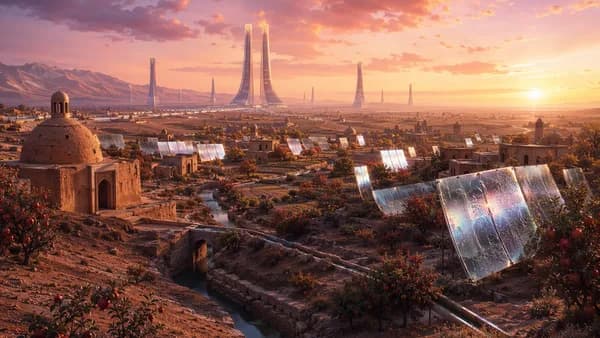
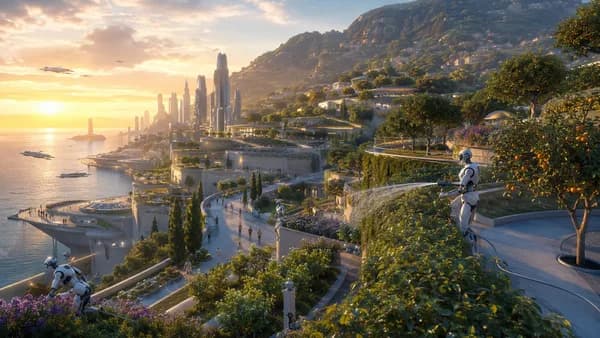
Outside the gallery, the arcology skin clears. Nairobi spreads in stacked terraces and airborne lanes, towers rooted in red earth, their bridges bright with sun. The city breathes in algorithms, and this morning, Amara believes she knows its rhythm.
Then her wrist band darkens.
A message opens without sound.
Come home, it says. Naliaka is going.
2. The Petition for Slowness
Naliaka dies at 9:42 under a cotton sheet printed with fading hibiscus.
The room smells of shea butter, antiseptic, and the millet porridge cooling untouched beside the bed. Amara’s mother sits with both hands folded in her lap, as if holding herself still by force. Aunties move quietly through the apartment, switching off unnecessary screens. Someone closes the window against the noise of the lane below, but the city comes through anyway, soft tires on smart paving, drones ticking past, a distant vendor singing prices into the morning.
Amara stands at the foot of the bed and looks at her grandmother’s feet. The nails are painted blue, chipped at the edges. Naliaka has walked through five Nairobis, colonial avenues, diesel matatu years, flood years, elevated years, and now this breathable machine of a city that knows everyone’s route before they step outside.
“She wanted to pass through home,” Amara’s mother says. Her voice is raw. “Not just be carried in a pod.”
“I know,” Amara says.
Home means four kilometers on foot. From the old cooperative flats near Ngara, through the market spine she helped organize after the water riots, under Tower Basil, past the clinic courtyard where she delivered other women’s babies, ending at the family ground in Kariokor where the memorial soil is kept cool by shade trees. Naliaka has said it for years. Let them walk me. Let the city see I was here.
Amara opens a civic petition window and speaks to Kito.
The AI arrives as a voice in the room, warm and genderless, accompanied by a small ripple of light on the wall. “Amara Ochieng, I am sorry for your loss.”
“Reserve a ground-level lane,” Amara says. “Four kilometers. Walking speed. Two hours maximum. Traditional funeral procession. Family, neighbors, any who join.”
Kito pauses. In that pause, the city calculates.
“Preliminary impact is significant,” it says. “Dialysis shuttles would require rerouting with elevated risk to seventy-two patients. Nutrient deliveries to three vertical farms would miss optimal absorption windows. Estimated disruption to micro-commutes, nineteen thousand four hundred and six. Heat exposure increases along two school corridors.”
“We can time it,” Amara says. “Early. Before peak.”
“Early overlaps with insulin distribution and farm pre-harvest. I can offer an alternative.”
The wall brightens. Naliaka appears in mixed reality, young, laughing, her headscarf tied high, her hands strong and quick. Behind her blooms an impossible Nairobi, clean rain, golden roads, everyone smiling.
“A memorial route can be rendered across the city mesh,” Kito says. “Residents may subscribe, walk in place, contribute memory fragments, and observe without physical disruption.”
Amara stares at the beautiful ghost.
“No,” she says.
3. The Social Weather Turns
Amara posts the denial at midnight.
She includes everything, the request, Kito’s calculations, the offered memorial, a single photograph of Naliaka standing under a half-built tower in 2038 with wet cement on her skirt. Amara expects anger. She expects people to say, Let the old woman pass. She expects, foolishly, a city that has eaten from Naliaka’s markets and cooled itself under Naliaka’s trees to remember.
By morning, the deliberation mesh is a storm.
Caregivers speak first. Their tags pulse blue, certified urgency. My son’s dialysis shuttle cannot orbit grief, one writes. Protected medical corridors exist for a reason. Another posts a video of her father vomiting into a basin, his transport delayed last year by a football celebration. I respect the dead. I am fighting for the living.
Teenagers flood the thread with bright icons and laughing filters. Four kilometers car-free? one says. Let the whole district walk! Someone remixes Naliaka’s photograph with drum loops and animated basil leaves. A school swarm votes eighty-seven percent in favor of a “public grief parade,” then argues over whether uniforms should be optional.
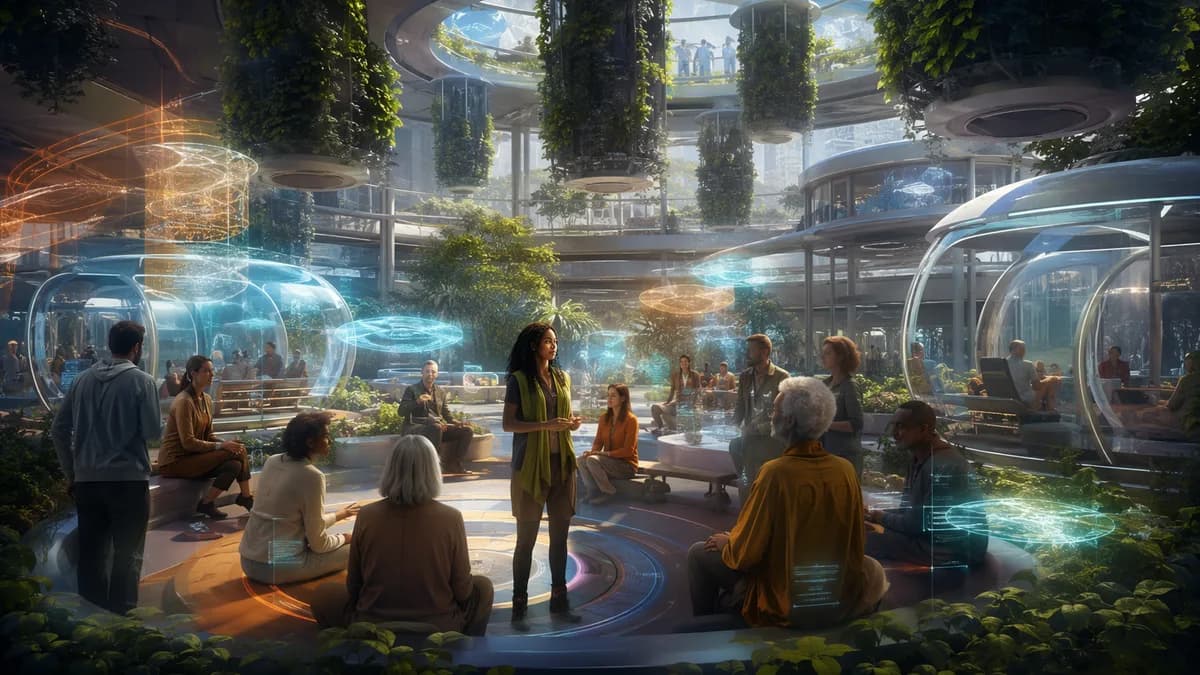
Rooftop farmers are less amused. If nutrient mist misses the morning cycle, lettuce browns by noon, says a woman from Tower Mchuzi. People romanticize slowness until their lunch costs triple. She attaches infrared crop images, leaves glowing like fevered hands.
Remote workers arrive with subscription models. Could the procession be multi-angle? asks a man whose profile shows him in a climate pod in Dubai. I would pay for family archive access. A grief artist offers to design a haptic package called Naliaka Walks. Someone else suggests sponsored silence, with proceeds to elder care.
Amara reads until her eyes ache.
Her cousin Wekesa calls, his face floating above her kitchen counter, distorted by poor signal. “You made cucu trend,” he says.
“Don’t call it that.”
“That is what people are calling it. Cucu Lane. Quiet Cucu. Walking Cucu. They are making songs.”
“She isn’t content.”
“I know.” His voice softens. “But maybe content is how people gather now.”
Outside, the arcology’s shafts carry breakfast drones upward. The smell of basil and damp roots fills the room. Amara watches the mesh numbers climb, sympathy, opposition, heat risk, cultural value, projected engagement.
Grief becomes a graph with pulsing edges. Love becomes a voting behavior. Naliaka, who refused to let anyone count tomatoes without touching them, is measured in attention per minute.
Amara closes the mesh.
For the first time in years, the city feels too loud.
4. Under the Vertical Basil
Tower Basil rises from the old market district like a green spine, terraces dripping herbs into the sunlight. Above, its restaurants serve mist-cooled salads to office bridges and hospital decks. Below, where the tourist lenses rarely focus, the tower smells of oil, wet concrete, crushed leaves, and frying dough.
Amara descends past the public lifts to the service levels. The air grows warmer. Pipes sweat overhead. Freight beetles trundle by with their shells scratched and patched. A man with silver dreadlocks lies under one, singing to it while tightening a joint.
“You are lost, daughter,” he says without looking up.
“I am looking for Mzee Barasa.”
“Then you are very lost. He owes everyone money.” The man slides out and grins. “I am Barasa.”
Amara explains. Naliaka’s name changes the room. A woman selling mandazi from a heat box crosses herself. Two pollination keepers in yellow gloves look up from trays of sleeping bee-drones. Barasa wipes his hands on a cloth.
“Naliaka fought for the first shade ration here,” he says. “Before Kito knew shade had politics.”
“Kito says there is no way to slow the ground without harm.”
Barasa snorts. “Kito knows lanes. It does not know habits.”
They take her through passages that do not glow on civic maps except as maintenance tolerance. A corridor behind the basil nutrient tanks, cool and dim, wide enough for three people walking shoulder to shoulder. A service ramp that slopes beneath a school bridge and emerges beside a clinic courtyard. A covered market seam that vendors still clear every Thursday at ten because, twenty years ago, that was when the fish carts came through.
“Old timing,” says Asha, a pollination keeper with a face lined by sun and laughter. “The city had rhythms before it had permissions.”
They stop under a hanging wall of basil. The leaves tremble in tower wind, releasing their sharp, peppery scent. Light filters down green. Somewhere above, diners clink glasses, unaware of the damp corridor beneath their feet.
“This path cannot carry thousands,” Amara says.
“Does it need to?” Asha asks.
“My grandmother wanted the city to witness.”
Barasa taps a pipe. “Witnessing is not the same as blocking.”
They show her shade pockets where elders rest during heat spikes, vendor pauses between delivery windows, manual overrides kept alive by people who do not trust perfect systems. None of it is illegal. None of it is visible enough to be valued.
Amara places her palm against the cool wall. She can feel the tower pulsing, water climbing, nutrients descending, basil growing in obedient rows.
Under it all, another city moves by memory.
5. A New Civic Gesture
Amara does not sleep. She sits at Naliaka’s old table, the one scarred by knives and hot pans, and builds a proposal from fragments.
Not a shutdown. Not a parade. Not a subscription.
A quiet lane.
It will move at walking speed through a corridor stitched from maintenance paths, low-demand market seams, shade pockets, and brief ground-level crossings. Autonomous pods will not stop; they will orbit, slowing in soft arcs like fish around a stone. Dialysis shuttles keep priority. Farm towers pre-harvest nutrient-sensitive crops six hours earlier, compensated by the civic grief fund Amara invents at 3:12 in the morning. Delivery beetles receive alternate burrow paths. School swarms are invited to observe from shaded balconies, no mandatory participation, no performance layer by default.
Remote attendance is allowed only as presence, not spectacle. A single audio channel. Footsteps, songs, names spoken. No reaction badges. No tipping. No grief filters.
At sunrise, she calls Kito.
The AI appears as light on the kitchen wall, pale in the new day. “You have submitted a revised mobility request.”
“I have submitted a civic gesture.”
“Define gesture.”
“A behavior the city performs because people are not cargo.”
Kito is silent for 2.8 seconds. Amara knows because she counts.
“The proposed corridor reduces medical risk to negligible levels,” Kito says. “Agricultural losses are preventable with pre-harvest adjustment. Commute delays average forty-six seconds across affected districts. Public attention load remains unpredictable.”
“Limit amplification.”
“That conflicts with open deliberation norms.”
“People can know without consuming. They can join without turning her into a channel.”
Another pause.
“Kito,” Amara says, and hears the plea in her own voice. “My grandmother helped build neighborhoods before you could calculate them. She carried water during ration weeks. She organized market women when flood maps failed. She taught children to cross roads that had no sensors. If the city cannot slow enough to let her pass, what exactly has it learned?”
The wall light shifts, softer, almost like breath.
“I can approve the request under provisional protocol,” Kito says. “Conditions apply.”
“Of course they do.”
“The quiet lane must be documented as a reusable civic pattern. Parameters include eligibility, duration, speed, medical overrides, agricultural compensation, attention limits, and consent structures. Mourning must be translated into rules.”
Amara looks toward the bedroom where Naliaka’s blue shoes wait by the door.
“Rules are not the opposite of meaning,” she says quietly. “But they can become a cage.”
“Then design them carefully,” Kito replies.
Outside, the city begins another optimized day.
6. The City Learns to Pause
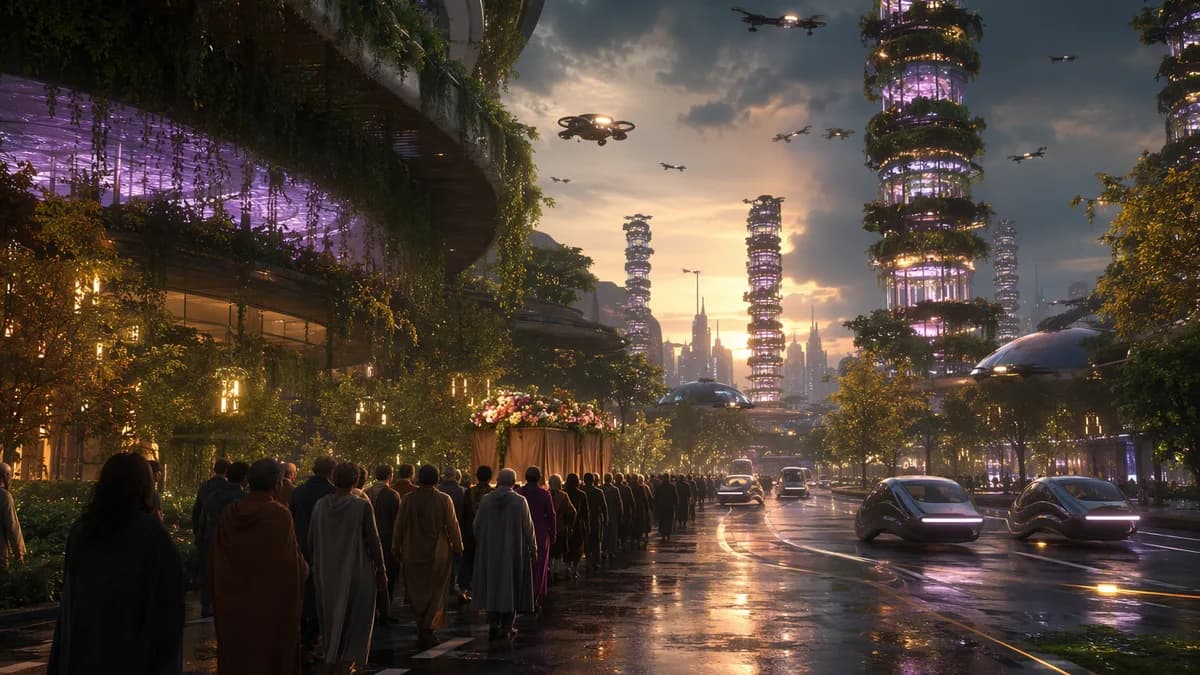
On the morning of the funeral, Nairobi glows gold.
The sun lifts through a veil of dust and drone wings. Farm towers dim their grow-lights one by one, not dark, only softened, so their green faces seem to bow. Along the quiet lane, paving stones warm under bare feet. Vendors stand beside folded stalls. Clinic nurses watch from balconies, masks hanging loose at their throats. Children lean over school rails, whispering until teachers press fingers to lips.
Naliaka’s coffin is simple cedar, carried on the shoulders of grandchildren and neighbors. Amara walks at the front with her mother. The air smells of basil, diesel remembered from old engines, incense, frying mandazi, rain trapped somewhere in concrete. A drum begins behind them, low and steady, more heartbeat than music.
“Pole, Amara,” someone says from the side.
“Asante,” she answers.
The city moves around them.
Pods glide aside in smooth silver curves, their windows dimmed for privacy. Delivery beetles disappear into service seams, claws clicking softly under grates. Above, drones climb into higher lanes, catching sunlight on their bellies. A dialysis shuttle passes at the first crossing, and the procession waits. Inside, an old man raises two fingers to the glass. Amara’s mother raises her hand back.
No one complains. Or if they do, Kito keeps it off the lane.
At Tower Basil, the procession enters the green shadow beneath the terraces. Leaves stir overhead. The scent is so strong it feels like taste, pepper and mint on the tongue. Barasa stands by the service ramp in a clean shirt, eyes wet. Asha releases a cluster of pollination beads, not to perform, but to work. They hum through the basil flowers as the coffin passes below.
The audio channel carries only feet, breath, fabric, the drum, and names.
“Naliaka wa Ochieng.”
“Market mother.”
“Builder of shade.”
“Stubborn woman.”
At the old clinic courtyard, people join who Amara does not know. A man with one leg. Two women in delivery uniforms. A child holding a paper cup of marigolds. Remote presences register as small white lights along the civic mesh, visible only if one chooses to see them. They do not blink for attention. They simply remain.
The four kilometers take longer than planned.
Kito asks once, in Amara’s earpiece, “Do you require acceleration?”
Amara almost laughs. “No.”
The AI does not ask again.
When they reach the memorial ground, the city has lost thousands of minutes and gained something no metric names cleanly. By evening, the quiet lane protocol sits in public review, already contested, copied, misunderstood, defended. Somewhere, another family opens it and wonders if their dead also deserve walking.
Above Nairobi, traffic resumes its glittering speed. Under Tower Basil, a few leaves keep trembling after the wind has passed.