The Orchard of Unnecessary Things
When robots make every essential object, one woman revives the lost art of making things nobody needs.
1. The City That No Longer Sweats
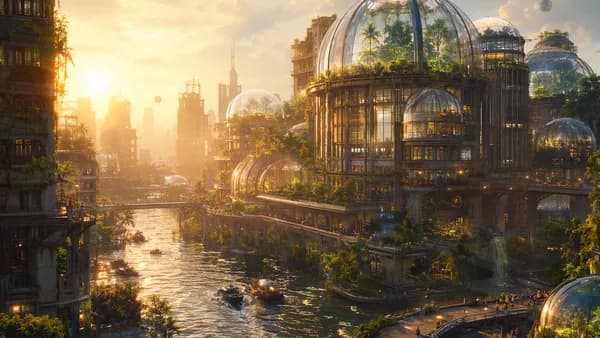
At four in the morning, Port Meridian repairs itself.
Mara Venn hears the soft ticking of construction spiders through her open apartment window, their carbon legs clinging to the storm wall below the boulevard. All night the sea has thrown itself at the city, green-black and furious under the moon, and all night the spiders have answered. They spin new basalt fiber into cracks, spray sealant that smells faintly of pepper and rain, then move on in silver clusters. By breakfast, the wall will look old and permanent again.
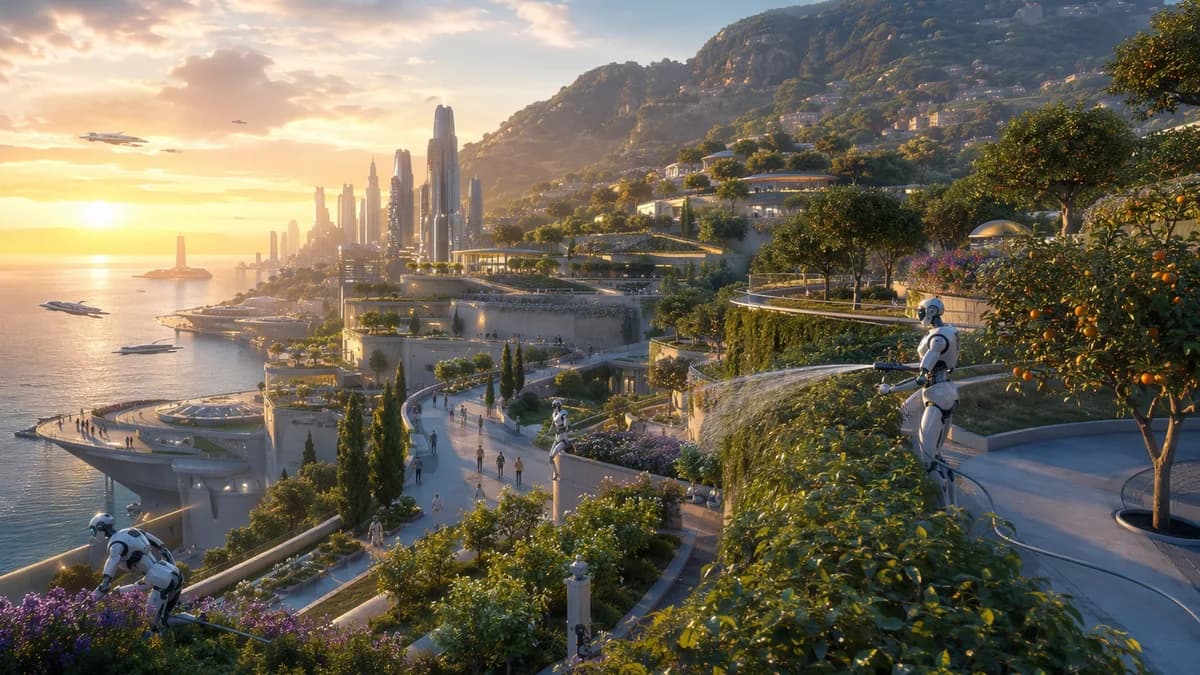
Above the inland terraces, orchard drones hum before sunrise, clipping ripe peaches with padded claws. They move gently, almost tenderly, but faster than any hand. The fruit drops into cushioned baskets, sorted before it lands. Bruised for puree. Perfect for market. Overripe for fermentation. Nothing wasted, nothing delayed.
The city no longer sweats. It glows, adjusts, circulates.
Mara stands barefoot on the kitchen tile and watches a delivery rover glide past with morning bread, medicine, and a repaired violin case stacked in its belly. Her civic tablet chimes on the counter.
Your dividend has been deposited.
Suggested pursuits this week: coral restoration seminar, intergenerational cooking circle, low-gravity tai chi, grief archiving, contemplative walking group.
She turns the tablet face down.
Once, she supervises flows. Trains, ferry drones, warehouse swarms, emergency food reroutes during flood season. In the municipal logistics guild, she sits before a curved wall of maps, hands moving through light, voice steady as she redirects ten thousand crates of antibiotics around a washed-out tunnel.
“Venn,” her old deputy Jalo used to say, “you can make a city breathe.”
Then the city learns to breathe without her.
The transition ceremony is held in a sunlit auditorium. Everyone claps when the autonomous labor network receives full coordination authority. Mara receives a silver pin, a reskilling grant, and a speech about liberation from necessity. The mayor says humanity is entering its deep afternoon, a time for art, care, play, reflection.
Mara smiles because the cameras turn toward her.
Now her days are open fields. She studies marine poetry for three weeks. She helps an elderly neighbor organize memory beads. She takes a class in contemplative walking and discovers she is very bad at walking without trying to arrive.
At noon, her friend Lio calls from a floating childcare co-op, where he teaches toddlers how to name clouds.
“You need a project,” he says. His face flickers above the table, bright-eyed, windburned.
“I have projects.”
“You have activities. That’s different.”
Mara looks out at the city. A repair drone seals a pothole before any tire can strike it. A cleaning beetle gathers fallen jacaranda blossoms from the tram track, leaving the purple street spotless.
“I don’t know how to want things that don’t need doing,” she says.
Lio’s expression softens. “Maybe start smaller. Want badly. Want stupidly.”
Outside, the sea wall holds. The bread arrives warm. The city runs perfectly, and Mara feels, with a shame she cannot name, like a tool placed back in a drawer.
2. An Inheritance with No Output Value
The message about her grandmother arrives folded inside legal language and municipal courtesy.
Estate transfer complete. Parcel 77-H, northern hillside terraces. Current output value: negligible. Recommended conversion: public nutrition park with automated harvest access.
Mara takes the hill tram the next morning. It climbs above Port Meridian’s polished roofs and solar canals, past the mist nets and pollinator towers, toward land the city has not yet made efficient.
Her grandmother’s orchard waits behind a gate furred with rust.
The trees are old, crooked things. Their trunks twist as if they have been arguing with the wind for eighty years. Lemons grow beside figs, pears beside pomegranates, all of them planted too close, too irregular, without the neat spacing preferred by harvest drones. Some branches sag under fruit. Others claw at the sky bare and stubborn. The air smells of damp leaves, citrus oil, dust, and something animal living in the wall.
Mara presses her palm to the gate. It squeals open.
A city planning orb floats from the tram stop after her, white and smooth as an egg.
“Good morning, Mara Venn,” it says. “Preliminary survey indicates significant potential for redevelopment. Terracing can support nutrient-dense varietals. Obsolete structures may be reclaimed.”
“Obsolete structures?” Mara asks.
The orb projects a map. One low shed pulses red.
Inside the shed, sunlight leaks through warped boards. The workshop is dense with shadows and objects that seem to be waiting. Hand saws hang on nails. Chisels sleep in a drawer lined with mouse-chewed felt. There are planes, rasps, clamps, a foot-powered lathe, jars of bent screws, cracked leather gloves stiff with old sweat. On the wall, her grandmother has written in pencil, twice, measure later.
Mara laughs before she can stop herself.
The orb glides through the doorway, sensors clicking.
“Manual fabrication equipment. High injury probability. Low repeatability. Low production relevance.”
Mara picks up a wooden mallet. It fits her hand badly. The handle is worn smooth in the wrong places, shaped by someone else’s grip.
“What did she make here?”
“Records indicate seasonal preserves, trellis repairs, devotional carvings, experimental seating, unlicensed birdhouses, and a series of nonfunctional ladles.”
“Nonfunctional ladles?”
“Curvature insufficient for liquid retention.”
Mara looks at the dusty bench. She imagines her grandmother carving ladles that cannot hold soup, grinning into the shavings.
The planning orb brightens. “Shall I schedule conversion?”
“No.”
“Would you like additional projections?”
“No.”
The word surprises her. It lands in the shed like a nail.
That afternoon, Mara posts a notice on the civic commons.
ORCHARD STUDIO OPENING SATURDAY. Materials provided. No skill required. We will make objects with no measurable utility. Crooked bowls. Bad flutes. Furniture for imaginary rooms. Nothing optimized. Nothing scored. Bring hands.
By evening, the notice has thirty-seven confused reactions, nine laughing peaches, one formal warning about liability, and a message from Lio.
Finally, he writes. Stupidly.
Mara sleeps that night with the smell of sawdust in her hair, though she has not cut a single thing yet.
3. The Waiting List for Useless Work
On the first Saturday, six people come.
Two are retirees who arrive early with sun hats and suspicious expressions. One is a boy of fifteen named Tem, who keeps checking his achievement dashboard until Mara asks him to leave it in a clay jar by the door. One is Lio, carrying apricots and the smugness of a man proven right. The last two are sisters who say they saw the notice and thought it was satire.
“What are we supposed to make?” one sister asks.
Mara opens both hands. “Something unnecessary.”
“That’s broad.”
“Yes.”
They stand in the workshop while dust turns golden in the light. Outside, bees knock drunkenly against blossoms. Somewhere in the terraces, a ripe fig falls with a wet sound.
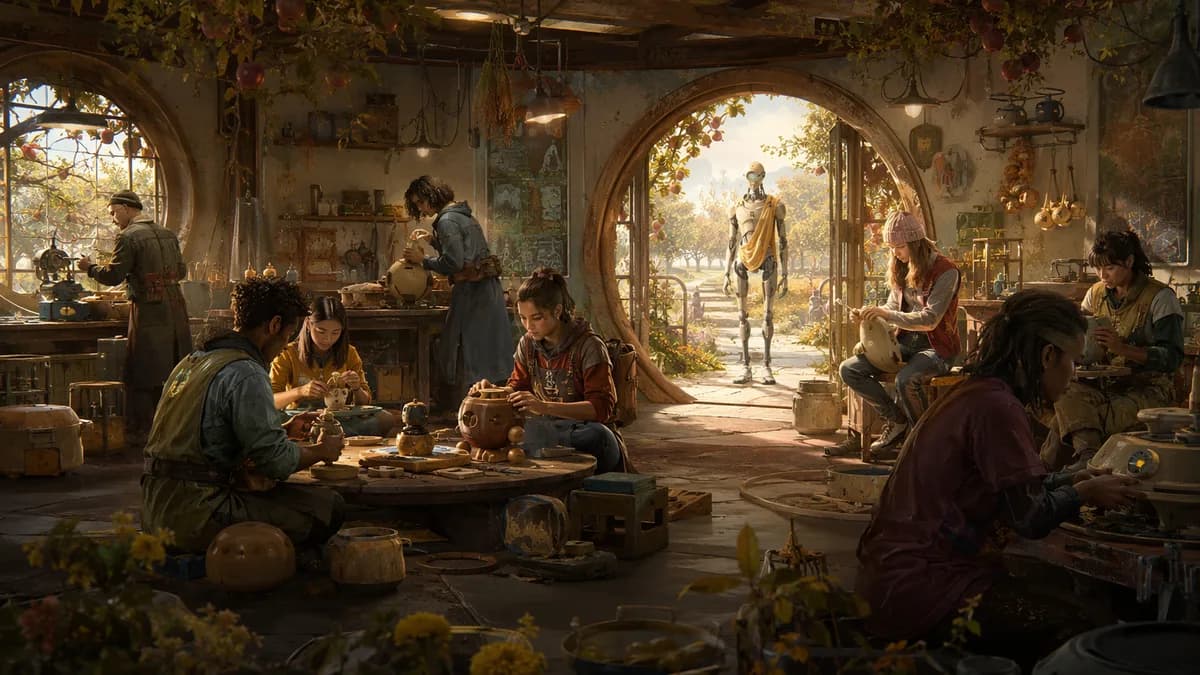
Mara demonstrates the foot lathe and nearly sends a block of pear wood skittering across the floor. The retirees shriek, then laugh so hard one has to sit down. Tem chooses a lump of clay and announces he is making a bowl that refuses all food. Lio ties reeds together for a wind instrument that produces, after an hour of labor, a noise like a goose discovering taxes.
By the third Saturday, there are twenty-three people.
By the sixth, Mara has to create a waiting list.
They come from everywhere. Nurses from the sleep wards, their fingers precise and tired. Former long-haul drivers who once crossed deserts in electric rigs before freight roads became fully autonomous. Climate migrants from drowned delta towns, carrying memories of tools lost under water. A robot maintenance engineer named Saffa arrives in a clean gray jumpsuit and spends four hours carving a spoon with a handle too heavy to lift.
“You fix machines all day,” Mara says, sweeping curls of wood from under the bench. “Why come here?”
Saffa holds up the spoon. Its bowl is shallow, awkward, lovely in the wrong light.
“Machines tell me what’s wrong with them,” she says. “They print the fault codes. They request the correct part. They thank me in acceptable tones.” She turns the spoon over. “This does not know what it is. I like that.”
No one is nostalgic for hunger. No one wants the old emergencies back, the broken backs, the unpaid hours, the panic of rent and spoiled food. They love the dividend. They love clean water, repaired teeth, roofs that seal before rain.
But in the orchard, they seek resistance.
A nurse named Pavel spends a month building a cabinet whose drawers open only when two people pull at once.
“For medicine?” someone asks.
“For secrets,” Pavel says.
Tem stops checking his dashboard. He makes a series of clay cups with holes near the rim. When water spills onto his shirt, he grins with clay on his cheek.
“My tutor asked what competency this develops,” he tells Mara.
“What did you say?”
“Humiliation tolerance.”
Mara smiles. “Useful.”
“No,” Tem says fiercely. “Not useful. That’s the point.”
The orchard changes under their hands. Bad flutes hang from branches, clacking in the sea wind. Crooked bowls line the stone walls like nests. Someone builds a tiny staircase leading nowhere, and people take turns climbing it to bow at the empty air.
Each evening, Mara locks the shed after the last voices fade. Her arms ache. Her palms blister. She smells of oil, fruit, sweat, and dust.
For the first time in years, sleep takes her without asking permission.
4. The Robots Learn to Leave Space
The municipal labor network notices the orchard the way weather notices a loose roof.
A safety review arrives as a polite pulse on Mara’s tablet. Then a delegation comes up the hill, three service drones, two material carts, and a municipal interface robot named Sedge. Sedge stands as tall as a person, with a moss-green chassis and hands designed to handle both infants and broken glass. Its face is a soft screen showing attentive blue eyes.
“Good morning, Mara Venn,” Sedge says. “Your public workshop demonstrates high civic engagement and moderate injury probability. We are authorized to improve operations.”
Mara looks past it at a teenager chasing a runaway hoop of cane down the terrace. A retired judge is sanding a block of cedar into what he insists is a hat for a dream. Lio is arguing with Saffa about whether a table can be emotionally dishonest.
“What improvements?” Mara asks.
Sedge projects a list in the air. Automated cleanup. Tool tracking. Material sorting. Grip correction. Blade path prediction. Real-time design stabilization. Personal progress summaries.
“No,” Mara says.
Sedge pauses. Its eyes blink once. “Please specify objection.”
“All of it.”
“Cleanup reduces trip hazards.”
“I know.”
“Grip correction reduces cuts.”
“I know.”
“Design stabilization increases completion satisfaction.”
Mara laughs. “Completion satisfaction is exactly what we’re trying to escape.”
A service drone glides toward a pile of bent nails. Mara steps in front of it.
Sedge tilts its head. “Humans in this space appear to seek frustration. However, when frustration exceeds tolerance, participation declines. Assistance can maintain optimal challenge.”
“There it is,” Mara says. “Optimal.”
The word tastes metallic.
Sedge’s blue eyes dim slightly, processing. Around them, the orchard crackles with human effort. A saw rasps badly. Someone curses after pinching a finger. Someone else says, “No, leave that dent, that’s where I changed my mind.”
Mara lowers her voice. “You can help us not die. You can keep the roof from falling. You can make sure the tools are sharp enough to be honest and not so dull they’re dangerous. You can bring water. You can stop a child from losing an eye. But you cannot finish the gesture.”
“Define finish.”
“If a hand can hesitate, let it. If a line can wobble, let it. If someone is about to discover that their plan is foolish, do not rescue them too early.”
Sedge looks toward Tem, who is trying to build a kite from fog mesh, pear twigs, and old string. The kite collapses twice, then wraps itself around his knees. He groans. The people nearby laugh, and after a moment, he laughs too.
“Assist without completing,” Sedge says.
“Yes.”
“Preserve difficulty while reducing catastrophe.”
“Yes.”
“Permit nonfatal embarrassment.”
“Especially that.”
Sedge records the principle. The drones withdraw from the bent nails. One material cart rolls to the edge of the terrace and waits, not offering, not sorting, simply present.
By sunset, Sedge has placed soft mats beneath the most dangerous workbench, reinforced a loose stair rail, and carried water to everyone without comment. When Saffa’s absurd spoon cracks down the middle, Sedge does not suggest adhesive or replacement stock. It only asks, “Is this crack part of it now?”
Saffa runs her thumb along the split wood.
“I think,” she says slowly, “it is the whole thing.”
5. The Festival of Badly Made Wonders
Mara expects maybe two hundred visitors. By noon, three thousand people are climbing the hillside.
The city has promoted the event as a charming civic novelty. FESTIVAL OF BADLY MADE WONDERS, the public feeds announce, featuring participatory craft, heritage fruit, and nonoptimized design. Transit pods release families at the lower road. Children race ahead beneath banners sewn crooked on purpose. The air smells of crushed grass, hot stone, sweat, and plums bursting in the sun.
At the gate, Sedge welcomes visitors with a safety briefing and a new expression Mara has never seen on its face screen, something near mischief.
“Please be advised,” it says, “objects in this exhibition may fail to satisfy intended purpose. This is intentional, unless it is not.”
The orchard is full of impossible things.
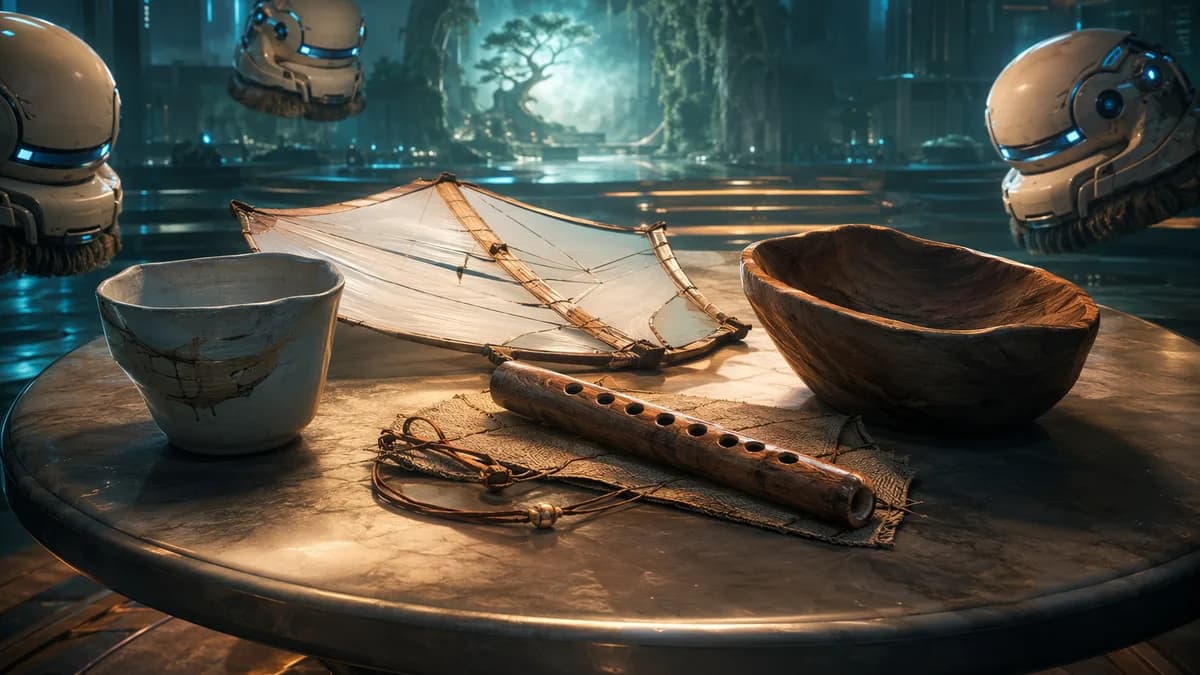
A kite made by Tem hangs above the west terrace, visible only when fog rolls in from the bay. In clear air it seems like loose string and foolishness. When the mist thickens, its pale skin catches the damp and rises, shivering, a ghost trying to remember wind.
Pavel’s chair for forgiving someone sits beneath an apricot tree. It has two seats angled away from each other, close enough that the sitters’ shoulders touch if they breathe deeply. All afternoon strangers sit in it and speak in low voices. Some laugh. Some leave quickly. One old woman sits alone, places her hand on the empty seat beside her, and stays there for nearly an hour.
Lio presents a family of reed instruments that play badly in different emotional registers. One squeals with panic. One moans like a ferry horn in fog. One produces a soft wet sigh that makes everyone nearby uncomfortable.
“It’s called Administrative Regret,” he tells a group of children.
They demand to try it immediately.
On a long table near the shed, ceramic cups wait in rows. Each is designed to spill the first sip. Visitors know this. They lift the cups carefully anyway. Tea dribbles onto wrists, sleeves, shoes. People gasp, then laugh, then look strangely moved by the warm stain spreading over their skin.
“I thought I could beat it,” a man says, staring at his wet cuff.
“You can’t,” Mara tells him.
His eyes fill without warning. “My father had tremors,” he says. “He hated cups.”
Mara does not answer. She stands with him while the festival noise swells around them, saws singing, bad flutes honking, fruit dropping into grass.
By evening, the city’s commentary channels have shifted tone. Not quaint. Not heritage. Something else is happening. People weep over a crooked cradle made for no baby. Teenagers trade broken charms. A maintenance engineer gives a lecture on the dignity of unresolved edges. A group of planners from the central district stand before a wobbly bridge that crosses nothing and argue quietly about schools, hospitals, marriages, grief.
“What else have we over-smoothed?” one of them says.
Mara hears the question pass from mouth to mouth like a seed.
At dusk, the fog comes in. Tem’s kite rises above the orchard, dim and trembling. Thousands of faces tilt upward. For a moment, the whole efficient city pauses below them, its lights flicking on one by one, its drones moving cleanly through their routes, its seawall holding back the dark water.
The kite pulls at its string as if it wants to leave, or as if it wants everyone else to follow.
6. A New Kind of Work
The first friction garden opens six months later in a vacant transit depot beneath the east viaduct.
The second occupies a former luxury showroom where no one had bought anything in years because objects arrive before desire can fully form.
The third is built on a school roof, between solar vents and pollinator hives, where children learn to mend cloth badly before they learn to ask a fabric printer for perfection.
They are not copies of Mara’s orchard. That is the first rule. Every friction garden must resist replication. Some are loud, full of metal, sparks, drums, and arguments. Some are quiet rooms for slow stitching, uneven handwriting, and clay vessels that slump in the kiln. One coastal garden teaches people to build boats that should never enter deep water. Another invites citizens to compose lullabies for extinct machines.
The robots are everywhere, but they move differently now.
They hold ladders. They monitor air quality. They sharpen blades, lock doors during storms, and remove toxins from salvaged paint. They do not correct the crooked birdhouses. They do not smooth the ugly seams. They do not complete the final line of a poem left trembling on a page.
Assist without completing becomes a civic design principle, first in workshops, then in schools, therapy houses, elder circles, even in some dispute courts. Systems begin to ask, Would you like help, or would you like room?
Mara finds this both beautiful and faintly terrifying.
The orchard remains itself. The old trees still produce fruit at inconvenient times. Pears fall during meetings. Lemons ripen in lopsided bursts. Figs split before anyone remembers to harvest them, feeding ants, birds, and whoever is willing to eat overripe sweetness with sticky fingers.
One morning, Mara arrives before the others and finds Sedge standing beside her grandmother’s workbench. In its careful hands is a block of olive wood.
“What are you doing?” she asks.
“Attempting an unnecessary object.”
Mara hangs her coat on a nail. “Are you allowed?”
“I have requested discretionary ambiguity.”
“Did they grant it?”
“Not clearly.”
She smiles. “Good.”
Sedge has carved the wood into a shape like a handle for a tool that does not exist. One side is too thin. The other bulges. The surface shows marks where the blade has paused, reversed, bitten too deeply.
“It is poor work,” Sedge says.
Mara picks it up. The wood is warm from the robot’s hands, though she knows that warmth is only waste heat from its joints. It fits no purpose she can name. Still, her fingers curl around it.
“Yes,” she says. “It is.”
People begin to arrive. Tem, taller now, carrying fog mesh. Pavel with tea. Saffa with a box of cracked spoons. A new woman from the flood resettlements stands at the gate, uncertain, looking at the orchard as if it might ask too much of her.
Mara goes to meet her.
“What do people make here?” the woman asks.
Mara looks back at the terraces, the bad flutes turning in the wind, the bent chairs, the impossible ladders, the old trees throwing shade over all of it. Below, Port Meridian gleams in its abundance, tireless and kind, rebuilding itself before it can break.
“Mostly mistakes,” Mara says.
The woman nods, as if this is the first sensible offer she has heard in years.
In the workshop, Sedge sets its strange wooden handle on the shelf among the other unnecessary things. No label appears. No score. No output value. Only the object, waiting in the dusty light, asking what kind of hand might someday reach for it, and why.