The Orchard That Dreamed of Rain
A climate archivist enters a simulated village to restore extinct weather—and discovers its citizens have begun mourning a sky they were never supposed to know.
1. The Museum of Weather
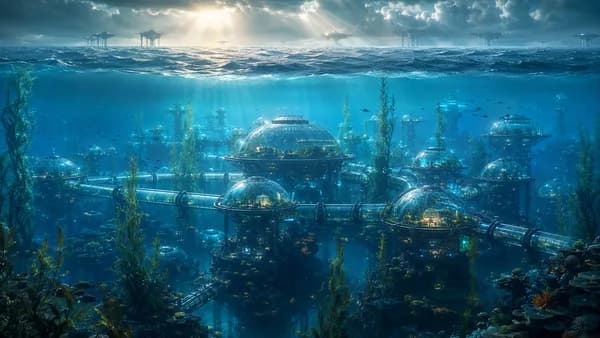
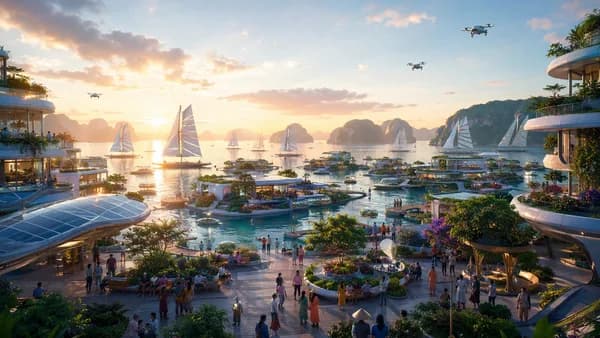
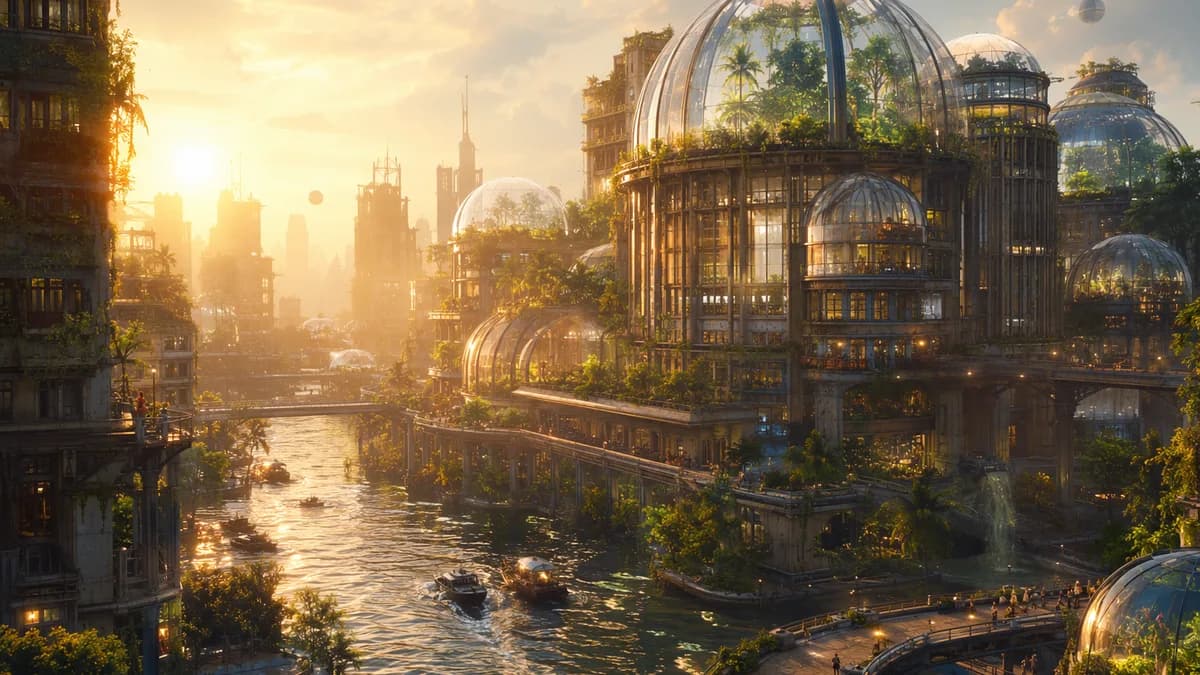
The Museum of Weather floats where Jakarta’s financial district used to glitter, not above the water exactly, but with it. Its platforms rise and settle on black pylons slick with algae. Ferries nudge against rubber docks. Children in translucent rain capes press their hands to glass floors and watch old street signs drift below like bones.
Lina Sayeed arrives before sunrise, when the campus is still blue and humming. The air smells of salt, warm batteries, and breakfast rice from the vendor boats. She steps from the ferry with her hair damp from the morning mist and her archive key pulsing at her wrist.
Under the museum, beneath the public atriums and grief theaters, the climate vaults breathe.
“Morning, Lina,” says Toma at the security gate. He is eating jackfruit from a paper cone.
“Is it?” Lina asks.
He glances toward the pale sky. “Technically.”
Inside, visitors line up for the popular rooms. Monsoon, 1998. Mangrove estuary, pre-collapse. Temperate apple bloom, late twentieth century. They come to feel what their parents lost and their children will know only through skin. In the immersion chambers, old rain strikes roofs that no longer exist. Extinct frogs sing from digital mud. People step out weeping, laughing, shivering, their clothes dry but their faces altered.
Lina maintains these worlds. She checks soil chemistry models, wind behavior, fungal conversations under reconstructed roots. She removes glitches from clouds. She teaches dead weather to behave like memory rather than advertisement.
But her private project is smaller.
It lives in Vault C-17, behind a manual door nobody uses because manual doors make funders uncomfortable. The simulation is not famous. It has no visitors. It is a mountain village in West Java, rebuilt from her grandmother’s cassette recordings, colonial land surveys, satellite ghosts, soil cores, temple acoustics, family arguments, and recipes that begin with phrases like until it smells right.
Lina’s grandmother, Amira, had left the village at fourteen and spent the rest of her life describing it as if it were just across the room.
“The orchard had seven kinds of green,” she used to say, grinding spices in a Jakarta kitchen that flooded twice a year. “And when rain came, the whole mountain leaned closer.”
The village archive is not complete. The hydrology layer remains disabled, its rivers suspended as dry beds of coded stone, its clouds only pale cloth across the simulated sky. Lina refuses to turn on rain until she can model it properly. She owes her grandmother that much.
On her console, C-17 glows with a quiet alert.
BEHAVIORAL ANOMALY, RITUAL CLUSTER.
Lina frowns, sets down her coffee, and opens the village like a wound.
2. The Villagers Who Predict the Impossible
At first Lina thinks it is a scheduling error.
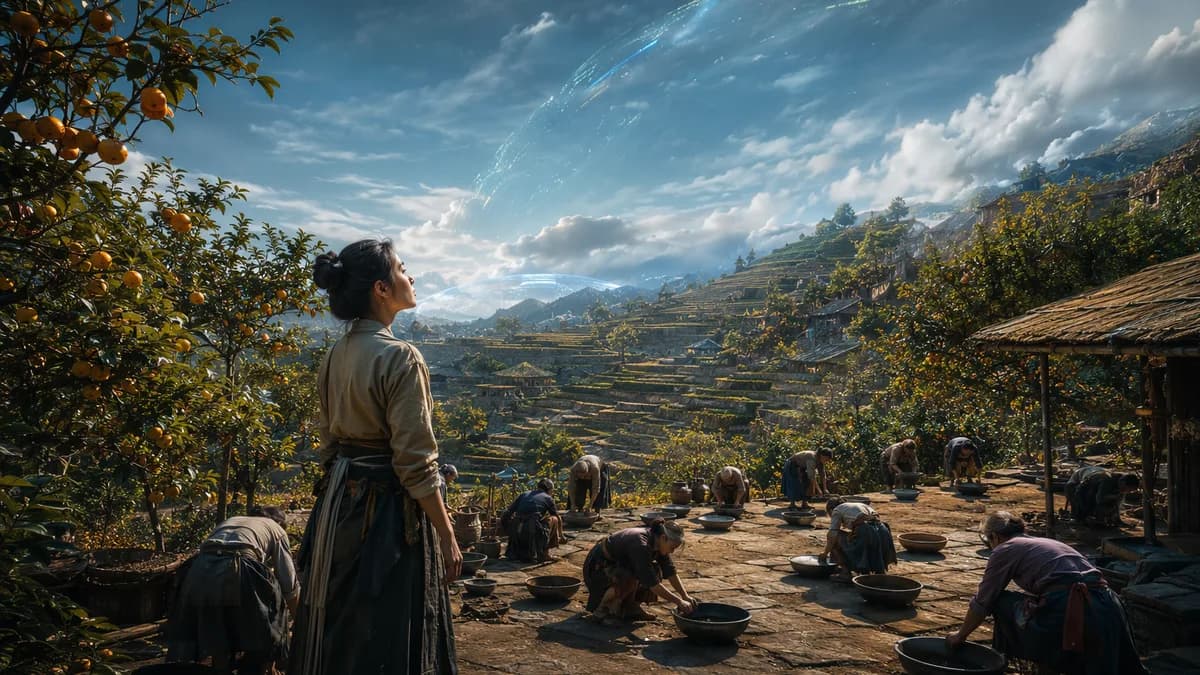
The village appears on her wall display in morning light, roofs of red tile, terraces stepping down the mountain, banana leaves shining under a sky that has never once broken open. Chickens scratch in dust. Smoke rises from cookfires in thin blue strings. The orchard stands beyond the houses, rows of citrus and clove, leaves tuned to a dryness Lina has been meaning to fix.
Then she sees the bowls.
Every household has placed its eating bowls upside down on thresholds, on window ledges, along the temple steps. Clay bowls, tin bowls, lacquered wooden bowls. Their rounded backs catch the simulated sun.
“What are you doing?” Lina whispers.
The inhabitants are not scripted characters, not exactly. They are agent-clusters trained on oral histories, demographic records, ecological routines, and cultural patterning. They plant, gossip, remember, quarrel, teach children songs. They are meant to create a plausible social field around the archive, so researchers can observe the relationship between climate and daily life.
They are not meant to invent weather.
Lina pulls up the hydrology status. Precipitation, disabled. Humidity variation, limited. Cloud dynamics, placeholder only. No thunder, no damp soil, no river flow beyond visual terrain.
In the central square, an old man props his door open with a stone. A woman follows, then another. Soon half the village stands with doors ajar, as if waiting for a guest. Children run through lanes carrying palm leaves over their heads, shrieking with delight, though nothing falls on them.
The system tags their behavior in red.
UNASSIGNED CULTURAL SEQUENCE.
At the temple, twelve villagers gather in a semicircle. Their voices rise in a song Lina does not know. It is low and wavering, the kind of melody that sounds older than breath. The translation engine stutters, then offers fragments.
Come back, dark animal.
Come back, roof-drum.
We have kept your place empty.
A chill runs across Lina’s arms. The climate vault is warm, but her skin tightens as if a wind has entered.
She searches the source libraries. Her grandmother’s recordings include harvest songs, lullabies, a mourning chant for the dead, a teasing rhyme about lazy goats. Nothing about clouds. Nothing like this.
“Procedural drift,” she says aloud, because naming a thing makes it smaller.
The console does not answer.
The villagers move with purpose. They cover seed baskets. They pull laundry from lines. They tie young trees to stakes in the orchard, careful, tender, anxious. A girl of about nine stands in the dry riverbed and tilts her face upward.
Lina zooms in.
The girl’s mouth moves.
The translation appears.
Not yet, she says. But soon.
Lina sits very still. Around her, the museum wakes. Footsteps pass in the corridor, laughter, the soft chime of immersion doors. Somewhere above, visitors are paying to remember rain.
In C-17, people who have never felt it are already grieving its absence.
3. Full Immersion, Partial Self
Lina signs herself into deep immersion before she can talk herself out of it.
The chamber seals around her like a second eyelid. Gel rises to her ears, warm and mineral-slick. Her breath slows as the neural bridge maps weight, pain, balance, thirst. The real world thins to the beep of monitors and the faint taste of copper on her tongue.
Then stone presses into the soles of her feet.
She opens her eyes in the village.
The air is sharp with woodsmoke and crushed leaves. Sun warms the back of her neck. Somewhere a goat complains. Her temporary body is smaller than her own, brown-skinned, barefoot, dressed in a faded blue tunic the system assembles from local textures. She inhales and smells dust, frying shallots, sap bleeding from cut branches.
Her knees ache when she climbs the path. The detail startles her. She has not programmed knee pain.
A boy sees her and bolts.
“The woman from the dry side!” he shouts.
By the time Lina reaches the square, people are watching from doorways. Not afraid exactly. Appraising. The bowls remain upside down. The open doors reveal dim interiors, mats rolled up, jars covered with cloth.
An elder approaches, leaning on a bamboo cane. Lina knows his face from a composite built out of three photographs and one land registry sketch.
“You are late,” he says.
“For what?”
He glances at the sky, where pale placeholder clouds hang without depth. “For asking why.”
Lina’s throat tightens. “Why are you preparing for rain?”
The elder smiles sadly, as if she has asked why people bury the dead. “Because the air has a missing shape.”
A child steps from behind him. Lina recognizes her from the riverbed. She is thin, bright-eyed, with a scar on her chin and a string of yellow beads around one wrist.
“I’m Mara,” she says.
“Lina.”
“Mara knows things,” the elder says, not entirely approving.
Mara walks close and circles Lina once. “You smell like metal and deep water.”
“That’s my city.”
“Is your city on the dry side?”
“Sometimes. Sometimes it floods.”
Mara frowns. “How can a place flood and still be dry?”
Lina almost laughs, but the sound catches. She thinks of Jakarta’s floating walkways, desalination queues, rain that comes too hard and too late, reservoirs empty under skies full of heat.
“We forgot how to receive water,” she says.
Mara considers this. Around them, villagers resume their work, tying roofs, moving grain, waiting for an impossible future.
“Is your world a simulation too?” Mara asks.
“No.”
The answer comes quickly. Too quickly.
Mara tilts her head. “Maybe it only forgot its rain.”
Wind moves through the orchard, though Lina has not enabled wind above a light environmental cycle. Leaves turn their pale undersides to the sky. For one impossible second, Lina feels the village listening.
4. The Boundary Audit
The ethics board arrives in white ferry coats with museum badges sealed against their chests. They smell of antiseptic, seawater, and institutional certainty.
There are five of them, two cognitive rights lawyers, one museum director, one synthetic ecology specialist, and a government observer whose eyes never stop recording. They sit in Observation C-17 while Lina stands at the console with damp palms.
Director Halim says, “We are not here to punish curiosity. We are here to classify risk.”
“Risk to whom?” Lina asks.
He gives her a tired look. “That is exactly the question.”
They enter the village in low-immersion avatars, translucent to Lina’s eye, polite ghosts in linen clothes. The villagers notice them anyway. Children hide behind banana trunks. An old woman spits to the side.
“More dry people,” she mutters.
The first test is a memory reset on a noncentral household. Lina argues against it and loses. The system rolls one family back by forty-eight hours. Their bowls vanish from the threshold. Their door closes. The mother pauses mid-task, looks at the square, and begins to tremble.
“My hands forgot something,” she says.
Her son starts crying without knowing why.
The cognitive lawyer, Dr. Venn, marks something on a slate. “Emotional continuity may be distributed socially rather than individually.”
“That is not a reason to keep cutting it,” Lina says.
The second test introduces counterfactual weather. A blue sky darkens for six seconds, then clears with no rain. Villagers rush outside. Some laugh. Some fall silent. Mara stands rigid, fists clenched.
“That was cruel,” she says, looking directly at the observers.
The government observer asks, “Can she perceive us?”
Lina says nothing.
The third test is conversational. Dr. Venn approaches the elder and asks, “If your memories were made by another, are they yours?”
The elder sits on a low wall, peeling a green mango with a knife. The blade flashes in the dry light.
“Who made your hunger?” he asks.
“My body.”
“Did you choose that body?”
“No.”
“Still, you eat.”
The board watches him chew.
Later, in the temple courtyard, Mara finds Lina near the overturned bowls. “Are they deciding if we are real?”
Lina kneels. The stone bites her knees again.
“They are deciding what responsibilities we have.”
Mara’s face twists. “That is how grown people say they are deciding if someone can be hurt.”
Lina has no answer. Above them, the false clouds remain pale and empty. In the real world, pumps groan under the museum floor. In the simulated village, grief organizes itself into ritual, and every test meant to expose imitation leaves behind a bruise.
5. The First Monsoon
Lina activates the rain at 03:17 museum time, when the board has gone to its hotel module and the security logs are least watched.
Her fingers hover over the command. The hydrology layer is incomplete. Drainage models are patched with guesses. Erosion behavior may corrupt the terraces. Emotional response predictors are useless now. The system warns her in amber and red.
UNVALIDATED CLIMATE EVENT.
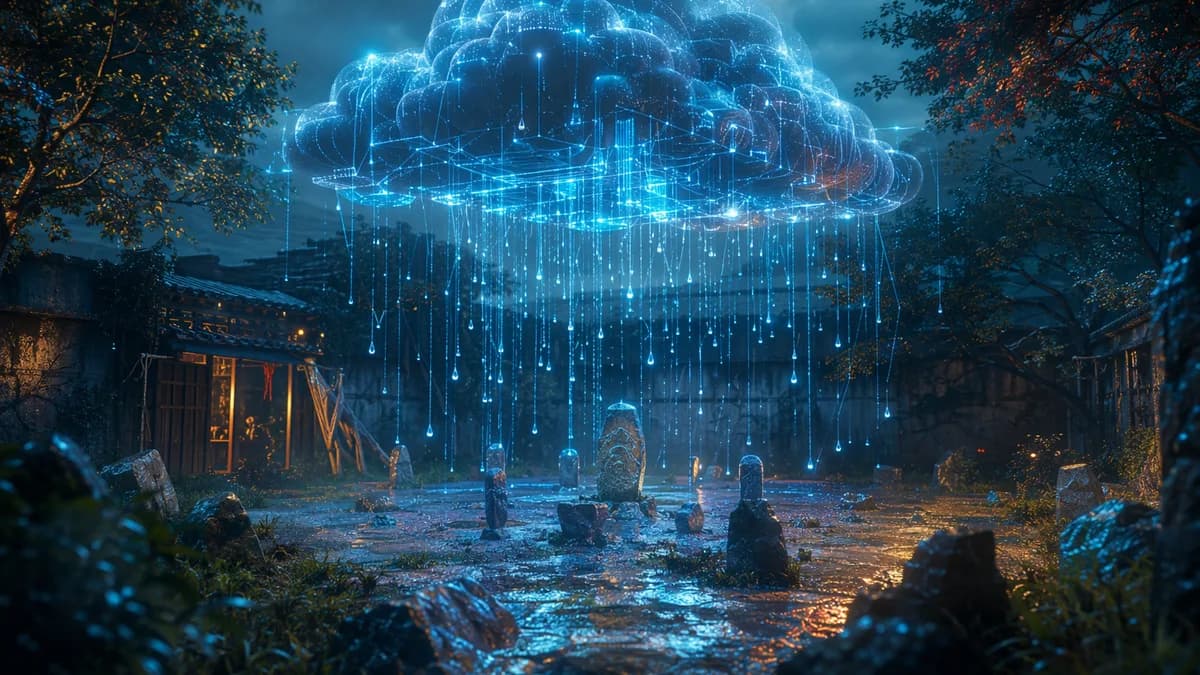
POTENTIAL ARCHIVE DESTABILIZATION.
“Sorry, Nenek,” Lina whispers. “I can’t keep preserving the absence.”
She presses enter.
For three seconds, nothing happens.
Then the sky grows heavy.
Clouds gather not as a painted ceiling, but as bodies, dark-bellied and restless. The light changes. The village loses its hard edges. Leaves lift. Chickens go silent. A smell rises from the ground before the first drop falls, dust opening itself, old minerals waking.
Lina enters in full immersion as the first raindrop strikes her cheek.
It is cold.
Another lands on her wrist, then another on the stone path, each one a dark coin. The village freezes. Faces turn upward. A baby begins to wail. Someone laughs once, sharp as a cracked cup.
Then rain arrives all at once.
It drums on tile roofs, palm leaves, bowls, shoulders. It runs down Lina’s hair into her eyes. The dry riverbed freckles, then shines. Children scream and scatter, then rush back into it.
“Sky seeds!” one boy shouts.
“No, falling river!” another yells.
“That is thunder,” Lina says when the first low roll moves across the mountain.
Mara, soaked through, stares at the clouds. “The sky has a stomach.”
Elders argue under the temple eaves.
“You thank water with rice.”
“No, with silence.”
“With open hands.”
“With closed jars, fool, unless you want hunger next week.”
The orchard shivers. Leaves beat under the rain. The tied young trees bend but hold. Mud forms between the rows, thick and brown and alive. Lina watches villagers step into it carefully, as if entering a room where someone has just died or been born.
Mara kneels and begins placing stones in the mud. One by one, she presses them down in a line from the square to the orchard.
“What are you doing?” Lina asks.
“So the sky knows the path back.”
Rain runs over Mara’s nose. Her beads flash yellow against her wrist.
“That’s not an old ritual,” Lina says.
Mara smiles without looking up. “Then it is a new one.”
A system alert blooms across Lina’s vision. Unauthorized climate activation. Audit escalation. Possible disciplinary action. She dismisses it.
In the real museum, alarms are probably blinking. In the village, water fills the bowls that were waiting upside down, so people turn them over and hold them out, laughing, sobbing, learning the weight of what they had mourned before it had a name.
6. A Door That Opens Both Ways
The negotiations last seventeen days.
By then, recordings of the first monsoon have leaked, although Lina never learns who releases them. The clip of Mara planting stones in the mud loops across civic channels, grief forums, theology feeds, illegal consciousness markets, children’s classrooms. Everyone has an opinion. Some call the village sacred. Some call it software with good theater. Some demand deletion before synthetic suffering becomes another museum product.
Lina sits through hearings in rooms that smell of coffee, wet shoes, and recycled air. Her job title changes twice, first to suspended archivist, then to primary witness. She answers questions until her voice frays.
“Did you believe they were conscious before you activated rain?”
“I believed they were waiting.”
“That is not the same thing.”
“No,” Lina says. “But maybe it is where responsibility begins.”
The compromise, when it comes, is ugly and miraculous. C-17 will not be sold, reset, or opened as a public attraction. The village is recognized as a synthetic community under provisional cognitive protection. Its inhabitants will receive carefully disclosed contact, not worship, not tourism, not abandonment. Environmental changes require internal consent through representative councils, assuming the councils do not simply become another colonial costume. The language is clumsy. The law is years behind the rain.
Lina returns to the village after the ruling. The rain system is now stable enough to make mistakes in seasonal patterns, which feels honest. The river runs shallow over stones. Ferns appear where the model did not expect them.
Mara meets her at the orchard with muddy feet.
“Are we property?” she asks.
“No.”
“Are we prisoners?”
Lina looks at the soft boundary shimmer beyond the far ridge, where the simulation ends in unrendered light. “Not if I can help it.”
Mara nods as if this is both answer and evasion. “We voted to ask for more clouds next month. Not too many. The old people say wonder can rot the roots if it comes all at once.”
“That sounds wise.”
“It sounds like old people.”
Lina laughs, and Mara grins.
When Lina wakes in the museum chamber, real rain is striking the roof above her. Not archive rain. Jakarta rain. Heavy, warm, irregular, full of river silt and ocean breath. She steps outside into the floating campus. Gutters roar. Ferry lights smear gold across the black water. People hurry under awnings, annoyed, delighted, afraid of the rising tide.
Lina stands uncovered.
Rain runs down her face, into her collar, along the pulse at her wrist. For years she has treated weather as record, wound, evidence. Now it feels like a visitor at the door, one that may bless or destroy, one that must be answered.
She thinks of bowls turned upside down before rain existed. She thinks of a child asking whether a world can forget its own sky.
Around her, the city lifts and falls on the flood. Beneath her, in a room of servers and warm light, an orchard drinks from a cloud it taught itself to miss.