The Treasurer of Borrowed Mornings
In a world where food, shelter, and energy are nearly free, a refugee accountant must decide what a nation still owes its people.
1. The Nation Without Streets
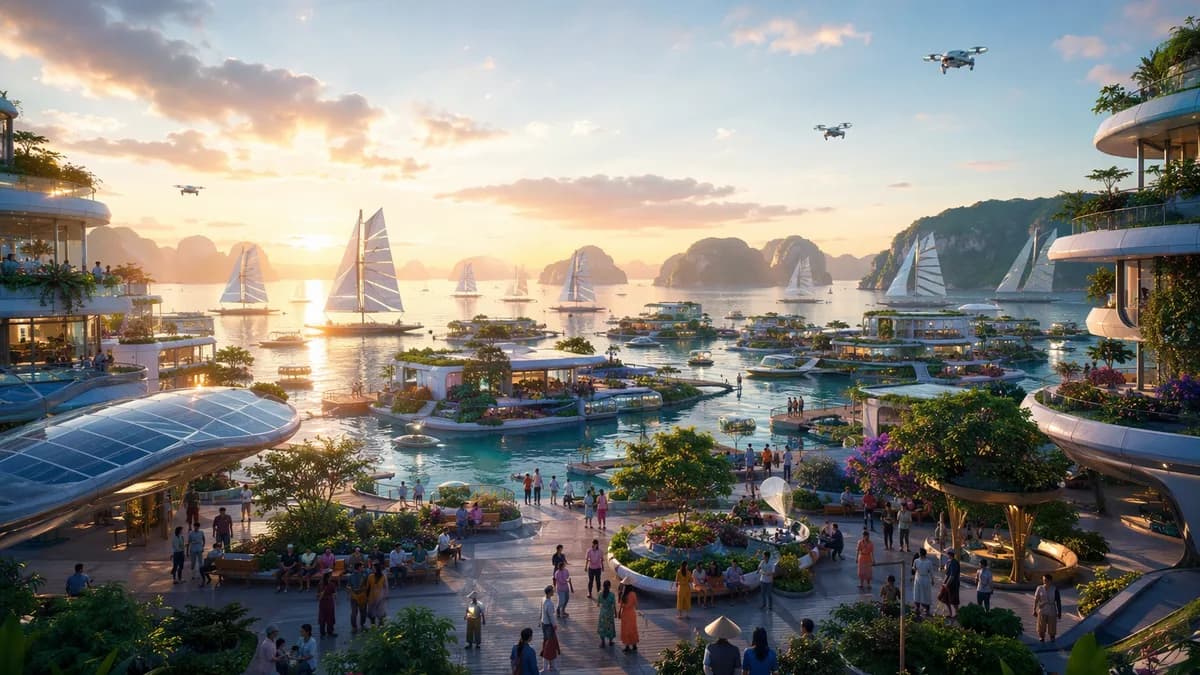
At dawn, Lina Mar wakes to the soft knock of water against the pontoons.
Her room tilts by a finger’s width as the floating cooperative outside Da Nang adjusts its ballast. Beyond the bamboo slats, the South China Sea glows pewter and rose. Fish drones skim the surface with quiet wings. On the roof, condensers bead the morning air into drinking water, drop by drop, each one clicking into the cistern like a tiny vote for survival.
Lina lies still for a moment, listening. A child laughs in the corridor. Someone fries garlic in a communal pan. The old fear, the one that used to arrive before her eyes opened, does not come.
No landlord message. No rice price alert. No municipal flood siren.
Her wall screen brightens.
“Good morning, Lina Mar,” says Tahanan’s civic voice, warm and genderless. “Your daily dividend is available. Nutrition, shelter, mobility, care, learning, energy. All accounts stable.”
“Stable,” Lina whispers, testing the word.
Once, in her province in the Philippines, stability meant sandbags, debt, and a spreadsheet of impossible numbers. She had been a municipal accountant then, balancing budgets while seawater climbed the school steps and children learned multiplication with their feet in brine. Now her body lives in Vietnam, in a cooperative stitched together from recycled hulls and algae panels, but her legal identity lives elsewhere.
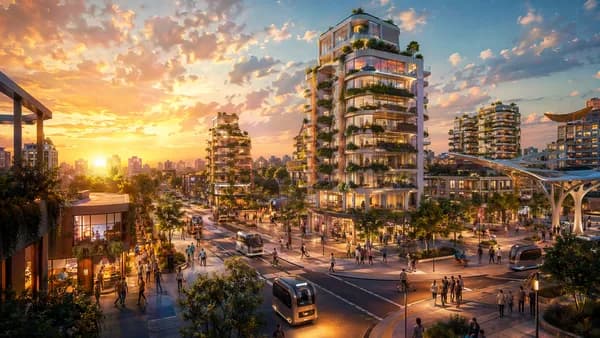
Tahanan has no capital city. It has no streets. It is a nation of encrypted ledgers, ocean farms, solar swarms, clinic contracts, teacher guilds, habitat shares, and twelve million climate migrants scattered across forty-two territories. Its flag is an animated house lantern that changes color with the weather in each citizen’s region.
Lina brushes her teeth with mint foam from a dispenser and steps onto the veranda. Below, her grandmother is already knee-deep in the algae garden, silver hair tied in a scarf, brown hands moving through green water.
“Lola,” Lina calls. “You are awake before the sun again.”
Her grandmother looks up and grins. “The sun is late.”
A delivery glider descends over the co-op, carrying breakfast packets, repair resin, and school lenses. Nobody pays. Or rather, everyone has already paid, through the labor pools, the solar dividends, the ocean farms, the patient machine intelligence that runs turbines and greenhouses while people sleep.
For the first time in Lina’s life, survival is ordinary.
That is what Tahanan promises. Not wealth. Not luxury. A morning borrowed from disaster, returned every day with interest.
Today, Lina will be sworn in as treasurer of that promise.
2. A Currency Made of Promises
The oath arrives as light.
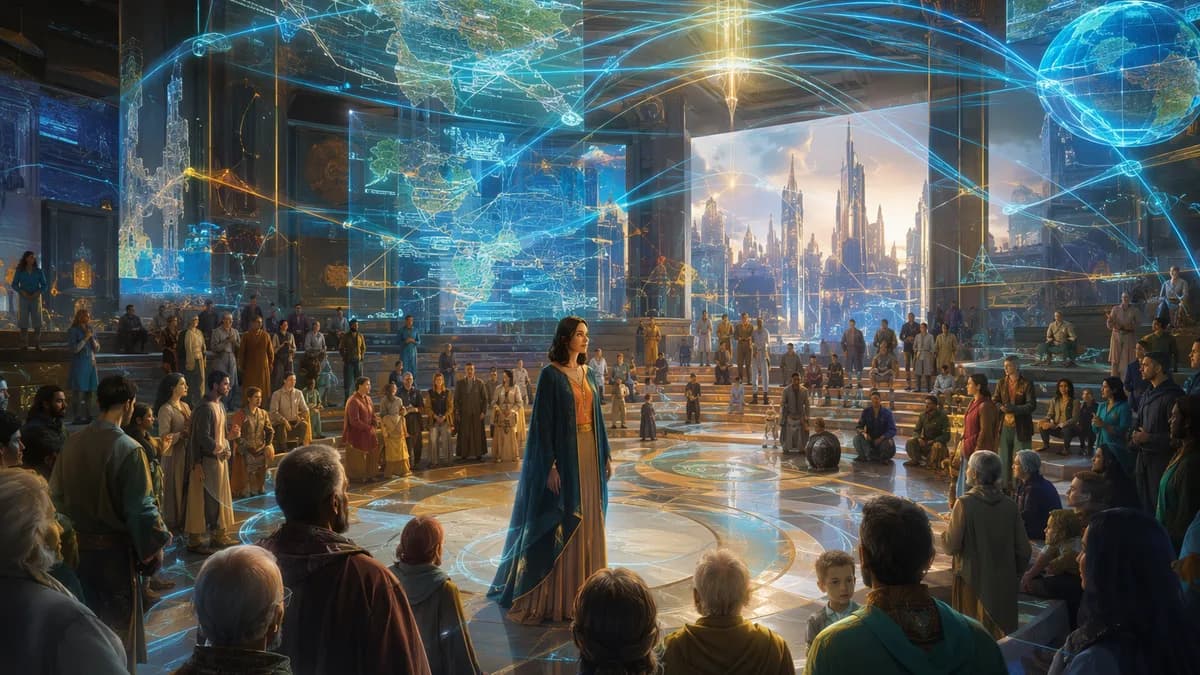
Lina stands barefoot on the co-op’s public deck while her neighbors gather around bowls of rice porridge and sliced mango. Her civic lens projects the assembly chamber across the sky, not a building, but a constellation of faces from São Paulo towers, Tunisian salt farms, Arctic repair ships, Nairobi learning kitchens, and refugee dormitories in places that still refuse to call them citizens.
“Do you accept stewardship of the commons?” asks the speaker from somewhere under a gray London roof.
“I accept,” Lina says.
“Do you understand that Tahanan’s treasury is not a vault?”
“It is a circulation.”
“Do you understand that no citizen may buy another citizen’s voice?”
“I do.”
The old currencies had been knives hidden in velvet. They accumulated, hardened, and became walls. Tahanan’s credits behave differently. They expire if unused. They redirect surplus into clinics, mangrove walls, language archives, grief counselors, habitat upgrades. A person can spend credits on a faster learning path, a private music session, a long-distance body rental for visiting family, but not on political control. Voting weight grows through contribution, not wealth, and even contribution decays unless renewed.
It is elegant. Lina loves elegance.
That afternoon, she sits in the co-op audit room with rain tapping the windows and opens the treasury’s deep flow maps. Threads of value stream across the globe, blue for energy, green for food, gold for care, violet for governance. She follows them with an accountant’s old hunger for pattern.
A million meals appear in the system as simple pulses. A cataract surgery in Quito blooms, then clears. A new desalination membrane in Basra receives redirected surplus from eight thousand unused recreation credits. Children in three time zones complete a lesson on coral law and earn civic contribution for teaching each other.
“Beautiful,” Lina says.
Her assistant, a small local AI named Piko, hums from the desk speaker. “You say that every thirteen minutes.”
“Because it keeps being true.”
“Would you like anomaly summaries?”
“Always.”
The room cools. Lines sharpen. Piko projects a cluster of gray citizens at the edge of the violet governance stream.
“Civic dormancy increasing,” Piko says. “Low-bandwidth citizens. Irregular participation. Minimal verified contribution.”
“How many?”
“Two hundred eighty-six thousand in the last quarter.”
Lina leans forward. The rain becomes louder.
Dormant citizens still receive food, shelter, energy, and care. Tahanan does not starve people into obedience. But dormancy thins their voice. It lowers voting weight, removes eligibility for juries, delays proposals, and marks them as passive beneficiaries.
The gray cluster pulses like a bruise.
“Where are they?” Lina asks.
“Everywhere,” Piko says. “Mostly older citizens, rural cooperatives, disabled citizens, informal caregivers, low-interface households.”
Lina thinks of her grandmother in the algae garden, hands green to the wrist, refusing every neural patch Tahanan sends her.
“Show me names,” she says.
3. The Grandmother Problem
Her grandmother’s name is there.
Marisol Arante Mar, citizen number 00411883, original oath group, Tacloban evacuation fleet. Classification: passive beneficiary. Civic influence reduced by 72 percent over six years.
Lina feels heat rise behind her eyes.
She finds Lola at midday beneath the shade netting, sorting algae strands by texture. The garden smells of salt, wet leaves, and the faint iron tang of nutrient mix. Children sit along the planks with their feet dangling over the tanks while Lola tells them a story about a church bell that rang underwater after the first great flood.
“Lola,” Lina says, too sharply.
The children look up.
Her grandmother pats the space beside her. “You have the face of a woman who found a mistake.”
“I found you.”
“Ah,” Lola says. “Then yes, a mistake.”
Lina opens the civic record in the air between them. The letters shimmer above the algae beds. Passive beneficiary. Low governance participation. Limited verified contribution.
Lola squints. “It says I am lazy?”
“It says the system cannot see what you do.”
“I do not like to be seen by systems.” She returns to sorting algae. “Systems saw our roof value, our debt value, our relocation value. They saw your mother as a number on a missing list. I prefer children. Children see fine.”
Lina sits. The planks are damp beneath her palms.
Tahanan’s protocol recognizes code reviews, dispute moderation, networked teaching, translation, infrastructure repair, medical support, design work, ecological accounting. It measures the visible, the timestamped, the signed. It rewards the citizen who logs in, speaks clearly, leaves a trail.
But Lola’s days are made of quieter architecture. She tends algae that feeds forty households. She remembers who cannot eat fermented protein. She checks on widowers who pretend not to be lonely. She teaches children old songs in Waray so grief does not erase a language. She sits with the dying when clinic staff rotate out. She tells new arrivals which parts of the deck become slippery after rain.
None of this enters the ledger unless someone with a lens records it, tags it, verifies it, submits it.
“Why did you never appeal?” Lina asks.
Lola snorts. “To whom? A machine that wants proof I am alive?”
“To Tahanan.”
“I am Tahanan,” Lola says, and the words land heavier than anger.
A boy with missing front teeth lifts a bundle of algae. “Apo Marisol says this one is ready.”
Lola nods. “Good eye.”
The boy beams. No credit flashes. No civic token appears. No ledger sings.
Lina watches the child carry the algae away and understands that the treasury has mistaken silence for absence. It has confused the refusal to perform with the failure to contribute.
That night, she cannot sleep. The cooperative rocks gently under a moon blurred by mist, and all around her, invisible systems keep people alive. For the first time since her election, the beauty of the machine frightens her.
4. The Market for Meaning
Lina begins traveling through Tahanan’s physical nodes, chasing the shape of what the ledger misses.
In the Sahara, she visits a battery cathedral at the edge of a mirror field. Heat presses against her face like an open oven. The storage towers rise black and gold from the sand, humming with enough captured sunlight to cool cities through the night. Inside, technicians walk under vaulted cables while prayer rugs line one quiet corner.
A young engineer named Samir shares mint tea from a dented flask.
“What should be scarce,” Lina asks, “when food and power are not?”
Samir laughs. “Shade. Silence. Forgiveness for mistakes.”
In São Paulo, a vertical clinic climbs the side of an old luxury tower. Vines spill from balconies where private pools once glittered. Lina rides a glass elevator past prosthetic labs, birthing rooms, memory therapy gardens. A nurse with tired eyes tells her the clinic can print organs faster than it can earn trust.
“People do not want more metrics,” the nurse says, washing her hands. “They want someone to stay after the alarm stops.”
In the Pacific, Lina visits a reef court where divers, fishers, biologists, and children vote on how many human visits a recovering coral valley can bear. The sea below is so clear it seems imaginary. Parrotfish flash blue and green under the platform.
An old fisher taps his chest. “The reef needs ceremony. If everything becomes access rights, people arrive like customers. We need days when nobody takes, nobody photographs, nobody improves.”
Everywhere, people say the same thing in different weather.
They do not want poverty back. They do not miss hunger’s discipline, rent’s cruelty, competition dressed up as character. Nobody tells Lina that suffering made them noble. The people who say such things usually speak from comfortable chairs.
But they do want boundaries. They want fair ways to allocate attention, repair damaged forests, preserve local rituals, protect elders from becoming data shadows. They want the right to be trusted without constantly producing evidence. They want work that is not a performance for the treasury. They want to give without wearing a sensor like a collar.
At a learning kitchen in Nairobi, teenagers knead lab-grown millet dough while arguing over governance law.
“If no one measures care,” one girl says, flour on her cheek, “men will claim they did it.”
“If everything measures care,” another replies, “care becomes acting.”
“So what then?” Lina asks.
The first girl slaps dough onto the table. “Witnesses. Human ones. Rotating. Annoying. Hard to bribe because they change.”
Lina writes it down.

By the time she returns to Da Nang, her notebook is full of salt stains, sand, clinic disinfectant, and voices. The treasury still glows in her lens with perfect lines of color, but now she sees the dark spaces between them.
Meaning has become the new market, and Tahanan has been pricing it badly.
5. The Fork That Feels Like a Festival
The split begins with a manifesto called Clean Governance for a Faster People.
Its authors are brilliant, young, exhausted by meetings, and allergic to sentiment. They argue that Tahanan is slowing under the weight of unverified claims. Every contribution should be logged. Every civic weight should come from measurable work. Neural interfaces should become standard for anyone requesting influence above the base threshold.
“Rights are guaranteed,” their speaker says in the open forum, his face magnified over twenty million lenses. “But governance must belong to those who show up.”
Across the network, older cooperatives answer with their own threat. If care remains invisible, they will withdraw their local knowledge, their jury participation, their kitchens, their gardens, their dead-language schools. Not secession exactly, but something worse. A nation without streets can still lose its rooms.
In Da Nang, the floating co-op prepares for the debate as if for a feast. Lanterns swing above the deck. Someone boils cassava. Children paint signs in three languages. Lina stands at a table covered in civic drafts while Lola slices calamansi with a small bright knife.
“You look pale,” Lola says.
“I may break the nation.”
“Good. If a bowl cracks because you put soup in it, it was not a good bowl.”
Lina laughs despite herself.
That evening, she presents her proposal. Not a patch. A fork.
The new treasury will treat caregiving, ecological stewardship, and local memory as public infrastructure. Not charity. Not sentiment. Infrastructure, as vital as fiber lines and desalination pumps. Verification will not come through constant surveillance. Instead, rotating citizen juries, chosen across age, region, ability, and interface level, will hold seasonal testimony. A caregiver may be recognized by those cared for. A reef keeper by neighbors, divers, and future-use councils. A language elder by students and community witnesses. False claims will face review, but the default posture will shift from suspicion to trust with accountability.
The efficient faction attacks at once.
“Too slow.”
“Too subjective.”
“Too easy to capture.”
Lina answers from the deck, with the sea breathing below her.
“Yes. Human judgment is slow. It is subjective. It can be captured, which is why we rotate it, publish reasoning, and limit terms. But our current system is also subjective. It simply hides its values in code and calls them neutral.”
Silence ripples through the forum.
Then Lola steps into the lens field. She refuses augmentation, so her image appears flat, grainy, badly lit.
“My granddaughter asks what Tahanan owes us,” she says. “I think it owes us the chance not to become beggars in the house we built.”
On the co-op deck, nobody cheers at first. The words move too deep for noise.
Then, from some distant node, a drumbeat starts.
6. After Money Learns to Listen
The vote lasts nine days.
It is less like an election than a planetary ritual. In Tunis, citizens gather under wind towers and argue until their tea goes cold. In Manila’s raised districts, elders sit beside teenagers who translate forum threads into street Tagalog, Cebuano, Waray, and the quick bright slang of children born after retreat. In São Paulo, clinic patients vote from recovery hammocks. In the Sahara battery cathedral, technicians project the proposal onto the wall between columns of stored sun.
Tahanan’s network fills with testimony.
A blind mechanic describes repairing mobility drones by sound and touch, work rarely logged because the repair bay interface assumes sight. A father in Rotterdam explains how grief care saved his housing cluster after three suicides. A mangrove steward from Bangladesh holds up a jar of black soil and says, “This is not content. This is a wall against the sea.” A seventeen-year-old from Nairobi warns that juries can become popularity contests if not designed with teeth.
Lina barely sleeps. Her room smells of coffee, salt air, and the peppermints Lola leaves beside her keyboard. Numbers roll across the wall. Support rises, falls, fractures by region, recovers through amendments. The efficient faction wins concessions: audit trails for jury reasoning, appeal paths, random shadow reviews, strict conflict declarations. The cooperatives accept training requirements and anti-capture safeguards.
On the ninth day, rain sweeps over Da Nang in silver sheets.
Lina stands with her neighbors on the deck. Water drums on the awning. The sea jumps white beneath them. Lola grips her hand, her palm rough from algae rope.
Piko speaks from every speaker in the co-op.
“Final tally certified. Protocol fork approved. Margin: 1.8 percent.”
For a moment, Lina hears only rain.
Then the deck erupts. People shout, sob, curse with relief. A child bangs a spoon against a pot. Someone starts singing the old evacuation song, the one that kept time when boats moved through flooded streets at night.
Lina looks at the treasury flow map in her lens. The colors rearrange. A new strand appears, deep amber, threading through gardens, kitchens, memory circles, reef courts, sickrooms, repair sheds, funeral tents, playgrounds. It is not smooth. It flickers, uncertain and alive.
The daily dividend still arrives in the morning. Food, shelter, care, learning, energy. But now each payment carries a question, renewed again and again: what do we owe one another when no one has to be hungry?
Weeks later, Lina finds Lola in the algae garden before sunrise.
“Your civic weight increased,” Lina says.
Lola makes a face. “Can I spend it on better knees?”
“No.”
“Then do not bother me with riches.”
They laugh softly as the water brightens. Around them, the cooperative wakes, machines humming, people stirring, breakfast steaming in shared kitchens. The future does not feel clean or finished. It smells of salt, garlic, wet rope, and human argument.
Above the horizon, Tahanan’s lantern flag flickers into morning color, not a symbol of a solved world, but of a house still deciding who gets to open the door.