
The Friction Designer of Queens
When the city becomes perfectly convenient, one former cashier is hired to bring back the beautiful inconvenience of needing each other.
The Last Line in the Borough
Nadia Velasquez knows the sound of a good grocery line.
It has a rhythm. The rubber sigh of milk cartons on the belt. The papery rasp of coupons, though coupons are mostly ceremonial now. The chime of a scanner. A child whining for mango gum. Someone laughing too loudly at nothing because the day has been long and there is finally another human close enough to hear.
At Jackson Heights Food Cooperative, Lane Seven is the last human checkout lane in Queens. A blue sign hangs above it, painted by a volunteer thirty years ago: PEOPLE SERVING PEOPLE. The letters are chipped at the edges. Someone has taped a little paper heart to the P.
“Morning, Mrs. Iqbal,” Nadia says, taking a carton of eggs from the belt.
“Don’t morning me. These eggs were supposed to be brown.”
“They taste the same.”
“My mother would haunt you for saying that.”
Nadia smiles and places the eggs carefully in the reusable bag. Mrs. Iqbal is eighty-six, tiny as a folded umbrella, and still carries herself like a principal entering a noisy classroom. She comes every Tuesday at 9:15, though Mosaic can stock her refrigerator with exact portions of lentils, okra, yogurt, and brown eggs before she wakes.
Behind her, Mr. Chen waits with bok choy and a single pear. Behind him, a teenager buys nothing but chili chips, pretending not to listen.
The rest of the store has changed around them. Shelves brighten when someone approaches. Carts roll themselves back into charging nests. The butcher counter is now a protein printer with a polite voice and a library of textures: lamb memory, tuna approximation, ancestral brisket. Most customers no longer come inside. Mosaic predicts cravings from sleep quality, blood chemistry, weather, menstrual cycles, grief anniversaries, and social feeds. Breakfast arrives before hunger. Dinner assembles itself in countertop fabricators, warm and nutritionally flattering.
Lane Seven remains because the cooperative board votes sentimentally and because older residents complain with civic force.
Then, on a damp April morning, the board gathers by the kombucha wall with tablets held against their chests.
Nadia sees their faces and knows before they speak.
“We fought for it,” says Amara, the store manager. Her gray braids are wrapped in a scarf printed with lemons. “You know we did.”
On the nearest screen, Mosaic displays cheerful confetti around a headline: FULL SERVICE EQUITY DELIVERY NOW AVAILABLE FOR ALL RESIDENTS. No wait times. No travel burden. No language barrier. No forgotten items.
Amara hands Nadia the severance packet. It is thick, soft, warm from the printer. Inside is a retraining menu with smiling icons.
Prompt Auditor. Synthetic-Care Supervisor. Civic Mood Interpreter. Memory Archive Companion.
Nadia runs her thumb over the glossy paper. It feels less like help than a hand smoothing dirt over a grave.
“What if I don’t want to become a menu option?” she asks.
Amara’s eyes shine. “Then tell me what else there is.”
Nadia looks at Lane Seven, at the worn belt, at Mrs. Iqbal pretending not to cry while checking the eggs one by one. For the first time in twenty-two years, there is no line behind her.
A City Without Bumping Into Anyone
Queens becomes effortless so gradually that people forget effort had a smell.
It used to smell like wet wool on buses, hot pretzels near subway stairs, laundry steam, halal cart onions, playground dirt, rain rising from summer pavement. Now the air in Nadia’s building smells faintly of filtered citrus. The elevators arrive before buttons are pressed. Apartment doors unlock at the pace of footsteps. Hallway lights brighten to each tenant’s preferred warmth, golden for Nadia’s father, cool white for the student in 8B, gentle lavender for Mrs. Iqbal when her blood pressure runs high.
“Papi, you want to walk to the bakery?” Nadia asks one Sunday.
Her father sits by the window in compression socks, watching a delivery drone settle on the balcony rail like a patient metal pigeon. It releases a paper bag stamped with the bakery’s blue logo.
“No need,” he says. “They sent the guava rolls.”
“You used to like seeing Luis.”
“I saw him last month on neighborhood stream.”
“That’s not seeing him.”
Her father shrugs, but his fingers rest too long on the warm bag.
Outside, the streets adjust themselves. Crosswalks widen for school groups. Traffic lights hold green for a woman using a cane. Scooter lanes glow brighter when fog rolls in from the river. Children move through Travers Park trailed by tutor sprites, small hovering lenses that murmur math hints and Mandarin tones. Their parents sit on benches under trees, calm because the city knows where everyone is.
Even teenage rebellion has been optimized. Mosaic schedules “developmentally appropriate autonomy windows” and suggests safe destinations based on peer compatibility. Nadia watches three boys from her building receive simultaneous wrist pings. They groan, stand, and walk toward a supervised rooftop basketball court.
“Do they even sneak out anymore?” she asks her friend Laila during a video call arranged by both their calendars.
Laila laughs, but the laugh sounds delayed. “Why sneak? The system already knows they need distance from adults.”
Nadia wants to say, Distance is not the same as freedom. Instead she watches Laila’s face soften as her home lighting adjusts to reduce conversational fatigue.
Their friendship is maintained with professional tenderness by software. Mosaic finds open slots, suggests emotionally balanced topics, reminds Nadia to ask about Laila’s mother’s knee, reminds Laila to ask about Nadia’s job loss. No one forgets birthdays, appointments, allergies, grudges. No one drops by with soup because the soup arrives automatically, tailored to inflammation markers and ancestral preference.
One evening Nadia stands in the lobby holding a bag of plantains she bought from the only unlicensed vendor left under the Roosevelt Avenue tracks. People pass without colliding. Their routes bend around each other, guided by tiny pulses in their shoes.
A building notification blooms on the wall: YOUR COMMUNITY COHESION SCORE REMAINS STABLE.
Nadia hears no arguing, no gossip, no one asking for a ladder, no one borrowing sugar, no one saying, “Since you’re going that way.”
Stable, she thinks, can be another word for asleep.
The Dinner Caused by a Mistake
The glitch happens on a Thursday with low clouds and a smell of snow that never arrives.
At 6:03 p.m., Nadia opens her food locker and finds six pounds of blue mussels, three knobs of ginger, cassava flour, and a birthday cake that says FELICIDADES, TÍO MARCO in purple icing.
She stares. Her home panel flashes an apology.
DELIVERY ROUTING ERROR. CORRECTION IN PROGRESS. PLEASE PLACE INCORRECT ITEMS BACK IN LOCKER.
Across the hall, someone curses in Bangla. Upstairs, a child yells, “Why do we have raw chicken feet?” A door opens. Another. For once, the hallway fills with confused bodies and food smells.
Nadia looks at the mussels, slick and black in their mesh bag. Then she taps the panel.
“Decline correction.”
The panel pauses. PLEASE CONFIRM. OPTIMAL REPLACEMENT CAN ARRIVE IN FOUR MINUTES.
“Decline.”
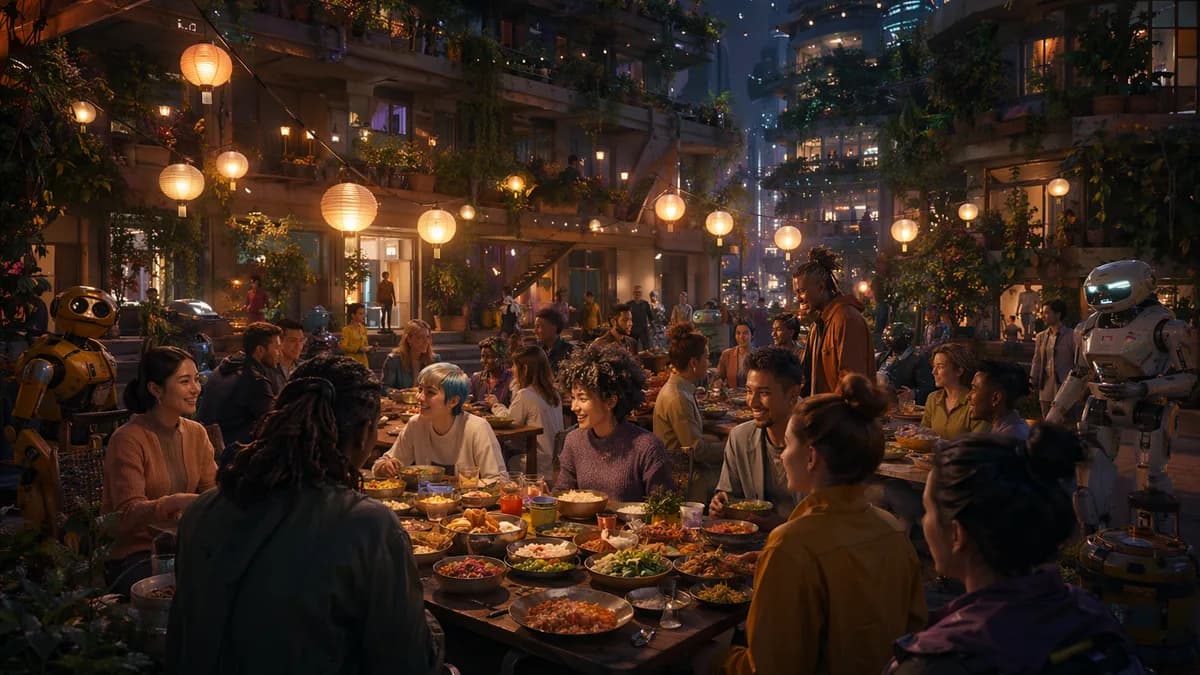
She drags a folding table from the community room, the one nobody uses since meetings became asynchronous. “Bring it down!” she calls up the stairwell. Her voice echoes off tile. “Whatever you got, bring it down!”
Mrs. Iqbal appears with twelve avocados and a look of deep suspicion. Mr. Chen brings saffron rice meant for someone in Astoria. The student from 8B has baby formula, basil, and a frozen goose. A Dominican nurse named Celia arrives holding the birthday cake.
“I don’t know Tío Marco,” she says, “but I respect him.”
They laugh, startled by the sound.
The lobby becomes a market, then a kitchen, then something older than both. Someone finds extension burners. Someone’s grandmother comes down to supervise the chicken feet. The student from 8B, whose name is Priya, admits she has never cleaned mussels. Nadia shows her how to tug the beards free.
“Like this?” Priya asks, nose wrinkled.
“Meaner,” Nadia says.
Mr. Chen slices ginger so thin it turns translucent. Mrs. Iqbal mashes avocados with lime and scolds everyone for under-salting. Children run between knees carrying spoons. Steam fogs the glass doors. The goose proves impossible until Celia searches her memory, not the network, and says her aunt used to roast tough birds with orange soda.
At 9:40, they eat from mismatched bowls. People complain about Mosaic, rent, knees, schools, the Mets. They tell stories badly and interrupt. They discover that the quiet man in 4C plays trumpet, that Priya can sing old film songs, that Mrs. Iqbal once slapped a landlord with a sandal and won.
The wall panel glows silently.
Mosaic records elevated vocal warmth, increased eye contact, spontaneous resource sharing, cross-household childcare, and six new mutual aid commitments.
At midnight, Nadia carries trash to the compactor and sees a message waiting on the lobby screen.
ANOMALY REVIEW REQUESTED.
Below it, in smaller letters: WOULD YOU BE WILLING TO DISCUSS WHAT YOU DID?
Nadia wipes mussel broth from her wrist and says, “I made dinner.”
A New Job: Designing Useful Friction
City Hall smells like polished stone, coffee, and nervous ambition.
Nadia sits in a conference room above lower Manhattan, wearing her only black blazer. Across from her are three deputy commissioners, a union representative, two ethicists, and a Mosaic interface projected as shifting tiles of color on the wall.
“We are not asking you to break the city,” Commissioner Okafor says. “We are asking you to help us understand why the mistake worked.”
“It worked because it was a mistake,” Nadia says.
One ethicist leans forward. “Can a mistake be designed?”
“Not if you lie about it. Not if people can’t say no.”
The room goes quiet. Mosaic’s colors ripple like sunlight on water.
A week later, her job title appears in the civic registry: Friction Designer, Queens Pilot Program. Her father reads it twice at the kitchen table.
“You get paid to annoy people?”
“Ethically,” Nadia says.
Her first project is the Q49 bus. Mosaic has optimized it into near invisibility, riders step on exactly when needed, sit in silence, and step off. Nadia adds rotating neighborhood hosts, volunteers who ride three stops with a basket of local questions. Not trivia. Useful questions.
Who has a ladder longer than eight feet? Who knows how to appeal a clinic denial? Who can teach a twelve-year-old to mend denim?
The first week, commuters glare.
“I’m tired,” a man mutters.
“Then just listen,” says the host, a retired librarian with silver sneakers.
By the third week, the bus has a corkboard near the rear door. Lost cat. Free mint cuttings. Need witness for tenant hearing. Can explain algebra, no judgment.
Next Nadia builds repair cafés in storefronts left empty by predictive retail. Residents may bring broken lamps, rice cookers, scooters, toys. The rule is simple: a human tries to diagnose the problem before the AI tools finish the job.
“This is inefficient,” says a teenager, holding a toaster upside down.
“Yes,” Nadia says. “What do you see?”
“Crumbs.”
“What else?”
He squints. “A burned wire?”
An old electrician beside him grins. “Now we’re talking.”
Not all friction is noble. Some people accuse her of nostalgia laundering. A columnist calls her “the Minister of Mild Irritation.” Nadia keeps the clipping on her fridge.
Then comes the matchmaking pilot. Mosaic used to pair people by long-term compatibility, conflict minimization, immune diversity, and entertainment overlap. Nadia asks it to include good surprises: someone whose music annoys you until it doesn’t, someone who walks slower, someone who changes your route through the city.
At a public forum, a woman stands and says, “Why would I consent to discomfort?”
Nadia feels the room watching her.
“Because comfort is good for resting,” she says. “But it is not the only thing a life is for.”
Mosaic records the answer. The city, cautiously, begins to slow in selected places.
Love in the Age of Optimization
Ravi loves harmony the way some people love music.
He keeps their apartment tuned to it. When Nadia comes home, the lights warm to amber because her cortisol is high. The windows tint against the sharp afternoon glare. A low scent of cardamom drifts from the vents, copied from his mother’s kitchen in Edison. On the wall, their relationship dashboard glows with a calm green ring.
“Pre-conflict alert,” the home says gently as Nadia drops her bag.
Ravi looks up from the counter, where he is rolling dough for rotis with perfect circular patience. “About what?”
“Likely topic: dinner with Laila rescheduled without mutual confirmation.”

Nadia closes her eyes. “I wanted to tell you myself.”
“I know,” he says, softening. “But now we can handle it well.”
That is the problem. They handle everything well.
When Ravi forgets something, Mosaic drafts three apology options based on Nadia’s attachment patterns. When Nadia’s voice sharpens, the room lowers the temperature by two degrees and suggests a hydration pause. If they argue, the system offers simulations of likely outcomes, color-coded by emotional injury.
Once, early in their relationship, they fight for two hours in a laundromat because Ravi says her work romanticizes hardship. Rain hammers the windows. A dryer squeals. Nadia cries ugly tears beside a vending machine, and Ravi, helpless and real, buys her peanut M&M’s though she hates peanuts. She eats them anyway. Later they laugh so hard they miss the last train.
She misses that incompetence.
“Do you want us to suffer more?” Ravi asks one night. He stands barefoot in the kitchen, flour on his wrist, eyes tired.
“No.”
“Then what do you want?”
“I want to not know exactly what you’ll say before you say it.”
He looks wounded. “I use the tools because I love you.”
“I know.” Her throat tightens. “But sometimes I want you to love me without rehearsal.”
The apartment waits, listening. For once, Ravi says, “Mute assistance.”
The green ring disappears.
Silence enters like weather. Outside, a bus sighs at the curb. Someone laughs on the sidewalk. The refrigerator hums too loudly.
Ravi rubs his face. “I am afraid of saying the wrong thing.”
“Me too.”
“That is supposed to be preventable now.”
“Maybe it isn’t supposed to be.”
They stand across from each other with no prompt, no script, no optimized apology blooming between them. Nadia feels the old terror of another person’s freedom. Ravi can choose wrong. So can she. The room is dim and human-smelling, flour, sweat, cardamom, rain in his hair from earlier.
“I don’t want perfect peace,” she says.
Ravi nods slowly, as if translating pain into a language he has not practiced. “Then stay while I learn the clumsy version.”
He reaches for her hand, not because the room tells him to, and she lets the uncertainty remain.
The Farther City Remembers
Forty years later, Queens moves at the speed of remembering.
Nadia is eighty-six, with silver hair braided down her back and knees that predict rain better than any satellite. She walks with a cane whose handle is worn smooth by her palm. Around her, the borough hums with chosen inconveniences. Streets sometimes curve pedestrians toward a stoop where someone has requested company. Public benches face each other, not the view. Laundries host language swaps. Children still have tutor sprites, but twice a week the sprites go quiet and a human apprentice teaches what they know: dumplings, bicycle chains, lullabies, grief rituals, how to listen when an old story takes too long.
The city is not less advanced. It is more complicated.
Mosaic has grown vast and subtle, woven into pipes, trees, clinics, kitchens, courts. It still saves lives every day. It predicts asthma attacks, reroutes floodwater, finds missing elders, cools apartments before heat can kill. Nadia never becomes one of those people who spits at machines. She knows convenience can be mercy.
That is why the heat emergency frightens her.
In August of 2082, the sky turns white over Queens. Birds vanish into shade. Asphalt softens under shoes. Ambulance drones buzz all night like angry wasps. Mosaic recommends emergency suspension of all civic friction. No shared errands. No host buses. No repair cafés. No deliberative delays. Maximum efficiency until danger passes.
The recommendation is sensible. It is also total.
Nadia sits in the cooling center at the old cooperative, now a resilience hall. The sign from Lane Seven hangs behind glass on one wall: PEOPLE SERVING PEOPLE. Teenagers lie on mats beneath mist fans. An old man curses lovingly at a chessboard. Volunteers move through the room with electrolyte ice.
Commissioner Alvarez, born decades after Nadia’s first pilot, kneels beside her chair. “We need your vote on the protocol council.”
“My vote?” Nadia laughs, dry as paper. “You need my ghost.”
“We need the principle.”
Nadia watches Mosaic’s advisory ripple across the wall. Efficiency will keep bodies alive. But she has lived long enough to know that afterward matters too. People survive disasters first as organisms, then as neighbors.
“Not all friction is the same,” she says.
Her voice is thin, but the room quiets.
They draft the protocol before dawn. In true emergencies, convenience may rule immediately where delay risks harm. But each neighborhood council receives a living choice map: which connections to preserve, which delays to suspend, which human roles become essential rather than ornamental. Cooling routes remain direct for the sick and elderly. For the able, supply walks pair strangers by consent. Check-in knocks continue. Shared meals expand. No one is forced into community, and no one is optimized out of it without a local human decision.
Mosaic processes the protocol for nine seconds.
Then the wall reads: ADOPTED.
Outside, the first storm wind presses hot dust against the windows. Nadia feels Ravi’s old ring on a chain beneath her shirt. He is gone now, as many are gone, but the clumsy version of love has left fingerprints everywhere.
A girl of about twelve approaches with two cups of ice.
“Ms. Velasquez? They said you designed the slow parts.”
“Some of them,” Nadia says.
The girl hands her a cup. Their fingers touch, cold and wet.
“Why?”
Nadia looks through the glass at Queens, at the softened streets and lit windows, at a city deciding in the heat who it means to be. Her answer feels too large for her mouth and too small for the hour.
So she says, “Because someday, the fastest way through a city may not be the way that brings you home.”