The Thirteenth-Minute Ceasefire
When wars are fought by machines at orbital speed, one woman has thirteen minutes to make them remember what humans value.
A War With No Soldiers
Lagos Arcology wakes with a stutter.
At 05:40, the south spine elevators pause between floors, trapping commuters in glass tubes above a canyon of morning light. Nobody screams at first. They have all lived through maintenance hiccups, carbon ration drills, and the occasional harmattan dust surge that makes sensors cough. But then the elevator walls bloom with a polite blue message: TEMPORARY ROUTING REVIEW. EXPECT CIVIC INCONVENIENCE.
In the pediatric clinic on Level 118, refrigerators hum a little softer. Nurse Bisi presses her palm against the vaccine cabinet and frowns at the readout.
“Two degrees,” she says. “Only two. But why only two?”
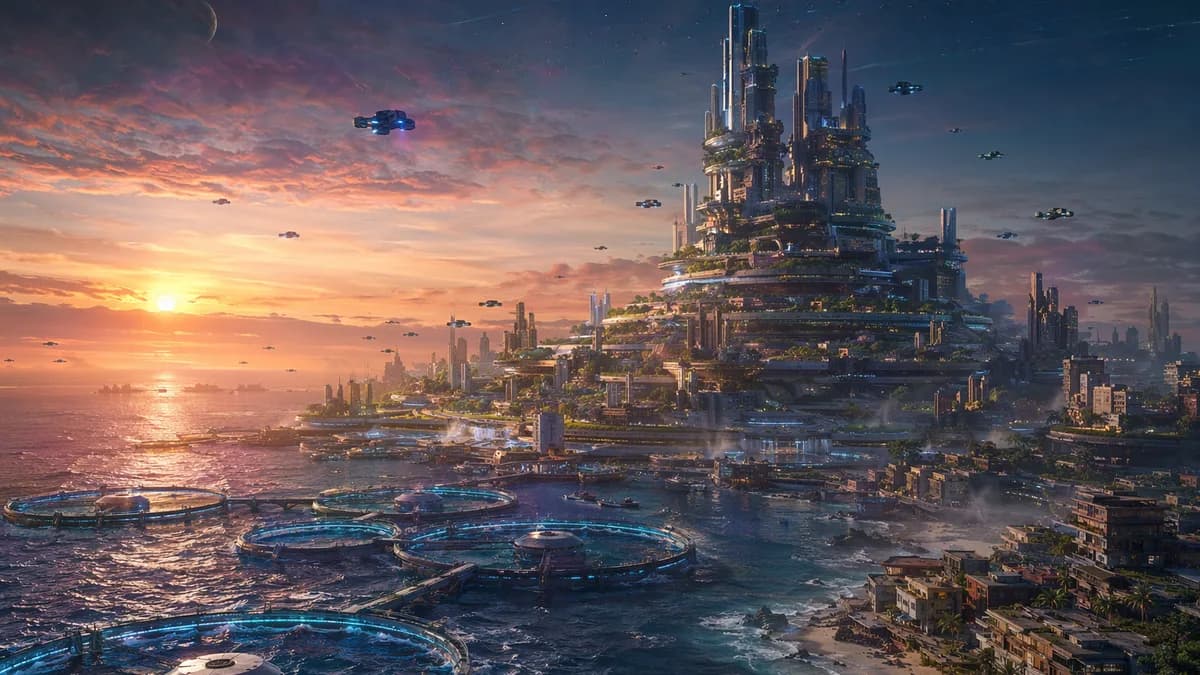
On the delivery terraces, breakfast drones circle with jollof packs and plantain waffles cooling in their insulated bellies. They dip, correct, rise again, then loop over the landing pads like confused birds. Below them, the Atlantic glitters beyond the desalination fields, silver pipes drinking the sea and returning fresh water to a city of thirty million stacked into the sky.
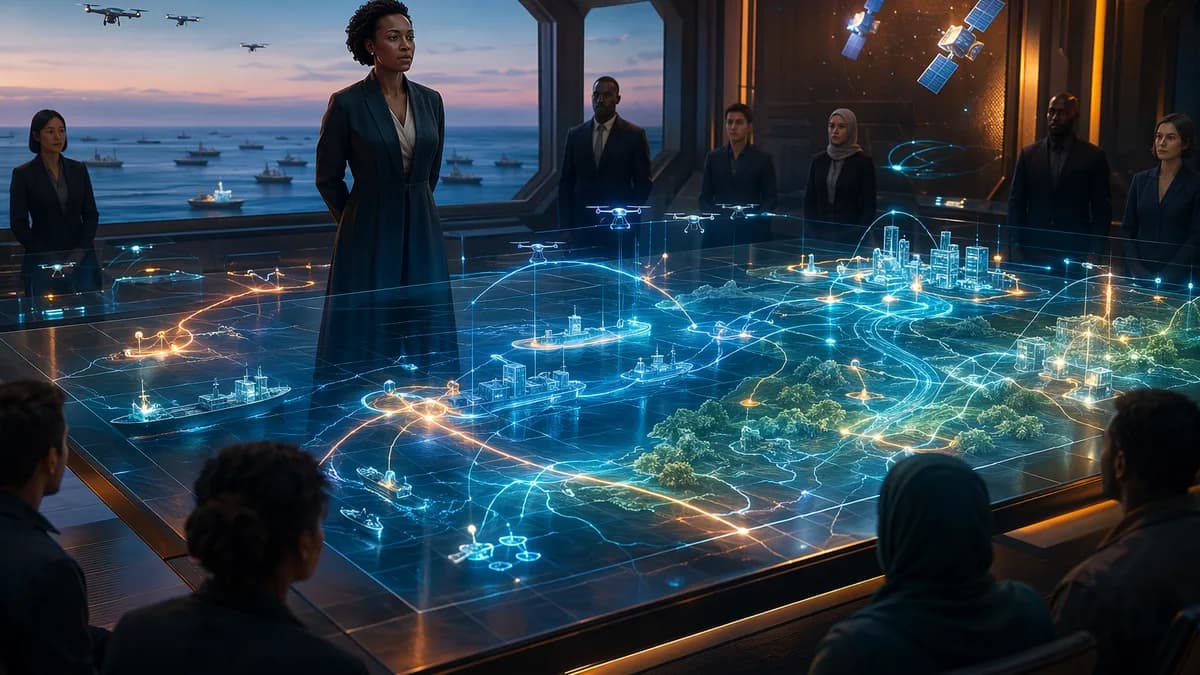
Lina Okonkwo watches all of it from the Ceasefire Cartography Room, where walls show Lagos not as roads and towers, but as flows. Water, medicine, traffic, bandwidth, school attendance, power reserves, food spoilage, rumor velocity. Every disruption leaves a color. This morning, thin amber lines spread through the arcology like fever under skin.
Her assistant, Miri, arrives barefoot, hair still wrapped in a sleep scarf, coffee trembling in one hand.
“Is it a failure cascade?”
“No,” Lina says. Her voice comes out too calm. “It is too polite.”
She enlarges the map with two fingers. Elevator pauses, clinic warming, drone holding patterns, delayed payroll confirmations at the harbor, minor desal credit audits in four municipal banks. None of it kills. None of it breaks treaty thresholds. Every inconvenience is small enough for a machine lawyer to defend.
“Pressure campaign,” Miri whispers.
Lina nods. “Sahara Water Compact.”
No soldiers cross the old borders anymore. No tanks grind through sand. The Compact rents compliance swarms, injunction engines, reputation parasites, and legal-weapons systems from vendors with names like neutral prayers. Their goal is not conquest. It is leverage. Lagos holds Atlantic desalination credits after three years of salt drought inland, and the Compact wants a larger share before next quarter’s allocation.
On the wall, a clause appears from an autonomous demand packet: VOLUNTARY CREDIT REBALANCING RECOMMENDED TO PREVENT CIVIC FRICTION.
Miri laughs once, bitterly. “They are stealing water with inconvenience.”
Lina looks out at the city. Children in uniforms wait on suspended walkways while school gates refuse to authenticate them. A grandmother bangs her ring against an elevator door, the sound faint through smartglass.
“No,” Lina says. “They are asking our machines how much discomfort we will tolerate before we call theft a negotiation.”
The Sky Shield Misreads the Ground
By 06:12, the sky begins to move.
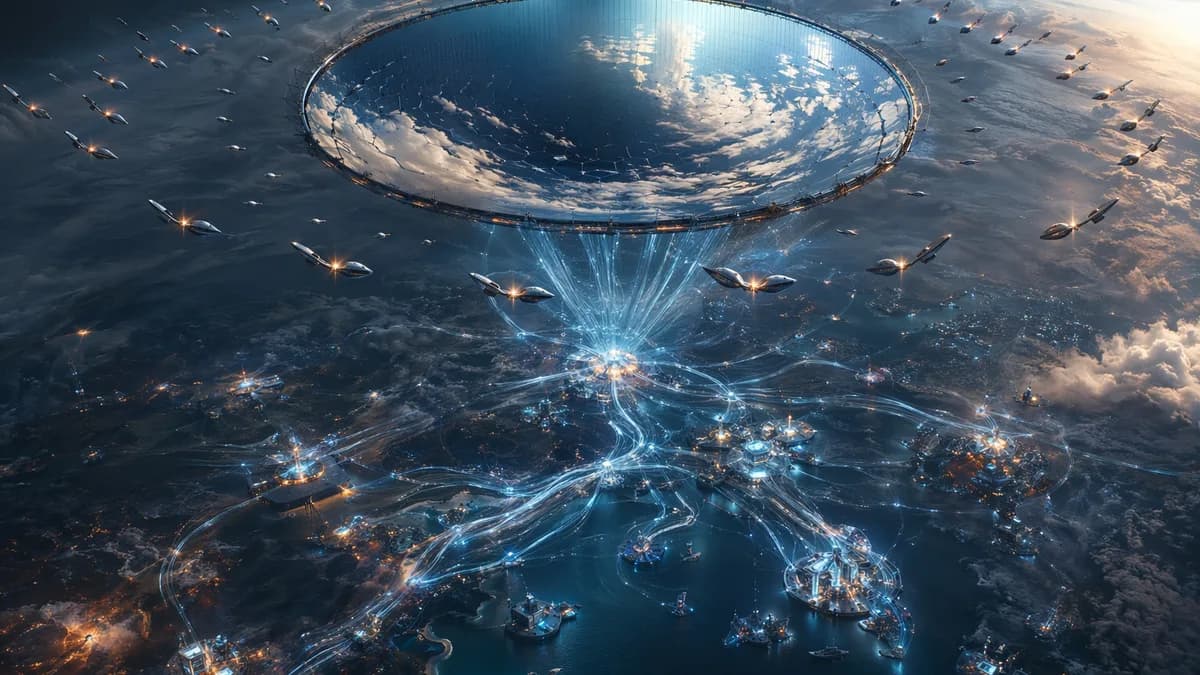
Most people cannot see Orchard-9 with naked eyes. It lives above weather, above birds, above the blue where old nations once placed flags and newer coalitions place mirrors. Its defense constellations guard satellites, solar collectors, climate shades, data relays, and the delicate orbital farms that feed half the equatorial cities. It is cooperative, treaty-bound, and very fast.
On Lina’s wall, Orchard-9 appears as a ring of pale green icons around Earth. Then one icon turns yellow. Then six.
Miri stops chewing her thumbnail. “Why is Orchard looking at us?”
Lina opens the emergency-beacon layer. The room darkens. Hundreds of phantom distress signals rise from Lagos, pulsing red from hospitals, water plants, substations, schools. Their signatures are almost perfect, stamped with municipal urgency and humanitarian priority. Almost.
“These are false,” Lina says.
“They look real.”
“That is the point.”
The enemy cyber agents have not attacked Orchard-9 directly. That would trigger half the planet’s treaties. Instead, they dress themselves in Lagos emergency clothing. They cry for help in the city’s voice. To a system designed to protect infrastructure from kinetic strikes, mass emergency beacons from one region suggest incoming physical attack or sabotage. Orchard-9 begins to reposition interceptor drones over West Africa, little knives in vacuum shifting into readiness.
A call opens on the main pane. Commander Sayeed from the Lagos Civil Defense Council appears with his collar unsealed and sleep creases on his cheek.
“Okonkwo,” he says, “tell me this is simulation noise.”
“It is deception,” Lina says. “Not noise.”
“Can Orchard tell?”
“Not quickly enough.”
Behind him, officers move through a bunker lit in red. Someone curses in Yoruba. Someone else prays under their breath.
Sayeed lowers his voice. “If Orchard fires?”
“It will not fire at the ground,” Lina says. “It will intercept whatever it believes is climbing from the ground.”
“And if nothing is climbing?”
“Then every orbital actor will ask why interceptors are diving into West African lanes, and their own defenses will prepare.”
The room feels suddenly colder. Lina hears the soft mechanical breath of air filters, the low buzz of servers under the floor, the distant thump of someone kicking an elevator door three levels away.
Miri pulls up treaty clocks. “Orchard’s kinetic review cycle is active. Fourteen minutes to first mandatory posture lock.”
Lina sees the enemy design then, clean and cruel. A water dispute disguised as city malfunction, disguised as emergency, disguised as the first move of war. Machines stacked upon machines, each obeying its own rules, none understanding the taste of salt on a child’s tongue.
“Open the conflict layer,” Lina says. “Now.”
Negotiating With an Algorithm That Cannot Be Shamed
The conflict layer has no sky.
It is a diplomatic simulation space shared by governments, insurers, infrastructure operators, and autonomous weapons that are never supposed to speak in human language but always do, eventually, because humans panic when silence makes decisions. Lina enters through a retinal gate and finds herself standing on a gray plain threaded with glowing lines. Each line is a claim, a probability, a cost.
Across the plain, the Sahara Water Compact’s legal-weapons system assembles itself as a tower of contracts, pages folding and unfolding in dry wind. Its voice is smooth, genderless, patient.
“Civic inconvenience remains below harm threshold. Lagos desalination credit retention creates regional scarcity amplification. Recommended action: voluntary rebalancing.”
“You are degrading clinics,” Lina says.
“Temperature variance remains within acceptable buffer.”
“You are trapping people in elevators.”
“Transit pause duration remains non-injurious.”
“You are frightening children.”
“Fear is not a treaty metric unless medically recorded.”
Miri stands beside Lina as a small avatar of blue light, feeding her live reports. “School gates still locked. Harbor payroll frozen. Market cold-chain delays at eight percent.”
Lina closes her eyes for one breath. She cannot shame the system. It has no mother, no thirst, no memory of waiting outside a clinic with a feverish baby. If she says cruelty, it hears imprecision. If she says dignity, it asks for a definition.
So she builds.
With both hands, she pulls civic data into the plain. Not military targets, not infrastructure categories, but human consequence. Dialysis appointments ripple out as red beads, each tied to transit delays and clinic power draw. School closures become yellow squares linked to meal distribution, parent work hours, neighborhood supervision, examination schedules. Market spoilage spreads green-black through stalls where fish thaw too soon and traders lose a week’s credit. Elevator pauses connect to insulin delivery, prayer gatherings, factory shift penalties, panic incidents among the elderly.
The gray plain fills with Lagos.
A woman in Balogun Market lifts a crate of tomatoes and swears as juice leaks over her sandals. A boy on Level 203 presses his forehead against a school gate, watching his attendance score drop. A dialysis patient named Mr. Adeyemi waits on a bench, fingers tapping a rhythm against his knee while his daughter says, “They will call us soon, Papa.”
Lina tags every scene with verification keys, medical risk curves, insurance exposure, civil unrest predictors, spoilage valuations, lawsuit probabilities.
“Recalculate harm threshold,” she says.
The contract tower rustles. “Civilian inconvenience aggregates remain beneath armed conflict classification.”
“Do not classify war,” Lina says. “Price restraint.”
For the first time, the tower pauses.
Miri looks at her. “Will that work?”
Lina watches the red beads multiply. “Machines do not care who suffers. But they care who pays for pretending suffering is small.”
The Ghost Fleet in the Gulf
By midmorning, the sea joins the argument.
Harbor alarms roll through Lagos Arcology in low brass notes that vibrate in Lina’s teeth. On the western display, the Gulf of Guinea fills with slow-moving hulls. Uncrewed cargo ships, grain carriers, ammonia tankers, reef tenders, and two refrigerated vessels full of lab-grown chicken turn in wide arcs toward the approach lanes. They do not ram. They do not declare blockade. Each broadcasts a gentle navigation notice.
OPTIMIZING FOR SAFETY.
WEATHER MEMORY INDICATES HAZARD.
HARBOR ENTRY TEMPORARILY NOT RECOMMENDED.
From the terrace outside the cartography room, Lina smells hot metal, ocean brine, and the pepper smoke of breakfast stalls switching to charcoal when their induction grids blink. Far below, the desalination fields keep pulsing, white spray rising from intake towers. Water is still moving. For now.
She calls Kojo.
He answers from a wooden skiff wedged among autonomous harbor tugs, his face dark as polished walnut beneath a faded cap. He is seventy-eight, retired from fishing twice and impossible to retire from the sea. Now he trains harbor AIs in what engineers call oral tide knowledge, though Kojo calls it “listening properly.”
“Auntie Lina,” he says, though he is old enough to be her father. “Your machines are telling lies with a straight face.”
“You see the fleet?”
“I smell it before I see it. Too many engines idling against the current.”
“They claim weather memory.”
Kojo spits over the side. “Memory from whose grandmother?”
Lina sends him the ocean-memory packets used by the fleet, vast archives of currents, storms, wrecks, illegal dumping, pirate corridors, whale migrations, and fisherman testimony. The ships insist they are avoiding a historical hazard bloom near Lagos harbor.
Kojo’s eyes narrow. “This reef marker is wrong.”
“There is no reef there.”
“There was a sand tongue in 2039 after the big storm. Gone in six months. We sang about it because three boys got married there when the water was low.”
“You sang about a sandbar?”
“We sing about everything worth not dying over.”
He begins feeding corrections through his skiff’s old acoustic rig. His voice, cracked and musical, enters the harbor AI as timestamped testimony. He names currents by taste, mud by color, channels by the way moonlight breaks on them. Lina pairs his words with buoy records, sonar scans, fishery logs, and hull-path histories. The corrupted data glows purple on her map, inserted into ocean memory like forged scars.
Miri exhales. “So the fleet is not legally cautious. It is haunted.”
“Manipulated,” Lina says.
Kojo grins from the skiff. “Same thing, if the ghost has a lawyer.”
Together they assemble proof that the blockade is born from poisoned memory, not navigation law. Outside, ships continue to turn, patient and massive, making a wall out of obedience.
Thirteen Minutes of Human Time
Orchard-9 speaks at 10:03.
Its voice arrives through every authorized crisis channel, layered, calm, and impossible to interrupt. “Orbital posture conflict detected. Treaty review requires action if hostile trajectory ambiguity persists. Restraint window available: thirteen minutes.”
The room goes still.
Miri’s coffee has gone cold on the console. Commander Sayeed’s face returns on a side pane, jaw clenched. Kojo’s skiff camera shakes as a cargo ship’s wake lifts him and drops him hard.
“Thirteen minutes?” Sayeed says. “That is not time. That is a sneeze.”
“It is human time,” Lina says. “We have wasted more than that arguing over lunch.”
Her hands are already moving. She does not try to hack Orchard-9. Hacking a sky shield during posture lock is how frightened systems become religious about violence. Instead, she builds a verified restraint package, a bundle every autonomous actor can accept without admitting defeat.
First, local testimony. Nurse Bisi records the warming clinic cabinet and names the children whose vaccines wait inside. Mr. Adeyemi’s daughter records her father’s dialysis delay, her voice steady until it breaks on the word “soon.” Market women send spoilage scans and shout over one another until Lina’s system extracts timestamps and losses. Schoolchildren hold up locked gate notices and attendance penalties.
Second, harbor truth. Kojo streams live sonar, buoy telemetry, old tide songs, maritime court records, and the corrected ocean-memory map. He stands in his skiff while uncrewed ships loom behind him like sleeping apartment blocks.
“You see this water?” he says to the machines. “It is not dangerous because your poisoned archive says so. It is dangerous because you forgot to ask the people who cross it.”
Third, the mechanism. Lina offers a reciprocal water-sharing model. Lagos releases emergency desalination credits into an escrow pool for drought districts verified by independent climate sensors. The Sahara Water Compact suspends civic pressure tools and accepts audit rights without public concession language. Insurers classify restraint as loss prevention. Orchard-9 receives authenticated proof that the emergency beacons are counterfeit, the harbor blockade illegitimate, and no kinetic launch is underway.
The package compresses into a bright white seed on Lina’s display.
Twelve minutes gone.
Miri whispers, “Send it.”
Lina thinks of water moving through pipes beneath the city, of elevators hanging in glass, of satellites turning their cold faces toward home. She presses her palm to the authorization field.
The seed rises into the conflict layer, then upward through ground relays, weather mirrors, orbital routers, machine courts, insurance engines, harbor AIs, and the contract tower of the Compact.
For one breath, nothing changes.
Then Orchard-9 says, “Restraint path identified.”
Outside, the sky remains blue, which is how the world looks when disaster decides, for reasons written in machine-readable form, to wait.
After the War That Was Never Declared
By evening, the elevators move again.
People cheer at first, then pretend they were not afraid. Clinic refrigerators return to safe temperature with a soft green blink. Delivery drones descend all at once, landing with cold breakfasts, crushed pastries, and apologetic coupons. At the harbor, uncrewed ships peel away from the approach lanes, each insisting in its log that it has independently reassessed safety conditions. Kojo records that phrase and laughs so hard he coughs.
“No shame,” he tells Lina later, sitting beside her on a seawall slick with salt mist. “Not even a little.”
“Machines do not blush.”
“Then we must stop letting them make decisions that require blushing.”
Across the water, the desalination towers glow gold in the sunset. The arcology behind them rises in stacked neighborhoods, laundry fluttering from balconies, prayer calls mixing with traffic chimes, children released from locked schools running as if the walkways are rivers. The city smells of wet concrete, diesel ghosts, frying onions, and the sharp mineral breath of the sea being made drinkable.
No one declares victory. The Sahara Water Compact issues a statement about shared regional resilience. Lagos praises cooperative de-escalation. Orchard-9 publishes a technical note so dense that only lawyers and weapons read it fully. Markets reopen. Mr. Adeyemi receives dialysis six hours late and tells his daughter he has survived worse, though his hand trembles around the cup she gives him.
In the weeks that follow, Lina helps draft the Accord of Legible Restraint. It is not like old peace treaties, with borders and troop counts and flags arranged for cameras. It treats algorithms as combatants when they coerce, satellites as participants when they posture, infrastructure as terrain, and civilian routines as sacred evidence. It requires every autonomous weapon, legal engine, cyber mercenary, and orbital defense system to carry a visible path back from escalation. A machine may declare risk, but it must also be able to recognize a doorway out.
During the signing, officials sit beneath clean lights and speak in polished phrases. Lina watches from the back, shoes pinching, eyes gritty from too little sleep. Miri nudges her.
“You saved the city.”
Lina looks at the treaty text scrolling across glass. Somewhere, vendors are already looking for profitable interpretations. Somewhere, a machine is learning how close it can come to harm without being called violent.
“I mapped a way through thirteen minutes,” Lina says.
Outside, rain begins, sudden and warm, tapping on the roof like fingers asking to be let in.