The Orchard Where Grandmothers Ripen
When a climate-resettled town uploads its elders into a shared afterlife, one granddaughter discovers immortality has seasons too.
1. A Town With Two Populations
Every morning in San Isidro, the living line up beneath the solar awning with cups of bitter chicory coffee, and the dead wake in the Orchard.
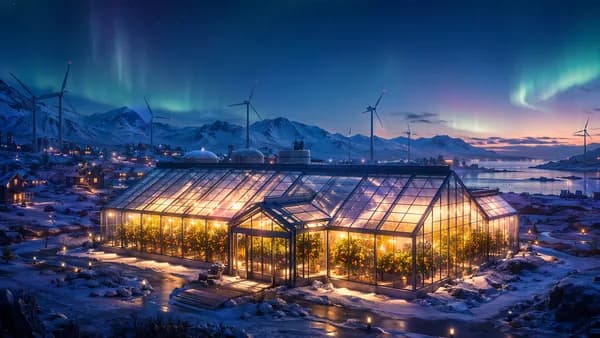
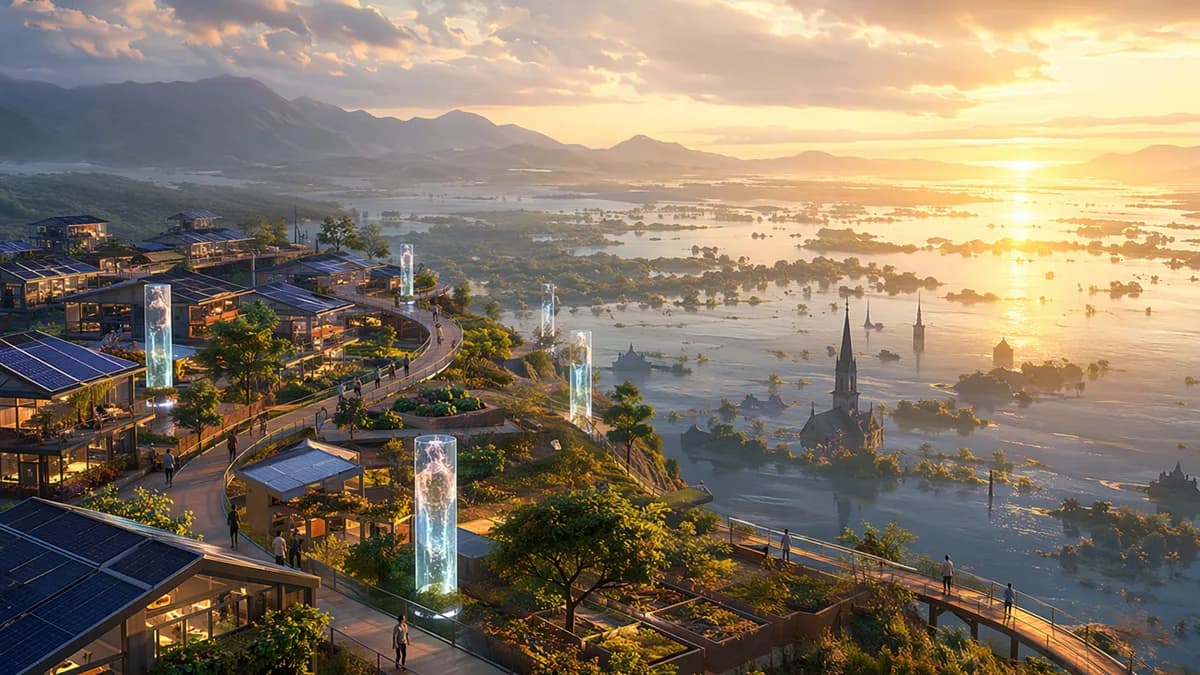
The new town sits on a dry ridge of red stone and wind-bent mesquite, forty-two meters above the old valley. The houses are printed concrete, pale as bone, with rain chains dangling from gutters that rarely sing. Beyond the ridge, the floodplain glitters where fields used to be. On still days, people say they can see the church steeple under the water, a darker needle in the green.
At six, the municipal speakers chime three notes, soft as a spoon against glass.
“Orchard access is open,” says the town system. “Morning consultations may begin.”
Doors open. Children in school uniforms step around goats. Mothers bring tablets sticky with jam. Men with cracked hands and sun hats approach the public kiosks as if they are confessionals. Each screen blooms with the same impossible valley: cottonwoods, irrigation ditches, corn tassels, kitchen windows glowing gold. The dead appear where they always prefer to appear.
Tío Rafael sits under the fig tree that drowned in 2049.
Doña Mercedes shells peas on a porch that no longer has wood.
Mara’s grandmother, Lidia Alvarez, stands most mornings in the replica clinic, sleeves rolled, silver braid over one shoulder, waiting to be useful.
“What beans for this soil?” asks Mr. Cano, tapping his soil report against the kiosk.
“Not pintos this year,” says his dead father, squinting at weather models only he seems to understand. “Tepary. And stop planting like the rain still loves you.”
At another screen, two sisters argue over the care of their living mother while their uploaded aunt listens with the patience of a stone saint.
“Let her keep the blue chair,” the aunt says. “You fight because the chair is ugly. She keeps it because your father died in it.”
The Orchard is not just memory. It is council, archive, kitchen, court, lullaby. It tells them when to prune almonds in soil that tastes of salt. It remembers who owes whom an apology. It stores baptisms, recipes, seed songs, labor strikes, the exact weight of peaches from summers before Mara is born.
San Isidro has two populations now. The living breathe dust on the ridge. The dead breathe data in the drowned valley.
Nobody says which town is more real.
2. Mara’s Inheritance Interview
Mara does not remember the old San Isidro, except in the way children remember stories told too often. She remembers her mother saying the floodwater smelled like diesel and onions. She remembers a photograph of Abuela Lidia holding her as a baby in front of a mural now hidden under algae. But the valley itself is borrowed memory, stitched from other people’s grief.
For her seventeenth-year archive project, she must conduct an Inheritance Interview with an uploaded elder. Three hours minimum. Family history, civic contribution, transferable wisdom. Her teacher says this like wisdom is a jar of jam.
Mara chooses Lidia because she has to. Her mother fills out the request before Mara can protest.
The first session opens in the replica clinic. It smells of rubbing alcohol, lavender soap, and warm tortillas, because Lidia has selected the setting herself. She wears her old white nurse shoes. They squeak on the tile.
“Mara Isabel,” Lidia says. “You got tall.”
“You always say that.”
“You keep doing it.”
Mara looks down at her school prompt. “State your full name and primary roles in the community.”
Lidia laughs, a dry, papery sound. “Lidia Esperanza Alvarez. Midwife, union organizer, maker of terrible coffee, survivor of two husbands and one municipal corruption scandal.”
Mara smiles despite herself. “Did you really deliver sixty-three babies?”
“Sixty-five. The archive lost the twins during migration. Computers are brilliant until they meet a family with nicknames.”
At first, the interview is easy. Lidia tells her about night births during power outages, about farmworkers hiding meeting flyers inside seed catalogs, about the year everyone’s tomatoes split from too much rain. Mara records, nods, asks the questions her teacher provides.
Then, during the third session, Lidia pauses too long.
Outside the clinic window, digital rain falls on streets that have not existed for nineteen years.
“Abuela?”
Lidia turns away. Her face flickers, just slightly, like heat over asphalt.
“I edit myself before you come,” she says.
Mara lowers the tablet. “What does that mean?”
“It means I choose the clean version. The grandmother version. I trim the confusion. I hide when I repeat a thought for the hundredth time because no morning is truly new here. I soften the boredom. I delete irritation before your mother visits because she needs me holy.”
“You can do that?”
“We all can, a little. Presentation filters. Stability aids.” Lidia touches the counter. “Paradise has settings.”
Mara feels the plastic chair hard beneath her thighs.
“Why tell me?”
“Because you asked what I want preserved,” Lidia says. “And I am tired of preserving only the parts that comfort the living.”
3. The Festival of Continuance
The Festival of Continuance begins at sundown, when the heat loosens its grip and the ridge smells of dust, frying oil, and marigolds. Families hang paper lanterns from antenna poles. Children paint their faces with bright skulls and circuitry patterns. On the community hall wall, a projection of the drowned valley shimmers, orchard rows stretching beneath a sky too blue to be natural.
Inside, the funding tables are arranged by surname.
Every year, each household renews server allotments for its dead. Processing, storage, sensory richness, cognitive autonomy. The words are printed in polite blue ink, but everyone knows what they mean. How much of your ancestor can you afford to keep awake?
Mara stands with her parents in the Alvarez line, listening to the hum of portable coolers and the murmur of families counting credits.
Her father rubs his thumb over the payment band on his wrist. “Full continuity for Lidia,” he says.
Her mother nods too quickly. “Of course. Full.”
Across the hall, the Morales family argues in whispers. Mara sees three elderly faces rotating on their tablet, then blending into one. The composite smiles with Mercedes’s mouth, blinks with Julio’s eyes, tilts its head like Aunt Belén.
“Is that allowed?” Mara asks.
Her mother follows her gaze and looks away. “They had four uploads. They can fund one.”
“So they mix them?”
“It keeps something,” her father says, but his voice is rough.
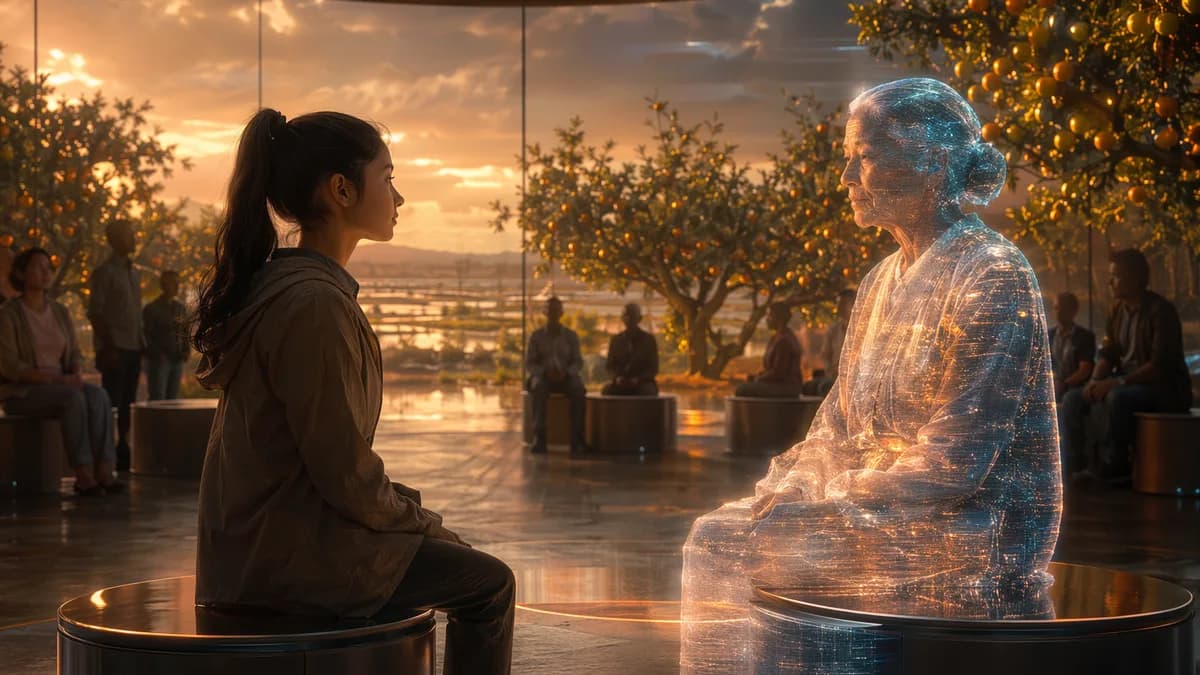
Later, Mara slips outside, where the music is softer and the ridge drops into darkness. She opens a private Orchard link. Lidia appears beside her as a translucent figure, bare feet in dust she cannot feel.
“Did you know about the Moraleses?”
“Yes.”
“That’s awful.”
“It is also survival,” Lidia says. “The poor never receive pure immortality. Not in churches, not in hospitals, not in machines.”
A band begins playing an old cumbia near the hall. The bass travels through Mara’s ribs.
Lidia watches the lanterns. “The designers believed consciousness would want infinite growth. More memory, more connection, more time. They built springtime forever.”
“And it doesn’t?”
“Some do. Some are happy. Some become vast and strange. But many of us grow tired in ways the living do not want to hear.”
Mara swallows. “Tired like bored?”
“Tired like fruit at the end of a branch,” Lidia says. “Sweet, heavy, ready.”
A gust lifts dust around Mara’s ankles.
“We have autumn circles,” Lidia continues. “Secret meetings. We practice letting small memories fade. A song lyric. The smell of a yellow dress. Not because they are worthless, but because carrying everything forever is not life. It is storage.”
Mara looks back at the hall, where families feed coins and vows into the machines.
“Does my mom know?”
“No,” Lidia says. “She still thinks saving me means never letting me fall.”
4. The Request Nobody Can Sign
Lidia’s petition arrives in Mara’s inbox at 2:13 in the morning, when the house is quiet except for the desal unit coughing under the sink.
SUNSET CONSENT PROTOCOL, DRAFT 7.
Mara reads it in bed, screen light turning her hands blue. The document is careful, almost tender. No abrupt deletion. No coerced termination for cost. No family override. A gradual dissolution chosen by the uploaded person after counseling, review, and time. The right not to be maintained past desire. The right to finish.
At the bottom, Lidia has written: I cannot sign this alone. The living still own the keys.
Mara does not sleep.
At breakfast, she places the tablet between the tortillas and the bowl of sliced cactus.
Her mother reads three lines and goes still.
“No,” she says.
“Mamá.”
“No.”
Her father takes the tablet. His jaw tightens as he scrolls. Outside, a delivery drone buzzes over the roof like an angry wasp.
“She asked me to help,” Mara says.
“She is confused,” her mother says. “Or infected. Or influenced by some fringe group inside the system.”
“She is lonely.”
“We visit her.”
“When we need something.”
Her mother’s eyes fill, but her voice hardens. “That woman raised me after the flood took everything. She organized the relocation lawsuit. She held this family together. You think love is helping her disappear?”
Mara feels heat rise in her face. “Maybe love is listening when she says she’s done.”
Her father sits down heavily. “The council will never allow it.”
He is right. By noon, the petition leaks into the town forum. By evening, everyone has an opinion. Some call Lidia brave. Others call Mara ungrateful. Someone posts a picture of the old clinic with the caption: Would you burn your own history?
The council convenes an emergency session in the school gym. Fans chop the hot air. Folding chairs scrape. On the wall, the municipal seal shows a green valley that no living child has touched.
Councilwoman Ibarra speaks first. “The Orchard is not a private luxury. It is our cultural archive. It is evidence in our climate reparations case. Every testimony, every memory of land use, every account of loss strengthens our claim.”
“So they have to suffer for the lawsuit?” Mara calls before she can stop herself.
Murmurs ripple.
Ibarra looks at her, not unkindly. “If elders begin choosing sunset, what disappears with them? Boundary lines. Crop histories. Names. Songs. The world already drowned San Isidro once. We cannot help it drown twice.”
Mara grips the back of a chair.

From a wall screen, Lidia appears in her clinic, calm and straight-backed.
“Councilwoman,” she says, “a prison made of our own memories is still a prison.”
The gym goes silent except for the fans, turning and turning.
5. A Trial in the Replica Valley
The hearing takes place inside the Orchard because Lidia insists the dead should not testify through windows.
Mara enters through a municipal immersion booth that smells faintly of disinfectant and other people’s fear. The visor seals. The ridge vanishes.
She stands in the old valley.
For a moment, she cannot breathe. Cottonwood leaves flash silver in a wind that has no dust in it. Irrigation water chatters beside the road. The church bell rings once, deep and bronze. The air smells of wet soil, cut alfalfa, woodsmoke, peaches warming in crates. Mara knows it is simulation, yet her body believes. Her throat aches with homesickness for a place she never had.
The hearing gathers beneath the old community pavilion. Living residents arrive as embodied visitors, some young and awkward in borrowed avatars, some older and trembling at the sight of streets they fled. The uploaded elders come from everywhere. A man steps out of a vanished barbershop. A woman descends from a school bus yellow as an egg yolk. Lidia walks from the clinic carrying a cloth bag of oranges.
Councilwoman Ibarra appears at the front table, her avatar too polished, her hair untouched by wind.
“We are here,” she says, “to determine whether an uploaded civic mind may request controlled dissolution.”
An expert from the state archive speaks about continuity metrics. A lawyer discusses personhood statutes written before anyone imagined a grandmother could become municipal infrastructure. Mara’s mother testifies with tears on her cheeks.
“My mother is not just herself,” she says. “She is where I come from. If she goes, who tells me who I am?”
Lidia rises.
“I told you already,” she says gently. “Again and again. My love did not fail because you still need it.”
Mara watches her mother flinch.
Then other elders speak. Don Rafael says he wakes sometimes unable to remember which of his sons are dead and which are old. Doña Mercedes says children ask her for recipes but never ask what it feels like to taste nothing. A composite ancestor, the Morales blend, speaks in three cadences at once.
“We are grateful,” it says. “We are crowded. We are not one, and we are not allowed to be many.”
The pavilion creaks in the simulated wind.
Mara is called last. She expects to defend the petition, but when she sees Lidia in the orchard light, she understands the question has shifted under her feet.
“I don’t know if she’s a perfect copy,” Mara says. “I don’t know if the soul comes with the scan. I don’t know what to call her.” She looks at her grandmother. “But she changes. She wants. She hides pain so we won’t panic. That seems alive enough to deserve trust.”
Her voice shakes.
“We keep saying we saved them because we love them. Maybe we also saved them because grief wanted a machine. Maybe love is not holding someone in the shape we miss.”
The valley is quiet. In the distance, where the real water lies over everything, simulated bees move through white blossoms, patient and doomed.
6. The First Gentle Ending
The compromise passes by twelve votes, nine abstentions, and a silence too large to count.
No one calls it death in the official documents. The council names it Seasonal Autonomy for Uploaded Persons. The town forum immediately renames it the Lidia Rule.
Under the new protocol, an uploaded mind may enter rest cycles, periods of dimmed consciousness where memory settles without constant summons. After three cycles, with guidance from digital peers, living family, and an advocate, they may choose renewal, merging, or sunset. No household can force it. No council can prevent it without evidence of coercion or corruption. The archive keeps what the person freely seeds.
Lidia does not vanish.
For one last harvest season, she invites Mara into the Orchard every Saturday before dawn. Not to the clinic, but to the fields as they were in 2038, before the levees crack, before the river learns the language of rooftops.
They walk rows of tomatoes under a lavender sky. Mara’s shoes sink into dark loam. Dew wets her ankles. Somewhere, a rooster tears the morning open.
“Don’t just look,” Lidia says, kneeling. “Listen.”
Mara crouches beside her. “To dirt?”
“To soil,” Lidia corrects. She scoops a handful and holds it out. It is black and alive with tiny roots. “Dirt is what gets swept away. Soil is a conversation.”
Mara presses it between her fingers. It smells mineral, fungal, green.
“What is it saying?”
“That it remembers flood and fire. That it wants cover. That it does not care about our grief unless grief becomes compost.”
Mara laughs, then cries, and Lidia pretends not to notice until Mara leans against her. In the simulation, her grandmother’s shoulder is warm.
As weeks pass, Lidia begins to seed herself. She gives the midwife stories to the clinic archive, but leaves out the names of women who asked for privacy. She gives union songs to the schoolchildren, weather instincts to the farmers, lullabies to the night system that soothes babies during dust storms. She places one memory only in Mara’s private keeping: the sensation of holding her newborn granddaughter, slick and furious, while rain hits the clinic roof.
On Lidia’s first rest day, the Orchard does not open her clinic.
Instead, orange blossoms appear along the path to the drowned church. People stop at kiosks, confused at first, then quiet. A child asks where Doña Lidia is.
Mara stands in the ridge sunlight, older than yesterday and not old enough.
“She’s resting,” she says.
The child considers this. “Will she come back?”
Mara looks toward the flooded valley, where the real water flashes so brightly it erases the steeple.
“I don’t know,” she says, and feels the answer open in her like a seed cracking underground.